The injection molding process of TPU material is one of the most valuable manufacturing techniques for producing flexible, durable, and wear-resistant parts at scale. Thermoplastic polyurethane (TPU) sits in a unique position between rigid plastics and soft rubbers, giving engineers the ability to create parts that combine elasticity with structural strength — something few other materials can match. From phone cases and watch bands to automotive bushings, medical tubing, and industrial conveyor belts, TPU injection molding powers products across virtually every major manufacturing sector.
TPU injection molding heats and injects TPU pellets into molds to create flexible, resilient parts, commonly used in footwear, automotive, and electronics.
This brief overview outlines the core steps in TPU injection molding, but mastering the nuances of the process can significantly enhance product performance and manufacturing efficiency. Delve deeper to learn how accurate mold design and process optimization can improve your results. For foundational knowledge, see our Injection Molding Complete Guide.
“TPU offers excellent abrasion resistance and flexibility.”True
TPU is widely recognized for its superior abrasion resistance and flexibility, making it ideal for demanding applications like footwear soles and cable jackets.
“TPU injection molding is less efficient than other methods.”False
TPU injection molding can be highly efficient and is often selected for its ability to produce detailed and durable parts.
What is TPU Material?
TPU stands for thermoplastic polyurethane elastomer rubber. It’s not a textile in the traditional sense, let alone leather. TPU overcomes many of the shortcomings of PVC, PU leather, and PU coating, and has made major breakthroughs in the application of waterproof and breathable fabrics.
TPU not only has most of the characteristics of rubber and ordinary plastics, but also has excellent comprehensive physical and chemical properties. It is a new type of polymer environmentally friendly material between rubber and plastic. It has both the softness of rubber and the hardness of hard plastic.
“TPU is both flexible and durable.”True
TPU’s unique composition allows it to maintain flexibility while providing strength and resistance to wear and tear, making it ideal for diverse applications.
“TPU is only used in clothing and footwear.”False
While TPU is popular in clothing and footwear, its applications extend to automotive, medical, and electronics industries due to its adaptable properties.
What are the Basic Characteristics of TPU Materials?
The basic characteristics of tpu materials are the main categories or options explained in this section. TPU materials offer high elasticity, excellent abrasion resistance, and flexibility across temperatures, making them ideal for footwear, medical devices (meeting ISO 10993 biocompatibility1 standards for tubing and housings), and automotive parts in demanding environments.
Wide Hardness Range
By changing the ratio of each reaction component of TPU, you can get products of different Shore hardness2 levels, and with the increase of hardness, the products still maintain good elasticity and wear resistance. The stiffness of TPU can be measured by the elastic modulus.
The elastic modulus of rubber is usually 1~10Mpa, TPU is 10~1000Mpa, and plastics such as nylon, ABS, PC, POM, etc. are 1000~10000Mpa.
Outstanding Cold Resistance
TPU has a low TPU glass transition temperature3 and remains elastic and flexible even at minus 35 degrees. It is flexible over a wide temperature range of -40 to 120 degrees Celsius without the need for plasticizers.
Oil-Resistant, Water-Resistant, Chemical Resistance , and Mildew-Resistant
TPU is good at resisting oils (mineral oils, animal and vegetable oils and lubricants) and many solvents. TPU\’s oil resistance is better than nitrile rubber, and it has an excellent oil resistance life.
Its Taber wear value is 0.5-0.35mg, which is the smallest among plastics. If MoS2, silicone oil graphite, etc. are added, the friction coefficient can be reduced and the wear resistance can be improved.
Tensile strength and elongation: TPU has a tensile strength that is 2-3 times that of natural rubber and synthetic rubber. The tensile strength of polyester TPU is almost 60MPa, and the elongation is almost 410%. The tensile strength of polyether TPU is 50MPa, and the elongation is >30%.
“TPU materials enhance product durability in harsh environments.”True
TPU’s resistance to abrasion and chemicals makes it suitable for use in challenging conditions.
“TPU materials are only suitable for footwear applications.”False
While widely used in footwear, TPU materials are also ideal for automotive, medical, and industrial applications due to their versatility and resilience.
What are the Process Conditions for Tpu Injection Molding Process?
Temperature
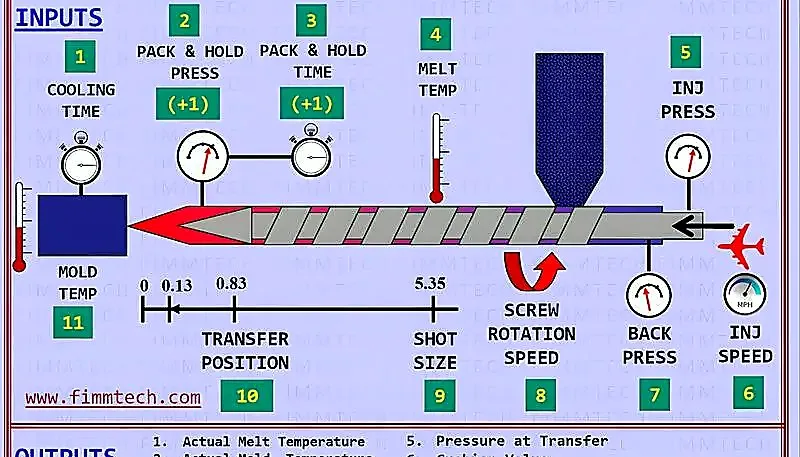
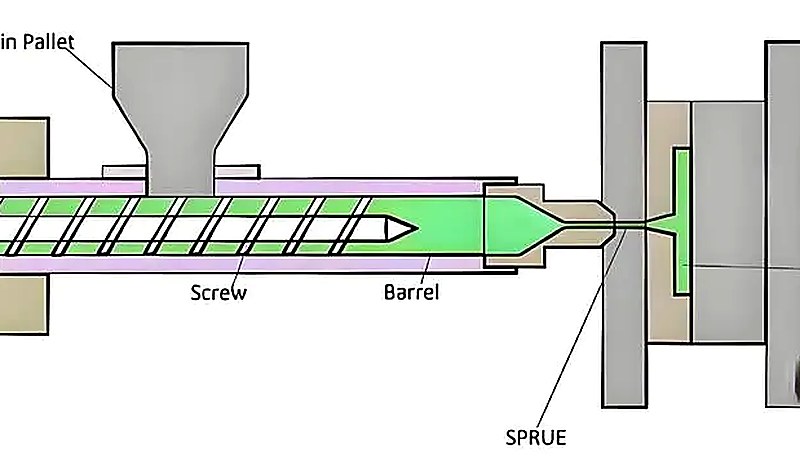
The temperatures you need to control in the TPU molding process are the barrel temperature, nozzle temperature, and mold temperature. The first two temperatures mainly affect the plasticization and flow of TPU, and the last temperature affects the flow and cooling of TPU. Learn more in our Injection Mold Design Guide.
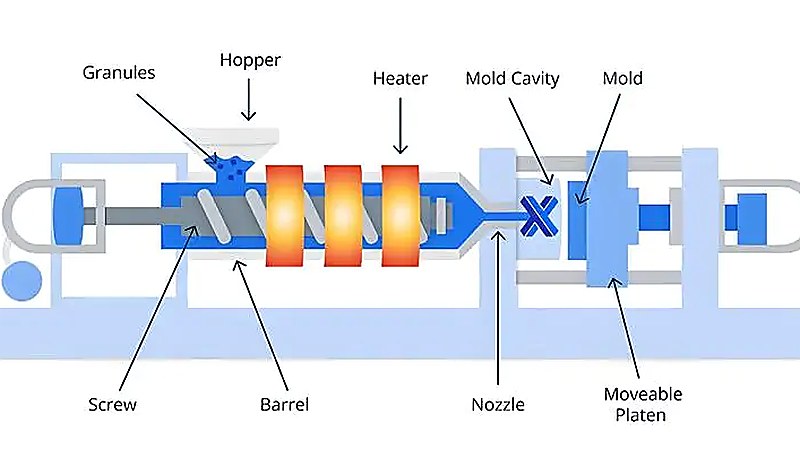
Barrel Temperature: The choice of barrel temperature is related to the hardness of TPU. TPU with high hardness has high melting temperature and high maximum temperature at the end of the barrel. The barrel temperature range used for processing TPU is 177~232°C. The distribution of barrel temperature is generally from one side of the hopper (rear end) to the nozzle (front end), and gradually increases, so that the temperature of TPU rises steadily to achieve the purpose of uniform plasticization.
Nozzle Temperature: The nozzle temperature is usually slightly lower than the maximum temperature of the barrel to prevent the molten material from drooling out of the straight-through nozzle.
MoldTemperature:The mold temperature is very important for the intrinsic performance and appearance quality of TPU products. It is determined by many factors such as the crystallinity of TPU and the size of the product. The mold temperature is usually controlled by a constant temperature cooling medium such as water.
The mold temperature of TPU products is generally 10~60℃.When the mold temperature is low, the melt freezes prematurely and produces streamlines, which is not conducive to the growth of spherulites, resulting in low crystallinity of the product and a late crystallization process, which causes post-shrinkage and performance changes of the product.
Pressure
The pressure in the injection molding process includes plasticizing pressure (back pressure) and injection pressure. When the screw retreats, the pressure on the top melt is the back pressure, which is adjusted by the overflow valve.
Increasing the back pressure will increase the melt temperature, reduce the plasticizing speed, make the melt temperature uniform, mix the colorants evenly, and discharge the melt gas, but it will extend the molding cycle. The back pressure of TPU is usually 0.3~4MPa.
Injection pressure is the pressure applied by the top of the screw to TPU. It’s used to overcome the flow resistance of TPU from the barrel to the cavity, increase the rate of melt filling, and compact the melt.
In other words, melt viscosity is determined by temperature and pressure, as well as TPU hardness and deformation rate. The higher the shear rate, the lower the viscosity. When the shear rate remains unchanged, the higher the hardness of TPU, the greater the viscosity.
When the shear rate is constant, the viscosity decreases as the temperature increases, but at high shear rates, the viscosity is not as affected by temperature as it is at low shear rates. The injection pressure of TPU is generally 20~110MPa.
Time
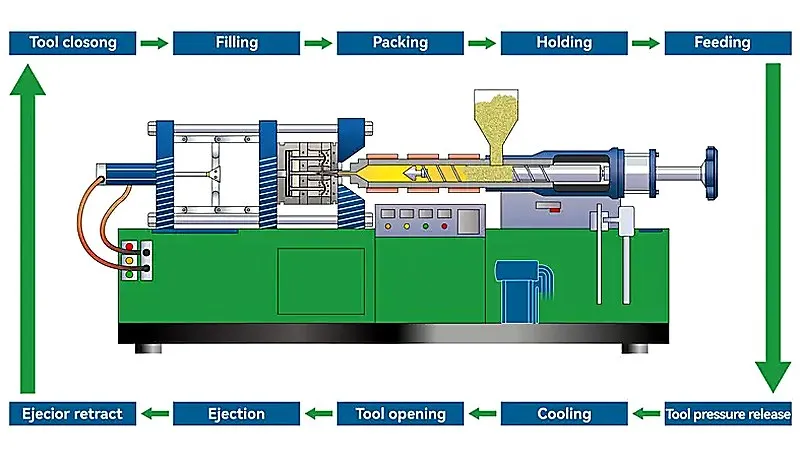
The time it takes to do an injection is called the molding cycle. The molding cycle includes the time it takes to fill the mold, the time it takes to hold the mold, the time it takes to cool the mold, and other times (like the time it takes to open the mold, take the part out of the mold, and close the mold), which all affect how much work you can get done and how much you can use your equipment.
The molding cycle for TPU is usually determined by how hard the TPU is, how thick the part is, and what shape the part is. The cycle is short for hard TPU, long for thick parts, and long for parts that have a lot of shapes.
Injection Speed
The injection speed is mainly determined by the configuration of TPU products. Products with thick end faces require lower injection speeds, while products with thin end faces require faster injection speeds.
Screw Speed
When you process TPU products, you need to use a low shear rate, so you need to use a lower screw speed. The screw speed of TPU is generally 20~80r/min, and 20~40r/min is better.
Shutdown Treatment
Since TPU may degrade after being exposed to high temperature for a long time, it should be cleaned with PS, PE, acrylic plastics or ABS after shutdown; if the shutdown exceeds 1 hour, the heating should be turned off.
Product Post-Processing
TPU often has uneven crystallization, orientation, and shrinkage due to uneven plasticization in the barrel or different cooling rates in the mold cavity. This results in internal stress in the product, which is more prominent in thick-walled products or products with metal inserts.
Products with internal stress often experience a decrease in mechanical properties during storage and use, silver streaks on the surface, and even deformation and cracking. The way to solve these problems in production is to anneal the product. The annealing temperature depends on the hardness of the TPU product.
The annealing temperature of products with high hardness is also high, and the annealing temperature of products with low hardness is also low. Too high temperature may cause the product to warp or deform, and too low temperature cannot achieve the purpose of eliminating internal stress.
Recycling of Recycled Materials
In the TPU processing process, waste materials such as runners, sprues, and off-spec parts can be recycled and reused. From the test results, 100% recycled materials without mixing with new materials do not significantly reduce the mechanical properties, and can be fully utilized .
“Correct TPU injection molding conditions prevent defects in final products.”True
Adhering to ideal temperature and pressure settings maintains material properties and reduces defects like warping and bubbles.
“You can use any mold temperature for TPU without affecting the outcome.”False
Incorrect mold temperatures can lead to poor surface finish and structural issues, emphasizing the importance of specific temperature ranges.
What are the Precautions in the Injection Molding Process of TPU Materials?
Material Drying
Because TPU is easy to absorb moisture and easy to hydrolyze, if the TPU raw materials are not dried thoroughly, it will easily cause processing difficulties.
If carbon powder or masterbatch is used for dyeing, it must be fully mixed with TPU natural colorant and dried together. Generally, a circulating air dryer or a dehumidifying dryer is used to dry TPU.
Recycled Material Processing
Nozzle materials, washing machine materials, or bad final products can be crushed and mixed with new materials, but they must be dried again before use. For some mechanical physical requirements, recycled materials cannot be used in injection molding processes.
More than 30% of all raw materials. Extruded recycled materials should be processed separately or added to new injection molding materials. Also, recycled materials should not be stored for too long. Use dry tops. Waste materials that cannot be recycled can be incinerated to get heat.
Control Injection Speed and Pressure
The speed and pressure of the injection are important for how well the TPU material flows and fills the mold. If the speed and pressure are too high, the material can break or make bubbles.
Control Mold Temperature
But if the mold temperature is too high, it can cause the material to overheat and decompose or bubble. If the mold temperature is too low, it can cause cold flow marks or shrinkage marks on the surface of the product.
Avoid Excessive Heating and Shearing
Excessive heating and high shear rates can degrade TPU during processing, causing discoloration, gas formation, and a permanent loss of mechanical properties. Keep barrel temperatures within the recommended range for your specific TPU grade, and avoid prolonged residence times in the barrel. If the machine will be idle for more than a few minutes, reduce the temperature settings or purge the barrel with a compatible material such as polyethylene to prevent thermal degradation.
Maintain a Clean Injection Molding Environment
The cleanliness of the injection molding environment is very important for the injection molding quality of TPU materials. If there are impurities and oil stains, they may stick to the mold surface or mix into the material, which will cause defects on the surface of the product or performance degradation.
“Injection molding of TPU requires precise temperature management.”True
TPU’s thermoplastic nature demands consistent temperature regulation to maintain material integrity and prevent defects.
“All TPU materials can be molded under the same conditions.”False
Different TPU formulations may require varied settings in temperature, speed, and pressure to achieve desired results, highlighting the need for tailored processing conditions.
What is the Process Flow of TPU Material Injection Molding?
Material Preparation
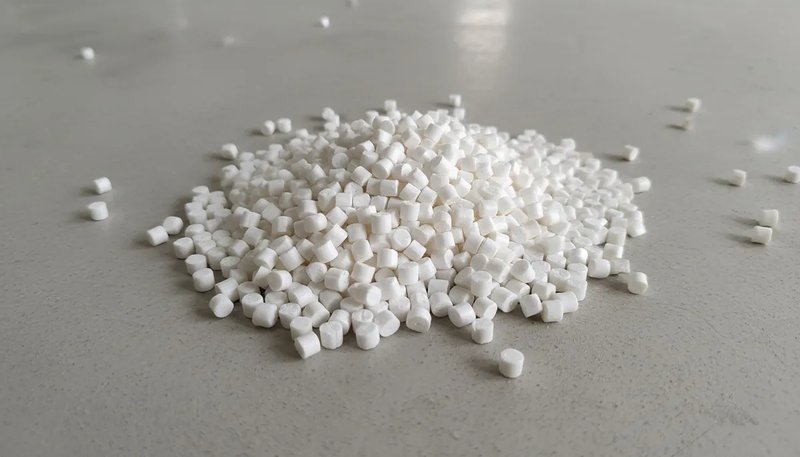
Before you start injection molding tpu pellets, you need to get them ready. This means drying them, preheating them, and mixing them. Drying gets rid of any moisture in the material so you don’t get bubbles or cracks when you’re injection molding.
Mold Design
When designing a TPU material injection mold, factors such as material fluidity, shrinkage, and demolding of the product need to be considered. Reasonable mold design can effectively reduce the defect rate of the product and improve production efficiency.
Injection Molding Machine Selection
Choosing the right injection molding machine is key to ensuring the stability of the TPU material injection molding process and the quality of the product.
Injection Molding Process Parameter Setting
Setting the injection molding process parameters is crucial for ensuring the quality of TPU material injection molding. These parameters include injection pressure, injection speed, holding time, mold temperature, and so on.
By setting the process parameters properly, you can make sure that the TPU material flows and fills the mold completely during the injection molding process, while avoiding defects like bubbles and shrinkage holes.
Product Post-Processing
After injection molding, TPU products need to be post-processed to eliminate internal stress, improve dimensional stability, and improve surface quality. Common post-processing methods include heat treatment, cooling, and surface treatment.
Heat treatment can eliminate the internal stress generated by the product during the injection molding process and improve its dimensional stability. Cooling helps the product to quickly shape and reduce deformation. Surface treatment can improve the appearance and performance of the product.
“TPU injection molding results in durable and flexible products.”True
TPU’s unique properties make it ideal for producing parts that require elasticity and resilience.
“TPU is the same as TPE in injection molding.”False
While TPU and TPE share similarity in flexibility, they are distinct materials with different compositions and performance characteristics.
What are the Defects in the Injection Molding Process of TPU Materials?
The Product has Cracks
Cracks are a killer for TPU products, usually appearing as hairline cracks on the surface of the product. When the product has sharp edges and corners, it often cracks in this part, which is very dangerous for the product.
To avoid cracks caused by poor demolding, the mold cavity must have enough demolding slope, and the size, position, and shape of the ejector pin must be appropriate. When ejecting, the demolding resistance of each part of the product must be uniform.
Overfilling happens when you shoot too much plastic into the mold. This can be caused by too much injection pressure or too much material being metered.
When you overfill the mold, you also put more stress on the mold components, which makes it harder to get the part out of the mold, and it makes the part crack (or even break). When you see this happening, you need to reduce the injection pressure to stop overfilling.
The internal stress from overfilling usually stays in the gate area. The area near the gate is brittle, especially the direct gate area, and it will break because of the internal stress.
Poor Surface Gloss of Products
Poor surface gloss is usually caused by inadequate polishing of the mold surface. When the surface condition of the mold cavity is good, increasing the material and mold temperature can improve the surface gloss of the product.
Additionally, if the material absorbs moisture or is contaminated with volatile substances or foreign matter, it can lead to poor surface gloss. Therefore, attention should be paid to factors related to the mold and materials.
The Product Has Burrs
TPU products often have burrs. When the pressure of the raw material in the mold cavity is too large, the parting force generated is greater than the clamping force, forcing the mold to open, causing the raw material to overflow and form burrs.
There are many reasons for burrs, such as problems with the raw materials, problems with the injection molding machine, improper adjustment, or even the mold itself. Therefore, when determining the cause of burrs, proceed from easy to difficult.
Check whether the raw materials are thoroughly dried, whether there are foreign objects mixed in, whether different types of raw materials are mixed, and the influence of raw material viscosity .
correctly adjust the pressure control system of the injection molding machine and the adjustment of the injection speed must be coordinated with the clamping force used; whether certain parts of the mold are worn, whether the exhaust holes are blocked, and whether the flow channel design is reasonable .
whether there is a deviation in the parallelism between the injection molding machine templates, whether the template tie rod force distribution is uniform, and whether the screw check ring and the melt barrel are worn.
Insufficient Filling of Products
When the molten material doesn\’t flow through all the corners of the mold, it\’s called insufficient filling. There are a few reasons for this: the molding conditions aren\’t set right, the mold isn\’t designed or made well, the product has thick parts and thin parts, and so on.
To fix this, you can raise the temperature of the material and mold, increase the injection pressure and speed, and make the material flow better. You can also make the runner or flow channel bigger, or change the gate\’s position, size, or number to make the material flow better.
Product Warping and Deformation
The reasons for the warping and deformation of TPU injection molded products are too short cooling and shaping time, too high and uneven mold temperature, and asymmetric flow channel system.
Therefore, when designing the mold, try to avoid too large a difference in thickness in the same plastic part; avoid excessive sharp angles; avoid too short a buffer zone, so that the thickness turns differ greatly; in addition, pay attention to setting the appropriate number of ejectors and designing a reasonable cavity cooling flow channel.
“Warping is a common defect in TPU injection molding.”True
Warping occurs due to uneven cooling rates which cause internal stresses, leading to distortion in the molded parts.
“Sink marks are only a cosmetic issue in TPU molding.”False
Sink marks indicate potential structural weaknesses, affecting both the appearance and the integrity of the final product.
If you are evaluating TPU injection molding suppliers for your next project, our Injection Molding Supplier Sourcing Guide provides a practical framework for comparing capabilities, lead times, and pricing across manufacturers.
- TPU injection molding requires precise temperature control: barrel 190–230°C, mold 10–60°C, adjusted to Shore hardness grade.
- Proper drying (80–110°C for 2–3 hours) is essential — residual moisture causes silver streaks and degraded mechanical properties.
- Injection pressure and speed must match TPU hardness: harder grades need higher pressure, softer grades need faster filling.
- Common defects like warping, short shots, and sink marks are preventable by optimizing cooling time, mold temperature, and holding pressure.
- TPU’s unique combination of flexibility, abrasion resistance, and temperature range (−40 to 120°C) makes it indispensable for footwear, automotive, and medical applications.
What Are the Frequently Asked Questions About TPU Injection Molding?
What temperature should TPU be injection molded at?
TPU is typically injection molded at barrel temperatures of 190–230°C with mold temperatures maintained between 10–60°C, though the exact settings depend heavily on the Shore hardness grade of the specific TPU material being processed. Harder TPU grades require higher barrel temperatures to achieve proper melt flow, while softer grades process effectively at lower temperatures. The nozzle temperature should generally be set slightly below the maximum barrel temperature to prevent premature drooling. Always consult the manufacturer’s technical data sheet for grade-specific processing windows.
Does TPU need to be dried before injection molding?
Yes, TPU must be thoroughly dried before injection molding to prevent surface defects and ensure consistent mechanical performance in finished parts. The recommended drying conditions are 80–110°C for 2–3 hours using a dehumidifying hopper dryer, bringing moisture content below 0.1% by weight. Residual moisture above this threshold causes silver streaks, surface bubbles, and significantly degraded mechanical properties including reduced tensile strength and elongation at break. Ester-based TPUs tend to absorb more moisture than ether-based grades and may require extended drying cycles. Always verify dryness with a moisture analyzer before loading material into the hopper.
What is the difference between ester-based and ether-based TPU for injection molding?
Ester-based TPU delivers superior mechanical strength, abrasion resistance, and oil resistance, making it the preferred choice for heavy-duty applications such as industrial conveyor belts, hydraulic seals, and sport shoe soles. However, ester-based grades are more susceptible to hydrolysis in humid or wet environments over time. Ether-based TPU offers excellent hydrolysis resistance, better low-temperature flexibility down to −40°C, and inherent microbial resistance, which makes it the standard choice for medical tubing, outdoor cable jackets, and aquatic sports equipment. Both types process similarly on standard injection molding machines, but drying requirements and optimal melt temperature profiles may differ between grades.
What causes warping in TPU injection molded parts?
Warping in TPU injection molded parts is primarily caused by uneven cooling across the part, insufficient cooling time before ejection, or inconsistent mold surface temperatures between the core and cavity halves. Additional contributing factors include excessive injection pressure combined with low mold temperature, and part geometries with significant wall thickness variations. The most effective countermeasures are extending the cooling cycle, ensuring uniform mold temperature through balanced cooling channel design, and reducing the temperature differential between the core and cavity to within 5°C.
Can TPU be overmolded onto other materials?
Yes, TPU is one of the most commonly overmolded materials and bonds well to substrates including ABS, PC, PA, and metal inserts when proper processing conditions are met. Successful overmolding requires adequate melt temperature for chemical bonding, clean substrate surfaces, and compatible material chemistry between the TPU and the substrate. Two-shot (two-component) molding is the most efficient production method, widely used for consumer electronics grips, power tool handles, and automotive interior components where a soft-touch surface is needed over a rigid structure.
In our experience, our team sees TPU defects rise quickly when drying, barrel heat, or shear rate drifts outside a stable process window. At our factory, we process 400+ materials on 47 injection molding machines from 90T to 1850T. For TPU trials, we usually start with 0.3MPa to 4.0MPa back pressure, 20.0MPa to 110.0MPa injection pressure, and 20.0r/min to 80.0r/min screw speed, then tune by hardness and wall thickness.
How Can You Master TPU Injection Molding for Better Products?
The injection molding process of TPU materials is a complex and delicate technology that requires comprehensive consideration of multiple factors such as material properties, mold design, injection molding machine selection, and process parameter setting.
By accurately controlling the key links and technical points in the injection molding process, we can produce high-quality and high-precision TPU products. In the future, with the continuous improvement of TPU material performance and the continuous innovation of injection molding technology, we have reason to believe that TPU material injection molding technology will be widely used in more fields and promote the sustainable development of related industries.
-
ISO 10993 biocompatibility: ISO 10993 biocompatibility refers to a series of standards for evaluating the biocompatibility of medical devices, relevant for medical-grade TPU grades used in tubing and device housings. ↩
-
Shore hardness: Shore hardness refers to a standardized measure of material hardness, where Shore A (0–100) is used for softer elastomers like TPU and Shore D for harder plastics. ↩
-
TPU glass transition temperature: TPU glass transition temperature refers to the temperature at which TPU transitions from a rigid to a rubbery state, typically between −40 °C and −20 °C for ether-based grades. ↩