 Skip to content

– Low-volume injection molding typically covers runs of 50 to 10,000 parts, bridging the gap between prototyping and mass production.
– Aluminum or soft-steel tooling can cut mold costs by 30–50% compared to hardened-steel molds, making short runs economically viable.
– Lead times shrink from 12–16 weeks to as little as 2–4 weeks, letting you validate designs and reach market faster.
– Material choices remain broad—most production-grade thermoplastics work, so you’re not sacrificing part quality for smaller quantities.
– It’s ideal for medical devices, automotive pre-series, consumer electronics pilots, and any scenario where demand is uncertain.
What Exactly Is Low-Volume Injection Molding?
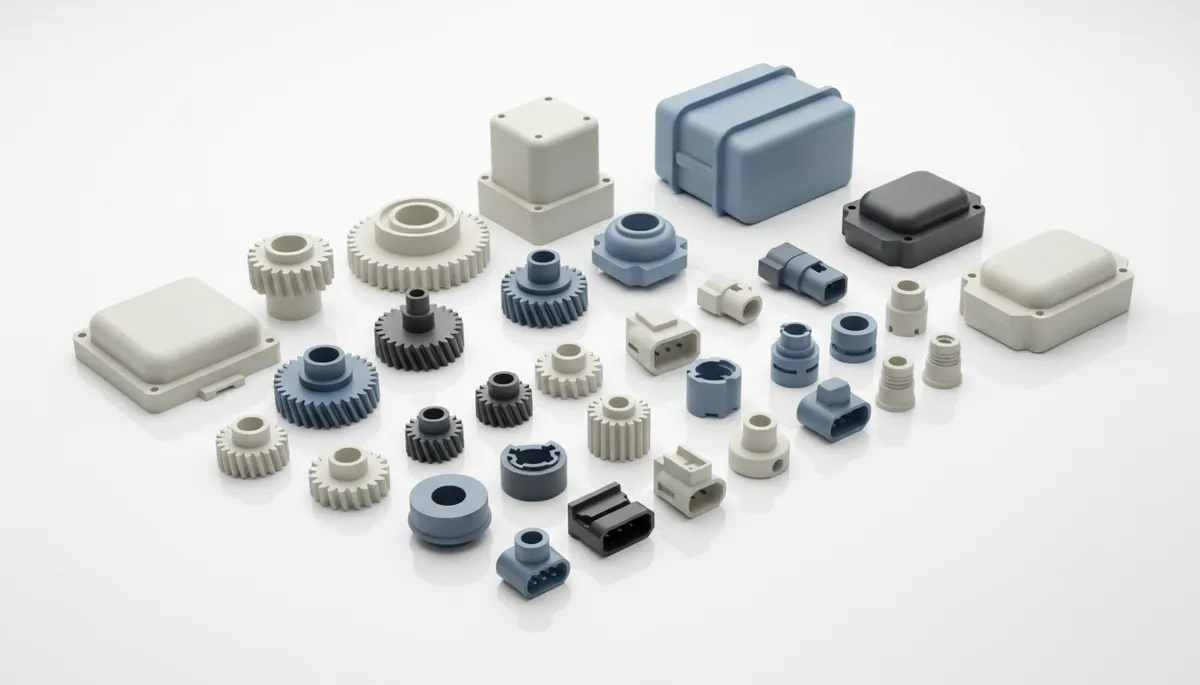
Low-volume injection molding is an moulage par injection1 process optimized for production runs typically ranging from 50 to 10,000 parts. Instead of investing in expensive hardened-steel tooling designed to last millions of cycles, manufacturers use aluminum molds or softer steel alloys that are faster and cheaper to machine.
In our factory at ZetarMold, we see this approach as the sweet spot for clients who need real production-grade parts—not just 3D-printed prototypes—but don’t yet have the demand to justify a $30,000–$80,000 hardened-steel mold. The parts that come off a low-volume mold are identical in material and performance to those from a high-volume tool; the difference is purely in tooling economics and mold lifespan.
The process itself follows the same fundamental steps as traditional injection molding: pellets are melted, injected into a mold cavity under pressure, cooled, and ejected. What changes is the tooling strategy, the cycle-time expectations, and the cost structure.
“Low-volume injection molding produces inferior parts compared to mass production.”Faux
Part quality depends on material, mold design, and process parameters—not production volume. Low-volume parts use the same resins and molding principles, delivering equivalent mechanical and aesthetic properties.
“Aluminum molds can produce thousands of high-quality parts before needing replacement.”Vrai
Modern 7075-T6 aluminum tooling routinely delivers 5,000–10,000+ shots with tight tolerances. For many programs, that’s more than enough before a design revision triggers a new tool anyway.
What Are the Key Parameters That Define a Low-Volume Run?
Several critical parameters separate low-volume injection molding from conventional high-volume production: mold material, cavity count, durée du cycle tolerance, and unit economics. Understanding these helps you decide whether this approach fits your project.
| Paramètres | Low-Volume (50–10,000 parts) | High-Volume (100,000+ parts) |
|---|---|---|
| Matériau du moule | Aluminum (7075-T6) or P20 steel | Hardened tool steel (H13, S136) |
| Coût de l'outillage | $3,000–$25,000 | $20,000–$100,000+ |
| Tooling Lead Time | 2–4 weeks | 8–16 weeks |
| Mold Life (shots) | 5,000–100,000 | 500,000–2,000,000+ |
| Cavity Count | Single or 2-cavity | 4, 8, 16+ cavities |
| Durée du cycle | 30–90 seconds (acceptable) | 10–30 seconds (optimized) |
| Part Cost (per unit) | Higher (due to tooling amortization) | Lower at scale |
| Design Changes | Easy and affordable to modify | Expensive rework |
In our experience, the sweet spot for aluminum tooling at ZetarMold sits around 1,000–5,000 parts. Below 50, you’re usually better served by Impression 3D ou Nous analysons votre fichier CAO 3D pour2. Above 10,000, the per-part savings from a hardened-steel tool start to make economic sense.
Cycle times are deliberately relaxed in low-volume runs. We don’t chase 15-second cycles because the mold doesn’t need to survive a million shots. Accepting a 45-second cycle lets us simplify cooling channel design, which in turn reduces tooling cost and lead time.
Why Does Low-Volume Injection Molding Matter for Your Business?
Low-volume injection molding matters because it eliminates the traditional trade-off between speed-to-market and part quality. It lets you launch with production-grade parts while keeping financial risk manageable—especially when market demand is unproven.
We’ve worked with startups that needed 500 units for a crowdfunding reward, medical device companies running clinical trials with 2,000 parts, and automotive OEMs validating fit-and-finish on pre-production assemblies. In every case, the alternative—committing to a full production mold—would have meant either a six-figure tooling investment or a six-month delay.
Here’s what this approach unlocks:
- Design iteration freedom. If testing reveals a épaisseur de la paroi issue or a snap-fit that doesn’t quite work, modifying an aluminum mold costs a fraction of reworking hardened steel.
- Bridge-to-production. Start selling with low-volume tooling while your production mold is still being built. Revenue starts flowing immediately.
- Market validation. Test real products with real customers before scaling. We’ve seen clients pivot their design after the first 500-unit run based on user feedback—an inexpensive lesson that would have cost tens of thousands with production tooling.
- Supply chain agility. For products with unpredictable demand—seasonal items, niche medical devices, specialty industrial components—low-volume runs mean you’re never sitting on excess inventory.
What Are Common Challenges in Low-Volume Molding and How Do You Solve Them?
The most common challenges are higher per-part costs, mold wear on softer tooling, limited cavity counts, and the perception that “low volume” means “low quality.” Each has a practical solution when you approach the project correctly.
Challenge 1: Higher per-part cost. With tooling amortized over fewer parts, each unit carries more overhead. Our solution at ZetarMold is to right-size the mold—use MUD inserts (Master Unit Die) that fit into a universal base, cutting tool cost by 20–40%. We also design for simpler parting lines and fewer side actions to keep machining hours low.
Challenge 2: Mold wear and surface finish degradation. Aluminum is softer than tool steel, so high-glass-fill resins or abrasive materials can wear the cavity. We address this by applying nickel plating or hard anodizing to critical surfaces, extending mold life by 2–3x without significantly increasing cost.
Challenge 3: Tight tolerances on soft tooling. Aluminum has a higher coefficient of thermal expansion3 than steel, which can affect dimensional consistency. We compensate by adjusting cooling parameters, using tighter process windows, and applying steel inserts at high-wear or high-precision features.
Challenge 4: Limited resin compatibility. Most engineering thermoplastics—ABS, PC, Nylon, PP, PE, TPU—run perfectly in aluminum tools. Only extremely abrasive or high-temperature resins (like PEEK or 40%+ glass-filled materials) require special consideration. For those, we use P20 pre-hardened steel instead.
“You can only use basic plastics like PP and PE in aluminum molds.”Faux
Aluminum tooling handles a wide range of engineering resins including ABS, polycarbonate, nylon, and TPU. With surface treatments, even moderately filled materials run well.
“MUD inserts and universal mold bases can significantly reduce tooling costs for small runs.”Vrai
MUD (Master Unit Die) systems let you swap cavity inserts in a standard frame, saving 20–40% on tooling and allowing faster changeovers between different part designs.
Which Industries Benefit Most from Low-Volume Injection Molding?
Medical devices, automotive pre-production, consumer electronics, aerospace, and industrial equipment are the industries that benefit most. Any sector where regulatory testing, market validation, or product customization demands smaller initial quantities is a strong fit.

- Dispositifs médicaux : Clinical trials, FDA submissions, and initial market launch often require 500–5,000 units in production-grade materials. We’ve molded surgical instrument housings, diagnostic device enclosures, and drug delivery components for clients navigating regulatory approval.
- Automobile : Pre-series validation, aftermarket parts, and specialty vehicle components rarely exceed a few thousand units. Low-volume molding delivers parts that meet OEM material specs without the six-figure tooling commitment.
- Consumer electronics: Crowdfunded products, limited editions, and first-generation launches use low-volume runs to test the market before scaling. We’ve helped clients go from concept to 2,000 retail-ready units in under six weeks.
- Aerospace and defense: Many components are needed in quantities of 100–1,000 with demanding material and traceability requirements. Aluminum tooling with full documentation meets these needs efficiently.
- Industrial equipment: Replacement parts, custom machine components, and legacy part reproduction often don’t justify production tooling. Low-volume molding keeps aging equipment running without massive investment.
What Does the Low-Volume Injection Molding Process Look Like Step by Step?
The process follows six stages: design review, tooling design, mold fabrication, sampling and validation, production run, and quality inspection. The entire timeline from design freeze to parts-in-hand typically runs 3–6 weeks at ZetarMold.

- Design for Manufacturability (DFM) review. We analyze your 3D CAD file for angles de dépouille4Angle de dépouille — Le léger cône appliqué aux parois verticales d'une pièce moulée pour faciliter l'éjection du moule. La dépouille typique est de 1 à 2° par côté ; une dépouille insuffisante provoque l'accrochage, l'endommagement de surface et des difficultés d'éjection.
- Tooling design. Our engineers create the mold design, selecting aluminum grade, cooling layout, ejection strategy, and parting line. For low-volume work, we favor simplified designs—straight-pull molds with minimal side actions.
- CNC mold fabrication. High-speed CNC machining cuts the aluminum cavity and core. Because aluminum machines 3–5x faster than hardened steel, we typically deliver finished molds in 10–15 days.
- T1 sampling. First shots off the mold are measured against your specifications. We provide a dimensional inspection report and sample parts for your approval. If adjustments are needed, aluminum molds can be modified in 1–3 days.
- Production run. Once samples are approved, we run the full quantity. For a typical 1,000-part order in ABS, expect 2–4 days of molding time with single-cavity tooling.
- Quality inspection and shipping. Parts undergo incoming inspection per your quality plan—CMM measurement, visual inspection, functional testing as required. We support full PPAP5 documentation when needed.
How Do Design Choices and Tooling Decisions Affect Part Quality?
Design choices—particularly wall thickness, draft angle, gate location, and rib design—have the single biggest impact on part quality in low-volume injection molding. Poor design leads to marques d'évier, page de guerre, and short shots regardless of how good your mold or machine is.

In our factory, we follow these proven guidelines:
- Épaisseur de paroi uniforme : Maintain consistent wall sections (typically 1.5–3.0 mm for most resins). Thick-to-thin transitions cause differential cooling and warpage. When we see walls varying by more than 25%, we recommend coring out thick sections.
- Adequate draft: We recommend 1–2° minimum draft on all vertical surfaces. For textured surfaces, add 1° per 0.025 mm of texture depth. Insufficient draft causes parts to stick in the mold, especially in aluminum tooling where surface galling is a concern.
- Smart gate placement: The gate location determines how plastic fills the cavity. We position gates at the thickest section and orient flow toward thin areas. For cosmetic parts, we use sub-gates or tunnel gates to hide the witness mark.
- Motif des côtes : Ribs should be 50–70% of the adjacent wall thickness to prevent sink marks on the opposite surface. In low-volume tooling, we sometimes accept slightly thicker ribs if structural requirements demand it, compensating with adjusted pack-and-hold pressure.
Tooling decisions matter equally. Cooling channel placement in aluminum molds is actually an advantage—aluminum’s thermal conductivity is roughly 5x higher than steel, enabling faster and more uniform cooling. We leverage this to reduce warpage on flat, thin-walled parts that would be problematic in steel tooling.

FAQ
What is the minimum order quantity for low-volume injection molding?
At ZetarMold, our minimum is typically 50 parts. Below that quantity, 3D printing or urethane casting is usually more cost-effective. The economic sweet spot for low-volume molding starts around 200–500 parts, where the per-unit cost becomes competitive with other manufacturing methods.
How much does low-volume injection molding tooling cost?
Tooling costs range from $3,000 for a simple single-cavity aluminum mold to $25,000 for complex multi-feature tools. The average project we handle at ZetarMold falls in the $5,000–$12,000 range. This compares favorably to $20,000–$100,000+ for production-grade hardened steel molds.
Can I use the same material in low-volume molds as in mass production?
Yes. Low-volume aluminum molds run the same production resins—ABS, polycarbonate, nylon, polypropylene, TPU, and many others. The only exceptions are highly abrasive materials (40%+ glass fill) or ultra-high-temperature resins (PEEK, PEI), which may require P20 steel instead of aluminum.
How long does it take to get parts from a low-volume injection molding project?
From design freeze to parts-in-hand, expect 3–6 weeks. Mold fabrication takes 2–3 weeks, sampling and approval add 3–5 days, and the production run itself is typically 2–5 days depending on quantity. Rush programs can compress this to as little as 2 weeks.
Is low-volume injection molding suitable for FDA-regulated medical parts?
Absolutely. The molding process is identical to mass production, so parts meet the same material and dimensional specifications. We provide full material traceability, process documentation, and can support ISO 13485 requirements. Many of our medical clients use low-volume molding for clinical trial quantities before transitioning to production tooling.
What happens when I need to scale up from low-volume to mass production?
We treat low-volume tooling as a stepping stone. Once your design is validated and demand grows, we build a hardened-steel production mold based on the same 3D data and process parameters proven during the low-volume phase. This de-risks the production tool since all design issues were already resolved.

Résumé
Low-volume injection molding fills a critical gap between prototyping and mass production. By using aluminum or soft-steel tooling, you get real production-grade parts in weeks instead of months, at a fraction of traditional tooling cost. The process works with most engineering thermoplastics, supports tight tolerances with proper design, and serves industries from medical devices to consumer electronics.
At ZetarMold, we’ve delivered thousands of low-volume projects and understand the nuances—when to use aluminum versus P20, how to optimize gate location for short runs, and where to invest in mold features versus accepting cycle-time trade-offs. Whether you need 200 parts for a clinical trial or 5,000 units for a product launch, low-volume injection molding offers the fastest path from validated design to market-ready parts.
Ready to explore low-volume injection molding for your next project? Contact ZetarMold for a free DFM review and quote.
-
Injection molding — A manufacturing process in which molten thermoplastic material is injected under pressure into a closed mold cavity, cooled, and ejected as a solid part. It is the most widely used method for producing plastic components at scale. ↩
-
Urethane casting — A low-volume manufacturing technique using silicone molds and polyurethane resins to produce prototype or bridge-production parts. It is cost-effective for quantities under 50 but lacks the material range and precision of injection molding. ↩
-
Coefficient of thermal expansion (CTE) — A material property describing how much a substance expands per degree of temperature change. Aluminum’s CTE is roughly twice that of steel, requiring compensation in mold design for dimensional accuracy. ↩
-
Draft angle — The slight taper applied to vertical walls of a molded part to facilitate ejection from the mold. Typical draft is 1–2° per side; insufficient draft causes sticking, surface damage, and ejection difficulties. ↩
-
Moulage par injection à faible volume : Processus, Coût et Avantages | Zetar ↩





 EN
EN  ES
ES  FR
FR  DE
DE  PT
PT  AR
AR  RU
RU  JA
JA  KO
KO  IT
IT  NL
NL  TR
TR  PL
PL 