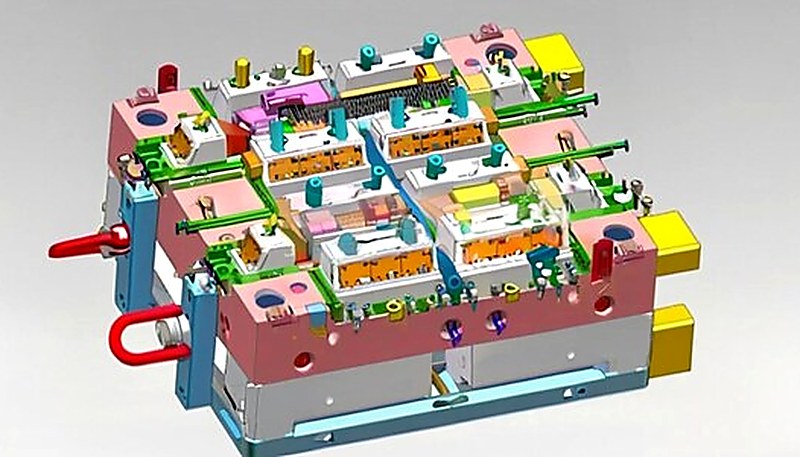
- Los cuatro tipos principales de canales de enfriamiento para moldes de inyección son: taladro recto, deflector, espiral y conformado.
- El enfriamiento representa el 70–80% del tiempo total del ciclo — la palanca más grande para la productividad.
- El enfriamiento conformal reduce el tiempo de ciclo en un 20–35% en comparación con los canales perforados rectos en geometrías complejas.
- El agua es el refrigerante más común; el aceite se usa para moldes que requieren temperaturas superiores a 90°C.
- El enfriamiento uniforme evita la deformación, las marcas de hundimiento y la variación dimensional en las piezas terminadas.
Por qué la elección del sistema de enfriamiento hace o deshace su molde
Elegir el sistema de refrigeración adecuado es la decisión con mayor impacto en el diseño del molde: controla el 70-80 % del tiempo de ciclo1. Al evaluar a un proveedor de moldeo por inyección para un molde de producción, es esencial conocer las opciones de refrigeración. Una elección incorrecta se paga en desperdicios y pérdida de productividad durante toda la vida útil del molde. Este artículo explica los cuatro tipos principales de canales de refrigeración y ofrece criterios para elegir el adecuado.
La refrigeración no es una consideración secundaria en el moldeo por inyección. Controla el 70-80 % del tiempo total del proceso de moldeo por inyección. La diferencia entre un molde bien refrigerado y otro mal refrigerado puede ser un ciclo de 12 segundos frente a uno de 18; en un molde de un millón de ciclos, esa es la diferencia entre obtener beneficios o no.
Este artículo explica los cuatro tipos principales de sistemas de refrigeración utilizados en moldes de inyección, compara su rendimiento y ofrece criterios para elegir el adecuado para su aplicación. Tanto si especifica su primer molde de producción como si optimiza uno existente, comprender los tipos de canales de refrigeración es la vía más rápida hacia mejores piezas y menores costes unitarios.
Una elección incorrecta de la refrigeración no solo ralentiza la producción, sino que genera problemas de calidad que se agravan con el tiempo. Una refrigeración desigual provoca alabeo, rechupes y desviaciones dimensionales que empeoran a medida que el molde se calienta durante una serie de producción. Corregir estos problemas posteriormente (clasificación, retrabajo, desecho) cuesta entre 5–10× más que diseñar correctamente la refrigeración desde el principio.
¿Qué es un Sistema de Enfriamiento de Molde de Inyección?
Un sistema de enfriamiento de molde de inyección extrae calor del plástico fundido a través de canales internos — y controla el 70–80% de su tiempo de ciclo. El sistema de enfriamiento es el mayor contribuyente al tiempo de ciclo en el moldeo por inyección.
Cuando el plástico fundido caliente (típicamente 200–300°C) entra en la cavidad, transfiere calor a las paredes de acero del molde. Sin enfriamiento activo, una pieza de ABS de 3 mm de espesor tardaría más de 120 segundos en solidificarse lo suficiente para la expulsión. Con un circuito de agua diseñado adecuadamente, esa misma pieza se expulsa en 15–25 segundos — una mejora de 5–8 veces.
El sistema de refrigeración afecta a tres resultados críticos: tiempo de ciclo (productividad), calidad de la pieza (estabilidad dimensional y aspecto) y longevidad del molde (fatiga térmica). Resolverlo bien en la fase de diseño del molde de inyección es mucho más barato que rediseñar los canales después de cortar el acero. Un rediseño de refrigeración después de T0 suele costar entre $5,000 y $15,000 y añade entre 2 y 4 semanas al calendario.
El circuito de enfriamiento consta de varios elementos que trabajan juntos: los canales internos perforados o formados en el acero del molde, la plomería externa (mangueras, colectores, conexiones rápidas), la unidad de control de temperatura (TCU o termorregulador) que calienta o enfría el refrigerante, y el sistema de gestión del flujo que asegura un flujo turbulento para una transferencia de calor máxima.
En ZetarMold, cambiar de canales perforados rectos a canales de refrigeración conformal cooling2 reduce el tiempo de ciclo entre un 20–35% en piezas de pared delgada. En 2024 documentamos una reducción del tiempo de ciclo del 28% en un programa de carcasas de ABS con una pared de 1.2mm.
Tipos de Canales de Enfriamiento en Moldes de Inyección
Los cuatro tipos principales de canales de enfriamiento son perforación recta, deflector, espiral y conformado — cada uno adecuado para diferentes geometrías y volúmenes. La siguiente tabla resume cómo se comparan en impacto en el tiempo de ciclo, costo de herramienta y complejidad.
| Tipo de Canal | Caso típico | Impacto en el tiempo de ciclo | Coste de utillaje | Complejidad |
|---|---|---|---|---|
| Perforación recta | Piezas planas y simples | Línea base | Bajo | Bajo |
| Deflector | Núcleos profundos, nervaduras altas | 10–15% más rápido que la perforación | Medio | Medio |
| Espiral | Piezas cilíndricas, redondas | 15–20% más rápido que el taladro | Medio | Medio |
| Conformal | Geometrías complejas, paredes delgadas | 20–35% más rápido que la perforación | Alta | Alta |
Canales de Enfriamiento Rectos Perforados
Los canales de taladro recto son el método de enfriamiento más común y menos costoso. El fabricante del molde perfora una serie de agujeros rectos de sección transversal circular a través de las placas del molde, luego los conecta con tapones y mangueras para formar un circuito. Más del 80% de todos los moldes de producción utilizan el enfriamiento por taladro recto como método principal.
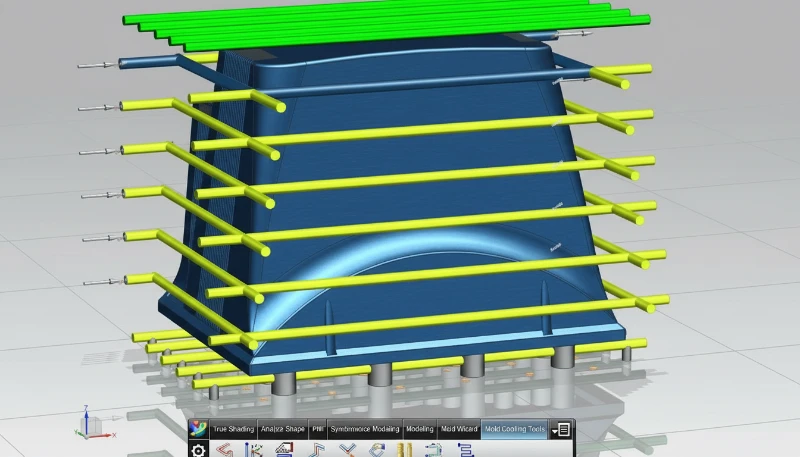
Estos canales funcionan bien con piezas planas de espesor uniforme, como bandejas sencillas, tapas planas o carcasas rectangulares. La limitación es la geometría: solo pueden perforarse líneas rectas, por lo que varía la distancia entre el canal y la superficie de la cavidad. Donde la cavidad se curva o presenta elementos profundos, la trayectoria de perforación no puede seguirla y deja puntos calientes que prolongan la refrigeración.
Los diámetros de perforación típicos oscilan entre 6 mm y 12 mm. La distancia desde la pared del canal a la superficie de la cavidad debe ser 1.5–2.0 veces el diámetro del canal — generalmente 12–15 mm — para equilibrar la eficiencia de enfriamiento con la integridad estructural del acero del molde. Un espaciado más cercano mejora la uniformidad de la temperatura pero debilita el acero entre los canales.
Canales de Enfriamiento con Deflector
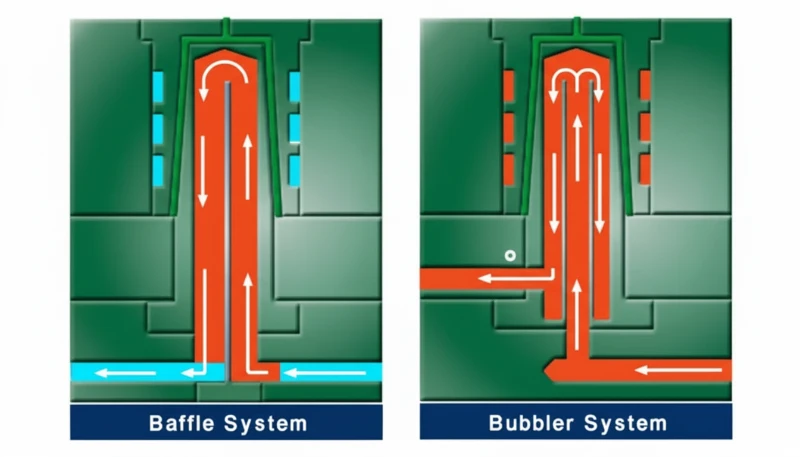
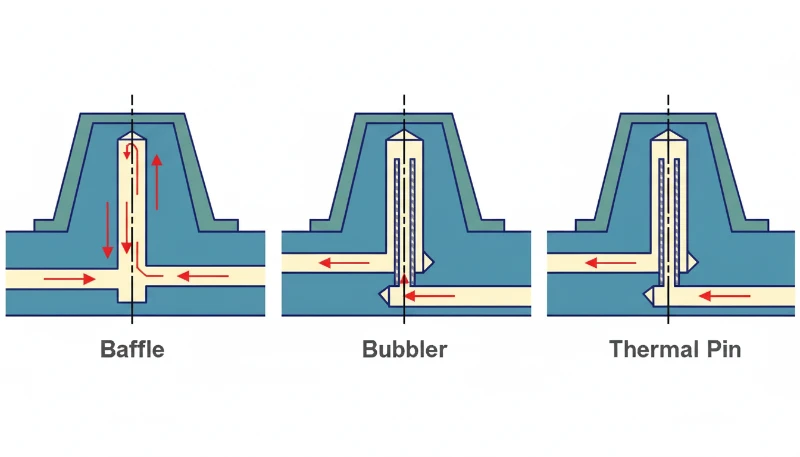
Los canales con deflector son esencialmente agujeros perforados rectos con una placa metálica (el deflector) insertada en el centro, dividiendo el agujero en dos mitades. El refrigerante fluye hacia arriba por un lado y hacia abajo por el otro, creando turbulencia que mejora la transferencia de calor en un 30–40% en comparación con el flujo laminar en un agujero perforado simple. El flujo turbulento rompe la capa límite que aísla la pared del canal.
Los deflectores son la solución habitual para refrigerar núcleos profundos y nervios altos a los que no llegan por sí solos los canales perforados en línea recta. El deflector puede colocarse descentrado para dirigir más refrigerante hacia la zona más caliente de la cavidad. Son relativamente económicos de añadir durante la construcción del molde, pero requieren un dimensionamiento cuidadoso: un deflector demasiado pequeño restringe el flujo, mientras que uno demasiado grande reduce la superficie de refrigeración.
Canales de Enfriamiento en Espiral
Los canales espirales envuelven los núcleos cilíndricos siguiendo una trayectoria helicoidal y mantienen una distancia constante respecto a la superficie de la cavidad en todo el circuito. Se utilizan principalmente para piezas redondas o cilíndricas, como tapas, recipientes y accesorios de tubería, cuya geometría se adapta naturalmente a un flujo helicoidal.
La ventaja frente al taladrado recto es la distancia de refrigeración uniforme. En un circuito taladrado alrededor de una pieza redonda se forman zonas muertas entre las líneas de taladro paralelas. Una espiral elimina por completo esos espacios. El refrigerante entra por la parte inferior, asciende en espiral alrededor del núcleo y sale por la parte superior —o viceversa—, lo que garantiza que cada punto de la superficie cilíndrica reciba una intensidad de refrigeración aproximadamente igual.
Los canales en espiral se mecanizan fresando una ranura en la superficie del núcleo y sellándola después con un manguito o un anillo insertado. Esto los hace más caros que los canales de perforación recta, aunque siguen siendo mucho más económicos que la refrigeración conformal. La principal limitación es que las espirales solo funcionan con geometrías de simetría rotacional: no pueden seguir contornos irregulares mejor que los canales de perforación recta.
Canales de refrigeración conformales
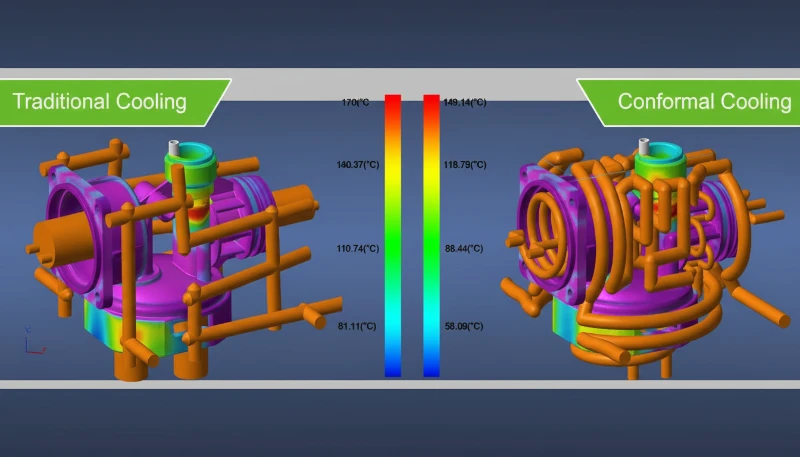
Los canales de enfriamiento conformados siguen el contorno exacto de la cavidad del molde y mantienen una distancia uniforme respecto a la superficie de la pieza, por compleja que sea la geometría. Se fabrican mediante impresión 3D de metal (fusión selectiva por láser) o, en algunos casos, mecanizando ranuras en insertos divididos y sellándolas con aleaciones de cobre conformables.
El resultado es un enfriamiento mucho más uniforme. Las zonas que serían puntos calientes en un molde con taladros rectos —cavidades profundas, nervios finos y superficies curvas— reciben la misma intensidad de enfriamiento que las zonas planas. En la carcasa compleja de un dispositivo médico con paredes de 1.2mm, el enfriamiento conformal puede reducir el tiempo de ciclo entre 20–35% frente al taladrado convencional.
La contrapartida es el coste. Un inserto con refrigeración conformal cuesta 2–4× más que uno taladrado equivalente debido al proceso de fabricación aditiva. Pero en herramientas de gran volumen con 500K+ inyecciones, el ahorro de tiempo de ciclo compensa la diferencia en semanas. También hemos visto que la refrigeración conformal reduce la deformación hasta 50% en piezas asimétricas porque el gradiente térmico es menor.
Los canales conformales también pueden tener secciones transversales variables y perfiles no circulares, algo imposible con la perforación convencional. Esto permite a los diseñadores de moldes optimizar de forma independiente la velocidad del flujo y el coeficiente de transferencia térmica en distintas zonas de un mismo inserto, un nivel de control térmico que los circuitos de perforación recta sencillamente no pueden igualar.
Medios de Enfriamiento: Agua, Aceite y Aire
El agua es el medio refrigerante en más del 90 % de las operaciones de moldeo por inyección del mundo. Ofrece una alta conductividad térmica3 (0,6 W/(m·K)), bajo coste, fácil disponibilidad y control preciso de la temperatura entre 10 °C y 90 °C mediante un termorregulador o una torre de refrigeración. El agua también tiene una elevada capacidad calorífica específica, por lo que absorbe mucha energía térmica por unidad de volumen.
El enfriamiento con aceite se utiliza cuando el molde debe funcionar a más de 90°C, algo común con resinas de ingeniería de alto rendimiento como PEEK (temperatura del molde de 160–200°C) o polisulfona (temperatura del molde de 120–160°C). Los sistemas de aceite funcionan hasta 300°C, pero tienen una conductividad térmica aproximadamente 4 veces menor que el agua (0.15 frente a 0.6 W/(m·K)) y requieren más energía para circular. También introducen riesgo de incendio a altas temperaturas y añaden una carga de mantenimiento considerable en comparación con los sistemas de agua.
La refrigeración por aire rara vez se utiliza como sistema principal porque la conductividad térmica del aire es aproximadamente 25× menor que la del agua (0.025 frente a 0.6 W/(m·K)). Suele emplearse como complemento: aire comprimido dirigido a puntos calientes concretos o en moldes para prototipos de muy bajo volumen donde el coste de un circuito de agua no está justificado. Algunos moldes utilizan aire auxiliar en los pasadores expulsores para refrigerar núcleos profundos a los que el agua no llega fácilmente.
| Propiedad | Agua | Aceite | Aire |
|---|---|---|---|
| Conductividad térmica | 0,6 W/(m·K) | Valor: 0.15 W/(m·K) | Valor: 0.025 W/(m·K) |
| Intervalo de temperatura | 10–90°C | 50–300°C | Solo a temperatura ambiente |
| Coste | Bajo | Medio | Muy bajo |
| Uso típico | La mayoría de las aplicaciones | Resinas para altas temperaturas | Solo prototipo |
Cómo el Enfriamiento Afecta la Calidad del Producto y el Tiempo de Ciclo
El rendimiento del sistema de enfriamiento afecta directamente a tres indicadores de calidad: precisión dimensional, aspecto superficial y uniformidad mecánica. Un enfriamiento desigual —cuando una zona de la pieza se solidifica más rápido que otra— provoca tensiones internas que generan deformación, rechupes y variaciones de contracción en la pieza.
Una diferencia de temperatura de solo 10°C en la superficie de la pieza puede causar una desviación dimensional medible de 0.1–0.3mm en una característica de 100mm. En piezas automotrices o médicas con tolerancias estrechas y una ventana de aceptación de ±0.05mm, esto supone un rechazo. El problema empeora durante la producción: a medida que el molde se calienta por los ciclos continuos, aumentan los gradientes térmicos y las piezas que superaron la inspección durante la primera hora empiezan a quedar fuera de especificación.
Sobre el tiempo de ciclo: en un ciclo típico de moldeo por inyección, el llenado tarda 1–3 segundos, la compactación 2–5 segundos y la refrigeración 10–40 segundos. La expulsión y la apertura/cierre del molde añaden otros 3–8 segundos. La refrigeración domina el ciclo total y representa el 70–80% del tiempo transcurrido en la mayoría de las aplicaciones.
El cálculo es sencillo. Si su ciclo actual dura 20 segundos y reduce el tiempo de enfriamiento en 3 segundos (una mejora del 15%), en un molde de 1 millón de ciclos ahorra 833 horas de máquina. Con una tarifa de máquina de $30–50/hora, eso supone una reducción del coste de producción de $25,000–$41,000, superior en la mayoría de los casos al sobreprecio de unos mejores canales de refrigeración. Por eso, optimizar la refrigeración es casi siempre la mejora con mayor ROI que puede realizarse en un molde de producción.
Principios de Diseño para Sistemas de Enfriamiento de Moldes
El diseño de la refrigeración del molde se rige por cinco principios fundamentales. Maximice el número de canales, mantenga una distancia uniforme respecto a la cavidad, alinee el flujo del refrigerante con el flujo del material, limite la diferencia de temperatura entre entrada y salida a 3–5°C y garantice un flujo turbulento en cada circuito. Un mayor número de canales con menor separación siempre ofrece mejores resultados que unos pocos canales grandes.
En primer lugar, maximice el número de canales y minimice el espaciado entre ellos. Un mayor número de canales con distancias de paso menores produce una temperatura más uniforme en la superficie de la cavidad. El límite práctico es la resistencia del molde: no se pueden colocar los canales tan cerca que el acero entre ellos se convierta en un punto débil. Como regla general, el ancho del puente entre dos canales paralelos debe ser al menos igual al diámetro del canal.
Cinco reglas para una disposición eficaz de la refrigeración
En segundo lugar, mantenga una distancia constante entre el canal y la superficie de la cavidad, idealmente de 12–15mm. Una distancia inferior a 10mm crea puntos fríos y riesgo de agrietamiento del acero bajo la presión de inyección; una superior a 20mm reduce considerablemente la eficiencia de refrigeración.
En tercer lugar, alinee la dirección del flujo del refrigerante con el flujo del material. La entrada del refrigerante debe estar cerca del punto de inyección, donde el plástico está más caliente. Este método de ‘paralelismo entre agua y material’ garantiza que el agua más fría entre primero en contacto con el plástico más caliente y que después el refrigerante, progresivamente más caliente, se ocupe de las zonas más frías de la pieza. El resultado es una solidificación general más uniforme y un alabeo considerablemente menor.
En cuarto lugar, mantenga la diferencia de temperatura entre la entrada y la salida del refrigerante por debajo de 3–5°C. Una diferencia de temperatura mayor indica que la superficie del molde cercana a la salida está mucho más caliente que la próxima a la entrada, lo que genera precisamente el tipo de enfriamiento desigual que causa deformación y variaciones dimensionales.
Quinto, especifique flujo turbulento en todos los circuitos: no basta con un caudal adecuado, sino que se requieren números de Reynolds reales superiores a 4000. El flujo laminar (Reynolds < 2300) crea una capa límite de movimiento lento a lo largo de la pared del canal que actúa como aislamiento térmico. En la práctica, esto significa que se necesita una velocidad mínima del refrigerante de 0.5–1.0 m/s en un canal de 10mm, lo que requiere una bomba capaz de suministrar 3–5 litros por minuto y circuito. Muchos moldes de producción tienen canales que parecen fluir bien (se ve circular el agua), pero en realidad se encuentran en el régimen de flujo transitorio (Reynolds 2300–4000), desaprovechando entre un 15–20% de la capacidad potencial de enfriamiento.
Estos cuatro principios se aplican independientemente del tipo de canal que elija. Incluso un molde con perforaciones rectas ofrece un buen rendimiento cuando los canales están correctamente espaciados, a la distancia adecuada de la cavidad y con un flujo turbulento de refrigerante. El tipo de canal determina el límite del rendimiento de refrigeración; los principios de diseño determinan cuánto se aproxima a ese límite.
En ZetarMold, nuestros 8 ingenieros sénior revisan cada disposición de refrigeración durante el DFM antes de cortar el acero. En un reciente programa de interior para automoción, detectar durante el DFM una distancia de 20mm entre canal y cavidad, demasiado grande, ahorró aproximadamente 4 segundos por ciclo, equivalentes a más de $120,000 durante la vida de producción del molde.
Cuándo actualizar de enfriamiento por perforación recta a enfriamiento conformal
Cambie a refrigeración conformal cuando la pieza tenga una geometría compleja: variación de pared superior a 3:1, elementos profundos de más de 50mm, paredes delgadas de menos de 1.5mm o un volumen anual superior a 200K ciclos. La decisión depende de la geometría de la pieza, el volumen de producción y el coste del tiempo de ciclo según la tarifa específica de su máquina.
Actualice cuando la pieza presente una variación del espesor de pared superior a 3:1, características profundas (>50mm) a las que no pueda llegar un taladrado recto, paredes delgadas (<1.5mm) que requieran un enfriamiento rápido y uniforme, o un volumen de producción anual superior a 200K inyecciones. En cualquiera de estos casos, el ahorro de tiempo de ciclo proporcionado por la refrigeración conformada normalmente amortizará el sobrecoste del utillaje durante la primera serie de producción.
Mantenga la perforación recta cuando la pieza sea sencilla y plana, el espesor de pared uniforme y el volumen de producción inferior a 100K inyecciones. Añadir refrigeración conformal a un molde sencillo es sobredimensionarlo: la mejora del tiempo de ciclo puede ser solo del 5–8%, lo que no justifica el sobrecoste de 2–4× del inserto.
Los deflectores y las espirales ocupan el término medio. Si tiene una pieza de complejidad moderada, pero no puede justificar el coste del enfriamiento conformado, los canales con deflectores en núcleos profundos más los canales en espiral sobre elementos cilíndricos proporcionarán un 60–70% del ahorro de tiempo de ciclo con un 20–30% del sobrecoste. Este enfoque híbrido es el que recomendamos para la mayoría de los programas de volumen medio en automoción y electrónica de consumo.
El cálculo del punto de equilibrio es sencillo: (sobrecoste del utillaje) ÷ (ahorro de tiempo de ciclo por pieza × tarifa de máquina). Si el resultado es inferior al volumen previsto, la refrigeración conformal se amortiza. Si es superior, mantenga canales convencionales e invierta el ahorro en otra área.
"Los canales de refrigeración conformados pueden reducir el tiempo de ciclo en un 20–35% en piezas con geometría compleja."True
Al mantener una distancia uniforme respecto a la superficie de la cavidad, los canales conformales eliminan los puntos calientes que limitan el momento de expulsión en moldes perforados convencionalmente. Casos documentados muestran una reducción del tiempo de ciclo del 28% en carcasas de ABS con paredes de 1.2mm.
"El enfriamiento por aceite siempre es mejor que el enfriamiento por agua porque el aceite puede alcanzar temperaturas más altas."False
El aceite tiene una conductividad térmica aproximadamente 4 veces menor que el agua (0,15 frente a 0,6 W/(m·K)), lo que significa una extracción de calor más lenta por unidad de flujo. El aceite solo es superior cuando la resina requiere temperaturas del molde superiores a 90°C —para la mayoría de las aplicaciones, el agua enfría más rápido, más barato y de manera más segura.
Comprender estos hechos le ayuda a hacer las preguntas correctas al evaluar cotizaciones de moldes de proveedores. Muchos fabricantes de moldes optan por defecto por el enfriamiento recto porque es la opción de menor costo, no porque sea la mejor elección para la geometría de su pieza. Preguntar específicamente sobre el tipo de canal de enfriamiento, la distancia entre el canal y la cavidad, y el número de Reynolds durante la etapa de DFM diferencia un molde bien diseñado de uno que le costará dinero en desperdicio y pérdida de productividad a lo largo de toda su vida productiva. Si su proveedor no puede explicar su estrategia de enfriamiento en términos de estos fundamentos, es una señal de alerta que vale la pena investigar antes de comprometerse con la fabricación del molde.
"La entrada del refrigerante debe situarse cerca de la zona de la entrada para lograr una uniformidad óptima de refrigeración."True
Colocar el agua más fría cerca de la compuerta —donde el plástico está más caliente— alinea el flujo de refrigerante con el del material. Este enfoque de 'agua y material en paralelo' reduce el gradiente de temperatura en toda la pieza en un 40–60%, lo que evita la deformación por enfriamiento diferencial y permite expulsar antes la pieza.
"Los canales de enfriamiento perforados en línea recta funcionan igual de bien para todas las geometrías de pieza."False
Los canales de perforación recta no pueden seguir características de cavidad curvadas o profundas, dejando puntos calientes en áreas como nervaduras altas, cavidades profundas y superficies curvadas. Para piezas con variación de grosor de pared superior a 3:1 o características profundas sobre 50mm, canales deflectores o conformales son necesarios para lograr una uniformidad de refrigeración aceptable.
Preguntas frecuentes
Preguntas frecuentes
¿Cuál es el sistema de refrigeración más común utilizado en moldes de inyección?
Los canales de refrigeración por agua de perforación recta son el sistema más común, utilizado en más del 80% de los moldes de producción mundial. Son la opción de menor costo y funcionan bien para piezas con geometrías relativamente simples y planas donde se puede mantener una distancia uniforme entre el canal y la cavidad en todo el molde. Para piezas más complejas, los fabricantes de herramientas generalmente complementan los circuitos de perforación recta con deflectores o insertos conformales en áreas críticas. El agua a 10–80°C es el refrigerante estándar, circulada por una unidad de control de temperatura (TCU) que mantiene la temperatura objetivo del molde dentro de ±1°C.
¿Cuánto añade el enfriamiento conformacional al costo del molde?
La refrigeración conformal generalmente añade 2–4 veces el costo al inserto refrigerado en comparación con la perforación convencional, debido al proceso de impresión 3D de metal (fusión por láser selectiva) requerido para fabricar los canales. Para un inserto de producción estándar que cuesta $3,000–$5,000 con perforación convencional, la versión conformal podría costar $8,000–$15,000. Sin embargo, para herramientas de alto volumen que ejecutan 500K+ ciclos, la reducción del tiempo de ciclo de 20–35% generalmente recupera este costo adicional dentro de los primeros ciclos de producción. El período exacto de recuperación depende de su tarifa horaria de máquina y la geometría específica de la pieza que se está moldeando.
¿Qué temperatura debe tener el agua de refrigeración?
La temperatura del agua de refrigeración depende del material moldeado y la especifica el fabricante de la resina. Los intervalos habituales incluyen 10–30°C para resinas de uso general como PP y PE (cristalización rápida), 40–60°C para resinas amorfas como ABS y PC, y 60–80°C para resinas de ingeniería como PA66 y PBT, que requieren moldes más calientes para cristalizar correctamente. La ficha técnica del fabricante del termoplástico siempre indica el intervalo recomendado de temperatura del molde. Trabajar a una temperatura demasiado baja puede causar líneas de flujo y tensiones residuales elevadas; una temperatura demasiado alta prolonga innecesariamente el tiempo de ciclo.
¿Por qué el agua es mejor que el aire para la refrigeración del molde?
El agua tiene aproximadamente 25 veces más conductividad térmica que el aire (0.6 vs 0.025 W/(m·K)), lo que significa que extrae calor del molde mucho más eficientemente por unidad de flujo. El agua también tiene una capacidad calorífica específica mucho mayor, permitiendo absorber más energía térmica antes que su temperatura aumente significativamente. Además, el agua permite un control preciso de temperatura mediante termorreguladores (±1°C de precisión), mientras que la refrigeración por aire ofrece casi ninguna capacidad de regulación de temperatura. El aire solo se usa como complemento en escenarios muy específicos — moldes prototipo, refrigeración localizada de puntos calientes, o donde el riesgo de fugas de agua es inadmisible.
¿Cómo causa la refrigeración deficiente deformaciones en piezas moldeadas por inyección?
El enfriamiento desigual crea gradientes de temperatura en la pieza: una zona se solidifica y contrae mientras otra sigue caliente y se contrae a un ritmo distinto. Esta contracción diferencial genera tensiones internas que deforman la pieza una vez expulsada y enfriada a temperatura ambiente. Una variación de solo 10°C en la superficie de la cavidad puede causar una desviación dimensional de 0.1–0.3mm en una característica de 100mm. El efecto es más acusado en piezas con espesor de pared no uniforme, secciones largas y delgadas o geometría asimétrica, precisamente las piezas que exigen el diseño más cuidadoso de los canales de enfriamiento para compensarlo.
¿Cuál es la distancia ideal entre los canales de refrigeración y la superficie de la cavidad?
La distancia recomendada desde la pared del canal de refrigeración a la superficie de la cavidad es de 12–15mm, o aproximadamente 1.5–2.0× el diámetro del canal para tamaños de perforación estándar de 8–10mm. Este rango equilibra la eficiencia de extracción de calor contra la integridad estructural del molde. Más cerca de 10mm crea puntos fríos localizados en la superficie de la pieza y riesgo de fractura del acero bajo las altas presiones de inyección (típicamente 80–140 MPa). Más allá de 20mm reduce significativamente la eficiencia de refrigeración — el acero actúa como aislamiento térmico, y termina circulando más refrigerante con rendimientos decrecientes en la remoción real de calor de la cavidad.
¿Se pueden combinar diferentes tipos de canal de refrigeración en un molde?
Sí, combinar tipos de canal es una práctica estándar en moldes de producción y es frecuentemente la aproximación más rentable. Una configuración común utiliza circuitos de perforación recta para áreas planas de la pieza, canales deflectores en núcleos profundos y nervaduras altas, canales espiral alrededor de características cilíndricas, y insertos conformales solo en las regiones más complejas o críticas térmicamente. Esta estrategia híbrida equilibra costo y rendimiento sin sobreingenierizar toda la herramienta. En ZetarMold, especificamos esta aproximación mixta en aproximadamente 60% de los moldes de producción — captura 70–80% del rendimiento térmico de la refrigeración conformal completa con un costo adicional de 30–40%.
tiempo de ciclo: el tiempo de ciclo es la duración total, medida en segundos, de un ciclo completo de moldeo por inyección, desde el cierre del molde hasta la expulsión de la pieza. ↩
refrigeración conformal: la refrigeración conformal consiste en canales de refrigeración que siguen el contorno de la superficie de la cavidad del molde y suelen fabricarse mediante impresión 3D de metal o fabricación aditiva. ↩
conductividad térmica: la conductividad térmica es una propiedad del material, medida en W/(m·K), que cuantifica la velocidad de transferencia del calor a través de una sustancia. ↩