- Les quatre principaux types de canaux de refroidissement pour moules d’injection sont les canaux percés droits, à déflecteur, en spirale et conformes.
- Le refroidissement représente 70 à 80% du temps de cycle total — c’est le principal levier de productivité.
- Le refroidissement conforme réduit le temps de cycle de 20–35% par rapport aux canaux percés droits sur les géométries complexes.
- L’eau est le fluide de refroidissement le plus courant ; l’huile est utilisée pour les moules exigeant des températures supérieures à 90°C.
- Un refroidissement uniforme évite le gauchissement, les retassures et les variations dimensionnelles des pièces finies.
Pourquoi le choix du système de refroidissement fait ou défait votre moule
Le choix du bon système de refroidissement est la décision qui influe le plus sur la conception du moule : il détermine 70–80 % de votre temps de cycle1. Lors de l’évaluation d’un fournisseur de moulage par injection pour un moule de production, il est essentiel de comprendre les différentes options. Une erreur se paie en rebuts et en perte de productivité pendant toute la durée de vie de l’outil. Cet article présente les quatre principaux types de circuits et les critères permettant de choisir le bon.
Le refroidissement n’est pas un aspect secondaire du moulage par injection. Il représente 70–80 % du temps total du procédé de moulage par injection. La différence entre un moule bien et mal refroidi peut faire passer le cycle de 12 à 18 secondes ; sur un outil prévu pour un million d’injections, c’est ce qui sépare la rentabilité de la perte.
Cet article présente les quatre principaux systèmes de refroidissement des moules d’injection, compare leurs performances et fournit les critères de choix. Qu’il s’agisse de spécifier un premier outil de production ou d’en optimiser un, comprendre les types de canaux est le moyen le plus rapide d’améliorer les pièces et de réduire les coûts unitaires.
Un mauvais choix de refroidissement ne ralentit pas seulement la production — il crée des problèmes qualité qui s’aggravent avec le temps. Un refroidissement irrégulier provoque gauchissement, retassures et dérive dimensionnelle, qui empirent à mesure que le moule chauffe pendant la production. Corriger ces problèmes en aval (tri, reprise, rebut) coûte 5–10× plus cher que de bien concevoir le refroidissement dès le départ.
Qu’est-ce qu’un système de refroidissement de moule d’injection ?
Un système de refroidissement de moule d’injection extrait la chaleur du plastique fondu via des canaux internes — et contrôle 70–80% de votre temps de cycle. Le système de refroidissement est le plus grand contributeur au temps de cycle en moulage par injection.
Lorsque la matière plastique fondue chaude (généralement 200–300°C) entre dans l’empreinte, elle transfère sa chaleur aux parois en acier du moule. Sans refroidissement actif, une pièce en ABS de 3mm d’épaisseur mettrait plus de 120 secondes à se solidifier suffisamment pour être éjectée. Avec un circuit d’eau correctement conçu, la même pièce est éjectée en 15–25 secondes — une amélioration de 5–8×.
Le système de refroidissement influe sur trois résultats critiques : le temps de cycle (productivité), la qualité des pièces (stabilité dimensionnelle et aspect) et la longévité du moule (fatigue thermique). Le concevoir correctement au stade du moule d’injection coûte bien moins cher que de modifier les circuits après l’usinage de l’acier. Une reprise du refroidissement après T0 coûte généralement 5 000 à 15 000 USD et ajoute 2 à 4 semaines au planning.
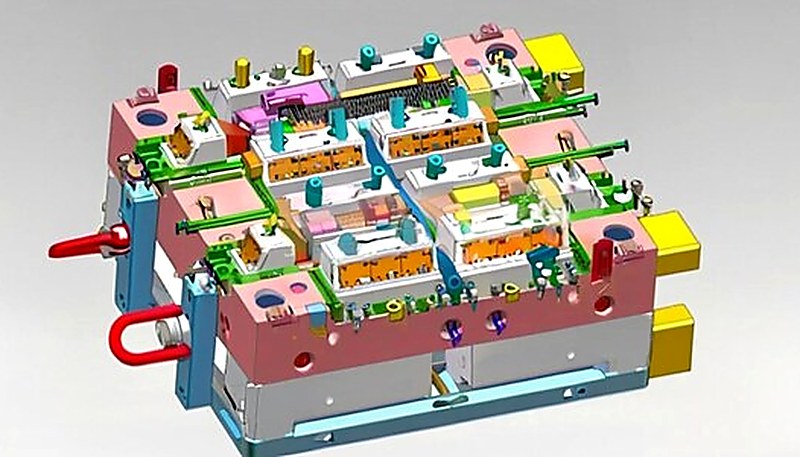
Le circuit de refroidissement comprend plusieurs éléments qui fonctionnent ensemble : les canaux internes percés ou formés dans l’acier du moule, la tuyauterie externe (flexibles, collecteurs, raccords rapides), l’unité de thermorégulation (TCU ou thermorégulateur) qui chauffe ou refroidit le fluide, et le système de gestion du débit qui assure un écoulement turbulent afin de maximiser le transfert thermique.
Chez ZetarMold, le remplacement des canaux forés droits par des canaux de refroidissement conformes2 réduit le temps de cycle de 20–35% sur les pièces à parois minces. En 2024, nous avons documenté une réduction de 28% sur un programme de boîtier ABS à paroi de 1.2mm.
Types de canaux de refroidissement dans les moules d’injection
Les quatre principaux types de canaux de refroidissement sont les canaux droits forés, à chicane, en spirale et conformes — chacun étant adapté à différentes géométries et volumes. Le tableau ci-dessous résume comment ils se comparent en termes d’impact sur le temps de cycle, le coût de l’outillage et la complexité.
| Type de canal | Cas d'utilisation typique | Impact sur le temps de cycle | Coût de l'outillage | Complexité |
|---|---|---|---|---|
| Perçage droit | Pièces simples et planes | Valeur de référence | Faible | Faible |
| Déflecteur | Noyaux profonds, nervures hautes | 10–15% plus rapide que le perçage | Moyen | Moyen |
| Spirale | Pièces cylindriques et rondes | 15 à 20% plus rapide que le perçage | Moyen | Moyen |
| Conforme | Géométries complexes, parois minces | 20 à 35 % plus rapide que le perçage | Haut | Haut |
Canaux de refroidissement percés en ligne droite
Les canaux percés droits sont la méthode de refroidissement la plus courante et la moins coûteuse. Le mouliste perce dans les plaques du moule une série de trous droits à section circulaire, puis les relie à l’aide de bouchons et de tuyaux pour former un circuit. Plus de 80 % de tous les moules de production utilisent principalement le refroidissement par perçage droit.
Ces canaux conviennent bien aux pièces plates d’épaisseur uniforme, telles que les plateaux simples, les couvercles plats ou les boîtiers rectangulaires. Leur limite tient à la géométrie : seuls des perçages rectilignes sont possibles, de sorte que la distance entre le canal et la surface de l’empreinte varie. Lorsque l’empreinte est courbe ou comporte des détails profonds, le perçage ne peut pas les suivre, ce qui laisse des points chauds et allonge le refroidissement.
Les diamètres de perçage typiques vont de 6mm à 12mm. La distance entre la paroi du canal et la surface de l’empreinte doit être de 1.5–2.0× le diamètre du canal — généralement 12–15mm — afin d’équilibrer l’efficacité du refroidissement et l’intégrité structurelle de l’acier du moule. Un espacement plus faible améliore l’uniformité de la température, mais affaiblit l’acier entre les canaux.
Canaux de refroidissement à déflecteur
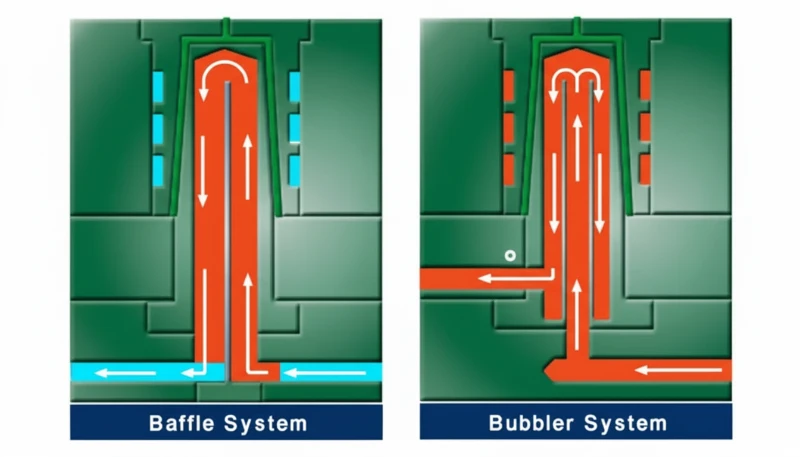
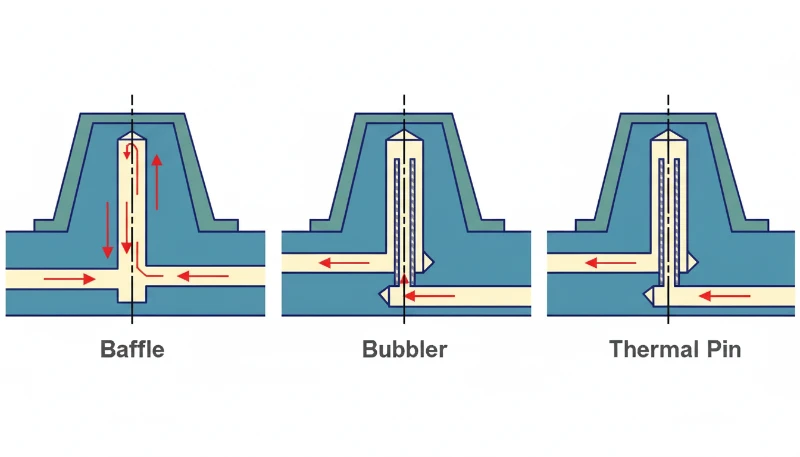
Les canaux à déflecteur sont essentiellement des trous percés droits dans lesquels une plaque métallique (le déflecteur) est insérée au centre, divisant le trou en deux moitiés. Le fluide de refroidissement monte d’un côté et redescend de l’autre, créant une turbulence qui améliore le transfert thermique de 30–40 % par rapport à l’écoulement laminaire dans un simple trou percé. L’écoulement turbulent rompt la couche limite qui isole la paroi du canal.
Les déflecteurs sont la solution de référence pour refroidir les noyaux profonds et hautes nervures inaccessibles aux canaux droits. Placés hors centre, ils dirigent davantage de fluide vers la zone la plus chaude. Peu coûteux à ajouter lors de la construction, ils exigent un dimensionnement précis : trop petits, ils limitent le débit ; trop grands, ils réduisent la surface de refroidissement.
Canaux de refroidissement en spirale
Les canaux spiralés s’enroulent autour des noyaux cylindriques selon un trajet hélicoïdal, en maintenant une distance constante par rapport à la surface de l’empreinte sur tout le circuit. Ils servent principalement aux pièces rondes ou cylindriques — bouchons, récipients et raccords de tuyauterie — dont la géométrie convient naturellement à un écoulement hélicoïdal.
L’avantage par rapport au perçage droit est une distance de refroidissement uniforme. Dans un circuit percé autour d’une pièce ronde, des zones mortes subsistent entre les lignes de perçage parallèles. Une spirale élimine entièrement ces intervalles. Le fluide entre par le bas, remonte en spirale autour du noyau et sort par le haut — ou inversement — de sorte que chaque point de la surface cylindrique reçoit une intensité de refroidissement à peu près égale.
Les canaux hélicoïdaux sont usinés en fraisant une rainure dans la surface du noyau, puis fermés par un manchon ou une bague rapportée. Ils coûtent plus cher que les canaux percés droits, mais bien moins que le refroidissement conforme. Leur principale limite est qu’ils ne conviennent qu’aux géométries de révolution : ils ne suivent pas mieux les contours irréguliers que les perçages droits.
Canaux de refroidissement conformes
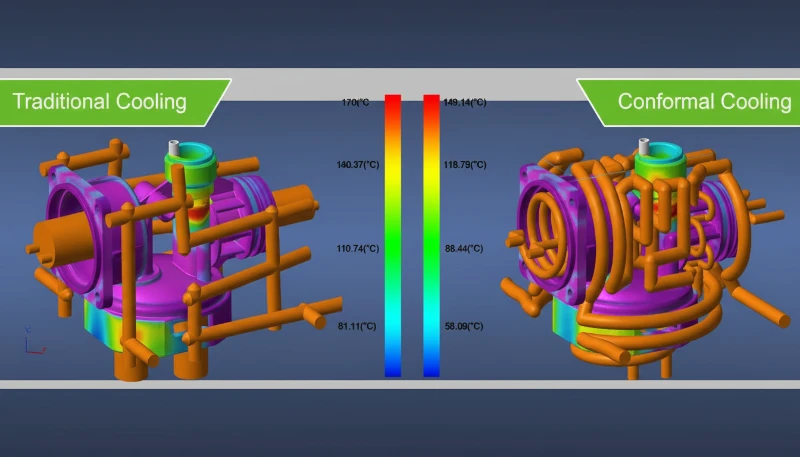
Les canaux de refroidissement conformes suivent exactement le contour de l’empreinte, en maintenant une distance uniforme par rapport à la surface de la pièce, quelle que soit la complexité géométrique. Ils sont fabriqués par impression 3D métal (fusion sélective par laser) ou, parfois, par usinage de rainures dans des inserts divisés, ensuite obturées par des alliages de cuivre conformes.
Le refroidissement obtenu est nettement plus uniforme. Les zones qui constitueraient des points chauds dans un moule percé en ligne droite — poches profondes, nervures minces, surfaces courbes — bénéficient de la même intensité de refroidissement que les zones planes. Sur un boîtier complexe de dispositif médical aux parois de 1.2mm, le refroidissement conforme peut réduire le temps de cycle de 20–35% par rapport au perçage conventionnel.
Le compromis concerne le coût. Un insert à refroidissement conforme coûte 2–4× plus cher qu’un équivalent percé en raison du procédé de fabrication additive. Mais pour les outillages de grande série dépassant 500K injections, les économies de temps de cycle amortissent la différence en quelques semaines. Nous avons également constaté que le refroidissement conforme réduisait le gauchissement jusqu’à 50% sur des pièces asymétriques, car le gradient de température dans la pièce est plus faible.
Les canaux conformes peuvent aussi présenter des sections variables et des profils non circulaires, impossibles à obtenir par perçage conventionnel. Les concepteurs de moules peuvent ainsi optimiser indépendamment la vitesse d’écoulement et le coefficient de transfert thermique dans différentes zones d’un même insert — un niveau de maîtrise thermique que les circuits percés droits ne peuvent égaler.
Fluides de refroidissement : eau, huile et air
L’eau est le fluide de refroidissement utilisé dans plus de 90 % des opérations de moulage par injection dans le monde. Elle offre une conductivité thermique3 élevée (0,6 W/(m·K)), un faible coût, une grande disponibilité et un contrôle précis de la température entre 10 °C et 90 °C au moyen d’un thermorégulateur ou d’une tour de refroidissement. Sa capacité thermique massique élevée lui permet également d’absorber beaucoup d’énergie thermique par unité de volume.
Le refroidissement à l’huile est utilisé lorsque le moule doit fonctionner au-dessus de 90°C — ce qui est courant avec les résines techniques hautes performances comme le PEEK (température du moule : 160–200°C) ou le polysulfone (120–160°C). Les systèmes à huile fonctionnent jusqu’à 300°C, mais leur conductivité thermique est environ quatre fois inférieure à celle de l’eau (0,15 contre 0,6 W/(m·K)) et leur circulation demande davantage d’énergie. Ils présentent également un risque d’incendie à haute température et exigent beaucoup plus de maintenance que les systèmes à eau.
Le refroidissement par air est rarement utilisé comme système principal, car la conductivité thermique de l’air est environ 25× inférieure à celle de l’eau (0.025 contre 0.6 W/(m·K)). Il sert plutôt d’appoint : air comprimé soufflé sur des points chauds précis ou moules prototypes en très petites séries lorsque le coût d’un circuit d’eau ne se justifie pas. Certains moules utilisent une assistance pneumatique sur les éjecteurs pour refroidir des noyaux profonds difficiles d’accès pour l’eau.
| Propriété | Eau | Huile | Air comprimé |
|---|---|---|---|
| Conductivité thermique | 0,6 W/(m·K) | 0,15 W/(m·K) | 0,025 W/(m·K) |
| Plage de température | 10–90°C | 50–300°C | Uniquement à température ambiante |
| Coût | Faible | Moyen | Très faible |
| Utilisation typique | La plupart des applications | Résines haute température | Prototype uniquement |
Influence du refroidissement sur la qualité du produit et le temps de cycle
Les performances du système de refroidissement ont une incidence directe sur trois critères de qualité : la précision dimensionnelle, l’aspect de surface et la constance mécanique. Un refroidissement irrégulier — lorsqu’une zone de la pièce se solidifie plus vite qu’une autre — génère des contraintes internes qui provoquent un gauchissement, des retassures et des variations de retrait sur la pièce.
Un écart de seulement 10°C sur la surface de la pièce peut provoquer une dérive dimensionnelle mesurable de 0,1–0,3mm sur une cote de 100mm. Pour des pièces automobiles ou médicales à tolérances serrées dont la fenêtre d’acceptation est de ±0.05mm, c’est un rebut. Le problème s’aggrave au fil de la production : le moule chauffe avec les cycles continus, les gradients thermiques augmentent et les pièces conformes pendant la première heure finissent hors spécifications.
Concernant le temps de cycle : dans un cycle de moulage par injection typique, le remplissage prend 1–3 secondes, le maintien 2–5 secondes et le refroidissement 10–40 secondes. L’éjection ainsi que l’ouverture et la fermeture du moule ajoutent encore 3–8 secondes. Le refroidissement domine le cycle total et représente 70–80 % du temps écoulé dans la plupart des applications.
Le calcul est simple. Si votre cycle actuel dure 20 secondes et que vous réduisez le refroidissement de 3 secondes (amélioration de 15%), vous économisez 833 heures-machine sur un outillage d’un million de cycles. À $30–50/heure, cela représente $25,000–$41,000 de réduction des coûts — davantage que le surcoût de meilleurs canaux de refroidissement dans la plupart des cas. L’optimisation du refroidissement offre donc presque toujours le meilleur ROI sur un moule de production.
Principes de conception des systèmes de refroidissement des moules
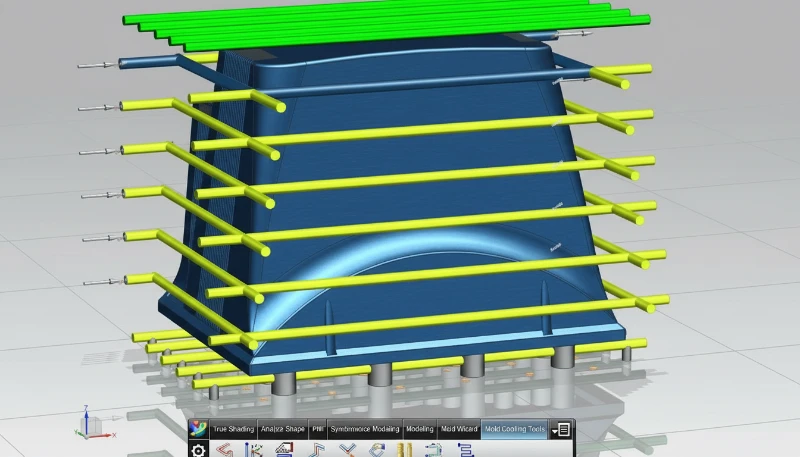
La conception du refroidissement du moule est régie par cinq principes fondamentaux. Maximisez le nombre de canaux, maintenez une distance constante par rapport à la cavité, alignez le flux du réfrigérant avec le flux de matière, limitez l’écart de température entrée-sortie à 3–5 °C et assurez un écoulement turbulent dans chaque circuit. Plus de canaux avec un espacement plus petit surpassent toujours moins de canaux de grande taille.
Premièrement, maximisez le nombre de canaux et réduisez leur espacement. Des canaux plus nombreux et rapprochés uniformisent la température de surface de l’empreinte. La limite pratique est la résistance du moule : les canaux ne doivent pas être assez proches pour fragiliser l’acier qui les sépare. En règle générale, la largeur de matière entre deux canaux parallèles doit au moins égaler leur diamètre.
Cinq règles pour une disposition efficace du refroidissement
Deuxièmement, maintenez une distance constante entre le canal et la surface de l’empreinte — idéalement 12–15mm. À moins de 10mm, des points froids apparaissent et l’acier risque de se fissurer sous la pression d’injection ; au-delà de 20mm, l’efficacité du refroidissement diminue fortement.
Troisièmement, alignez le sens d’écoulement du fluide de refroidissement sur celui de la matière. L’entrée du fluide doit se trouver près du point d’injection, là où le plastique est le plus chaud. Cette approche dite « eau-matière parallèle » fait d’abord entrer l’eau la plus froide en contact avec le plastique le plus chaud, puis confie les zones plus froides de la pièce à un fluide progressivement plus chaud. Il en résulte une solidification globale plus uniforme et un gauchissement nettement réduit.
Quatrièmement, maintenez l’écart de température entre l’entrée et la sortie du fluide de refroidissement en dessous de 3 à 5 °C. Un écart plus important signifie que la surface du moule près de la sortie est nettement plus chaude que près de l’entrée, ce qui crée précisément le type de refroidissement inégal responsable du gauchissement et des variations dimensionnelles.
Cinquièmement, imposez un écoulement turbulent dans chaque circuit — pas seulement un débit suffisant, mais un nombre de Reynolds supérieur à 4000. L’écoulement laminaire (Reynolds < 2300) crée le long de la paroi une couche limite lente qui agit comme isolant thermique. En pratique, il faut une vitesse minimale du fluide de 0.5–1.0 m/s dans un canal de 10mm, donc une pompe fournissant 3–5 litres par minute et par circuit. De nombreux moules semblent bien alimentés, mais restent en régime transitoire (Reynolds 2300–4000), perdant 15–20% de la capacité de refroidissement potentielle.
Ces quatre principes s’appliquent quel que soit le type de canal choisi. Même un moule à canaux percés droits fonctionne bien lorsque les canaux sont correctement espacés, placés à la bonne distance de la cavité et parcourus par un fluide de refroidissement turbulent. Le type de canal détermine le plafond des performances de refroidissement — les principes de conception déterminent à quel point vous vous en approchez.
Chez ZetarMold, nos 8 ingénieurs seniors examinent chaque circuit de refroidissement lors de la DFM avant l’usinage de l’acier. Sur un récent programme d’intérieur automobile, la détection en DFM d’une distance de 20mm entre le canal et l’empreinte (trop grande) a permis d’économiser environ 4 secondes par cycle — soit plus de $120,000 sur la durée de production de l’outillage.
Quand passer du perçage droit au refroidissement conforme
Passez au refroidissement conforme lorsque votre pièce a une géométrie complexe — variation d’épaisseur supérieure à 3:1, caractéristiques profondes au-delà de 50 mm, parois fines inférieures à 1,5 mm, ou volume annuel dépassant 200 000 cycles. La décision se résume à la géométrie de la pièce, au volume de production et au coût du temps de cycle au taux horaire spécifique de votre machine.
Passez à cette solution lorsque la pièce présente une variation d’épaisseur de paroi supérieure à 3:1, des formes profondes (>50mm) inaccessibles au perçage droit, des parois minces (<1.5mm) exigeant un refroidissement rapide et uniforme, ou un volume annuel supérieur à 200K cycles. Dans chacun de ces cas, les gains de temps de cycle du refroidissement conforme amortissent généralement le surcoût d’outillage dès la première série de production.
Conservez des canaux percés droits lorsque la pièce est simple et plate, que l’épaisseur de paroi est uniforme et que le volume de production est inférieur à 100K injections. Ajouter un refroidissement conforme à un moule simple relève de la surconception — le gain de temps de cycle peut n’être que de 5–8%, ce qui ne justifie pas le surcoût de 2–4× de l’insert.
Les déflecteurs et les spirales constituent une solution intermédiaire. Si votre pièce est moyennement complexe mais que le coût du refroidissement conforme ne se justifie pas, des canaux à déflecteurs sur les noyaux profonds associés à des canaux en spirale sur les éléments cylindriques procureront 60–70% du gain de temps de cycle pour 20–30% du surcoût. Cette approche hybride est celle que nous recommandons pour la plupart des programmes automobiles et d’électronique grand public de moyenne série.
Le calcul du seuil de rentabilité est simple : (surcoût de l’outillage) ÷ (économie de temps de cycle par pièce × taux machine). Si le résultat est inférieur à votre volume de production prévu, le refroidissement conforme est rentabilisé. Dans le cas contraire, conservez des canaux conventionnels et investissez l’économie ailleurs.
"Les canaux de refroidissement conformes peuvent réduire le temps de cycle de 20–35% sur les pièces à géométrie complexe."True
En maintenant une distance uniforme par rapport à la surface de l’empreinte, les canaux conformes éliminent les points chauds qui limitent le moment de l’éjection dans les moules percés conventionnellement. Des cas documentés montrent une réduction de 28% du temps de cycle sur des boîtiers en ABS à paroi de 1.2mm.
"Le refroidissement à l’huile est toujours meilleur que celui à l’eau, car l’huile peut atteindre des températures supérieures."False
La conductivité thermique de l’huile est environ 4× inférieure à celle de l’eau (0.15 contre 0.6 W/(m·K)), ce qui implique une extraction de chaleur plus lente à débit égal. L’huile n’est supérieure que lorsque la résine exige une température de moule supérieure à 90°C ; pour la plupart des applications, l’eau refroidit plus vite, à moindre coût et de manière plus sûre.
Comprendre ces faits vous aide à poser les bonnes questions lors de l’évaluation des devis de moules des fournisseurs. De nombreux moulistes choisissent par défaut un refroidissement par canaux percés droits parce qu’il s’agit de l’option la moins coûteuse, et non parce qu’elle convient le mieux à la géométrie de votre pièce. Poser des questions précises sur le type de canal de refroidissement, la distance entre le canal et l’empreinte et le nombre de Reynolds pendant la phase DFM distingue un outil bien conçu d’un outil qui vous coûtera de l’argent en rebuts et en perte de productivité pendant toute sa durée de production. Si votre fournisseur ne peut pas expliquer sa stratégie de refroidissement à partir de ces principes fondamentaux, c’est un signal d’alerte à examiner avant de vous engager dans l’outillage.
"L’entrée du fluide de refroidissement doit être placée près de la zone du point d’injection pour optimiser l’uniformité du refroidissement."True
Placer l’eau la plus froide près du seuil — là où le plastique est le plus chaud — aligne le flux du fluide de refroidissement sur celui de la matière. Cette approche « eau-matière en parallèle » réduit de 40–60% le gradient de température dans la pièce, évite le gauchissement dû au refroidissement différentiel et permet une éjection plus précoce.
"Les circuits de refroidissement forés en ligne droite sont aussi efficaces pour toutes les géométries de pièces."False
Les canaux percés droits ne peuvent pas suivre les formes courbes ou profondes de l’empreinte, ce qui laisse des points chauds dans les zones comme les nervures hautes, les poches profondes et les surfaces courbes. Pour les pièces dont la variation d’épaisseur dépasse 3:1 ou comportant des formes profondes de plus de 50mm, des déflecteurs ou des canaux conformes sont nécessaires pour obtenir une uniformité de refroidissement acceptable.
Questions fréquemment posées
Questions fréquemment posées
Quel est le système de refroidissement le plus couramment utilisé dans les moules d’injection ?
Les canaux de refroidissement à eau percés en ligne droite sont le système le plus courant, utilisé dans plus de 80% des moules de production dans le monde. Ils constituent l’option la moins coûteuse et conviennent bien aux pièces de géométrie relativement simple et plane, pour lesquelles une distance uniforme entre le canal et l’empreinte peut être maintenue dans tout le moule. Pour les pièces plus complexes, les outilleurs complètent généralement les circuits percés droits par des lames ou des inserts conformes dans les zones critiques. L’eau à 10–80°C est le fluide de refroidissement standard ; elle circule grâce à une unité de régulation thermique (TCU) qui maintient la température cible du moule à ±1°C.
Combien le refroidissement conforme ajoute-t-il au coût du moule ?
Le refroidissement conforme coûte généralement 2–4× plus cher pour l’insert refroidi que le perçage conventionnel, en raison de l’impression 3D métal par fusion laser sélective nécessaire à la fabrication des canaux. Un insert de production standard coûtant $3,000–$5,000 avec perçage conventionnel peut coûter $8,000–$15,000 en version conforme. Toutefois, pour les outils à grand volume dépassant 500K injections, les économies de cycle de 20–35% amortissent généralement ce surcoût lors des premières séries. La période exacte dépend du taux horaire machine et de la géométrie de la pièce.
À quelle température doit être l’eau de refroidissement ?
La température de l’eau de refroidissement dépend du matériau moulé et est spécifiée par le fabricant de la résine. Les plages courantes sont de 10–30°C pour les résines de commodité comme le PP et le PE (cristallisation rapide), de 40–60°C pour les résines amorphes comme l’ABS et le PC, et de 60–80°C pour les résines techniques comme le PA66 et le PBT, qui exigent des moules plus chauds pour une cristallisation correcte. La fiche technique du fabricant du thermoplastique indique toujours la plage de température de moule recommandée. Une température trop basse peut provoquer des marques d’écoulement et de fortes contraintes résiduelles ; une température trop élevée allonge inutilement le temps de cycle.
Pourquoi l’eau est-elle meilleure que l’air pour le refroidissement des moules ?
La conductivité thermique de l’eau est environ 25× supérieure à celle de l’air (0.6 contre 0.025 W/(m·K)), ce qui signifie qu’à débit égal elle extrait bien plus efficacement la chaleur du moule. L’eau possède également une capacité thermique massique beaucoup plus élevée, ce qui lui permet d’absorber davantage d’énergie thermique avant que sa température n’augmente sensiblement. De plus, l’eau permet une régulation précise de la température au moyen de thermorégulateurs (précision de ±1°C), tandis que le refroidissement par air ne permet presque aucune régulation thermique. L’air n’est utilisé qu’en complément dans des situations très particulières — moules prototypes, refroidissement localisé de points chauds ou lorsque le risque de fuite d’eau est inacceptable.
Comment un refroidissement insuffisant provoque-t-il la déformation des pièces moulées par injection ?
Un refroidissement irrégulier crée des gradients de température dans la pièce : une zone se solidifie et se rétracte tandis qu’une autre reste chaude et se contracte à un rythme différent. Ce retrait différentiel génère des contraintes internes qui déforment la pièce après son éjection et son refroidissement à température ambiante. Un écart de seulement 10°C sur la surface de l’empreinte peut provoquer une dérive dimensionnelle de 0.1–0.3mm sur une cote de 100mm. L’effet est maximal sur les pièces à épaisseur de paroi variable, à sections longues et minces ou à géométrie asymétrique, précisément celles dont la conception des canaux de refroidissement doit être la plus soignée.
Quelle est la distance idéale entre les canaux de refroidissement et la surface de la cavité ?
La distance recommandée entre la paroi du canal de refroidissement et la surface de l’empreinte est de 12 à 15 mm, soit environ 1,5 à 2,0 fois le diamètre du canal pour des perçages standard de 8 à 10 mm. Cette plage concilie l’efficacité de l’extraction thermique et l’intégrité structurelle du moule. Une distance inférieure à 10 mm crée des points froids localisés à la surface de la pièce et risque de fissurer l’acier sous les fortes pressions d’injection, généralement de 80 à 140 MPa. Au-delà de 20 mm, l’efficacité du refroidissement diminue fortement : l’acier agit comme un isolant thermique et il faut faire circuler davantage de liquide de refroidissement pour un rendement décroissant sur l’extraction réelle de la chaleur de l’empreinte.
Pouvez-vous combiner différents types de canaux de refroidissement dans un seul moule ?
Oui, la combinaison de différents types de canaux est une pratique standard dans les moules de production et constitue souvent l’approche la plus rentable. Une configuration courante utilise des circuits percés droits pour les zones planes de la pièce, des lames dans les noyaux profonds et les nervures hautes, des canaux hélicoïdaux autour des caractéristiques cylindriques et des inserts conformes uniquement dans les zones les plus complexes ou thermiquement critiques. Cette stratégie hybride équilibre coût et performance sans surdimensionner l’ensemble de l’outillage. Chez ZetarMold, nous spécifions cette approche mixte sur environ 60% des moules de production — elle procure 70–80% des performances thermiques d’un refroidissement entièrement conforme pour 30–40% du surcoût.
temps de cycle : Le temps de cycle est la durée totale d’un cycle complet de moulage par injection, mesurée en secondes, depuis la fermeture du moule jusqu’à l’éjection de la pièce. ↩
refroidissement conforme : Le refroidissement conforme désigne des circuits qui suivent le contour de la surface de l’empreinte, généralement fabriqués par impression 3D métallique ou fabrication additive. ↩
conductivité thermique : La conductivité thermique est une propriété du matériau mesurée en W/(m·K), qui quantifie la vitesse de transfert de chaleur à travers une substance. ↩