

- Impacto del DFM en los costos de moldeo por inyección
- Simple single-cavity molds for small parts cost $2,000–$15,000; complex multi-cavity molds for precision parts range from $30,000–$100,000+.
- Per-part production costs typically fall from $5–$20 at 1,000 units to $0.10–$2.00 at 100,000+ units as tooling cost is amortized.
- DFM review before mold cutting reduces tooling cost by 15–30% and cuts cycle time by 10–25% on average.
- ZetarMold runs 47 injection molding machines across multiple shift patterns; selecting the right machine tonnage reduces energy cost by 10–20% per part.
What Are the Main Cost Components of Injection Molding?
Injection molding cost breaks down into three components: tooling ($5,000–$100,000+), material ($1–$5/kg), and per-part production cost ($0.01–$10+) — each behaves differently at different volumes. Tooling cost1 is a one-time investment of $2,000–$100,000+ depending on mold complexity; material cost is a recurring per-part expense equal to part weight × resin price per kg; and processing cost includes machine time, energy, labor, and overhead, typically expressed as machine hourly rate × cycle time2. Understanding which cost driver dominates your production scenario is the key to accurate cost estimation.
At 1,000 parts, tooling cost per unit may equal $10–$100, making it the dominant cost. At 100,000 parts, the same tooling cost per unit drops to $0.01–$1.00, and per-part material and processing costs—typically $0.10–$2.00 combined—become dominant. This crossover point is critical for make-vs-buy decisions: for runs under 2,000 parts, moldeo por inyección de bajo volumen with simplified tooling or prototype molds often delivers better total cost than full production molds.

How Much Does Injection Mold Tooling Cost and What Drives It?
Mold tooling cost is determined by five factors: part complexity (number of undercuts, side actions, lifters), part size, number of cavities, steel grade, and surface finish requirement. A simple single-cavity mold for a 50×30 mm flat part in P20 steel costs $2,000–$6,000. A 4-cavity mold for a 120×80 mm housing with two side actions in H13 steel costs $20,000–$45,000. A 16-cavity hot-runner mold for small precision components in S136 stainless costs $50,000–$100,000+.
The number of cavities is the most misunderstood tooling cost driver. A 4-cavity mold does NOT cost 4× a single-cavity mold—it typically costs 1.5–2.5× because machining time scales sublinearly and many costs (design, MUD frames, hot runner3 manifold) are shared. However, cavity number directly impacts per-part cost: a 4-cavity mold running the same cycle time as a single-cavity mold produces 4 parts per cycle, effectively cutting machine time cost per part by 75%. The optimal cavity count minimizes total cost at a given annual volume.
| Tipo de molde | Cavities | Tamaño de la pieza | Grado de acero | Estimated Cost (USD) |
|---|---|---|---|---|
| Simple prototype mold | 1 | Small (<50mm) | Aluminum or P20 | $2,000–$6,000 |
| Production single-cavity | 1 | Medium (50–150mm) | P20 / 718H | $6,000–$18,000 |
| Multi-cavity production | 4–8 | Small–Medium | P20 / H13 | $18,000–$50,000 |
| High-cavitation hot runner | 16–32 | Small precision | S136 / NAK80 | $50,000–$120,000 |
| Large complex mold | 1–2 | Large (>300mm) | H13 / S7 | $30,000–$80,000 |
How Do Material and Resin Costs Affect Injection Molding Price?
Material cost per part = part weight (g) × runner weight (g) / (1 − scrap rate) × resin price ($/kg) / 1,000. For a 15g PP part with 3g runner at $1.20/kg resin and 2% scrap: (15 + 3) / 0.98 × 1.20 / 1,000 = $0.022 per part. At $8/kg for PC or $12/kg for PEEK, the same calculation yields $0.147 or $0.220 per part. Resin selection is therefore a major cost lever: switching from PC to ABS for a non-critical housing can save $0.05–$0.15 per part, or $5,000–$15,000 per 100,000-unit run.
Runner system design directly affects material cost in cold-runner tools. A cold runner of 50g per shot for a 20g part adds 150% material weight overhead. Converting to a hot-runner system eliminates runner waste but adds $3,000–$15,000 to tooling cost. The break-even point is typically 50,000–200,000 parts depending on resin price and runner weight. For expensive engineering resins above $5/kg, hot-runner ROI is achieved within 30,000–50,000 parts. In our factory, we default to hot-runner systems for all multi-cavity molds on materials costing above $3/kg.
What Processing Parameters Most Affect Per-Part Production Cost?
Estimación de Costos de Moldeo por Inyección: Guía Completa 2026 diseño de moldes de inyección with additive manufacturing inserts, are the primary engineering tool for cooling time reduction.
Machine selection is the second key lever. Running a 150-ton press where a 60-ton press would suffice adds 30–50% to machine hourly rate unnecessarily. Press size is determined by clamp force requirement: F (tons) = projected area (cm²) × cavity pressure (MPa) / 100. For a 200 cm² part at 30 MPa average cavity pressure, required clamp force = 60 tons. Our factory matches each job to the smallest appropriate machine among our 47 presses, reducing energy cost per part by an average of 15% compared to oversized machine selection.
Are Processing Cost Assumptions About Machine Size and Cycle Time Correct?
“Reducing cycle time by 20% on a high-volume run of 1 million parts saves tens of thousands of dollars in production cost.”Verdadero
At a machine rate of $80/hour, a 35-second cycle processes 102 parts/hour. Reducing to 28 seconds processes 128 parts/hour—a 25.5% output increase. For 1 million parts, this saves 1,940 machine-hours × $80 = $155,200 in processing cost alone. Cycle time reduction through better cooling, process optimization, and part design changes is the highest-ROI engineering activity in high-volume injection molding programs.
“Using the largest available injection molding machine always produces better parts and lower scrap.”Falso
Oversized machines do not improve part quality and significantly increase per-part cost through higher energy consumption, longer heating and cooling times, and higher machine rates. Press selection should match clamp force requirements within 20% of machine capacity. Running a 500-ton machine for a job requiring 80 tons wastes 80–90% of energy and adds $30–$60/hour in unnecessary machine costs.
How Does Design for Manufacturability Reduce Injection Molding Cost?
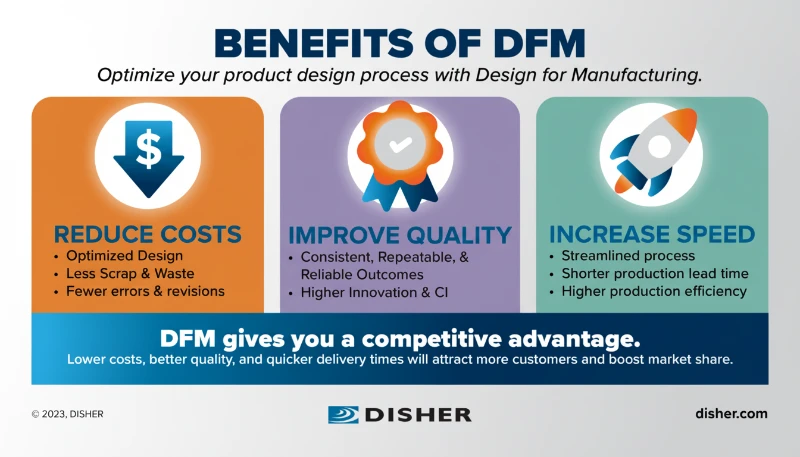
Design for manufacturability (DFM) review before mold cutting is the single most cost-effective activity in the injection molding development process. Common DFM findings that reduce cost: (1) Eliminating undercuts requiring side actions saves $3,000–$8,000 per side action in tooling cost; (2) Achieving uniform wall thickness (target: ±20% variation) reduces cycle time by 15–25% and eliminates sink marks; (3) Adding proper draft angles (1–3° per side) eliminates ejection damage and polish-out cost; (4) Relocating weld lines away from stress concentration zones reduces functional scrap by 30–60%.
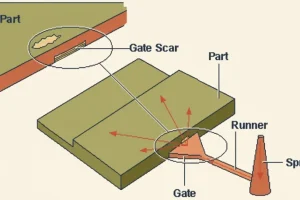
In our experience across thousands of DFM reviews, the most common costly design features are: (1) uniform thick walls (>4mm) where coring out to 2–3mm shell construction saves 25–40% of material cost; (2) zero-draft vertical walls requiring mold polishing to Ra 0.1 μm to enable ejection—adding $2,000–$5,000 to tooling cost; and (3) cosmetic requirements specifying class-A gloss finish (SPI-A1/A2) on all surfaces, requiring texturing or EDM on non-critical faces unnecessarily. Gate location review also prevents weld lines, blush marks, and gate vestige issues that drive field returns and rework cost.

How Do Volume and Amortization Affect Injection Molding Cost Per Part?
Total cost per part = (tooling cost / total volume) + material cost per part + processing cost per part. For a $20,000 mold, $0.15 material cost, and $0.25 processing cost: at 10,000 units: $2.40/part; at 50,000 units: $0.80/part; at 100,000 units: $0.60/part; at 500,000 units: $0.44/part. The tooling cost contribution drops from $2.00 to $0.04 per part as volume increases from 10,000 to 500,000—a 50× reduction in tooling cost per unit.
For multi-year programs, mold life expectancy directly affects amortized tooling cost. A P20 steel mold lasts 300,000–500,000 cycles; an H13 hardened mold lasts 1,000,000–2,000,000 cycles. If annual volume is 200,000 parts and the program runs 5 years (1,000,000 total), a P20 mold requires replacement after year 2–3 (adding $15,000–$20,000 mid-program), while an H13 mold completes the program without replacement. For programs above 500,000 total parts, specifying H13 steel instead of P20 saves money over program life despite higher initial tooling cost.
When Does Upgrading to Harder Mold Steel Pay Off?
“Specifying harder mold steel (H13 vs P20) saves money on high-volume programs despite higher initial tooling cost.”Verdadero
H13 hardened tool steel costs 15–25% more than P20 to machine and heat treat, but extends mold life from 300,000–500,000 cycles (P20) to 1,000,000–2,000,000 cycles (H13). For a program requiring 1,000,000 parts, P20 requires 2–3 mold replacements at $15,000–$20,000 each, adding $30,000–$60,000 to total program tooling cost. H13 completes the run with no replacement. The additional steel cost of $3,000–$8,000 delivers net savings of $22,000–$52,000 over the program.
“The lowest tooling quote always results in the lowest total program cost for injection molding.”Falso
Low tooling quotes often reflect shortcuts: lower steel grade, fewer hardened inserts, simplified cooling circuits, or reduced mold trial cycles. These savings are typically recovered—and exceeded—through higher scrap rates, shorter mold life requiring early replacement, slower cycle times due to poor cooling, and dimensional variability requiring corrective actions. A mold quote 20% cheaper that produces 5% higher scrap rate costs $50,000 more per million parts at $1/part value. Total program cost analysis must include scrap, rework, mold maintenance, and replacement cost.
Secondary operations add 20–80% to part cost in many programs: pad printing and hot stamping add $0.03–$0.15 per part; ultrasonic welding of assemblies adds $0.05–$0.30 per part; chrome or decorative plating adds $0.50–$3.00 per part. Packaging and logistics costs for injection-molded parts average 5–15% of part cost for domestic supply and 10–25% for offshore supply chains. Quality control—inspection fixtures, CMM time, incoming inspection—adds 2–8% to total program cost. These secondary costs are frequently underestimated in initial cost models.
Mold maintenance and repair is another underestimated cost. A well-maintained mold in our factory requires cleaning every 50,000–100,000 shots, minor polishing every 200,000 shots, and core/cavity insert replacement every 500,000–1,000,000 shots. Annual maintenance budget should be 5–10% of initial tooling cost for P20 molds running 24/7, or 2–5% for H13 molds on single-shift schedules. Ignoring maintenance leads to progressive quality degradation and eventually catastrophic mold failure—repairs for damaged hardened molds typically cost $5,000–$25,000. We track all mold maintenance costs in our ERP system and pass this data to customers in quarterly tooling reports.

How Can You Reduce Injection Molding Costs Without Sacrificing Quality?
Seven proven cost reduction strategies for injection molding programs: (1) DFM review before mold cutting—15–30% tooling cost reduction, 10–25% cycle time reduction; (2) Hot-runner conversion for high-volume runs above 50,000 parts—eliminates runner material waste and reduces cycle time 5–15%; (3) Family molds for related components—one mold producing 2–4 parts simultaneously reduces per-part tooling cost by 30–60%; (4) Análisis del flujo de moldes to optimize gate location and predict warpage—prevents costly tooling modifications after steel is cut; (5) Insert molding to consolidate metal and plastic assembly into one step.
Additional strategies: (6) Material substitution—replacing PC with ASA for UV-exposed outdoor parts saves $3–$6/kg with equivalent UV resistance; replacing POM with glass-filled nylon for gear applications saves $1–$3/kg with similar wear properties; (7) Production scheduling optimization—running high-volume jobs on multi-shift or lights-out schedules reduces effective machine rate by 15–25%. In our factory, we also perform regular thermoplastic material benchmarking to identify lower-cost equivalent resins for existing programs without compromising specification compliance.
How Does Sourcing Consolidation and Scheduling Reduce Program Cost?
Sourcing consolidation also reduces effective cost: combining multiple injection-molded part numbers from the same program with one supplier enables shared tooling setups, eliminates duplicate incoming inspection, and unlocks volume discounts of 5–15% on material purchases. In our factory, customers with 10+ active part numbers receive dedicated production scheduling priority and a quarterly cost review.
In these reviews, we proactively identify optimization opportunities across the customer’s full product portfolio. This collaborative approach has delivered average cost reductions of 8–12% per year for our longest-tenured customers.
Annual cost benchmarking against market rates for resins and machine time ensures program costs remain competitive as input prices fluctuate. We provide customers with a live cost model spreadsheet that updates automatically when resin prices change, giving full transparency into per-part cost composition and enabling rapid DFM decisions when design revisions arise.

Frequently Asked Questions About Injection Molding Cost?
¿Cuánto cuesta el moldeo por inyección para una pieza simple en bajo volumen?
For a simple part under 100 mm with no undercuts and basic cosmetic requirements, total cost at 1,000 units typically ranges from $3–$10 per part. This breaks down as: tooling $3,000–$8,000 (amortized to $3–$8/part at 1,000 units), material $0.05–$0.30/part, and processing $0.20–$0.60/part. At 10,000 units, the same part typically costs $0.80–$2.50/part as tooling is amortized further. These estimates assume domestic molding at $70–$100/hour machine rates; offshore molding at $20–$40/hour can reduce processing cost by 40–60%, though tooling quality and lead time vary.
¿Cuál es el factor más costoso en el moldeo por inyección?
At low production volumes (under 10,000 parts), tooling cost is almost always the most expensive factor, often representing 60–90% of total cost per part. At medium volumes (10,000–100,000 parts), tooling and processing become roughly equal. At high volumes (above 100,000 parts), material cost and processing cost dominate, with tooling contributing less than 5% of per-part cost. For parts made from expensive engineering resins—PEEK at $80–$150/kg, LCP at $30–$60/kg, or fluoropolymers at $50–$200/kg—material cost can dominate even at medium volumes. Engineering thermoplastics like PEEK and LCP often make material the dominant cost even at medium volumes because their resin prices of $80–$200/kg dwarf processing costs.
¿Cómo puedo estimar el costo de moldeo por inyección antes de obtener un presupuesto?
A reasonable cost estimate can be built from four inputs: (1) Part weight in grams, from 3D model volume × material density; (2) Resin price per kg from commodity or engineering grade databases; (3) Estimated cycle time from part wall thickness (cooling time ≈ wall thickness² in seconds for standard thermoplastics); (4) Machine hourly rate from regional benchmarks ($40–$80/hour for Asia, $70–$130/hour for North America). Total per-part cost = (part weight + runner weight) × resin price/1000 + (cycle time/3600) × machine rate. Add 20–30% for overhead, scrap, and secondary operations.
¿La externalización del moldeo por inyección a China siempre reduce el costo total?
Offshoring reduces machine hourly rates by 40–70% compared to North America and Europe, but the total cost picture is more complex. Tooling quality from tier-1 Chinese moldmakers is generally excellent and comparable to domestic tooling at 30–50% lower cost. However, offshore programs add: shipping and import duties (5–15% of part value), longer supply chain lead times (4–8 weeks vs 1–2 weeks domestic), quality inspection costs, and intellectual property exposure. For high-volume commodity parts, offshore total cost is typically 30–50% lower. For complex precision parts requiring rapid iteration, domestic supply often delivers better total value.
¿Cómo afecta el espesor de la pared al costo del moldeo por inyección?
Wall thickness has a direct quadratic relationship with cooling time: doubling wall thickness approximately quadruples cooling time, which dominates total cycle time. A part with 4mm walls cooling for 40 seconds costs roughly 4× more per part in machine time than a 2mm wall part cooling for 10 seconds. Material cost also scales directly with wall thickness. DFM-guided wall thickness reduction from 4mm to 2.5mm on a simple housing typically reduces per-part cost by 30–50% through simultaneous reductions in material and cycle time. The minimum functional wall thickness for structural injection-molded parts is typically 1.2–2.0mm depending on material.
¿Cuál es el punto de equilibrio entre el mecanizado y el moldeo por inyección?
The break-even point depends on part complexity and material. For simple shapes in standard engineering plastics, injection molding becomes cost-competitive at 200–500 parts when tooling costs $3,000–$8,000. For complex parts requiring 5-axis CNC machining, the break-even is typically at 100–300 parts. The formula: injection molding wins when (tooling cost + per-part IM cost × volume) < (per-part CNC cost × volume). Per-part CNC cost for plastic parts is typically $5–$50 depending on complexity; per-part IM cost at volume is $0.10–$2.00. At 500 parts and $15 CNC cost vs $0.50 IM cost: $3,000 tooling + $250 IM = $3,250 vs $7,500 CNC—injection molding wins.
-
tooling cost: Tooling cost refers to the total investment required to design and manufacture an injection mold, including steel, machining, surface finishing, and trial runs, typically ranging from $2,000 to $100,000 depending on complexity and material. ↩
-
cycle time: Cycle time is the total duration of one injection molding cycle, measured in seconds, encompassing injection, packing, cooling, and ejection phases; it is the primary driver of per-part production cost at high volumes. ↩
-
hot runner: A hot runner is a heated manifold system within an injection mold that keeps plastic melt at processing temperature, eliminating cold runner waste and reducing per-shot material consumption by 20–60%. ↩




 ES
ES  EN
EN  FR
FR  DE
DE  PT
PT  AR
AR  RU
RU  JA
JA  KO
KO  IT
IT  NL
NL  TR
TR  PL
PL 