 İçeriğe geç

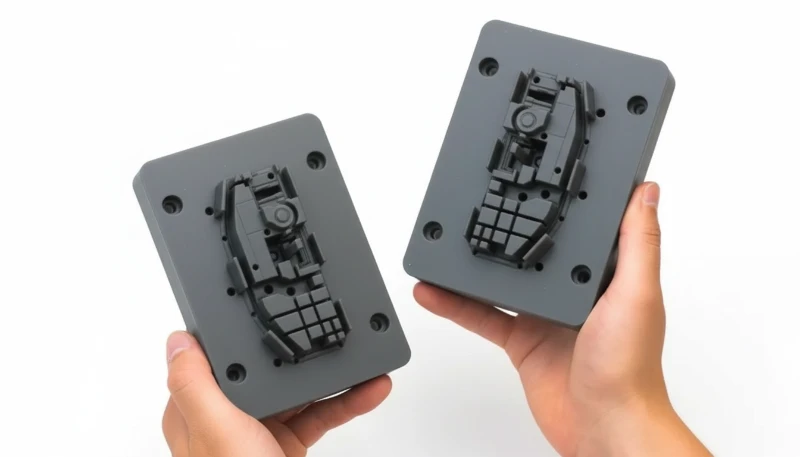
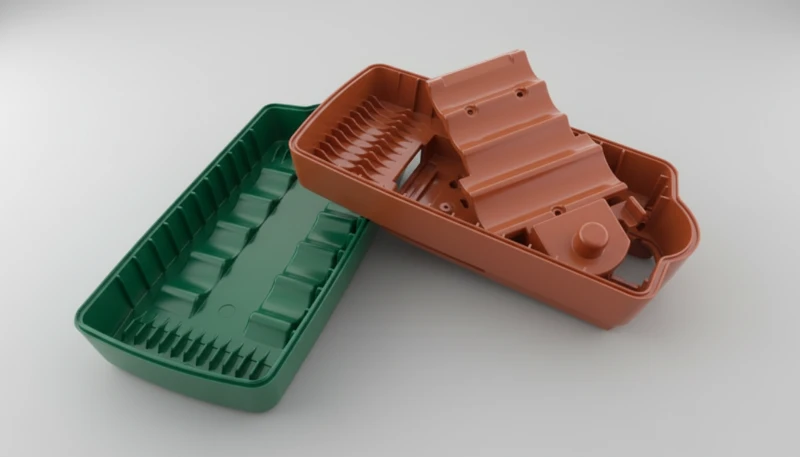
P20 ve H13 takım çeliğinden işlenmiş enjeksiyon kalıpları, hassas parça kopyalama için gerekli olan kesin boşluk yüzeylerini gösteriyor.
– Mold cost ranges from $3,000 for simple prototype tooling to over $100,000 for complex multi-cavity production molds.
– The most common molding defects—sink marks, warpage, and flash—are preventable with proper mold design and process control.
– Steel P20 and H13 are the most widely used mold materials, chosen for their balance of machinability, durability, and thermal performance.
What Exactly Is an Injection Mold and How Does It Work?
An injection mold is a precision steel or aluminum tool with machined cavities that define the shape of a plastic part. In our factory, we describe it simply: the mold is the heart of injection molding. Molten plastic—heated to 200–320°C depending on the resin—is injected under pressures of 700–1,400 bar into the closed mold. The mold’s cooling channels drop the melt temperature below the material’s solidification point in seconds, the mold opens, and ejector pins push the finished part free. The entire cycle repeats in as little as 5 seconds for thin-walled parts or up to several minutes for thick structural components.
The mold itself consists of two main halves: the cavity side (A-plate) and the core side (B-plate). These interlock at the parting line, which you can see as a faint seam on most molded parts. Inside, the runner system channels plastic from the machine nozzle through sprues and runners into the gate—the controlled entry point to the cavity. Vents machined to 0.01–0.02 mm depth allow trapped air to escape without creating flash.

What Are the Main Types of Injection Molds?
The main types of injection molds are two-plate molds, three-plate molds, hot runner molds, family molds, and multi-cavity molds—each suited to different production needs and part geometries. In our facility, we run all five types daily, and choosing the right type is often the single biggest cost decision a customer makes.
İki Plakalı Kalıplar are the industry workhorse. They split into two halves at one parting plane, making them the easiest to design, maintain, and repair. We use them for roughly 70% of our projects.
Üç Plakalı Kalıplar add a second parting plane, allowing the runner to separate from the part automatically. This gives designers freedom to gate anywhere on the part surface—ideal for complex geometries where a side gate would leave a mark in a visible area.
Sıcak Yolluk Kalıpları eliminate the cold runner entirely by keeping the plastic molten inside the mold. We’ve saved customers 15–30% in material costs on high-volume projects by switching to hot runners, though the upfront tooling cost is $8,000–$20,000 higher.
| Kalıp Tipi | Typical Cost Premium | İçin En İyisi | Runner Waste |
|---|---|---|---|
| Two-Plate Cold Runner | Baseline | General production | 5–30% by weight |
| Three-Plate Cold Runner | +10–20% | Complex gate positioning | 5–30% by weight |
| Sıcak Koşucu | +30–80% | High-volume, no runner waste | Near zero |
| Multi-Cavity (8–32 cavities) | +50–200% | Very high-volume, same part | Varies |
| Family Mold | +20–40% | Multiple different parts in one mold | Varies |
“A more expensive mold always produces better parts.”Yanlış
Mold cost reflects complexity and cavity count, not necessarily part quality. A simple $5,000 single-cavity mold with excellent steel and polish will outperform a poorly designed $50,000 multi-cavity tool every time.
“Mold quality depends on design precision and steel selection, not price alone.”Doğru
The key quality factors are proper venting, balanced cooling channels, correct draft angles, and appropriate steel hardness for the production volume. These design decisions matter far more than total cost.
What Materials Are Used to Make Injection Molds?
Injection molds are made primarily from tool steels—most commonly P20, H13, S136, and NAK80—selected based on required production volume, plastic material being run, and surface finish requirements. In our experience, choosing the wrong steel grade is one of the most common and costly mistakes in mold procurement.
P20 (Pre-hardened steel, 28–32 HRC) is the most widely used mold base material worldwide. It machines easily, holds a good polish to SPI B-2 standard, and handles up to 500,000 shots with most commodity plastics like ABS, PP, and PE. We recommend P20 for most production molds in the 50,000–500,000 shot range.
H13 (Hot work tool steel, 44–48 HRC after heat treatment) excels with abrasive or high-temperature resins. When customers run glass-filled nylon or PC/ABS at over 300°C, we specify H13 core and cavity inserts. It can deliver 1–2 million shots with proper maintenance.
S136 (Stainless tool steel) is our standard specification for medical, food-contact, and optical applications. Its corrosion resistance prevents rust from PVC outgassing and maintains mirror-polish finishes (SPI A-1 to A-2) over millions of cycles.
For prototype molds needing just 1,000–10,000 parts, we often use 7075 aluminum—it machines 3–5× faster than steel, cutting prototype lead time from 4 weeks to 1–2 weeks at 40–60% lower cost.
How Is Mold Cost Calculated and What Drives the Price?
Fabrikamızda, müşteri memnuniyetsizliklerinin çoğunun—maliyet aşımları, kalite sorunları, gecikmiş teslimatlar—tasarım aşamasında alınan kararlardan kaynaklandığını, üretim hattından değil, öğrendik. Doğru duvar kalınlığı, eğim açıları ve giriş konumuyla enjeksiyon kalıplama için tasarlanmış bir parça, orta maliyetli bir kalıpta bile mükemmel sonuçlar üretecektir. Kötü tasarlanmış bir parça ise en pahalı kalıpta bile sorun yaşayacaktır.
The biggest cost driver is machining time. CNC machining complex 3D surfaces, EDM burning fine details, and hand-polishing mirror finishes can each take dozens of hours. A mold for a simple flat cover might take 80 machining hours total; a complex automotive connector with sliders and lifters might take 400+ hours.
The second major factor is cavity count. A 16-cavity mold costs roughly 3–4× more than a single-cavity mold (not 16×, because the mold base, cooling, and ejection systems are shared). For parts needing 1 million+ units per year, multi-cavity tooling quickly pays for itself through lower per-piece cycle costs.
Tolerances and surface finish also drive cost significantly. A mold held to ±0.05 mm costs far more than one to ±0.1 mm—not because the target is harder, but because inspection, fitting, and hand-work time multiplies. Mirror-finish cavities (SPI A-1) require 20–40 hours of polishing per cavity by experienced craftsmen.

What Are the Most Common Injection Molding Defects and How Are They Fixed?
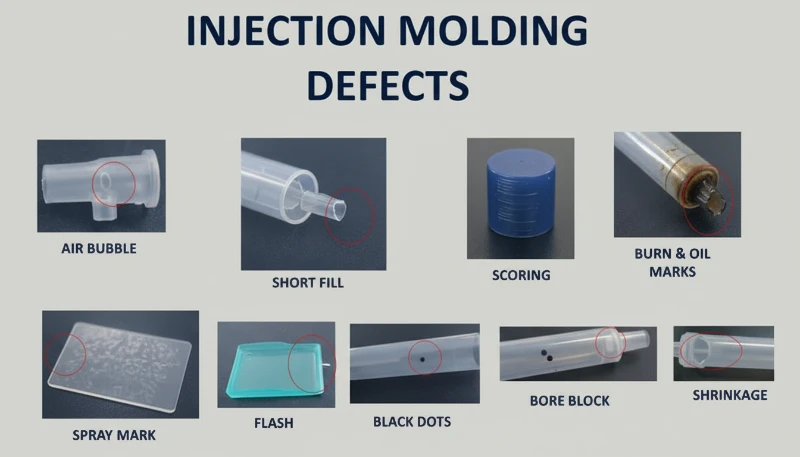
The most common injection molding defects are sink marks, warpage, short shots, flash, and weld lines—all of which can typically be resolved by adjusting process parameters, modifying the mold, or redesigning the part. In our factory, we’ve found that over 80% of defects originate from process settings rather than mold design flaws, which is good news because process fixes are faster and cheaper than tooling modifications.
Lavabo İşaretleri appear as surface depressions over thick sections. The root cause is excessive wall thickness or insufficient shrinkage compensation1 in the mold design. We fix most sink mark issues by increasing holding pressure (typically 50–80% of injection pressure) and extending hold time by 0.5–2 seconds.
Çarpıklık results from uneven cooling, asymmetric wall thickness, or mismatched melt temperature2 across the part. Balanced cooling channel design is the permanent fix; in the short term, we adjust mold temperature differentially—running the concave side warmer than the convex side to compensate.
Flaş is thin plastic film at the parting line, caused by excessive injection pressure, worn mold surfaces, or insufficient clamping force. We check parting line fit to 0.005 mm flatness; if the mold is in good condition, flash usually signals that injection pressure exceeds the machine’s clamping capacity.
“Increasing injection speed always fixes short shots.”Yanlış
Short shots (incomplete fills) are more often caused by insufficient venting or blocked gates than by injection speed. Blindly increasing speed can worsen burn marks and jetting without solving the fill problem.
“Diagnosing the root cause before adjusting process parameters prevents short shots effectively.”Doğru
Proper diagnosis—checking vent depth (should be 0.01–0.02 mm), gate size, melt temperature, and material moisture—identifies whether the short shot is a tooling, process, or material issue before any adjustments are made.
How Long Does an Injection Mold Last and How Should It Be Maintained?
A well-maintained injection mold typically lasts 500,000 to 1,000,000 shots for P20 steel molds, 1–2 million shots for H13 molds, and 5+ million for hardened S136 or 420SS molds. We’ve seen molds in our facility still running strong at 3 million shots—and others fail at 50,000 from poor maintenance. The difference is almost entirely the maintenance protocol.
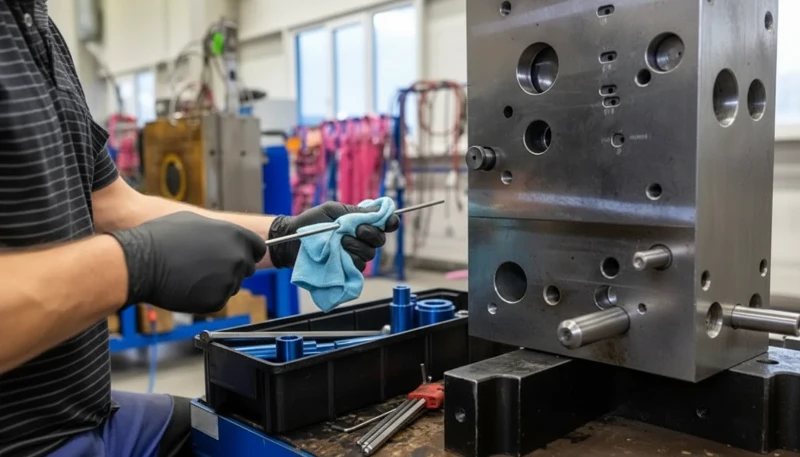
After every production run, we clean the mold with approved plastic-safe solvents, blow out cooling passages, inspect parting lines for wear or damage, apply rust-inhibiting oil to all steel surfaces, and store the mold in a climate-controlled environment. This routine takes 1–2 hours per mold but adds hundreds of thousands of shots to service life.
The most critical maintenance interval is the preventive maintenance (PM) inspection—in our factory, we schedule full PM every 50,000 shots. This includes measuring cavity dimensions against original specs (catching wear before it exceeds tolerance), checking ejector pin fit and straightness, testing cooling channel flow rates, and re-polishing gate areas that experience high shear stress.
What Is the Difference Between a Prototype Mold and a Production Mold?
A prototype mold is a lower-cost, shorter-lead-time tool designed for 1,000–50,000 shots to validate part design; a production mold is a hardened steel tool engineered for 500,000+ shots at full production tolerances. In our operation, we produce both—and we advise every customer to start with a prototype mold unless they have 100% confidence in their design.
Prototype molds (also called “soft tools”) typically use aluminum or P20 steel and are machined to ±0.1 mm tolerances. They’re produced in 2–4 weeks and cost $3,000–$15,000. Their purpose is to generate real production-representative parts—not 3D printed samples or RTV cast parts—for functional testing, regulatory submission, and assembly validation.
Production molds use hardened H13 or S136 steel, are held to ±0.01–0.05 mm tolerances, include full cooling and ejection systems optimized for cycle time, and are built for 5–20+ year service. Lead time is 4–8 weeks and cost is $8,000–$150,000+. We’ve watched customers skip the prototype phase and pay for three sets of production mold modifications—costing far more than the prototype mold they avoided.
Frequently Asked Questions About Injection Molds
Q: How long does it take to make an injection mold?
A: Standard production molds take 4–6 weeks; complex molds with sliders and lifters take 6–10 weeks. Prototype molds in aluminum can be completed in 1–3 weeks. Lead time is primarily driven by machining and polishing hours, not waiting time.
Q: What is the minimum order quantity for injection molding?
A: There is no technical minimum—you can run 1 shot. Economically, injection molding becomes cost-competitive versus 3D printing at roughly 500–1,000 parts, depending on part complexity and size. Below that, the mold amortization cost per part is too high.
Q: Can injection molds be repaired if damaged?
A: Yes, most mold damage is repairable. Common repairs include welding and re-machining worn cavity areas, replacing damaged ejector pins, re-polishing scratched surfaces, and refitting worn parting lines. In our repair shop, we restore molds that customers have given up on—successfully returning them to production-quality condition.
Q: What draft angle is required for injection molded parts?
A: A minimum of 1°–2° draft per side is required for smooth ejection from most molds. Textured surfaces require 3°–5° additional draft per 0.025 mm of texture depth. Insufficient çekim açısı3 is one of the most common design errors we see from customers submitting their first injection molding project.
Q: What is a mold flow analysis and do I need one?
A: Kalıp akış analizi4 (using software like Moldflow or Moldex3D) simulates plastic filling, packing, and cooling to predict defects before the mold is cut. We recommend it for any part thicker than 4 mm, parts with varying wall thickness, optical components, or structural parts. The $500–$2,000 analysis cost is trivial compared to a $20,000 mold modification.
Q: How many cavities should my mold have?
A: Cavity count should match your annual volume demand divided by the number of machine hours per year, factoring in cycle time. As a rule of thumb: under 100,000 parts/year → 1–2 cavities; 100,000–500,000 parts/year → 4–8 cavities; 500,000+ parts/year → 8–32 cavities. We calculate the optimal cavity count during every quoting process.
Q: What is the difference between a cold runner and hot runner system?
A: A cold runner is an unheated channel that solidifies with each shot and is either recycled or discarded; a hot runner keeps the plastic permanently molten inside the mold using electric heaters, eliminating runner waste. Hot runners cost more upfront ($8,000–$20,000 extra) but reduce material cost, cycle time, and post-processing on high-volume projects.
Özet
Injection molding remains one of the most versatile and economical manufacturing processes for plastic parts. The key to success lies in understanding the fundamentals: choosing the right mold type and steel for your volume, designing for moldability from the start (draft angles, uniform wall thickness, adequate venting), and establishing a disciplined maintenance program to protect your tooling investment.
In our factory, we’ve learned that most customer frustrations—cost overruns, quality issues, late deliveries—trace back to decisions made in the design phase, not on the production floor. A part designed for injection molding with correct wall thickness, draft angles, and gate location will produce excellent results even in a moderate-cost tool. A poorly designed part will struggle in even the most expensive mold.
Enjeksiyon Kalıp SSS: En Çok Sorulan Sorular Yanıtlandı
-
Shrinkage compensation is the practice of designing mold cavities slightly larger than the desired final part dimensions to account for the volumetric reduction that occurs as molten plastic cools and solidifies, typically 0.2–2.0% depending on the resin. ↩
-
Melt temperature is the temperature at which the plastic material is fully plasticized and ready for injection; it must be controlled within the resin manufacturer’s recommended range (typically ±10°C) to ensure consistent viscosity, fill behavior, and part quality. ↩
-
Draft angle is the taper applied to the vertical walls of a molded part perpendicular to the parting line, enabling the part to release cleanly from the mold without scuffing or sticking; insufficient draft causes ejection problems and surface damage. ↩
-
Mold flow analysis is a computer simulation technique that models the flow, cooling, and solidification of molten plastic inside a mold cavity, identifying potential defects such as weld lines, air traps, and warpage before the physical mold is manufactured. ↩





 EN
EN  ES
ES  FR
FR  DE
DE  PT
PT  AR
AR  RU
RU  JA
JA  KO
KO  IT
IT  NL
NL  TR
TR  PL
PL 