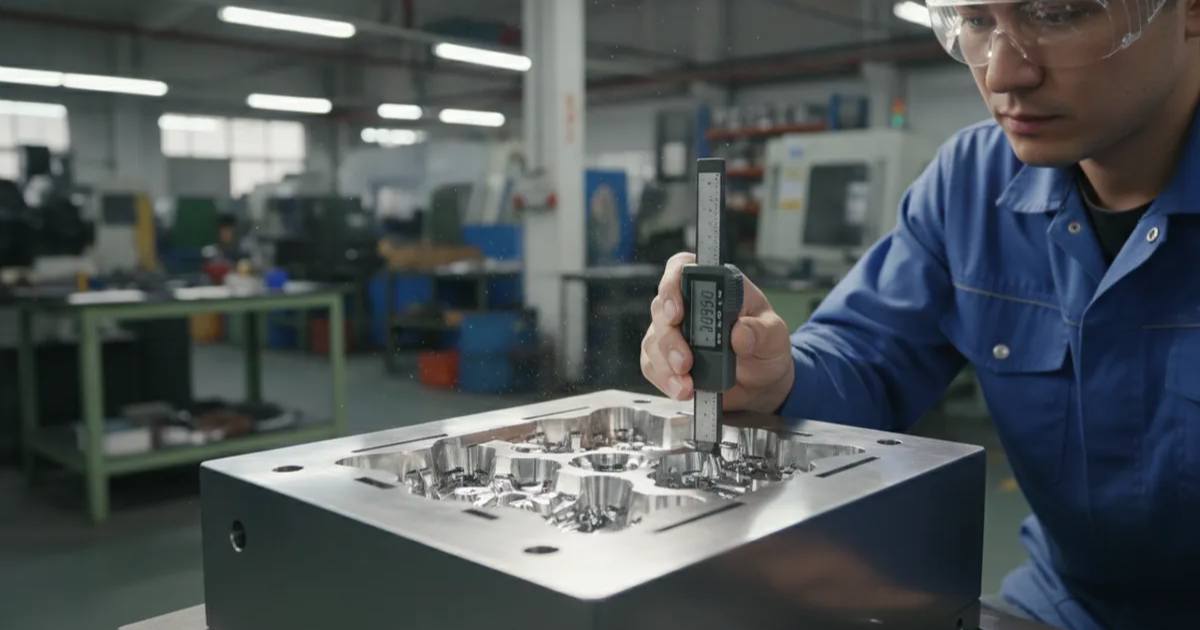
PEEK is one of the most capable thermoplastics available to a design engineer, and one of the most expensive to mold well. When a buyer sends us a PEEK drawing, the first question is rarely about the resin datasheet. It is about money: what will the part cost, what will the tool cost, and where does the budget risk sit. Those are fair questions, and they deserve engineering answers rather than a sales brochure.
This article walks through PEEK injection moulding cost the way our team discusses it on the factory floor: how resin price converts to cost per part, how tooling behaves, how machine time and process variables shape both quality and price, and what evidence you should expect before trusting any quotation. If you are newer to the molding side of sourcing, our injection molding process guide covers the fundamentals this article builds on.
- PEEK resin price dominates cost per part at low volumes; tooling amortization dominates once volumes rise.
- PEEK tooling costs more than commodity-resin tooling because of higher melt temperatures, hot molds, abrasive fillers and tighter shrinkage control.
- Machine time cost is a function of tonnage, cycle time and scrap rate, not just the hourly rate on the quote.
- Drying, packing profile and cooling discipline are process variables that protect quality and cost at the same time.
- Repeatable processes are demonstrated with control charts and capability data, never with a single good sample.
- Before requesting a quotation, fix resin grade, volumes, tolerance expectations and tooling ownership terms in writing.
What Drives the Cost of PEEK Injection Moulding?
Four levers set the price of a molded PEEK part: resin price per kilogram, tooling investment, machine hour rate multiplied by cycle time, and the annual volume that spreads the first three across every shipped part. Quality requirements push all four levers upward at once.
PEEK behaves differently from commodity materials. It softens near 340 °C and processes around 360 to 400 °C, it needs a hot mold to crystallize properly, and it punishes shortcuts in drying and packing. Those traits raise setup scrap, lengthen cycles and demand better tool steel. A supplier who quotes PEEK as if it were ABS is a supplier you should question.
Certification requirements add another layer. When a part supports a medical or otherwise regulated program, documentation, traceability and validation work become part of the cost base, and a serious molder shows you that line item instead of burying it inside the part price.
How Much Does PEEK Material Cost per Part?
The honest answer is that resin is usually the largest single cost line for volumes below a few thousand parts, and the arithmetic is simpler than buyers expect. Cost per part starts with part weight plus runner weight, adjusted for scrap, multiplied by resin price per kilogram. The surprises live in the details.
Practical check: How Much Does PEEK Material Cost per Part
| Control point | What to verify before release |
|---|---|
| Process parameters | Settings recorded for the approved sample |
| Inspection plan | Method and frequency tied to your drawing |
| Change control | Written approval before a material or tool change |
PEEK1 is sold in unfilled, glass-filled and carbon-filled grades, and the price spread between them is wide. Fillers change stiffness, wear behavior and cost simultaneously, so grade selection is an engineering decision, not a purchasing decision. Runner systems matter as much as grade: a cold runner that leaves twenty percent of every shot in the scrap bin quietly inflates material cost for the life of the program, while a hot runner trims that waste in exchange for higher tooling spend.
Drying is another real cost. Moist PEEK produces silver streaks, voids and degraded mechanical properties at melt temperature, so proper drying before molding is not optional. It takes hours in heated equipment, and a molder who skips it is not saving you money; the cost reappears as scrap and instability.
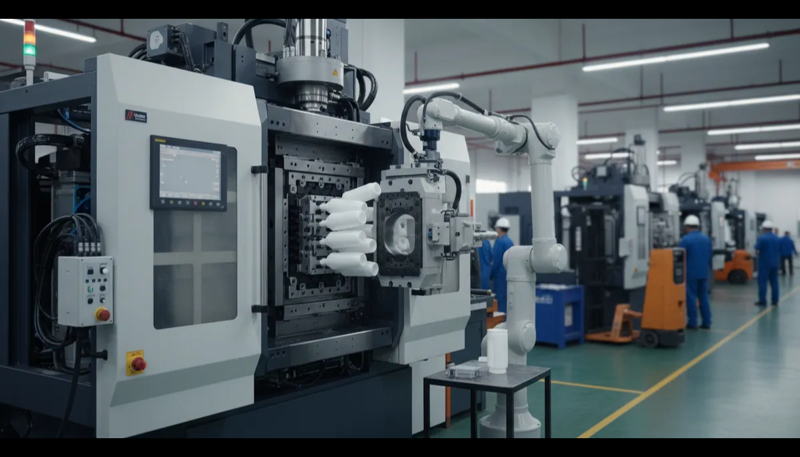
Machine fit affects material behavior too. The shot should sit comfortably within the press shot capacity2; running a five-gram part on a machine sized for hundreds of grams means long barrel dwell, degraded resin and drifting shrinkage. This is why we match PEEK work to press size deliberately instead of accepting whatever machine happens to be free.
When a datasheet property must be reproduced on real parts, ask how the specimens were molded. ASTM D3641 is a standard practice for injection-molded test specimens of thermoplastic molding and extrusion materials, and it gives both sides a common baseline for comparing resin performance.
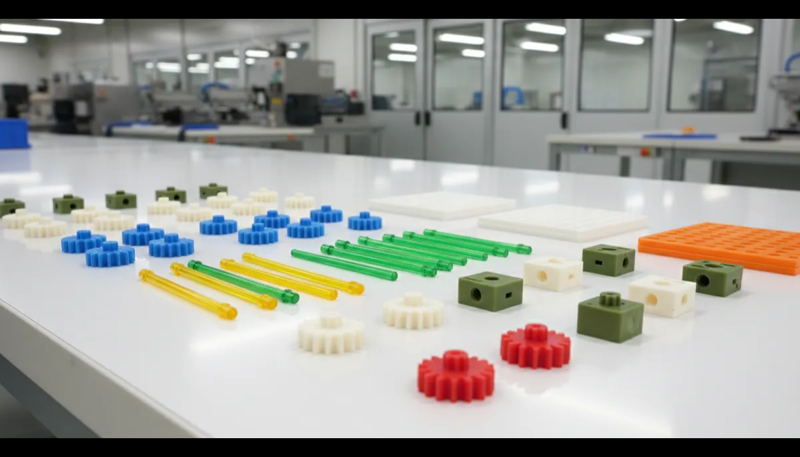
How Do Tooling Costs Behave in PEEK Projects?
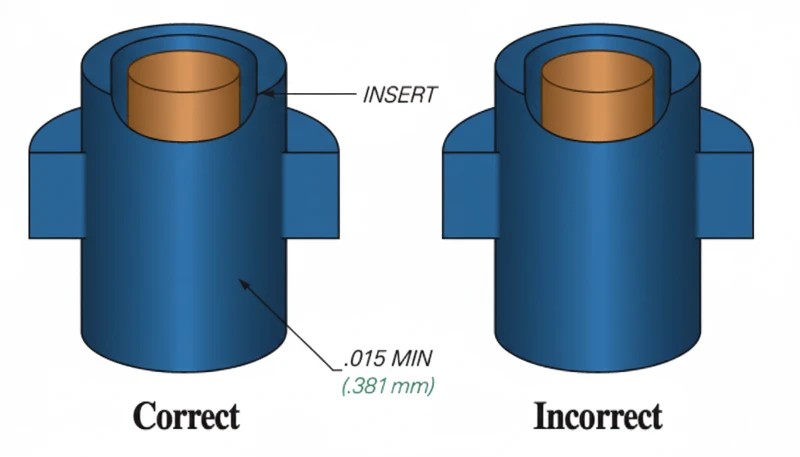
Tooling is where PEEK projects differ most from commodity projects. Higher melt temperatures, abrasive fillers and the need to control shrinkage push molders toward harder steels, better cooling design and more robust ejection. How a mold is engineered is covered in depth in our injection mold guide; here we focus on what tooling choices do to your budget.
Three patterns are worth knowing. First, harder steel costs more up front and lasts longer under abrasive filled resins; for a long-running program it is usually the cheaper path, for a short prototype run it may not be. Second, cooling design drives cycle time, and cycle time drives machine cost on every part for the life of the program; a mold that runs ten seconds slower than necessary can cost more than the steel you saved. Third, glass and carbon fillers erode gates and shut-off surfaces faster than unfilled resin, so the maintenance plan should budget for that reality.
The mold is also where ownership terms hide. Who pays for repairs, who owns the asset, and what happens if the program moves are contract questions that decide your real tooling cost. Settle them before the purchase order, not after the first repair bill.
Tooling cost per part falls as annual volume rises, as long as the mold is maintained and the program runs as planned.True
A fixed tooling investment divided across more shipped parts shrinks the per-part share, which is why volume must be stated honestly before anyone quotes.
The lowest mold quote is always the lowest total tooling cost.False
Thin steel, weak cooling and fragile ejection surface later as repairs, slower cycles and scrap, and those costs routinely exceed the money saved on the original quote.
Which Process Variables Control Quality and Cost at the Same Time?
Melt temperature, mold temperature, injection speed, packing pressure and time, and cooling time. Those five variables decide dimensional quality, crystallinity, cycle time and scrap rate simultaneously, which is why process engineering is cost engineering in molding.
Melt and mold temperature sit at the top of the list for PEEK. The resin processes around 360 to 400 °C at the nozzle, and the mold runs hot, commonly near 180 to 200 °C, so the polymer crystallizes3 into the structure the datasheet promises. A cold mold produces parts that look acceptable and underperform, and underperforming parts discovered late are the most expensive scrap you will ever buy. Injection speed and the packing profile then control sink, flash and residual stress: over-packing hides sink but locks in stress, while under-packing leaves voids in thick sections.
Statistical thinking keeps this disciplined. The NIST/SEMATECH e-Handbook explains how designed experiments, control charts and capability analysis provide a structured way to understand and control process variation, and molding rewards exactly that discipline. Machine capability matters as much as settings, because shot-to-shot repeatability, barrel temperature stability and clamp behavior differ between presses, and a process proven on one machine does not transfer unchanged to another.
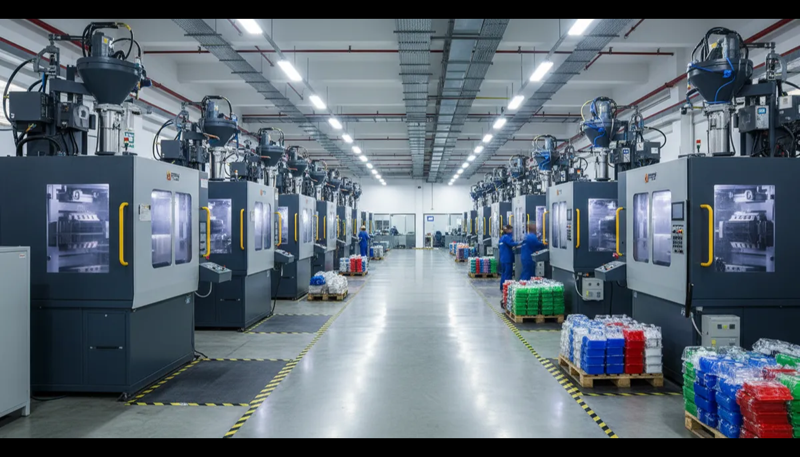
On our Shanghai floor, 47 injection molding machines spanning 90T to 1850T give us deliberate room to match the press to the part instead of forcing every program onto whatever is free. A small PEEK bushing runs on a compact press with short barrel dwell, while a large manifold moves to a higher-tonnage machine with the shot capacity to keep residence time sane. Our 8 senior engineers review drying records, packing profiles and cooling layouts together before first article, because that review is where most cost leaks get removed. With more than 20 years of molding since our founding in 2005 and 400+ materials in regular use, that matching step is routine, not exceptional.
How Should You Separate Machine Settings from Material and Mold Behavior?
Change one layer at a time and record what moves. Machine settings are the values an operator dials; material behavior is what the resin does in response; mold behavior is what the steel does to the melt. Confusing the three layers is how teams chase drift with knobs that cannot fix it.
Stabilize the material layer first: resin grade, drying, regrind policy and lot changes. Then characterize the mold layer: gate freeze, venting, cooling balance and fill pattern. Only then tune machine settings: temperatures, speeds, pressures and cushion. A short designed experiment4 is the efficient way through this — vary a handful of factors systematically, measure the outputs that matter, and keep the settings that demonstrably move the result.
The payoff is troubleshooting speed. If dimensions drift after a material lot change, the cause probably sits in the material layer, and turning machine knobs only masks it. If sink appears on one tool but not its twin, the mold layer is suspect. Teams that document which layer a change belongs to build knowledge that survives personnel turnover, and that knowledge shows up as stable cost per part.
How Should You Budget Cost per Part and Tooling?
Build the budget as three blocks. The material block is weight times grade-adjusted price, plus expected scrap. The machine block is hourly rate times cycle time, divided by parts per cycle, plus setup amortization and a realistic scrap allowance. The tooling block is the mold investment, maintenance and modifications spread over the agreed volume. Quote comparisons only mean something when all three blocks are built the same way.
Common shortcuts create false confidence here. Skipping or shortening drying lowers the quoted cycle time and quietly raises scrap. Loosening a tolerance on paper to make it easier to hit hides variation instead of removing it. Accepting a quote with no drying, capability or maintenance line items does not remove those costs; it just moves them to the stage where they are most expensive to fix.
Tolerances deserve their own decision, made early. ISO 20457 addresses tolerances and acceptance conditions for plastics moulded parts, and agreeing on its tolerance groups before quoting prevents the classic dispute where a buyer expects precision-grade parts on a commercial-grade budget. When comparing candidate suppliers on these blocks, our injection molding supplier sourcing guide outlines how to structure the evaluation.
| Decision point | What to prepare | Why it matters |
|---|---|---|
| Resin grade | Filled or unfilled, color, industry requirements | Sets material price and the process window |
| Annual volume | Firm first-year and expected multi-year quantities | Determines tooling amortization and steel choice |
| Tolerances | Critical dimensions mapped to ISO 20457 groups | Prevents paying for precision you do not need |
| Tooling terms | Ownership, maintenance and transfer clauses | Decides total tooling cost, not just the quote |
| Validation needs | Sampling plan and capability expectations | Fixes the evidence you will accept before mass production |
What Should You Verify Before Requesting a Quotation?
Drawings with tolerances, honest volumes, the resin grade, and the evidence standard you expect. A quotation built on those four inputs is comparable; a quotation built on a part name and a guess is padded, and the padding is your money.
Incomplete drawings deserve special mention. Missing tolerances do not make requirements disappear; they make the molder price the uncertainty. The same is true of vague volume forecasts: a supplier who cannot trust the volume will amortize tooling over a small number and charge you a premium per part. Bringing the real numbers to the table is the cheapest cost-reduction step available.
Risk check: What Should You Verify Before Requesting a Quotation
| Decision | Signal to proceed |
|---|---|
| Sample approval | Measured data signed by both sides |
| Capacity check | Quoted volume fits the machine plan |
| Handover pack | Inspection plan and contacts documented |
Once those inputs are fixed, submit the drawings for an engineering review and quotation through our contact page. A useful review will question your tolerances, ask about drying and machine fit, and explain which cost blocks dominate; a review that only sends back a number is telling you something.
What Evidence Shows the Process Is Repeatable?
Control charts and capability numbers from a stable process, backed by documented validation work — not a single good sample. The U.S. Food and Drug Administration process validation guidance frames validation as objective evidence across the product lifecycle that a process can consistently deliver results meeting predetermined requirements, and that framing applies well beyond regulated industries.
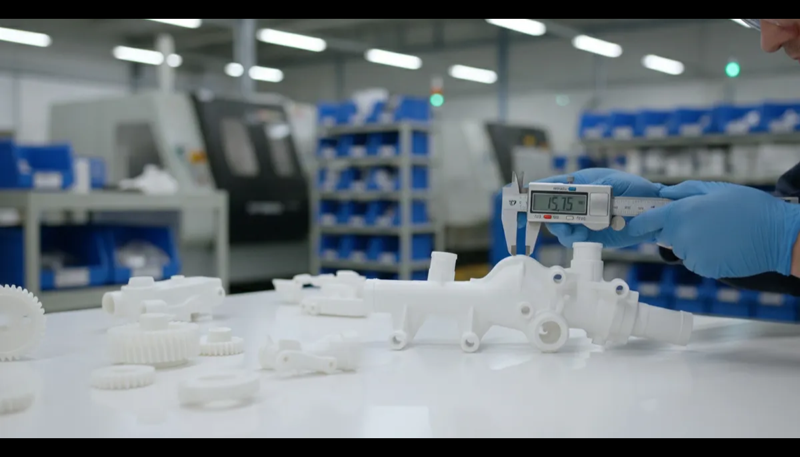
Concretely, expect three things. First, a process window established during setup, with the factors that were tested and the settings that were chosen. Second, control charts on critical dimensions across a production run, showing the process holds its center over time. Third, capability figures such as Cpk5 computed on those charts, which compare process spread and centering against your tolerance limits and translate directly into expected defect rates.
This is also where shortcut detection gets easy. If a supplier cannot produce charts, or offers a tray of five perfect samples instead of a capability study, the honest conclusion is that repeatability has not been demonstrated yet. That is not automatically a disqualifier for a prototype program, but it is a disqualifier for trusting a mass-production price.
Capability indices computed on an in-control process support meaningful claims about repeatability.True
Capability indices compare process spread and centering with tolerances, so values calculated from a stable, charted process describe what the process will keep doing.
One good first article proves the process is repeatable.False
A single sample carries almost no information about variation, and variation is exactly what a repeatability claim is about.
None of this requires you to become a molding engineer. It requires you to ask for the same evidence a good molder would demand of itself: the right machine, a dried and specified resin, a process window established deliberately, and charts that prove the window holds. Ask for those, and the cost discussion stops being a negotiation and becomes arithmetic.
Frequently Asked Questions About PEEK Injection Moulding Cost
How much does PEEK injection moulding cost per part?
There is no single number, but the calculation is predictable: part weight plus runner, adjusted for scrap, times resin price, plus machine time, plus tooling amortized over real volume. A small, simple part in unfilled PEEK at thousands of parts per year can land far below a large, tight-tolerance part in a filled grade. Anyone quoting without weight, grade, volume and tolerance is guessing.
Why is PEEK tooling more expensive than commodity-resin tooling?
Higher melt temperatures, hot molds, abrasive fillers and tighter shrinkage control push the design toward harder steel, better cooling and more robust ejection. Those choices cost more up front and typically return the difference through longer tool life and faster, more stable cycles.
Control check
| Data to request | Why it reduces risk |
|---|---|
| Capability study | Shows variation against the tolerance |
| Material certificates | Links each lot to the resin grade |
| Maintenance log | Exposes tool condition before the run |
Can I reduce cost by molding PEEK from regrind?
Sometimes, but treat it as an engineering decision. Regrind can shift melt flow and mechanical properties, and fillers lose fiber length with each pass, which changes strength and wear behavior. For regulated or high-load parts, most teams specify virgin resin and ask for the molder regrind policy in writing.
Does PEEK molding require special equipment?
Not exotic equipment, but the right fit: barrel temperatures many general-purpose machines cannot hold, a mold temperature controller capable of near 200 °C, adequate shot capacity to avoid long dwell, and corrosion and wear protection for filled grades. Clamp tonnage should match the projected area, as with any material.
How many samples should I see before trusting a quoted price?
Enough to see variation, not just quality. A capability run of dozens to hundreds of parts with control charts on critical dimensions tells you what the process will keep doing; five perfect samples tell you only what happened once. Ask how the quoted scrap rate was established.
Is post-machining or annealing always needed for PEEK parts?
Not always. Tight tolerances, thick sections or flatness requirements may call for annealing to stabilize dimensions, and some features are cheaper to machine than to mold. If either applies, it should appear as its own line item in the quotation rather than as a surprise after delivery.
Decision check
| Stage | Practical guard |
|---|---|
| Quotation review | Cost drivers stated separately from assumptions |
| Tool build | Milestone dates with a named owner |
| Production ramp | First-article data before volume release |
Footnotes
-
PEEK is a semi-crystalline high-performance thermoplastic, polyetheretherketone, valued for heat, chemical and wear resistance. ↩
-
Shot capacity is the maximum melt volume, measured in grams, that an injection unit can deliver in one stroke. ↩
-
Crystallinity is the fraction of a polymer structure that exists as ordered crystalline phase rather than amorphous, measured in percent. ↩
-
DOE refers to a designed experiment in which several process factors are varied systematically to map their effects on measured outputs. ↩
-
Cpk is a process capability index that compares process spread and centering against tolerance limits, measured in dimensionless units. ↩