Nylon 6 (PA6) is one of the most widely specified engineering thermoplastics in injection molding, and almost every feasibility conversation about it starts with the same question: what temperature should we run? The honest answer is that PA6 has useful windows, not magic numbers, and those windows only mean something when drying, machine condition, and mold behavior are controlled alongside them.
This guide gives you the practical barrel, nozzle, and mold temperature ranges used on real molding floors, then walks through the process variables, evidence checks, and supplier questions that decide whether a PA6 process is genuinely repeatable. If you are an engineer preparing a molding feasibility review, or a procurement buyer qualifying a supplier, this is the working checklist view of what good looks like. For the wider machine-side context, our injection molding complete guide covers the full process end to end.
Two ideas repeat throughout this guide and are worth stating up front. First, the grade datasheet defines the material window, the machine builds and holds the melt, and the mold decides how the part solidifies; keeping those three responsibilities separate turns most temperature arguments into short, testable questions. Second, every number here is a starting window for a trial on dry, healthy material, not a substitute for measuring your own machine.
- Unfilled Nylon 6 is typically molded with a melt temperature of roughly 230–280 °C, but the specific grade datasheet always wins over any general range.
- Mold surface temperature for PA6 usually sits between 60 and 100 °C, trading cycle time against crystallinity and dimensional stability.
- Drying is not optional: PA6 absorbs moisture quickly, and wet resin hydrolyzes in the barrel long before any temperature setting matters.
- Barrel setpoints are not melt temperature; measure the melt directly and audit the difference machine by machine.
- When troubleshooting, separate machine settings from material behavior and mold behavior, because the three fail in different ways.
- Repeatability is proven with statistical evidence across time, cavities, and material lots, never with one good shot.
- Before requesting a quotation, ask a supplier for drying records, melt audits, and cavity-level process data rather than a machine list.
What Is Nylon 6 Processing Temperature in Practical Terms?
In practical terms, unfilled Nylon 6 is molded with a measured melt temperature of roughly 230–280 °C and a mold surface temperature of roughly 60–100 °C. These are starting windows, not fixed setpoints, and the correct values for your part come from the specific grade datasheet plus the geometry you are molding.
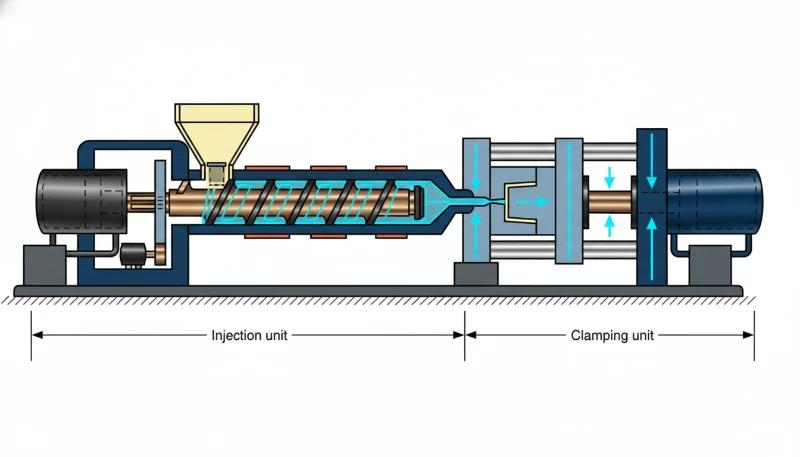
The barrel is divided into independently controlled heater zones 1. A common arrangement runs the rear zone below the target melt, ramps through the middle, and holds the front zone and nozzle close to the target melt temperature. The rear zone mainly preheats pellets so the screw does not shear cold material, while the front zones finish the melt. If the rear zone runs too hot, pellets soften early and conveying becomes erratic.
Mold temperature 2 is a separate, equally important setting. PA6 is semi-crystalline, so the temperature of the cavity steel directly changes how much crystallinity develops in the part, and with it the shrinkage, stiffness, and post-molding dimensional drift you will fight later.
As a rule of thumb for trial planning, expect the rear zone to sit 20–40 °C below the target melt, the middle zones to bridge that gap in even steps, and the front and nozzle zones to hold within about 10 °C of the datasheet midpoint. Mark the approved starting profile on the process sheet so anyone recovering the machine returns to a known state rather than a guessed one.
One caution belongs here: published ranges describe healthy, dry material on a machine in good condition. A wet hygroscopic resin or a worn screw can force the team away from any textbook window, which is why the verification checks later in this article matter more than the numbers themselves.
How Do Barrel Zones, Nozzle, and Mold Temperatures Interact?
The zones work as a staged melt train, and treating them as one number is the fastest way to hide a problem. Melt is built progressively, metered by the screw, and delivered through the nozzle into the mold.
The nozzle deserves special attention with PA6. The resin is relatively fluid when molten, so a nozzle set too hot tends to drool and string when the machine retracts. Many shops run the nozzle at or slightly below the front-zone setpoint and use sprue break or deceleration to keep the tip clean. If drooling persists, the usual suspects are nozzle temperature, backpressure, and residence time rather than any single magic setpoint.
A practical habit is to record both the setpoints and the measured melt at the nozzle during every trial. When the two drift apart by more than roughly 10–15 °C, the heater bands, thermocouples, or screw recovery are telling you something the controller screen cannot, and that measured difference becomes your baseline for comparing machines.
The table below shows typical starting windows for unfilled PA6. Treat it as a starting point for trials, not as a finished process sheet.
| Zone or variable | Typical starting window |
|---|---|
| Rear barrel zone | 220–240 °C |
| Middle barrel zone | 240–260 °C |
| Front barrel zone | 250–270 °C |
| Nozzle | 250–270 °C |
| Measured melt | 230–280 °C |
| Mold surface | 60–100 °C |
Mold temperature interacts with the melt through the part itself. A colder mold freezes the surface quickly, shortens cycle time, and lowers crystallinity, which usually means more post-molding shrinkage and less stable dimensions. A hotter mold builds crystallinity and dimensional confidence but costs cycle time. On tooling questions such as gate size, cooling layout, and cavity steel selection, our injection mold complete guide goes into the mold half of that equation in depth.
Which Process Variables Should You Establish and Monitor?
Beyond the temperature window, the variables that decide PA6 part quality are drying quality, injection speed and pressure, hold pressure and time, screw speed and backpressure, cooling time, and total residence time 3 in the barrel.
Drying and moisture control. PA6 is strongly hygroscopic. A typical drying recipe is about four hours at 80 °C in a desiccant dryer, but the resin supplier’s datasheet defines the actual requirement, and the only acceptable proof is a moisture measurement on the pellets at the press, not a timer on the dryer.
Injection and holding phase. Injection speed sets shear heating, which adds to barrel heat and can push a marginal melt into degradation. Holding pressure and hold time must be verified against gate seal, because PA6 shrinks as it crystallizes and will sink or drift dimensionally if the pack phase is guessed. A useful gate-seal check is to mold a short series with increasing hold time, plot part weight, and stop where the curve flattens; that flat region is your validated hold time.
Screw speed, backpressure, and residence. High screw speed and heavy backpressure add shear heat on top of the heater setpoints. Long residence time in a hot barrel degrades PA6 even when every heater reads nominal, so purge-and-measure checks belong in the routine.
Standardized comparisons. When you need comparable material data rather than part-specific tuning, ASTM D3641 is the standard practice for injection-molded test specimens of thermoplastic molding and extrusion materials, which is why laboratories use it to keep molding conditions consistent between samples.
How Do You Separate Machine Settings from Material and Mold Behavior?
When a PA6 part comes off the press wrong, the cause sits in one of three families: the machine and its settings, the material state, or the mold itself. The discipline that separates them is simple: change one family at a time and verify with a measurement, not an impression.
Drying state can change PA6 melt behavior enough to mimic a temperature problem.True
Moist PA6 hydrolyzes inside the barrel, molecular weight drops, viscosity falls, and parts come out brittle and streaked, which looks exactly like an overheated melt even though the real problem is water.
You can judge whether PA6 pellets are dry enough by looking at them.False
Dried and moist PA6 pellets look identical to the eye, so dryness must be verified with a moisture measurement at the press using the resin supplier’s method, never by appearance or by trusting the dryer timer.
In day-to-day troubleshooting, the practical sequence is to confirm the material state first, because it is the cheapest thing to check and the most often wrong. Only then adjust machine settings, and only then look at the mold. Teams that reverse this order often spend a week chasing heater setpoints when the answer was a dryer with a leaking hose.
What Evidence Shows the Process Is Repeatable?
Repeatability means the process stays in control across time, cavities, operators, and material lots, and that you can prove it with data rather than with a saved machine screen from a good day.
Statistical process control gives this discipline a shared language. The NIST/SEMATECH e-Handbook of Statistical Methods describes how designed experiments, control charts, and capability analysis provide a disciplined way to understand and control process variation, and injection molding is exactly the kind of multi-variable process those tools were written for.
The regulated-industry view adds lifecycle thinking. The FDA process validation guidance frames validation as objective evidence, collected across the product lifecycle, that a process can consistently deliver a result meeting predetermined requirements. Strip away the regulatory wrapper and that standard is a fair demand for any engineering part.
In molding practice, the evidence package usually includes a capability index 4 on critical dimensions, cavity-to-cavity layouts, gate seal studies, and a documented melt temperature audit. A short designed experiment on the variables from the previous section turns opinions into a defensible process window. Where part criticality justifies it, cavity pressure sensors turn that package from periodic sampling into confirmation on every shot.
One practical warning: evidence collected only at start-up is not evidence of repeatability. The study that matters measures the process again hours later, after the barrel has seen hundreds of shots and the material has been exposed to the room.
Which Common Shortcuts Create False Confidence?
Most PA6 process failures trace back to a handful of familiar shortcuts: skipping press-side moisture checks, trusting barrel setpoints as melt temperature, treating the first good shot as proof, and copying recipes between machines.
A process that produces one good part on day one can still drift out of tolerance within the same shift.True
Material lots change, ambient humidity changes, the barrel thermal state changes as it cycles, and wear progresses, so a single good sample says nothing about where the process sits three hours later.
Copying a proven setpoint sheet from one machine to another guarantees the same part quality.False
Barrel geometry, screw and barrel wear, heater band condition, and thermocouple placement all differ between machines, so identical numbers produce a different actual melt, and only a melt measurement reveals the gap.
The antidote to all of these is the same: verify the invisible states. Measure moisture, measure melt, and measure dimensions across cavities and across time. A process that is checked is a process that can be quoted with a straight face.
How Should You Qualify a Supplier or Prepare a Nylon 6 Feasibility Review?
Before you request a quotation, the highest-value step is to ask a supplier the questions this article raises and watch how concretely they answer. A capable PA6 molder will talk about drying verification at the press, melt audits, cavity pressure studies, and dimensional capability data without prompting. Our supplier sourcing guide walks through the full supplier evaluation in detail.
Ask for three artifacts specifically: a moisture log from the press, a measured melt temperature record from a recent run, and a capability summary on a dimension you actually care about. A supplier who produces these quickly has the habits this article describes; one who answers with a machine list is selling capacity, not process control.
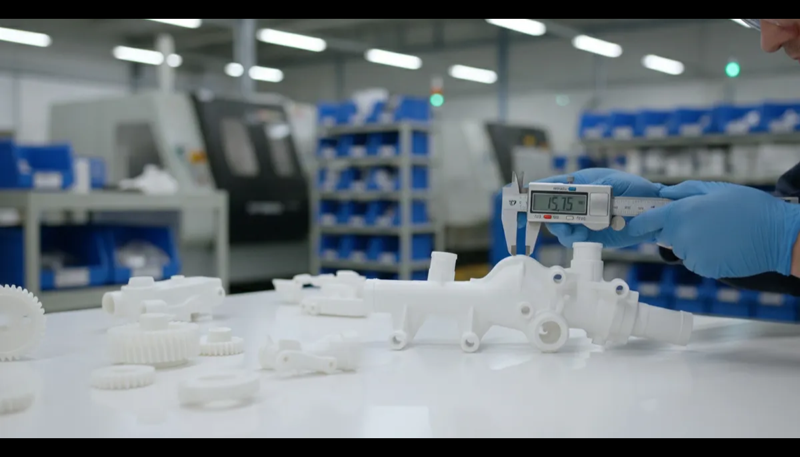
Our Shanghai operation was founded in 2005 and runs 47 injection molding machines ranging from 90T to 1850T, supported by 8 senior engineers and more than 10 QC specialists. With 400+ materials processed and more than 20 years of molding experience, we have learned that PA6 disputes are rarely about the temperature chart; they are about whether drying and melt verification are enforced habits on the floor. That is also why our in-house mold shop, which supports more than 100 mold sets per month and operates under ISO 9001, ISO 13485, ISO 14001, and ISO 45001, designs cooling and gate layouts that keep the mold half of the temperature equation predictable instead of hoping setpoints carry the load.
The table below is a first-response guide for the most common PA6 temperature and process disputes.
| Symptom | Most likely family | First check |
|---|---|---|
| Silver streaks or splay | Material moisture | Press-side moisture measurement |
| Brittle parts, low impact strength | Material degradation | Melt audit and residence time review |
| Flash alternating with short shots | Machine and mold balance | Hold pressure profile and venting |
| Dimensions drift cavity to cavity | Mold behavior | Cavity layout and mold temperature survey |
| Same recipe, different parts | Machine condition | Measured melt, not setpoint readout |
If you are preparing a feasibility review and want an engineering opinion on your PA6 part and tooling, contact our team for an engineering review and quotation. Bring the grade, the datasheet, and the tolerance expectations; the temperature conversation gets much shorter when those three exist.
Frequently Asked Questions
What temperature does Nylon 6 melt at?
Nylon 6 has a melting point around 220–225 °C, but molding happens well above that, with typical melt temperatures of roughly 230–280 °C. Always treat the specific grade datasheet as the authority, since additives and fillers shift the working window.
Can you overheat Nylon 6 during molding?
Yes. Above the upper end of the working window, PA6 oxidizes and degrades quickly, which shows up as brittleness, discoloration, and gassing. Long residence time at high melt temperature does the same damage even when the heater setpoints look reasonable.
What happens if Nylon 6 is not dried before molding?
Moist PA6 hydrolyzes in the barrel, cutting molecular weight and producing brittle parts, silver streaks, and drooling from the nozzle. The damage is chemical and irreversible, so no temperature adjustment can repair a wet shot.
What mold temperature gives the best Nylon 6 parts?
For most unfilled PA6 parts, a mold surface between 60 and 100 °C is the working range, and the better dimensional stability usually comes from the upper half of it. The trade-off is cycle time, so the right choice balances tolerance demands against part cost.
How long can Nylon 6 sit out before it needs re-drying?
It depends on ambient humidity, but PA6 starts re-absorbing moisture within minutes to hours of exposure. Many molders limit open-air time to a couple of hours and re-dry anything exposed longer, verified by moisture measurement rather than assumption.
Does glass-filled Nylon 6 use the same processing temperatures?
Glass-filled grades generally run in similar or slightly higher melt ranges, but they shear-heat more, shrink less, and abrade the screw and mold surfaces more. Treat a filled grade as its own qualification, with its own datasheet and drying requirements.
Practical check
| Control point | What to verify before release |
|---|---|
| Process parameters | Settings recorded for the approved sample |
| Inspection plan | Method and frequency tied to your drawing |
| Change control | Written approval before a material or tool change |
Use this table as the minimum exit criteria for a PA6 trial release. Anything less leaves the temperature conversation open-ended, and anything more should exist because your drawing or industry standard demands it, not because habit added it.
Footnotes
-
Barrel temperature zones are the independently controlled heater sections along an injection molding barrel, measured in degrees Celsius and set from rear to nozzle to build the melt in stages. ↩
-
Mold surface temperature refers to the temperature of the cavity and core steel at the part interface, measured with contact probes rather than read from a controller setting. ↩
-
Residence time refers to how long material remains inside the heated barrel and screw assembly, from feeding through injection. ↩
-
A capability index is a statistical measure, such as Cpk, describing how well a controlled process output fits inside its specification limits. ↩