 콘텐츠로 건너뛰기

For a comprehensive overview, see our Injection Mold Complete Guide.
- 나일론(PA)은 성형 전 80–90°C에서 4–6시간 건조하여 수분을 0.2% 미만으로 줄여야 합니다; 건조되지 않은 재료는 스프레이, 기포, 그리고 최대 30%의 강도 손실을 유발합니다.
- PA6 용융 온도는 230–260°C입니다; PA66는 260–290°C가 필요합니다; 금형 온도는 비강화 등급의 경우 60–80°C, 유리 섬유 강화 변종의 경우 80–100°C여야 합니다.
- 나일론의 높은 수축률(PA6의 경우 1.0–2.0%, PA66의 경우 1.5–2.5%)은 뒤틀림을 방지하기 위해 신중한 벽 두께 균일성과 게이트 배치를 요구합니다.
- 유리 섬유 보강 나일론(PA6-GF30)은 인장 강도를 약 70 MPa에서 약 170 MPa로 증가시키지만 이방성 수축을 유발하여 몰드 흐름 분석이 필요합니다.
- 우리 공장에서는 자동차 및 전기 응용 분야의 나일론 부품이 적절한 공정 제어로 ±0.05–0.10 mm의 치수 공차를 달성합니다.
나일론 사출 성형이란 무엇인가요?
나일론 사출 성형은 polyamide1 열가소성 플라스틱4 수지는 용융되어 750~1,250 bar의 압력으로 강철 금형에 주입되고, 등급과 보강재에 따라 일반적으로 60~170 MPa 범위의 인장 강도를 가진 정밀 부품으로 냉각됩니다.
나일론(상업명: 폴리아미드(PA))은 1935년 듀퐁이 도입한 세계 최초의 합성 엔지니어링 열가소성 수지입니다. 오늘날에도 탁월한 피로 저항성, 자체 윤활 표면 및 구조적 적용 분야에서의 비용 효율적인 성능으로 인해 가장 널리 성형되는 엔지니어링 수지 중 하나로 남아 있습니다.
나일론의 결정적 특성은 반결정성 분자 구조입니다: 고분자 사슬이 냉각 중에 규칙적인 결정 영역으로 배열되어, ABS나 PC와 같은 비정질 수지에 비해 나일론에 높은 강성과 강도를 부여합니다. 그러나 동일한 결정성으로 인해 상대적으로 높고 변동이 큰 수축이 발생하며, 이는 나일론 부품 설계의 주요 과제입니다.
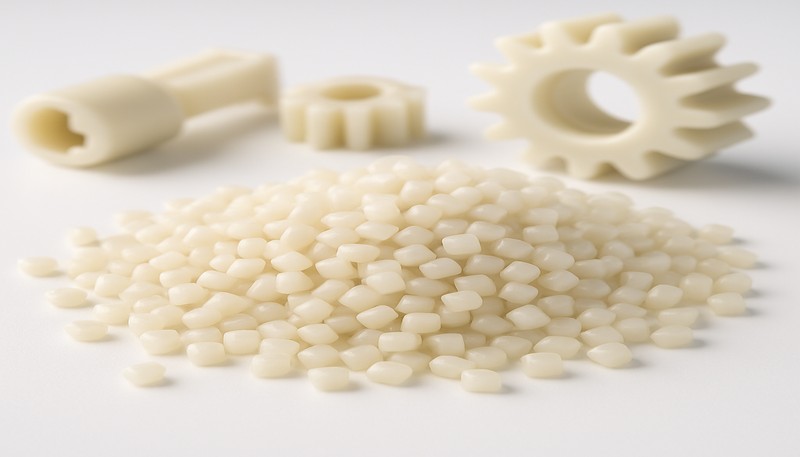
우리 공장에서는 배기 배럴과 제습 건조기가 장착된 표준 왕복 스크류 사출 성형기로 나일론을 가공합니다. 핵심 상류 단계인 건조는 필수입니다: 나일론은 매우 2 그리고 기계 배럴에 도달할 때 수분 함량이 중량 기준 0.2% 미만이어야 합니다. 건조 단계를 건너뛰면 스프레이 자국, 기포, 그리고 재료 데이터시트 값보다 20–30% 부족한 기계적 특성을 보게 될 것입니다.
나일론의 강인성, 내화학성, 하중 하의 치수 안정성은 기어, 베어링 케이지, 전기 커넥터, 케이블 타이, 그리고 후드 아래 자동차 부품 — 금속은 너무 무겁고 표준 범용 플라스틱은 강도가 부족한 응용 분야 — 에서 최적의 선택으로 만듭니다.
다른 엔지니어링 수지와 비교했을 때, 나일론은 탁월한 강도 대비 비용 비율을 제공합니다. PA6 펠릿은 PEEK의 약 1/3 비용, PPS의 약 1/2 비용으로 거래되면서, 80–130°C 작동 범위에서 대부분의 구조적 플라스틱 응용 분야를 만족시키는 인장 강도, 피로 저항성, 그리고 화학적 호환성을 제공합니다.
사출 성형에 사용되는 나일론 종류
PA6, PA66, PA12은 사출 성형 나일론 적용 분야의 90% 이상을 차지합니다. 적합한 등급은 작동 온도, 수분 노출 및 요구되는 기계적 성능에 따라 달라집니다.
| Grade | Melt Temp (°C) | HDT (°C, 1.8 MPa) | 인장 강도(MPa) | 흡수율 (%) | Typical Use |
|---|---|---|---|---|---|
| PA6 | 230–260 | 65 | 70–85 | 2.5–3.5 | 기어, 커넥터, 하우징 |
| PA66 | 260–290 | 90 | 80–95 | 2.0–2.5 | 자동차 엔진실 내부, 패스너 |
| PA12 | 220–250 | 55 | 50-60 | 0.25 | 연료 라인, 유연 부품 |
| PA6-GF30 | 240–275 | 200+ | 160–175 | 1.5 | 구조적 자동차 부품, 브래킷 |
| PA66-GF30 | 270–295 | 250+ | 170–190 | 1.2 | 고온 구조 부품 |
| PA46 | 300–330 | 160 | 100–115 | 2.5 | 고열 전기 부품 |
PA6(폴리카프로락탐)은 가장 경제적인 등급으로, 낮은 용융 온도가 배럴 마모와 사이클 시간을 줄여주기 때문에 가공이 가장 쉽습니다. PA66(폴리헥사메틸렌 아디파미드)은 더 높은 열변형 온도(1.8 MPa에서 PA6의 65°C에 비해 90°C)를 가지고 있어 지속적인 열 부하를 받는 엔진실 부품에 선호됩니다.
PA12는 특수 분야를 차지합니다: 매우 낮은 수분 흡수율(PA6의 2.5~3.5%에 비해 0.25%)로 인해 유체 처리 튜빙, 연료 라인 및 공압 호스의 표준 재료입니다. 습한 환경에서 치수 안정성이 중요한 경우, PA12는 낮은 강성에도 불구하고 PA6과 PA66을 크게 능가합니다.
유리 섬유 보강 등급(GF15, GF30, GF50)은 인장 강도를 배가하고 크리프를 현저히 줄이지만, 이방성 수축을 유발합니다: 흐름 방향 수축은 0.2~0.5%일 수 있는 반면, 횡방향 수축은 0.8~1.5%로 유지됩니다. 금형 흐름 분석3 강철 절단 전에 유리 섬유 충전 나일론 부품의 경우 공차가 엄격할 때 필수입니다.
“PA66는 더 높은 녹는점으로 인해 PA6보다 더 높은 가공 온도가 필요합니다.”True
PA66의 녹는점은 255~265°C로 PA6의 215~225°C보다 높습니다. 이로 인해 PA6의 230~260°C에 비해 PA66은 260~290°C의 배럴 온도가 필요하며, 추가적인 열 및 전단 응력을 처리하기 위해 고사양 히터 밴드와 내마모성 스크류가 요구됩니다.
“모든 나일론 등급은 유사하게 높은 수분 흡수율을 가지므로 건조 시간을 표준화할 수 있습니다.”False
수분 흡수는 등급에 따라 크게 다릅니다: PA12는 0.25%만 흡수하는 반면 PA6는 2.5–3.5%를 흡수합니다. PA12 펠릿은 가공 안전 수분 0.2% 이하에 도달하기 위해 85°C에서 단 2시간이 필요할 수 있는 반면, 높은 주변 습도에서 PA6는 6–8시간이 필요할 수 있습니다. 건조 시간을 표준화하면 PA12는 과건조(취약성 위험)되거나 PA6는 건조 부족(스플레이 및 분해)될 수 있습니다.
나일론 사출 성형 공정 매개변수
나일론 용융 온도는 등급에 따라 230°C에서 295°C 사이로 설정해야 하며, 배럴 존은 후면에서 전면으로 증가시켜야 합니다 — 후면 존은 중간보다 10–20°C 낮게, 노즐은 전면보다 5–10°C 높게 — 균일한 용융을 보장하고 냉각 슬러그를 방지하기 위함입니다.

아래 표는 가장 일반적인 나일론 등급의 주요 공정 윈도우를 요약합니다. 이는 시작점 값입니다; 실제 최적화는 부품 형상, 벽 두께, 그리고 러너 시스템 설계에 따라 진행되어야 합니다. 공정 윈도우는 의도적으로 보수적으로 설정되었습니다 — 대량 생산 설정을 확정하기 전에 금형 시험을 실행할 것을 권장합니다.
| 매개변수 | PA6 | PA66 | PA12 | PA6-GF30 |
|---|---|---|---|---|
| 용융 온도 (°C) | 230–260 | 260–290 | 220–250 | 240–275 |
| Mold temperature (°C) | 60–80 | 70–100 | 30–60 | 80–100 |
| Injection pressure (bar) | 750–1100 | 800–1250 | 700–1000 | 900–1300 |
| Holding pressure (bar) | 450–700 | 500–750 | 400–650 | 550–800 |
| Back pressure (bar) | 5–15 | 5–15 | 진정으로 저온 강성과 고온 내성이 모두 필요한 애플리케이션 — 엔진실 내 전기 커넥터 등 — 에는 PA612 또는 PPA(폴리프탈아미드)를 고려하십시오. 이들은 더 높은 비용으로 중간 성능을 제공합니다. ZetarMold는 동일한 프레스 플랫폼에서 이들 세 가지 소재 모두를 처리하여 프로토타입 샘플링 시 비용과 성능의 균형을 시험할 수 있습니다. | 10–20 |
| Screw speed (rpm) | 80–150 | 60-120 | 80–150 | 50–100 |
| 냉각 시간(초) | 15–30 | 20–35 | 15–25 | 20–40 |
| Drying temp/time | 80°C / 4–6 h | 80°C / 4–6 h | 85°C / 3–4 h | 80°C / 4–8 h |
Mold temperature has a significant impact on crystallinity and surface finish. For unreinforced PA6, a mold temperature of 60–80°C gives a good balance of cycle time and part quality. Dropping mold temperature below 40°C to speed up cycle time reduces surface crystallinity, which actually lowers fatigue resistance and can create internal stresses that cause long-term dimensional creep.
For glass-filled grades, we recommend mold temperature of 80–100°C. Hotter molds allow glass fibers to reorient more freely and reduce the fiber-knit appearance at weld lines. In our factory, we use heated mold temperature controllers with ±2°C precision for glass-filled nylon parts — not oil at the press.
Injection speed should be moderate: nylon’s low melt viscosity means it fills quickly. Excessive injection speed generates frictional heat that can degrade the polymer and produce discoloration or gas burns at the end of fill. We typically set injection speed at 60–80% of machine maximum for nylon, then fine-tune based on fill balance across multi-cavity tools.
Screw back pressure for nylon should be kept low — 5–15 bar for unreinforced grades, up to 20 bar for glass-filled — since nylon’s low viscosity means excessive back pressure increases residence time without improving melt quality. Extended residence time at barrel temperature accelerates hydrolytic chain scission and reduces molecular weight in the finished part.
“Higher mold temperature improves surface quality and mechanical properties in nylon parts.”True
Mold temperatures of 80–100°C for PA6/PA66 promote more complete crystallization, reduce internal stress, and improve surface gloss and weld-line strength. Parts molded at 40°C may look similar but show lower fatigue strength and higher creep under sustained load in service.
“Maximizing injection speed fills nylon parts better and reduces short shots.”False
Nylon has low melt viscosity and fills readily at moderate speed. Maximum injection speed creates excessive shear heat (nylon degrades above 300°C), generates gas traps and burn marks at the end of fill, and can cause flash in thin-walled areas. Short shots in nylon are more commonly caused by insufficient injection pressure or inadequate venting, not slow fill speed.
건조 요구사항 및 수분 제어
Nylon must be dried at 80–90°C for 4–8 hours in a dehumidifying hopper dryer to reduce moisture below 0.2% by weight; failure to dry results in hydrolytic degradation of the polymer chain during processing, causing reduced molecular weight, splay, bubbles, and mechanical property losses of 20–30%.
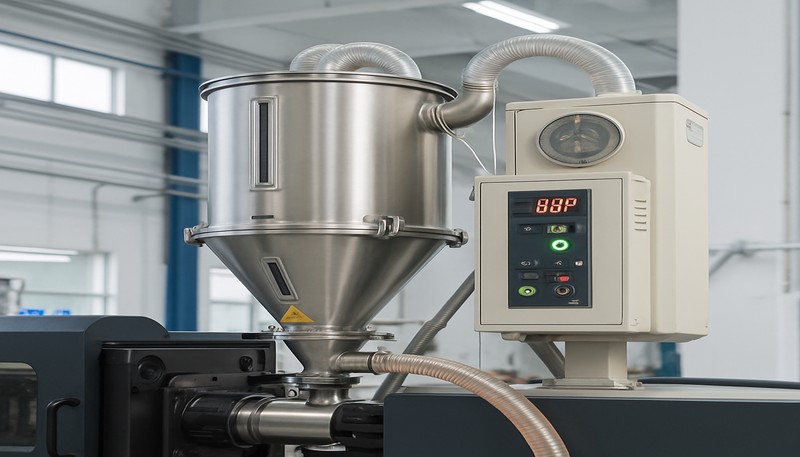
Nylon is one of the most hygroscopic engineering resins in common use. PA6 at equilibrium in ambient conditions (50% RH, 23°C) holds 2.5–3.5% moisture by weight — and each absorbed water molecule attacks the amide bond at barrel temperatures, breaking polymer chains and permanently reducing molecular weight. Unlike ABS or PP where moisture causes only surface splay, wet nylon undergoes irreversible molecular degradation.
The minimum drying specification is: dehumidifying dryer with dew point below −30°C, temperature 80°C, airflow ≥1 m³/hr per kg/hr throughput, duration 4–6 hours for PA6/PA66, 3–4 hours for PA12. A standard hot-air oven is not sufficient for nylon — you need a desiccant dehumidifying system to reach dew points low enough to pull the last percentage points of moisture.
In production, we monitor moisture with a Karl Fischer titrator before first shot and whenever material is changed. If moisture exceeds 0.3%, we extend drying by one hour and re-test. Once material is in the heated hopper, it can absorb moisture from compressed air in the machine’s plasticating zone — so we also ensure the purge guard seals properly and the screw is never left idle with nylon in the barrel above 200°C.
Over-drying is also a concern: PA6 held at 90°C for more than 12 hours begins to show thermally oxidized yellowish color and slight embrittlement. PA12, with its lower moisture absorption, needs shorter drying time. Operators sometimes set a blanket 8-hour cycle for all nylon — this risks damaging PA12. Best practice is to set grade-specific drying recipes in the dryer controller.
Storage after drying is equally important. Dried nylon pellets exposed to ambient air re-absorb moisture within 30 minutes; we transfer pellets directly from the dryer hopper through a sealed conveying line to the machine barrel. For smaller batch runs, we use sealed moisture-proof bags and re-dry if the bag has been open for more than 2 hours.
나일론 사출 성형의 일반적인 결함 및 예방
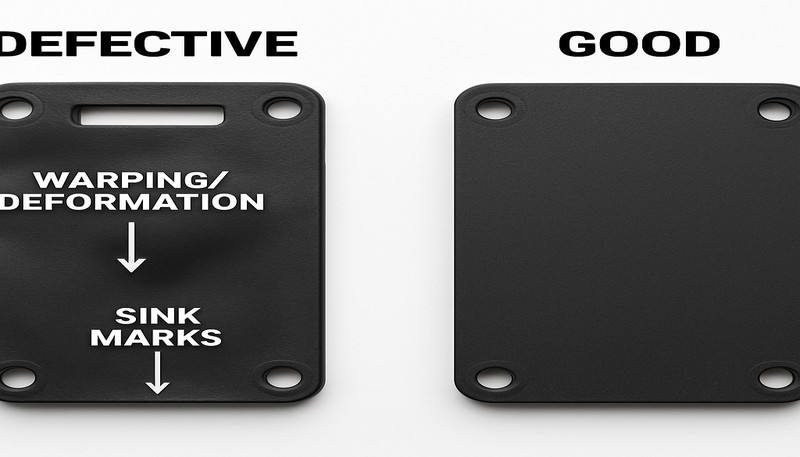
Nylon’s most frequent injection molding defects are warping (caused by shrinkage asymmetry), splay/silver streaks (from moisture or degraded material), and sink marks (from insufficient holding pressure or thick sections); each has a specific root cause and process-level remedy.
| 결함 | Primary Cause | 솔루션 |
|---|---|---|
| 워핑 | Asymmetric shrinkage from uneven cooling or wall thickness | Uniform wall thickness (≤3:1 ratio), balanced cooling, raise mold temp |
| Splay / Silver streaks | Moisture in resin or material degradation at barrel | Dry to <0.2% moisture; check barrel temp, reduce residence time |
| 금형 수명 종료: | Insufficient holding pressure, thick wall section | Increase hold pressure/time; reduce wall thickness with ribs |
| 쇼트 샷 | Insufficient injection pressure or poor venting | Increase injection pressure; add vents at last-fill areas |
| 플래시 | Clamping force insufficient or parting line worn | Check clamp force; reduce injection pressure and speed |
| 용접 라인 | Converging flow fronts, low melt or mold temp | Raise melt and mold temperature; relocate gates |
| Bubbles / Voids | Wet resin or gas trapped in melt | Extend drying time; add venting; reduce screw back pressure |
| Discoloration | Thermal degradation — too long residence time | Reduce barrel temperature; increase shot size utilization to >30% |
| Delamination | Glass fiber breakage or contamination | Reduce screw speed; check for purge contamination |
Warping is the defect we fight most in nylon, especially with thin flat parts like cover plates and housings. Nylon’s shrinkage of 1.0–2.5% is 3–5× higher than PC and inherently more variable because the crystallization front does not freeze simultaneously across all wall sections. In our factory, we address this with conformal cooling channels to equalize temperature across the tool and by specifying ribs rather than uniform thick sections for structural parts.
Splay and silver streaks are almost always a moisture problem. When we see splay in a production run, the first action is always to pull a sample from the dryer hopper and measure moisture — not to adjust the machine. Nine times out of ten, the dryer has malfunctioned, a desiccant bead is saturated, or someone opened the hopper lid during a shift change.
Weld lines in nylon are stronger than in many resins (nylon’s low viscosity allows good knit-line fusion), but they remain a weak point in glass-fiber-reinforced grades where fibers align parallel to the weld surface. For structural parts with weld lines, we specify weld-line tensile strength at 60–70% of base material strength and position gates to push weld lines away from high-stress areas.
Chemical resistance is another factor in defect prevention: nylon’s resistance to oils, greases, and aliphatic hydrocarbons is excellent, but it swells in strong acids and is attacked by phenols. Parts designed for chemical exposure should be tested with the actual service fluid before finalizing wall thickness, as even 0.5% swell can close press-fit interfaces and jam mechanical assemblies.
Post-mold moisture conditioning is recommended for structural nylon parts. Immersing freshly molded PA6 parts in 80°C water for 2–4 hours (DAM-to-conditioned cycle) relieves molding stresses and pre-saturates the part to its service-environment moisture level — eliminating the dimensional change that would otherwise occur gradually in the field over the first 3–6 months of use.
산업별 나일론 응용 분야
Nylon’s combination of mechanical strength, fatigue resistance, chemical compatibility, and cost effectiveness makes it the dominant engineering resin in automotive under-hood components, electrical connectors, industrial gears, and consumer goods requiring load-bearing plastic parts.
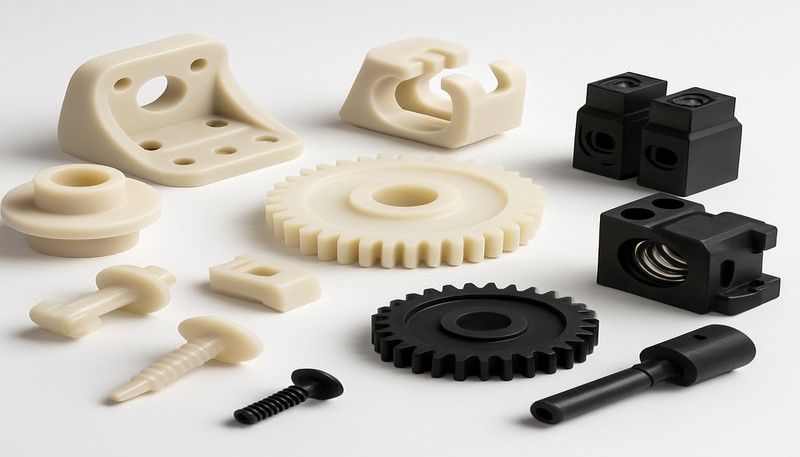
Automotive accounts for roughly 40% of engineering nylon consumption. Under-hood applications — intake manifolds, air ducts, cooling fans, cable ties, and transmission housings — demand the sustained heat resistance of PA66-GF30, which retains 50% of its room-temperature strength at 130°C. Structural exterior parts like door handles and mirror brackets use unreinforced PA6 for its toughness and UV-stabilized surface quality.
Electrical and electronics is the second-largest end market. Nylon 66 is the standard material for connector housings, terminal blocks, relay bases, and circuit breaker bodies. Its UL94 V-2 rating (unreinforced) and V-0 at 0.4 mm with flame-retardant additives make it widely accepted in safety-certified assemblies. Glass-filled grades are used for precision connector housings where dimensional stability through reflow soldering temperatures is required.
Industrial machinery applications leverage nylon’s self-lubricating properties: PA6 and PA66 gears, bushings, cam followers, and conveyor chain links operate with no external lubrication at moderate loads, reducing maintenance costs significantly versus metal alternatives. In our factory, we regularly mold PA6 gears with module 1–4 in cavities of 4–16, held to AGMA quality 8 tolerances (±0.025 mm pitch diameter).
Consumer and sporting goods represent a growing segment: ski bindings, bicycle components, power tool housings, and appliance components all use nylon for its combination of high strength-to-weight ratio, impact resistance, and the ability to achieve Class A surface finishes with proper mold polish and processing conditions.
나일론 사출 성형 부품 설계 지침
Optimal wall thickness for nylon injection molded parts is 1.5–3.5 mm; thinner walls may cause short shots and excessive fiber orientation in glass-filled grades, while thicker walls extend cycle time and create sink marks over internal ribs.
Nylon’s high shrinkage demands that wall thickness variation be kept below 3:1 across any section. Where thick sections are needed for strength, add hollow structures or ribs rather than solid walls. A 3 mm rib at 60% of wall thickness (1.8 mm) provides nearly equivalent stiffness with far less shrinkage-driven warping than a 3 mm uniform wall extending from a 2 mm section.
Draft angles for nylon should be 0.5–1.0° minimum on side walls, increasing to 1.5–2.0° for textured or matte surfaces. Nylon’s semi-crystalline nature means it can grip polished steel surfaces more aggressively than amorphous resins at certain mold temperatures — inadequate draft leads to drag marks and dimensional error even when ejection force is sufficient.
Gate location is critical for managing weld lines and shrinkage direction. For glass-filled nylon, we use 사출 금형 설계5 simulation to optimize gate position to align fibers in the primary load direction. Edge gates work well for flat parts; pin gates or sub gates are preferred for cosmetic surfaces where gate vestige must be minimized. In our experience, a center gate on a circular nylon gear consistently outperforms a side gate in terms of shrinkage uniformity and runout under 0.05 mm.
Rib design matters especially for nylon: rib thickness should not exceed 50–60% of the adjoining wall to prevent sink marks. Rib height should be ≤3× wall thickness and draft angle ≥0.5° per side. Use fillets at rib bases (radius ≥0.5 mm) to reduce stress concentration — nylon’s notch sensitivity means a sharp internal corner can reduce impact strength by 30–50%.
자주 묻는 질문
사출 성형용 PA6와 PA66의 차이점은 무엇인가요?
PA6 (polycaprolactam) has a melt point of 215–225°C and is processed at 230–260°C; PA66 (polyhexamethylene adipamide) melts at 255–265°C and requires 260–290°C barrel temperatures. PA66 has a higher heat deflection temperature (90°C versus 65°C at 1.8 MPa) and better retention of mechanical properties at elevated temperature, making it preferred for under-hood automotive applications. PA6 is easier to process, lower cost, and sufficient for most structural ambient-temperature applications. Both grades require similar drying protocols (80°C, 4–6 hours) and show similar shrinkage behavior in the 1.0–2.5% range.
사출 성형 전 나일론을 얼마나 오래 건조해야 하나요?
PA6 and PA66 require drying at 80°C for 4–6 hours in a dehumidifying dryer with dew point below −30°C, reducing moisture below 0.2% by weight. PA12, with lower equilibrium moisture (0.25%), can be dried in 3–4 hours at 85°C. Material that has been exposed to ambient humidity for more than 8 hours after drying should be re-dried. Hot-air ovens are not suitable — only desiccant dehumidifying systems achieve the required low dew point. Over-drying PA6 beyond 12 hours at 90°C risks thermal oxidation and slight yellowing.
나일론 사출 성형 부품의 뒤틀림 원인은 무엇인가요?
Nylon warping is primarily caused by asymmetric shrinkage: differential cooling rates between thick and thin sections, imbalanced runner systems, or non-uniform mold temperature create internal stresses that cause the part to distort after ejection. Glass-fiber reinforcement amplifies this because flow-direction shrinkage (0.2–0.5%) differs significantly from transverse shrinkage (0.8–1.5%), creating a strong tendency for flat panels to bow in the transverse direction. Prevention involves maintaining uniform wall thickness (≤3:1 ratio), using balanced cooling channels to target ±5°C temperature uniformity across the tool, avoiding asymmetric runner systems, and running mold flow analysis to predict warpage before steel is cut. In production, we also use ejection simulation to identify regions where differential cooling creates bending moments that cause distortion after the part leaves the tool.
나일론을 유리섬유 강화재와 함께 사출 성형할 수 있나요?
Yes — PA6-GF30 and PA66-GF30 are among the most widely molded engineering materials. Glass fiber at 30 wt% increases tensile strength from ~80 MPa to ~170 MPa and dramatically reduces creep, but requires higher processing temperatures (240–295°C barrel), higher injection pressure (900–1,300 bar), and mold temperature of 80–100°C. The mold must use H13 or equivalent hardened tool steel (≥HRC 50) in wear-critical areas due to glass fiber abrasivity. Venting must be generous because glass-filled nylons degas more aggressively. Gate and runner diameter should be 20–30% larger than for unfilled grades to reduce shear-induced fiber breakage.
나일론 사출 성형에 가장 적합한 몰드 재료는 무엇인가요?
For unfilled nylon (PA6, PA66, PA12), P20 pre-hardened steel is suitable for moderate production runs up to 200,000 shots. For glass-filled grades, H13 tool steel hardened to HRC 48–52 is recommended due to abrasive wear from glass fibers — using P20 for glass-filled nylon typically results in cavity erosion within 50,000 shots. For high-volume production exceeding 1 million shots, S136 or 2316 stainless is preferred in the gate and runner system where wear is highest. All mold surfaces should have at least 0.5° draft and be polished to SPI A2 or better for cosmetic parts.
나일론 6과 나일론 66의 수축률은 얼마입니까?
PA6 shrinkage is 1.0–2.0% in flow direction and 1.2–2.5% transverse; PA66 shrinks 1.5–2.5% in flow and 1.8–3.0% transverse. Glass fiber reduces shrinkage significantly: PA6-GF30 shows 0.2–0.5% in flow direction and 0.8–1.5% transverse. Moisture absorption after molding also causes post-mold dimensional change: PA6 absorbs up to 2.5% moisture at 50% RH, expanding by approximately 0.7% in linear dimension over 24 hours. Parts with tight dimensional tolerances should be measured after conditioning to 50% RH for 48 hours, not immediately after molding.
나일론 사출 성형 부품은 어떤 산업에서 사용되나요?
Automotive is the largest consumer — PA66-GF30 dominates under-hood structural parts (air intake manifolds, radiator end tanks, cooling fan blades). Electrical and electronics use PA66 extensively for connector housings, terminal blocks, and relay bases due to its UL94 rating and dimensional stability. Industrial machinery uses PA6 for self-lubricating gears, bearings, and conveyor components. Consumer goods and sporting equipment (ski bindings, power tool housings) use PA6 for its toughness and surface quality. Medical device housings use medical-grade nylon with biocompatibility certifications.
-
polyamide: Polyamide (PA) is a thermoplastic polymer characterized by amide linkages (-CO-NH-) in the backbone chain, known for high tensile strength, thermal resistance, and self-lubricating properties. ↩
-
hygroscopic: Hygroscopic refers to a material’s tendency to absorb moisture from the surrounding environment; nylon absorbs 2–3% moisture by weight at equilibrium, which degrades melt viscosity and causes splay or silver streaks if not dried before molding. ↩
-
mold flow analysis: Mold flow analysis is a computer simulation technique that predicts how molten plastic fills a mold cavity, used to optimize gate location, cooling layout, and injection parameters before cutting steel. ↩
-
thermoplastic: A thermoplastic is a polymer that softens and melts when heated above its glass transition or melt temperature and solidifies upon cooling, allowing repeated processing without chemical degradation under normal conditions. ↩
-
injection mold design: Injection mold design refers to the engineering process of creating the tool geometry, gating system, cooling channels, and ejection mechanism that determine part quality, cycle time, and mold longevity. ↩



 EN
EN  ES
ES  FR
FR  DE
DE  PT
PT  AR
AR  RU
RU  JA
JA  KO
KO  IT
IT  NL
NL  TR
TR  PL
PL 