 コンテンツへスキップ

の中で 射出成形 process, mold temperature is one of the most powerful — and most underrated — process variables you can control. It affects everything: surface finish, dimensional accuracy, cycle time, warpage, crystallinity, and even the internal stress locked inside the part. Getting it right is not optional — it is the difference between a stable production run and a scrap rate that eats your margin.
This guide breaks down exactly how mold temperature works, which control method to use for your situation, specific temperature ranges for common materials, and the practical adjustments that separate a good molder from one that constantly fights defects.
- Mold temperature controls cooling rate, crystallinity, and part dimensional stability.
- Water systems work for most materials under 95 C; oil systems are needed above that.
- Each resin has an optimal mold temperature range — deviating by even 5 to 10 C can cause visible defects.
- Uniform cooling channel design prevents warpage and sink marks.
- Higher mold temperature improves surface finish but increases cycle time.
What Is Mold Temperature in Injection Molding?
Mold temperature is the temperature of the cavity surface that contacts the molten plastic. It is not the temperature of the cooling medium entering the mold — it is what the steel surface actually reads when measured with a contact thermometer or pyrometer after a few cycles have stabilized. This distinction matters because the delta between coolant supply and cavity surface can be 10 to 20 C depending on steel thickness, channel placement, and coolant flow rate.
When hot melt (typically 180 to 320 C depending on the material) enters the 射出成形金型 キャビティに入ると、すぐに熱を鋼に伝え始めます。金型の役割は、その熱を制御された速度で除去し、部品を適切な構造(非晶質または semi-crystalline2 — and the right dimensions.
If the mold is too cold, the plastic surface freezes on contact. That sounds good for fast cycles, but it traps frozen-in stresses, creates weak weld lines, and produces dull or inconsistent surface finishes. If the mold is too hot, the part takes longer to solidify, shrinks more, and can warp or stick in the mold. Neither extreme serves you well.
In practice, we define mold temperature as a range, not a single number. For example, PP (polypropylene) typically runs at 20 to 60 C mold temperature, while PEEK needs 160 to 200 C. The exact value within that range depends on part geometry, wall thickness, and what surface quality you need.
Why Does Mold Temperature Matter So Much?
金型温度は、表面仕上げ、精度、サイクル時間、反り、および機械的強度を制御する単一の変数です。ほとんどの現場で最も過小評価されているプロセス変数です。
1. Surface finish and appearance. 温かい金型は、プラスチック表面がキャビティ壁に対して滑らかに形成されることを許容し、光沢のある均一な表面を生成します。
2. Dimensional accuracy and shrinkage. 半結晶性樹脂(PA、POM、PEEK)は冷却中に著しい結晶化が起こる。高い金型温度はより大きく均一な結晶を生成する—収縮率は大きくなるが、はるかに予測可能である。
3. Cycle time. 射出成形サイクルの約60~70%は冷却時間である。金型温度を40°Cから80°Cに上げると、サイクルタイムが30~50%増加する可能性がある。
金型温度を40°Cから80°Cに上げると、サイクルタイムが30~50%増加する可能性がある。
寸法精度と収縮です。半結晶性樹脂(PA、POM、PEEK)は冷却中に大きな結晶化を起こします。金型温度が高いと、より大きく均一な結晶が生成され、収縮量は増えますが、予測可能性ははるかに高くなります。温度が低いと完全な結晶化の前に構造が凍結され、部品はその後24~72時間にわたって収縮を続けますが、これは金型鋼で補正することはできません。 3. Cycle time. 射出成形サイクルの約60~70%は冷却時間である。金型温度を40°Cから80°Cに上げると、サイクルタイムが30~50%増加する可能性がある。このトレードオフ—品質向上対出力低下—は、温度コントローラーを設定するたびに行う核心的な技術的判断である。
「油温加熱システムでは、金型温度を最大250℃まで上げることができます。」真
Thermal oil circulation systems are rated for continuous operation at 200 to 250 C, making them the standard choice for high-temperature engineering plastics like PEEK (160 to 200 C mold temp), PPS (130 to 160 C), and PEI. However, oil systems have slower response times and higher maintenance requirements compared to water.
「金型が冷たいほど、常に部品の成形が速くなります。」偽
While a cold mold does reduce cooling time, it also increases the risk of short shots, poor surface finish, and weld-line weakness. The net effect on productivity depends on scrap rate — a faster cycle with 15% scrap is slower overall than a slightly longer cycle with 2% scrap.
4. Warpage and residual stress. Uneven mold temperature creates differential shrinkage. The side of the part against a hotter cavity surface shrinks more than the cooler side, and the part curls. This is the single most common cause of warpage in flat, thin-wall parts and one of the hardest defects to fix after the tool is built.
5. Mechanical properties. For semi-crystalline materials, mold temperature determines the crystal structure. A part molded at the correct temperature will have higher tensile strength, better impact resistance, and improved chemical resistance compared to the same part quenched in a cold mold. This effect is most pronounced in nylon and POM.
ZetarMold工場データ:上海工場では、90Tから1850Tまでの47台の射出成形機を稼働しており、すべて独立したPID制御温度ユニットを装備しています。医療および精密部品では、リアルタイム熱電対フィードバック付き閉ループコントローラーを使用し、金型温度をプラスマイナス1℃以内に維持します。
How Do You Control Mold Temperature?
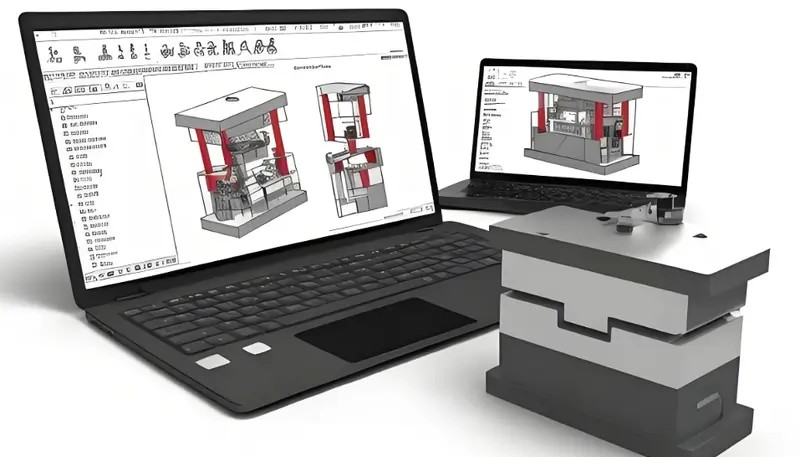
There are three main methods: water cooling, oil heating and cooling, and electrical heating. The method you choose depends on the target temperature, the material, and the part requirements. Most production shops use water for 80% or more of their tooling.
Water circulation (standard). A temperature controller circulates water through channels drilled into the mold. For standard applications below 95 C, pressurized water systems are the default. They are fast, efficient, and easy to maintain. Most commodity plastics (PP, PE, PS, ABS) and many engineering plastics (PC, POM) use water systems. The key advantage of water is its high specific heat capacity — it absorbs and transfers heat faster than any other practical coolant.
Oil heating and cooling (high-temperature). When you need mold temperatures above 95 C — which is common for PEEK, PPS, LCP, PEI, and high-temperature nylons — you switch to thermal oil. Oil systems can reach 200 to 250 C safely. The trade-off is slower response time, higher energy consumption, and more maintenance (oil degradation, seal leaks). Oil also has lower specific heat capacity than water, so it takes longer to stabilize after start-up or temperature changes.
Electrical cartridge heaters. For very specific zones that need independent temperature control — like a hot runner manifold or a core insert that tends to run cold — cartridge heaters with thermocouple feedback give you pinpoint accuracy. They are not used for full-mold temperature control but for targeted supplements to the primary cooling system.
What Are the Recommended Mold Temperatures by Material?
Below is a practical reference table based on material supplier data sheets and real production experience. These are starting points — you fine-tune from here based on your specific part geometry and quality requirements.
| 素材 | Abbreviation | Mold Temp Range (C) | Cooling Medium |
|---|---|---|---|
| ポリプロピレン | PP | 異なる温度制御方法はどのように比較されますか? | Water |
| Polyethylene (HDPE/LDPE) | PE | 15 to 60 | Water |
| Polystyrene (General/HIPS) | 追記 | 異なる温度制御方法はどのように比較されますか? | Water |
| ABS | ABS | 40 to 80 | Water |
| Polyamide 6 (Nylon 6) | PA6 | 60 to 90 | Water/Oil |
| Polyamide 66 (Nylon 66) | PA66 | 70 to 100 | Water/Oil |
| ポリカーボネート | PC | 80 to 120 | Water/Oil |
| Polyoxymethylene (Acetal) | POM | 60 to 100 | Water/Oil |
| Polybutylene Terephthalate | PBT | 40 to 80 | Water |
| Polyethylene Terephthalate | PET | 120 to 150 | Oil |
| Polyetheretherketone | 覗き見 | 160 to 200 | Oil |
| Polyphenylene Sulfide | ピーピーエス | 130 to 160 | Oil |
| Thermoplastic Polyurethane | TPU | 20 to 50 | Water |
| Polymethyl Methacrylate (Acrylic) | PMMA | 60 to 90 | Water |
| Polyphenylene Oxide (Noryl) | PPO/PPE | 70 to 100 | Water/Oil |
How Does Mold Temperature Affect Part Quality?
金型温度は、四つの最も一般的な成形品欠陥(シンクマーク、弱い溶接線、ショットショット、および反り)を直接引き起こすまたは防止します。各問題に対して調整することは通常最も迅速な解決策です。 Sink marks. 厚肉部の表面がコアが完全に充填される前に固化すると、これらが現れます。高い金型温度は表面形成を遅らせ、より多くの保圧時間を許容し、シンクマークの深さを大幅に減少させます。5 mm厚のABS突起の場合、金型温度を40 °Cから70 °Cに上げると、シンクマークの深さを0.3 mmから0.05 mm未満に削減できます。 Weld lines. 二つの流動前面が合流する場所では、溶接部の強度は二つの溶融表面がどの程度融合するかに依存します。
温かい金型は、合流点での溶融前面温度を高く保ちます。ガラス充填PA66の場合、金型温度を80 °Cから120 °Cに上げると、溶接線強度を20から30%改善できます。 Short shots. 過度に冷たい金型は、溶融体がキャビティを完全に充填する前に凍結させます。温度を上げると流動長が改善され、特に薄肉部品において効果があります。 Warping. 金型の片側が他側より高温で運転されると、部品は不均一に収縮し、高温側に向かって反る。対策は両ハーフに同じ目標温度を設定するだけではなく、実際の表面温度が2~3°C以内で一致することを確認することである。
Weld lines. 二つの流動前面が合流する場所では、溶接部の強度は二つの溶融表面がどの程度融合するかに依存します。温かい金型は、合流点での溶融前面温度を高く保ちます。ガラス充填PA66の場合、金型温度を80 °Cから120 °Cに上げると、溶接線強度を20から30%改善できます。 Short shots. 金型が冷たすぎると、溶融樹脂がキャビティを完全に充填する前に凍結してしまう。温度を上げると流動長が向上し、特に薄肉部品で効果的である。これは多キャビティ金型で断続的な未充填が発生した際に最初に確認すべき事項である。 Warping. 平坦な部品が最も影響を受けやすい。
金型の片側が他側より高温で運転されると、部品は不均一に収縮し、高温側に向かって反る。対策は両ハーフに同じ目標温度を設定するだけではなく、実際の表面温度が2~3°C以内で一致することを確認することである。
How Do You Design Cooling Channels for Uniform Temperature?
Uniform mold temperature is the goal, and it starts with cooling channel design during toolmaking. The principles are straightforward but often compromised for cost or time reasons — which you pay for later in higher scrap rates and endless process tweaking.
Channel placement. Cooling channels should follow the cavity contour as closely as possible. The distance from the channel center to the cavity surface should be 1.5 to 2.5 times the channel diameter. Too close, and you get cold spots; too far, and cooling is too slow. In our shop, the standard is 2x the diameter for most production molds.
Flow velocity. Turbulent flow transfers heat 3 to 5 times more efficiently than laminar flow. You want a Reynolds number3 above 4000 in every channel. That means your coolant pump needs enough pressure to push water through all channels at adequate velocity — not just dump it through the largest channel and starve the rest.
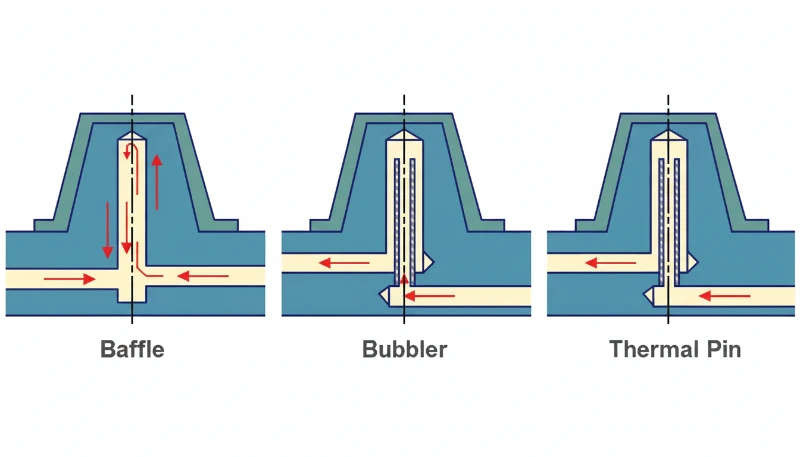
Baffles and bubblers. For deep cores or areas that are difficult to reach with straight channels, baffles (flat plates that split flow into two directions) and bubblers (tubes inside a larger hole) are the practical solution. They work well, but they increase pressure drop and need regular cleaning to prevent scale buildup.
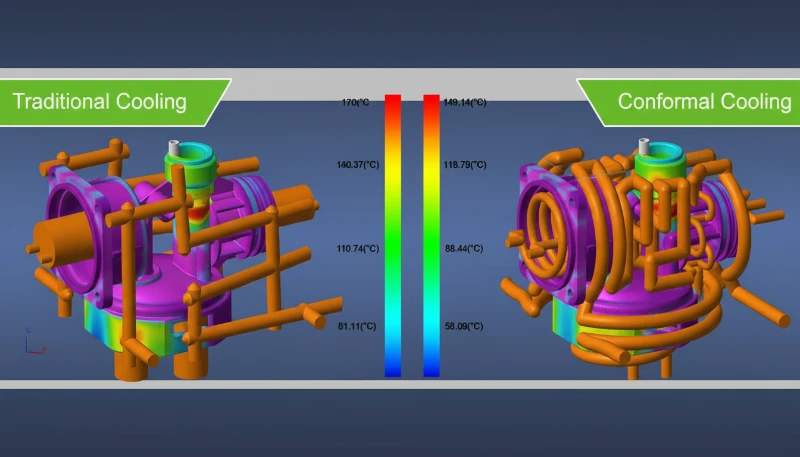
Conformal cooling. 金属3Dプリンティング(DMLS/SLM)により、キャビティ輪郭に正確に沿った冷却チャネルを作成できます。コンフォーマル冷却はサイクルタイムを20~40%削減し、ホットスポットを解消します。プリントインサートのコストはドリルプレートの3~5倍ですが、高量産(10万個以上)では価値があり、短期生産では過剰です。
「キャビティ表面での5℃の温度勾配は、精密部品において測定可能な寸法変動を引き起こす可能性があります。」真
For parts with tolerances of plus or minus 0.05 mm or tighter, a 5 C temperature difference between the fixed and moving mold halves produces differential shrinkage that pushes dimensions out of spec. This is why precision molders target cavity surface temperature uniformity within plus or minus 2 C.
「油温加熱システムでは、金型温度を最大250℃まで上げることができます。」偽
Thermal oil circulation systems are rated for continuous operation at 200 to 250 C, making them the standard choice for high-temperature engineering plastics like PEEK (160 to 200 C mold temp), PPS (130 to 160 C), and PEI. However, oil systems have slower response times and higher maintenance requirements compared to water.

How Do Different Temperature Control Methods Compare?
マルチキャビティ金型全体での冷却液の不均一流れ
| Method | Temp Range | Response Speed | 精密 | メンテナンス | 最適 |
|---|---|---|---|---|---|
| Water (standard) | 10 to 90 C | 速い | Plus or minus 1 to 2 C | 低い | Most commodity and engineering plastics |
| Pressurized water | 90 to 130 C | 速い | Plus or minus 1 to 2 C | 低~中 | PC, high-temp nylon, POM |
| Thermal oil | 100 to 250 C | Slow | Plus or minus 2 to 5 C | 高い | PEEK, PPS, PEI, LCP |
| Electric cartridge | 200 to 400 C | ミディアム | Plus or minus 1 C (local) | ミディアム | Hot runners, targeted zones |
| Conformal cooling and water | 10 to 90 C | Very fast | Plus or minus 1 C | 低い | High-volume precision parts |
What Common Problems Come from Wrong Mold Temperature?
ここでは、金型温度が適切に設定されていない場合に生産現場で繰り返し見られるトラブルシューティング表を紹介します。これらの問題に直面している場合は、他の調整を行う前に、まず金型温度を確認してください。
| オペレーターは、機械のノズル付近では耐熱手袋と保護眼鏡を着用する必要があります。ほとんどのエンジニアリングプラスチックでは、溶融温度が摂氏250度を超えます。最新の機械にはインターロック式安全ゲートが装備されており、開くとクランプ機構が停止します。PVCやアセタールなどの材料を加工する際には、加工温度で有害な蒸気が発生するため、適切な換気が不可欠です。油圧システムの定期的な点検により、生産現場での滑り事故や火災リスクを引き起こす漏れを防止します。ZetarMoldでは、すべてのオペレーターが生産を開始する前に認定安全トレーニングプログラムを修了し、各機械は四半期ごとに安全インターロック検証を受け、非常停止システムが正しく機能することを確認しています。 | Likely Cause | Fix |
|---|---|---|
| Gloss variation on textured surface | Mold too cold — plastic skin freezes before replicating texture | Raise mold temp 10 to 15 C |
| Sink marks at ribs or bosses | Mold too cold — insufficient packing before freeze-off | Raise mold temp and extend packing time |
| Warpage on flat parts | Temperature gradient between mold halves exceeds 5 C | Balance flow rates, add baffles, check for blocked channels |
| Long cycle time | Mold temperature set too high for the material | Lower within recommended range; verify with cavity thermocouple |
| Short shots in thin walls | Mold too cold — premature freeze | Raise mold temp 10 to 20 C |
| Ejector pin marks or sticking | Mold too hot — part not rigid enough at ejection | Lower mold temp or increase cooling time |
| Brittle parts (PA/POM) | Mold too cold — insufficient crystallization | Raise mold temp to upper end of recommended range |
| Dimensional drift between cavities | Uneven coolant flow across multi-cavity mold | 半結晶性: |
How Do You Measure and Monitor Mold Temperature?
標準的な手法は、スポットチェックには放射温度計、連続監視には熱電対を使用し、冷却水温度測定値とクロスチェックすることである。生産では少なくとも2つの方法が必要である。温度コントローラーの表示だけに頼るのは測定ではない—それは設定値であり、実際のキャビティ表面温度ではない。 Surface pyrometer. 最も迅速な方法。安定化のために5から10ショットを運転後、接触式高温計を脱型直後のキャビティ表面に向けます。少なくとも三箇所 — ゲート近く、充填終端、および厚肉部 — で測定します。ばらつきが5 °Cを超える場合、冷却は均一ではありません。
Thermocouple sensors. 生産中の連続監視には、金型鋼材に埋め込まれた熱電対(キャビティ表面から1~2mm下)がリアルタイムデータを提供する。最新の温度コントローラーの多くはこれらの測定値を記録し、温度が設定範囲外にずれた場合に警報を発動できる。 Coolant flow and temperature differential. 各回路に入るおよび出る冷却剤の温度を測定します。2から3 °Cの差は正常です;5 °C以上は回路が過剰な熱を吸収していることを意味し、通常は不十分な流量または過長のチャンネルを示します。
How Does Mold Temperature Affect Specific Materials?
金型温度の影響は、半結晶性樹脂と非晶性樹脂で根本的に異なる。半結晶性材料は適切な結晶形成のために70~200°Cを必要とし、非晶性樹脂は主に応力緩和のために20~120°Cを必要とする。 PA6 and PA66 (Nylon). ナイロン6の溶融体処理温度は通常230から280 °Cで、標準グレードの金型温度は70から90 °C、ガラス充填バージョンでは80から120 °Cです。40 °C以下では、PA66は不均一に結晶化し、成形数日後に反りを生じる成形品を生成します。 PC (Polycarbonate). PCの溶融体射出成形温度は280から320 °Cで運転され、金型温度は80から120 °Cです。PCは非晶質 — 内部応力が懸念であり、結晶化ではありません。
冷たい金型はポリマー鎖を高度に配向した状態で凍結させ、応力割れのリスクを生み出す。 TPU (Thermoplastic Polyurethane). TPU成形プロセスパラメータは狭い:溶融温度190~230°C、金型温度20~50°C。冷たすぎると表面が鈍くなり、温かすぎると部品が金型に付着する。柔らかいグレードほど感度が高い。 PEEK (Polyetheretherketone). PEEKは最も高い金型温度を必要とする:油加熱による160~200°C。150°C以下では結晶化が不十分となり、強度と耐薬品性が低下した部品が生成される。
What Are Advanced Mold Temperature Control Techniques?
Varitherm動的加熱、パルス冷却、コンフォーマルチャネルなどの先進技術は、サイクルタイムを20~40%短縮しながら品質を向上させることができる。投資は必要だが、大量生産ではすぐに回収される。 Varitherm (dynamic mold temperature control). 金型は射出中に高温に加熱され、その後、取り出しのために急速に冷却される。これにより、高温金型の表面品質と、低温金型に近いサイクルタイムが得られる。蒸気または高温油と冷却水の切り替えが必要だが、自動車内装トリムのような高外観部品では、塗装や表面再仕上げ工程を不要にする。 Pulse cooling. パルス冷却は、冷却回路内の流動と停止を交互に繰り返す。
停止期間中、熱は金型鋼材のより深部に伝導し、より均一な温度勾配を作り出す。流れが再開されると、全体の熱がより効率的に除去される。研究によれば、厚肉部品で10~15%のサイクルタイム短縮が実現される。 Insulation layers. 多キャビティ金型では、キャビティ間に熱遮断材(チタン合金またはセラミック)を挿入し、高温運転キャビティから低温運転キャビティへの熱伝達を防止します。これにより、同一金型内で異なる材料または肉厚を、温度ゾーンのクロスコンタミネーションなしで運転できます。サプライヤーを評価し、金型温度能力がプロジェクトにどのように影響するかを理解したい場合は、構造化評価フレームワークについては injection molding supplier sourcing guide をご覧ください。
金型温度に関する最もよくある質問は何ですか?
よくある質問
What is the ideal mold temperature for ABS injection molding?
ABSの場合、推奨される金型温度は40〜80℃です。表面仕上げが重要でない汎用部品では、50〜60℃で運転します。塗装なしで高光沢の表面が必要な場合は、70〜80℃にして完全なテクスチャ再現性を得てください。40℃を下回ると、部品表面に流れ跡やくすみが生じます。また、ABSは非晶質であるため、金型温度は主に表面品質と残留応力に影響し、結晶化度にはあまり影響しないことに注意してください。これが経験豊富な成形業者が常に材料サプライヤーのデータシートの推奨値から始め、最初の生産試作時の実際のキャビティ温度測定と部品検査結果に基づいて微調整する理由です。
Can mold temperature be too high?
はい、その通りです。金型が熱すぎると、部品は射出前に十分に固化しません。これにより、金型へのこびり付き、変形、サイクルタイムの延長、収縮率の増加が引き起こされます。極端な場合、部品は金型から離れる際に自重で変形することがあります。常に材料サプライヤーが推奨する範囲内に留まり、温度コントローラーの表示だけに頼らず、放射温度計で実際のキャビティ表面温度を確認してください。これが経験豊富な成形業者が常に材料サプライヤーのデータシートの推奨値から始め、最初の生産試作時の実際のキャビティ温度測定と部品検査結果に基づいて微調整する理由です。
How does mold temperature affect cycle time?
冷却時間は通常、射出成形サイクル全体の60~70%を占めます。金型温度が高いと、部品が十分に剛性を持って射出可能な温度に達するまでの時間が長くなります。金型温度が20℃上昇すると、サイクルタイムは10~30%増加することがありますが、これは肉厚と材料の熱伝導率に依存します。そのため、品質要件を満たす範囲で可能な限り低い金型温度を使用すべきです。これが経験豊富な成形業者が常に材料サプライヤーのデータシートの推奨値から始め、最初の生産試作時の実際のキャビティ温度測定と部品検査結果に基づいて微調整する理由です。
What is the difference between mold temperature and melt temperature?
溶融温度は、プラスチックが金型キャビティに入る時の温度で、通常は材料に応じて180〜320℃です。金型温度は、鋼製キャビティ表面の温度で、通常は15〜200℃です。これらは独立して制御されます―溶融温度はシリンダーヒーターとスクリューのせん断作用により、金型温度は冷却または加熱システムにより制御されます。最適な部品品質のためには、両方とも正しく設定する必要があります。これが経験豊富な成形業者が常に材料サプライヤーのデータシートの推奨値から始め、最初の生産試作時の実際のキャビティ温度測定と部品検査結果に基づいて微調整する理由です。
How do you fix warpage caused by uneven mold temperature?
まず、5~10ショットの安定化後に放射温度計を使用して複数点のキャビティ表面温度を測定します。高温ゾーンと低温ゾーンを特定します。次に、バルブで流量を調整し、過冷却された流路には流量制限部品を追加し、冷却不足の領域にはバッフルを設置するなどして、冷却液の流量を均一化します。目標は、キャビティ表面全体の温度差を3℃未満にすることです。永続的な反りが生じる場合は、金型内の冷却流路レイアウトを変更する必要があるかもしれません。これが経験豊富な成形業者が常に材料サプライヤーのデータシートの推奨値から始め、最初の生産試作時の実際のキャビティ温度測定と部品検査結果に基づいて微調整する理由です。
Does mold temperature affect shrinkage in injection molding?
はい、顕著に影響します。金型温度が高いほど、PA、POM、PEEKなどの半結晶性材料では結晶化が進み、収縮が増加します。PC、ABS、PSなどの非晶性材料では、金型温度が収縮に与える影響は小さいものの、残留応力緩和を通じて寸法精度に影響を及ぼします。厳しい公差が要求される場合、金型温度範囲の下限と上限における収縮量の差を考慮する必要があります。そのため、経験豊富な成形業者は常に材料サプライヤーのデータシートの推奨値から開始し、初回生産試作時の実際のキャビティ温度測定と部品検査結果に基づいて微調整を行います。
What happens if you run PA66 with a mold temperature below 50 C?
ナイロン表面は、結晶化度が大幅に低い、ほとんど非晶質の層として凍結します。これにより、引張強度が10~20%低下し、耐薬品性が減少し、吸湿速度が増加し、部品表面に目に見える流れ跡が生じることがよくあります。構造用または負荷支持用PA66部品の場合は、常に70℃以上の金型温度を使用して、適切な結晶化と機械的性能を達成してください。これが経験豊富な成形業者が常に材料サプライヤーのデータシートの推奨値から始め、最初の生産試作時の実際のキャビティ温度測定と部品検査結果に基づいて微調整する理由です。
How tight should mold temperature tolerance be for precision parts?
公差がプラスマイナス0.05mm以下の精密部品の場合、全てのキャビティ表面で金型温度をプラスマイナス2℃以内に制御することを目指します。これには、適切に設計された冷却チャネル、バランスの取れた冷却剤の流れ、熱電対フィードバックを備えたPID制御温度ユニットが必要です。光学レンズや医療部品などの超精密成形の場合、目標はプラスマイナス1℃であり、通常はコンフォーマル冷却または複数の独立した温度ゾーンが必要です。このため、経験豊富な成形業者は常に材料サプライヤーのデータシートの推奨事項から始め、最初の生産試作運転中の実際のキャビティ温度測定と部品検査結果に基づいて微調整を行います。
Get Mold Temperature Right — From Day One
ZetarMoldでは、47台の射出成形機(90T~1850T)のそれぞれが独立したPID制御温度ユニットを装備しています。8名のシニアエンジニアチームが、部品形状と材料に最適化された冷却レイアウトを設計します。上海工場での400種類以上の材料処理と20年以上の経験を活かし、初回成形から100万個目まで金型温度を一貫して維持します。無料見積もりを取得してください。
-
型温度: 金型温度とは、射出成形中に溶融ポリマーと接触するキャビティ表面の温度を指し、通常は金型内のチャネルを通して水または熱油を循環させることで制御されます。 ↩
-
semi-crystalline: 半結晶性とは、溶融状態から冷却する際に秩序立った結晶領域を形成するポリマータイプを指します。金型温度は、ナイロン、POM、PEEKなどの半結晶性ポリマーの結晶化速度と度合いを直接制御します。 ↩
-
Reynolds number: レイノルズ数とは、パイプやチャネル内の流体流動パターンを予測するために使用される無次元数を指します。レイノルズ数が4000を超えると乱流を示し、層流よりも3〜5倍優れた熱伝達を提供します。 ↩



 EN
EN  ES
ES  FR
FR  DE
DE  PT
PT  AR
AR  RU
RU  JA
JA  KO
KO  IT
IT  NL
NL  TR
TR  PL
PL 