 コンテンツへスキップ

- Metal insert injection molding permanently encapsulates metal components (brass inserts, threaded nuts, electrical contacts) within plastic parts during the molding cycle.
- The primary advantages over post-mold insertion are superior pull-out and torque strength, elimination of secondary assembly operations, and consistent insert positioning accuracy.
- Heat-staking (ultrasonic or thermal) and press-fitting are alternative post-mold methods but cannot match the bond strength of in-mold insertion for demanding applications.
- The main design challenges are differential thermal expansion between metal and plastic, insert fixation during injection, and the risk of cracking in brittle polymers around the insert.
- Proper insert design—including knurling geometry, undercut features, and L/D ratio—determines the long-term retention strength of the assembled part.
What Is Metal Insert Injection Molding and How Does the Process Work?
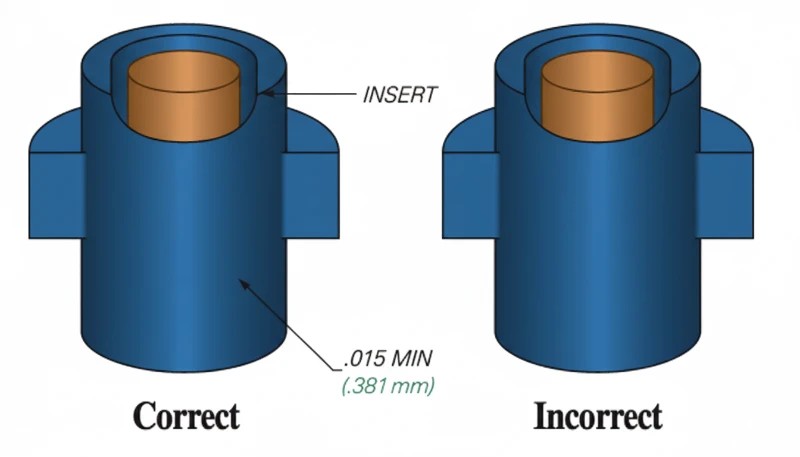
Metal insert injection molding is a manufacturing process in which metal components—most commonly threaded inserts, electrical contacts, pins, bushings, or structural reinforcements—are placed into a mold cavity before plastic is injected. The molten plastic flows around the metal insert and solidifies, encapsulating it within the part. When the mold opens, the finished component contains a permanently embedded metal feature with no additional assembly required.
This process is fundamentally different from post-mold insertion methods (heat staking, ultrasonic insertion, or press fitting), where the metal component is added after the plastic part has been molded. In-mold insertion achieves superior mechanical performance because the plastic shrinks onto the insert during cooling, creating compressive retention forces that complement the mechanical interlocking provided by knurling or undercuts on the insert surface—a principle central to the 射出成形プロセス1
The process sequence is:
- Place metal inserts into precision locating features in the mold (manually or robotically)
- Close the mold; inserts are held by locating pins or cores
- Inject molten plastic at controlled temperature and pressure
- Allow cooling until the plastic solidifies around the insert
- Eject the finished part; the insert is permanently encapsulated
| Insert Type | 一般材料 | 申し込み | Retention Mechanism |
|---|---|---|---|
| Threaded inserts | Brass, stainless steel | Fastening points, screw bosses | Knurling + shrink-on |
| Electrical contacts | Copper, brass, beryllium copper | Connectors, switches, sensors | Undercuts + encapsulation |
| Structural pins | Steel, aluminum | Hinge points, load-bearing joints | Through-hole + encapsulation |
| Bearing inserts | Bronze, stainless steel | Rotating shafts, guide bushings | Interference fit + encapsulation |
| Decorative inserts | Aluminum, stainless | Logos, trim, aesthetic accents | Shallow encapsulation |
In-mold insertion achieves higher insert pull-out strength than post-mold ultrasonic insertion.真
In-mold insertion achieves pull-out forces 20–50% higher than ultrasonic insertion of equivalent inserts in the same plastic, because the plastic shrinks radially onto the knurled insert surface during cooling. Ultrasonic insertion relies on locally melted and re-solidified plastic, which creates a smaller effective bonding zone. For applications requiring maximum retention strength—such as high-torque screw joints—in-mold insertion is the preferred method.
What Are the Main Benefits of Metal Insert Injection Molding?
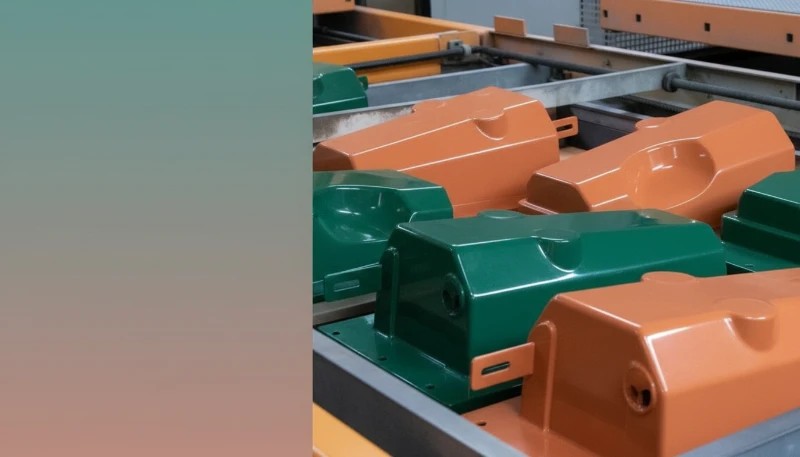
Insert injection molding delivers advantages that neither pure plastic nor pure metal components can match alone:
Elimination of assembly operations: When metal inserts are molded in, the finished part exits the press complete—no secondary press-fitting, heat staking, or assembly jig operations are required. For high-volume production, this eliminates a labor-intensive station that can represent 15–30% of total part cost on complex assemblies.
Superior joint strength: Insert molded thread bosses consistently outperform post-molded inserts in torque-out, push-out, and pull-out tests. The plastic’s thermal shrinkage creates a precompressed interface between the knurled insert and the surrounding polymer—analogous to a shrink-fit metal joint. This compressive retention is additional to the mechanical interlocking from knurling or undercuts.
Precise insert positioning: Mold locating pins position each insert to ±0.1 mm accuracy relative to the part datum. Post-assembly methods cannot achieve this consistency reliably in high-volume production. Precise positioning is critical in electrical connector bodies and sensor housings where contact location determines functional performance.
Increased design freedom: Insert molding enables part geometries that would be impossible to manufacture in metal alone. A complex connector housing with 20 embedded contacts can be produced in a single molding cycle; achieving the same result with machined metal would require multiple parts and assembly steps.
Material optimization: By placing metal only where strength, conductivity, or wear resistance is needed, insert molding allows the bulk of the part to be produced in lower-cost, lower-density plastic. The result is a lighter, more cost-effective component that performs like a metal part—a key advantage over オーバーモールディング2
What Design Rules Govern Metal Insert Placement and Geometry?
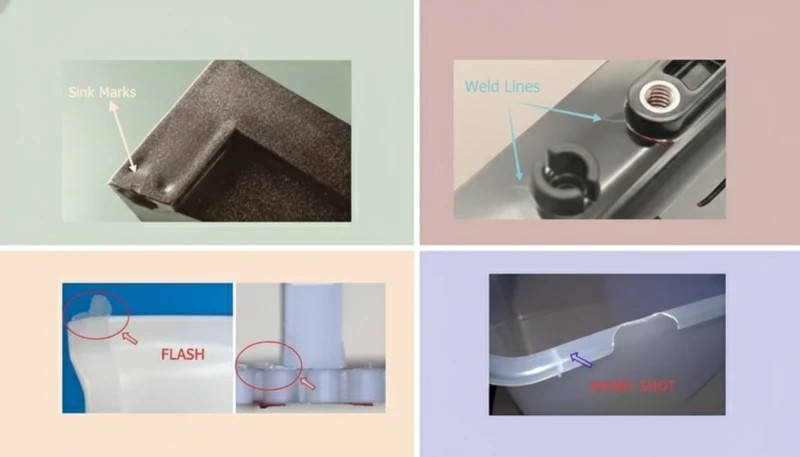
The mechanical performance of insert-molded components depends critically on the insert’s geometry and its relationship to the surrounding plastic. Poor insert design is the most common cause of cracking, insert loosening, or early field failure.
Minimum wall thickness: The plastic wall surrounding the insert must be thick enough to contain the hoop stress created by thermal contraction during cooling. The general rule is:
- For brass inserts in PP or PE: wall thickness ≥ 0.8 × insert outer diameter
- For brass inserts in ABS or PA: wall thickness ≥ 0.6 × insert outer diameter
- For steel inserts in PC or POM: wall thickness ≥ 1.0 × insert outer diameter (stiffer plastic, higher stress risk)
Knurling and undercut geometry: The insert’s outer surface must provide mechanical interlocking features that resist both axial (push/pull) and rotational (torque) forces. Standard diamond knurling provides both. For applications requiring primarily axial retention (e.g., press-fit bearing inserts), circumferential grooves or barbs are more effective. Undercut depths of 0.2–0.4 mm with a 60° included angle provide good interlocking without creating excessive stress risers.
Embedment depth (L/D ratio): The insert must be encapsulated deep enough to achieve the required retention force. For most thread applications, minimum embedment depth = 1.5 × insert outer diameter. For press-fit inserts in high-load applications, 2.0 × D is recommended. Insufficient embedment depth is the most common cause of insert pullout in service.
Insert preheating: Preheating brass inserts to 150–200°C before placement in the mold reduces the thermal shock experienced by the plastic during fill. The heated insert allows the plastic near its surface to cool more slowly, reducing residual stress in the critical transition zone between metal and plastic. For brittle polymers (PC, glass-filled PA), insert preheating is especially important.
Insert orientation and draft: Inserts must be oriented so that the primary load direction (axial or radial) is perpendicular to the most compliant plastic deformation direction. Threaded inserts should have their axis perpendicular to the parting line—a key guideline in プラスチック射出成形金型設計3
Which Plastic Materials Are Best Suited for Metal Insert Molding?
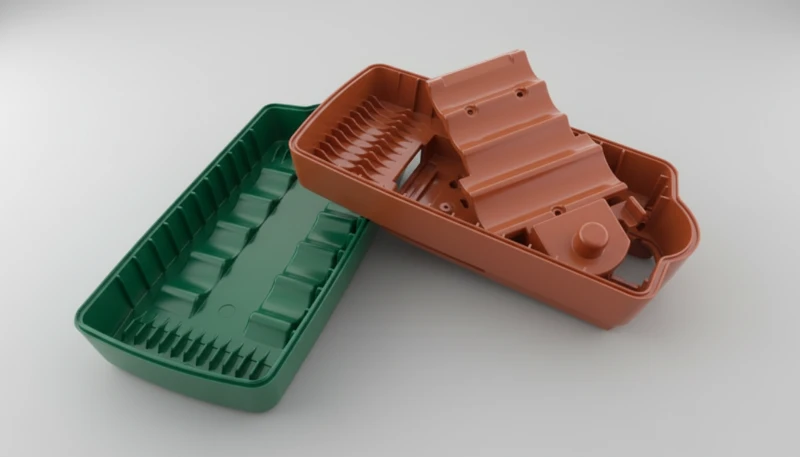
Not all injection molding resins perform equally well with metal inserts. The primary material selection criteria are:
- Coefficient of thermal expansion (CTE): The mismatch between metal and plastic CTE determines the magnitude of interface stresses during thermal cycling. Larger CTE differences generate higher stresses. Polymers with CTEs closer to brass (18–20 µm/m·°C) experience lower thermal stress than those with very high CTEs (LDPE: ~200 µm/m·°C).
- Elongation-at-break: Polymers with higher elongation (PE, PP, flexible grades) can absorb more shrinkage deformation without cracking during cooling. Brittle polymers (glass-filled PA, POM, rigid PC) need thicker walls and insert preheating to manage the stress.
- Chemical resistance to metal: Some polymers can react with metal surfaces (particularly copper in brass) under elevated temperatures, degrading adhesion or causing localized degradation.
| プラスチック | Insert Molding Suitability | 稼働中のプラスチック射出成形機が部品を生産中 | 代表的なアプリケーション |
|---|---|---|---|
| PA66 (Nylon) | 素晴らしい | Good CTE match with brass; pre-dry | Automotive connectors, structural |
| PA6 | 素晴らしい | More flexible than PA66; easier on inserts | General mechanical components |
| ABS | グッド | Moderate CTE; needs adequate wall | Consumer electronics, housings |
| PC | Good with care | Brittle; preheat inserts; 1.0×D wall | Optical components, medical |
| PP | 中程度 | High CTE; large wall required; risk of loosening | Low-load fastening, consumer |
| POM (Acetal) | 中程度 | Low elongation; cracking risk; preheat essential | Precision mechanical, gears |
| 覗き見 | グッド | Low CTE; high temperature; specialist tooling | Aerospace, medical implants |
Any plastic material can be used for insert injection molding without modification.偽
Material selection for insert molding requires careful evaluation of CTE mismatch, elongation-at-break, and brittleness. Brittle, glass-filled polymers with high modulus and low elongation—particularly glass-filled POM and certain PC/ABS blends—can crack around inserts during cooling if wall thickness, preheat temperature, or injection parameters are not optimized for the metal-plastic combination. A material that performs perfectly in standard injection molding may be unsuitable for insert molding without design modifications.
What Are Common Defects in Insert Molded Parts and How Are They Prevented?
Metal inserts can be added to any injection molded part without modifying the mold design.偽
Insert molding requires dedicated mold features—locating pins, core pulls, or ultrasonic insertion bosses—to hold inserts precisely during injection. Standard molds cannot accommodate inserts without redesign.
Thread inserts in injection molded parts consistently outperform molded-in plastic threads in pull-out strength.真
Metal threaded inserts provide 3–5× higher pull-out and torque resistance than equivalent plastic threads, making them essential for assemblies subjected to repeated fastening or high-vibration environments.
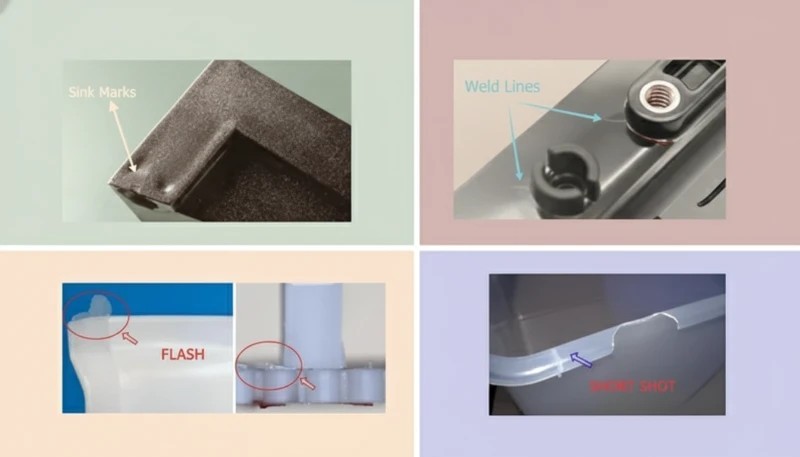
Cracking around the insert: The most serious defect. Radial cracks originating at the insert/plastic interface occur when shrinkage stresses exceed the polymer’s tensile strength at that location. Prevention: increase wall thickness, preheat inserts, reduce mold temperature, use a higher-elongation polymer grade, and ensure no sharp edges on the insert that act as crack initiators.
Insert misalignment: Inserts that shift during fill, producing parts where the insert axis is off-center or tilted. This creates uneven wall thickness and a stress concentration that promotes cracking. Prevention: use tight-fitting mold locating pins, ensure inserts are within dimensional specification, and consider robotic loading for consistency.
Weld lines near inserts: When melt flow splits around a circular insert, the two flow fronts meet on the downstream side and form a weld line. Weld lines have 20–40% lower strength than bulk material. Prevention: position gates so the weld line forms at a non-critical location, or use a fan gate to minimize split-flow distance.
Flash over insert face: Plastic flash that covers the functional face of an insert (e.g., the thread bore or contact surface). Prevention: ensure the mold sealing surface contacts the insert face with adequate force; use mold springs or insert retainer pins to maintain positive contact during injection.
Incomplete encapsulation: The plastic does not fully surround the insert, leaving voids or exposed metal. Prevention: increase injection speed and melt temperature to improve flowability; review gate location and insert orientation relative to the flow direction—critical aspects of precision injection mold improvement4
Frequently Asked Questions About Injection Molding with Metal Inserts
Q: What is the difference between insert molding and overmolding?
A: Insert molding encapsulates a pre-formed component (typically metal) within plastic in a single injection cycle. Overmolding applies a second plastic material over a previously molded plastic substrate, typically to add grip, color, or compliance. The key difference is material type (metal vs. plastic substrate) and the purpose (structural retention vs. aesthetic or functional surface addition). Some complex parts use both: metal inserts molded in first, then overmolded with a second polymer.
Q: Can insert molding be fully automated?
A: Yes. Robotic insert loading systems place inserts with repeatable positioning accuracy of ±0.05 mm, at cycle times comparable to manual loading. For high-volume production (>500,000 parts/year), robotic loading is standard practice. The system uses a vibratory bowl feeder or magazine loader to supply oriented inserts to the robot pick-point, and a vision system to verify correct insertion before the mold closes.
Q: How do I specify the correct knurling pattern for my brass insert?
A: The knurling pattern should be matched to the primary load direction. Diamond knurling (both axial grooves and circumferential rings) is the most common and resists both push/pull and torque forces. For pure torque applications (screw threads), diamond knurling is essential. For pure axial applications (press-fit shafts), circumferential grooves alone are sufficient. Standard diamond knurling has a 60° included angle with pitch of 0.6–1.0 mm.
Q: Is insert molding suitable for small production volumes?
A: Yes, but tooling cost per part is relatively high for small volumes. Insert molding tooling is more complex and expensive than standard injection molds due to the locating features for insert placement. For volumes below 10,000 parts, post-mold insertion methods (heat staking, press fitting) often have a lower total cost despite their lower joint strength. For volumes above 50,000 parts, in-mold insertion’s cycle time and strength advantages typically justify the tooling investment.
Q: What are the dimensional tolerance capabilities for insert position?
A: In-mold locating pins position inserts to ±0.1 mm from the nominal position relative to the part datum. This is sufficient for most electrical connector and threaded fastener applications. For tighter tolerances (e.g., ±0.05 mm for optical or high-frequency electrical applications), robotic loading combined with vision verification achieves this level of consistency in mass production.
Q: Can insert molding be used with recycled or bio-based plastics?
A: Yes, with some considerations. Recycled materials may have more variable melt viscosity, affecting flow consistency around inserts—particularly if the insert has complex geometry. Bio-based polymers (PLA, bio-PA) generally perform similarly to their conventional equivalents in insert molding, but should be evaluated specifically for each application. Material variability is a greater concern for insert molding than for standard molding due to the tighter process windows required for injection molding production cost reduction5
Summary: When to Choose Metal Insert Injection Molding for Your Application
Metal insert injection molding is a mature, versatile process that delivers unique performance advantages when parts require a combination of plastic’s design freedom and metal’s mechanical, electrical, or wear properties at specific locations.
Choose insert injection molding when:
- The application requires threaded connections that will be repeatedly assembled/disassembled (brass inserts dramatically outperform direct-in-plastic threads for torque durability)
- Electrical contacts must be precisely positioned relative to a plastic housing (connectors, sensors, switches)
- Production volume is high enough to justify the tooling investment (typically >50,000 parts)
- Assembly time savings from eliminating secondary operations provide a meaningful cost reduction
- The part will experience thermal cycling that would loosen post-molded inserts
Consider alternatives (heat staking, ultrasonic insertion) when:
- Production volumes are below 10,000–50,000 parts per year
- The insert position varies across product variants (post-mold methods offer more flexibility)
- The plastic is too brittle to accommodate in-mold shrinkage stresses (in this case, ultrasonic insertion creates a smaller stress zone)
When designed and processed correctly, insert injection molding is one of the most cost-effective ways to produce complex metal-plastic assemblies at scale, combining the efficiency of injection molding with the functional performance of precisely positioned metal components.
-
The mechanics of plastic shrinkage retention around metal inserts are analogous to interference fit joints; detailed process guidance is covered in injection molding process engineering documentation. ↩
-
The cost and performance advantages of integrating metal and plastic in a single operation are well-established in overmolding and insert molding literature as alternatives to multi-part assembly. ↩
-
Insert design rules—particularly wall thickness and embedment depth—are among the key considerations in plastic injection mold design for components with embedded features. ↩
-
Defect prevention in insert-molded parts relates to broader principles of precision injection mold improvement, including gate placement optimization and weld line management. ↩
-
Material selection for insert molding demands evaluation of melt viscosity consistency—a consideration addressed in injection molding production cost reduction guides covering material grade optimization. ↩




 JA
JA  EN
EN  ES
ES  FR
FR  DE
DE  PT
PT  AR
AR  RU
RU  KO
KO  IT
IT  NL
NL  TR
TR  PL
PL 