Stimare i costi di uno stampo a iniezione un tempo significava attendere giorni per un preventivo del fornitore. Il nostro Calcolatore dei costi dello stampo a iniezione ti fornisce una cifra indicativa in pochi secondi — attrezzatura dello stampo, prezzo per pezzo e costo totale del progetto, tutto suddiviso in modo da vedere dove vanno i soldi.
Questo strumento si basa su dati di prezzo reali del settore: costi delle basi stampo per dimensione e grado di acciaio, prezzi dei materiali al chilogrammo, tariffe orarie macchina per tonnellaggio della pressa e curve di sconto per volume. Non sostituisce un preventivo formale, ma vi avvicina abbastanza da consentire decisioni nelle fasi iniziali, in modo rapido.
Come si usa il calcolatore dei costi dello stampo a iniezione?
Il calcolatore è uno strumento gratuito che produce una ripartizione completa dei costi in meno di 30 secondi. Inserisci le dimensioni del pezzo, il materiale, il tipo di stampo e il volume per vedere affiancati il costo dell'attrezzatura dello stampo, il prezzo per pezzo e il costo totale del progetto. Per la preparazione dell'RFQ e il confronto tra fornitori, la nostra guida all'approvvigionamento di fornitori di stampaggio a iniezione tratta la qualificazione e il rischio commerciale.
Per una visione più ampia dello stampaggio a iniezione, la nostra guida pilastro copre i fondamenti del processo, il comportamento dei materiali e le decisioni di produzione.
Il calcolatore ha tre gruppi di parametri di input. In Progettazione del pezzo, imposta le dimensioni del pezzo, la complessità (sottosquadri, filettature, anime laterali), la finitura superficiale (standard SPI1/VDI) [fn:1] [fn:2] e la classe di tolleranza. In Stampo e produzione, scegli il tipo di stampo (alluminio per prototipi, P20 di produzione o H13/S136 temprato), il numero di cavità, la resina e la durata prevista dello stampo. In Volume di produzione, trascina il cursore fino alla tua quantità annuale — lo strumento applica automaticamente gli sconti sul volume oltre 5K, 10K, 50K e 100K pezzi.
Fai clic su Calcola stima per vedere la ripartizione completa dei costi: costo dell’attrezzatura dello stampo, prezzo per pezzo, costo del materiale per parte, tempo di ciclo stimato, costo dello stampo ammortizzato per parte e prezzo effettivo per parte al tuo volume.
Cosa determina il costo di uno stampo a iniezione?
La complessità della parte, il numero di cavità, la finitura superficiale e il grado di acciaio dello stampo sono i quattro fattori di costo. Uno stampo prototipo in alluminio a cavità singola costa da 1500 a 5000 USD; uno stampo di produzione in acciaio a più cavità supera facilmente i 50,000 USD.
Anche la scelta del materiale incide notevolmente sul costo per parte. Le resine commodity come PP o ABS costano $1.80–$2.50/kg, mentre i gradi ingegneristici come il PEEK arrivano a $55/kg o più. Il peso della parte, determinato dalle dimensioni e dallo spessore della parete, moltiplica tale differenza. A 60 grammi per una parte media, il solo materiale PEEK costa ~$3.80 per stampata — rispetto a $0.14 per il PP.
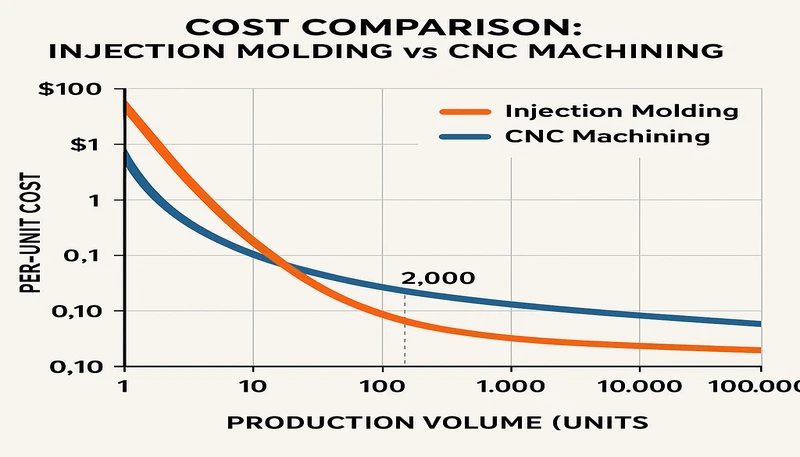
Il volume è il grande equalizzatore nell'economia dello stampaggio a iniezione. Ammortizzare uno stampo da 20.000 dollari su 100.000 pezzi aggiunge appena 0,20 dollari per pezzo. Su 1.000 pezzi, lo stesso stampo aggiunge 20 dollari per pezzo. In base alla nostra esperienza nella produzione di pezzi presso Zetar, il punto di pareggio in cui uno stampo in acciaio temprato diventa più economico per pezzo rispetto all'attrezzaggio in alluminio si colloca solitamente tra 5.000 e 10.000 unità. Al di sotto di tale soglia, i risparmi sull'attrezzaggio in alluminio superano la sua minore durata dello stampo. Al di sopra, la maggiore durata utile e le tolleranze più strette dell'attrezzaggio in acciaio offrono un chiaro vantaggio di costo per pezzo.
I layout a più cavità amplificano ulteriormente questo effetto: uno stampo a quattro cavità può costare da due a tre volte più di uno a cavità singola, ma produce quattro parti per ciclo, riducendo il costo di lavorazione per parte di circa il 75 percento. Per i programmi che superano le 100,000 unità annue, il risparmio per parte di uno stampo indurito a più cavità recupera tipicamente il sovrapprezzo dell'attrezzatura entro la prima produzione.
"Uno stampo multi-cavità in acciaio temprato può ridurre il costo di lavorazione per pezzo del 75 percento rispetto a uno stampo a cavità singola."Vero
Corretto. Quattro cavità producono quattro parti per ciclo, quindi il costo orario macchina viene ripartito su quattro parti. L’attrezzatura costa di più inizialmente, ma il risparmio per parte recupera l’investimento a volumi superiori a 50.000 unità.
“Il costo del materiale è la singola componente di costo più elevata nello stampaggio a iniezione a tutti i livelli di volume.”Falso
Falso. A bassi volumi (meno di 5,000 pezzi), l'ammortamento dell'attrezzaggio domina il costo per pezzo. Ad alti volumi, il costo di lavorazione (tempo macchina e manodopera) supera tipicamente il costo del materiale per le resine di base.
Quali sono i tipici benchmark di costo in base alla dimensione del pezzo?
Per una rapida verifica, ecco gli intervalli tipici di costo dell'attrezzatura per uno stampo di produzione a cavità singola di complessità moderata (acciaio P20, finitura lucidata):
| Dimensione del pezzo | Intervallo di costo tipico dello stampo | Stima del tempo di ciclo |
|---|---|---|
| Piccolo (< 50 mm) | $1,800 – $3,000 | 12–18 secondi |
| Medio (50–150 mm) | $3,200 – $5,500 | 20–30 secondi |
| Grande (150–300 mm) | $6,000 – $10,500 | 34–44 secondi |
| Extra grande (> 300 mm) | $12,000 – $22,000+ | 50–66 secondi |
Questi intervalli presuppongono una complessità moderata con alcuni sottosquadri, azione laterale standard e una finitura superficiale VDI 3400 lucidata3 [fn:3]. L'aggiunta di layout multi-cavità, tolleranze di precisione (inferiori a più o meno 0,05 mm) o anime a svitamento per elementi filettati spinge i costi al livello successivo. I sistemi a canale caldo, che eliminano lo scarto del canale e riducono il tempo di ciclo, aggiungono da 3.000 a 8.000 dollari per cavità ma si ripagano rapidamente a volumi superiori a 50.000 parti. I meccanismi lifter per i sottosquadri interni e le anime collassabili per gli elementi a sformo inverso sono ulteriori fattori di costo che i costruttori di stampi quotano caso per caso.
Come si calcola il costo per parte?
Il costo per parte è la somma di materiale, lavorazione e spese generali. Per le resine commodity a volume medio, la ripartizione tipica è di circa il 30 percento materiale, il 50 percento lavorazione e il 20 percento spese generali. Il calcolatore scompone ogni componente in modo che tu possa vedere dove va il denaro e identificare la maggiore leva di riduzione dei costi per il tuo specifico programma.
Il costo del materiale segue una formula semplice: prezzo della resina al chilogrammo per il peso della parte in chilogrammi per un fattore di scarto di 1.15 che tiene conto di canali, materozza e scarti di avvio. Per l'ABS a 2.50 dollari al kg e una parte da 60 grammi, il costo del materiale risulta di circa 0.17 dollari per parte. Passando a un nylon caricato con vetro a 4.00 dollari al kg, tale valore raddoppia a 0.33 dollari per parte. Per il PEEK a 55 dollari al kg, il solo materiale raggiunge 3.80 dollari per stampata — un aumento di ventidue volte rispetto al PP commodity a parità di peso della parte. Ecco perché la selezione del materiale ha un effetto così drastico sul prezzo per parte, soprattutto per le parti più pesanti.
Il costo di lavorazione è determinato dalla tariffa oraria della macchina, dal tempo di ciclo e dal numero di cavità. La formula è: tariffa oraria della macchina divisa per 3600, moltiplicata per il tempo di ciclo in secondi, divisa per il numero di cavità. Una pressa da 75 tonnellate a 75 dollari all'ora che esegue cicli di 25 secondi su una singola cavità costa circa 0.52 dollari per parte. Passando a uno stampo a quattro cavità sulla stessa pressa, il costo di lavorazione scende a circa 0.13 dollari per parte — una riduzione del 75 percento. Vediamo regolarmente i clienti ottenere questo tipo di risparmio quando passano dall'attrezzatura prototipo a cavità singola agli stampi di produzione a più cavità presso Zetar.
Le spese generali aggiungono tipicamente dal 20 al 30 percento oltre a materiale e lavorazione, coprendo l'ispezione QC, i materiali di imballaggio, le operazioni secondarie di rifilatura o assemblaggio e la gestione logistica. Per parti medicali o automobilistiche che richiedono certificati di ispezione in ingresso, rapporti di ispezione del primo articolo o documentazione di controllo statistico di processo, le spese generali possono salire al 35 percento o più. Il calcolatore utilizza un margine di spese generali predefinito del 25 percento, che copre la produzione di grado commerciale standard.

"Gli stampi in alluminio possono ridurre i tempi di ciclo dal 15 al 30 percento rispetto agli stampi in acciaio grazie a una più rapida dissipazione del calore."Vero
Corretto. La conducibilità termica dell’alluminio è circa quattro volte superiore a quella dell’acciaio P20, consentendo un raffreddamento più rapido e tempi di ciclo più brevi. Questo vantaggio è più significativo per le parti con sezioni di parete spesse.
“Gli stampi in acciaio temprato (H13/S136) sono sempre la scelta più conveniente per qualsiasi progetto di stampaggio a iniezione.”Falso
Falso. Per volumi inferiori a 5,000 pezzi, il maggiore costo di attrezzaggio dell'acciaio temprato non viene mai recuperato. L'attrezzaggio in alluminio o P20 offre un costo totale di programma inferiore a volumi bassi e medi.
Il calcolatore applica un margine di spese generali del 25 percento e poi vi sovrappone gli sconti sul volume: 5 percento a 5.000 pezzi, 10 percento a 10.000, 15 percento a 50.000 e 20 percento a 100.000 o più. Queste soglie riflettono le comuni fasce di prezzo del settore in cui i fornitori iniziano a offrire riduzioni significative per pezzo. Per le resine personalizzate o ingegnerizzate, l'effetto del volume è ancora più marcato perché il costo del materiale rappresenta una quota maggiore del prezzo totale per pezzo. Nella maggior parte dei casi la curva di sconto si appiattisce oltre i 200.000 pezzi, perché il fattore dominante diventa il costo di lavorazione piuttosto che l'ammortamento dell'attrezzatura.
Quando passare dall'attrezzatura di prototipazione a quella di produzione?
Se il vostro volume annuo è inferiore a 5.000 pezzi e il design è ancora in evoluzione, uno stampo prototipo in alluminio è quasi sempre la scelta giusta. L'attrezzatura costa dal 40 al 70 percento in meno rispetto all'acciaio, i tempi di consegna sono più brevi (in genere da 2 a 4 settimane contro 5-8 per l'acciaio) e le modifiche sono più economiche. Nella nostra attrezzeria in Zetar possiamo modificare una cavità di uno stampo in alluminio in un solo giorno per semplici variazioni geometriche. Il compromesso: la vita utile dello stampo è in genere inferiore a 100.000 stampate, le tolleranze sono più ampie e le opzioni di finitura superficiale sono limitate rispetto all'attrezzatura in acciaio temprato [fn:2].
L'alluminio dissipa inoltre il calore più rapidamente dell'acciaio, il che può ridurre i tempi di ciclo dal 15 al 30 percento, un vantaggio di costo significativo per le produzioni in piccola serie.
Per programmi superiori a 10.000 pezzi all'anno con un design stabile, uno stampo di produzione in acciaio per utensili P20 si ripaga entro la prima serie. Una migliore finitura superficiale, tolleranze più strette, una maggiore durata dello stampo e le opzioni multicavità riducono tutte il costo per parte. A 50.000 o più pezzi all'anno, l'acciaio temprato (H13 o S136) diventa conveniente perché la maggiore durata dello stampo, da 500.000 a oltre un milione di iniezioni, elimina i fermi macchina per la ri-attrezzatura e mantiene una qualità costante dei componenti lungo l'intera serie di produzione.
Abbiamo visto clienti ridurre il costo totale del programma dal 30 al 40 percento semplicemente passando da uno stampo P20 a cavità singola a uno stampo H13 a due cavità su pezzi con volumi superiori a 200.000 unità annue — il maggiore investimento in attrezzaggio viene recuperato entro il primo lotto di produzione.
Come si ottiene un preventivo preciso per uno stampo a iniezione?
Un preventivo preciso viene generalmente restituito entro 24 ore dall'invio del modello 3D e delle specifiche del pezzo.
Invia il tuo modello 3D e i requisiti per un preventivo preciso e dettagliato entro 24 ore. I nostri ingegneri valutano la geometria del pezzo, consigliano l'acciaio dello stampo e la disposizione delle cavità, e restituiscono una ripartizione completa dei costi così puoi prendere rapidamente una decisione informata.
Domande frequenti
Domande frequenti
Quanto è accurato il calcolatore dei costi dello stampo a iniezione?
I costi degli stampi a iniezione variano ampiamente in base alle dimensioni del pezzo, alla complessità e al grado dell'attrezzatura. Uno stampo prototipo in alluminio a cavità singola per un pezzo semplice parte in genere da circa $800 a $2,000. Uno stampo di produzione a cavità singola in acciaio P20 con complessità moderata si colloca spesso tra circa $1,800 e $3,000 per pezzi piccoli, $3,200 e $5,500 per pezzi medi e all'incirca $6,000 e $10,500 per pezzi grandi. Gli stampi extra-grandi multi-cavità in acciaio temprato (H13/S136) per la produzione ad alto volume con tolleranze strette possono superare i $30,000 e raggiungere oltre $60,000 per costruzioni complesse. Anche la posizione geografica, i tempi di consegna, l'ambito di validazione e l'inclusione del campionamento influenzano il prezzo. –section 28
Qual è il costo tipico di uno stampo a iniezione?
I costi degli stampi a iniezione variano ampiamente in base alle dimensioni del pezzo, alla complessità e al grado dell'attrezzatura. Uno stampo prototipo in alluminio a cavità singola per un pezzo semplice parte in genere da circa $800 a $2,000. Uno stampo di produzione a cavità singola in acciaio P20 con complessità moderata si colloca spesso tra circa $1,800 e $3,000 per pezzi piccoli, $3,200 e $5,500 per pezzi medi e all'incirca $6,000 e $10,500 per pezzi grandi. Gli stampi extra-grandi multi-cavità in acciaio temprato (H13/S136) per la produzione ad alto volume con tolleranze strette possono superare i $30,000 e raggiungere oltre $60,000 per costruzioni complesse. Anche la posizione geografica, i tempi di consegna, l'ambito di validazione e l'inclusione del campionamento influenzano il prezzo.
Il costo dello stampo per parte diminuisce con l’aumento del volume?
Sì, l'ammortamento dell'attrezzatura dello stampo è uno dei fattori di costo più significativi nello stampaggio a iniezione. Uno stampo di produzione da 15.000 $ ripartito su 10.000 pezzi aggiunge 1,50 $ a ciascun pezzo. Lo stesso stampo su 100.000 pezzi aggiunge solo 0,15 $ per pezzo. Su un milione di pezzi, il contributo dell'attrezzatura scende ad appena 0,015 $. Questa relazione è la ragione principale per cui i programmi ad alto volume possono giustificare costosi stampi in acciaio temprato multi-cavità: il risparmio per pezzo derivante da cicli più rapidi e da un maggior numero di cavità supera rapidamente il maggiore investimento iniziale in attrezzatura.
Qual è il materiale più economico per lo stampaggio a iniezione?
Tra le resine comuni per lo stampaggio a iniezione, il polipropilene (PP) a circa 1,80 $ al chilogrammo e il polietilene (PE) sono i materiali commodity a costo più basso. Anche l'ABS, a circa 2,50 $/kg, è ampiamente utilizzato e ha un prezzo competitivo. Salendo nella scala dei costi, il nylon (PA6/PA66) e il POM si collocano nella fascia media a 3,50–4,00 $/kg. Le resine tecniche ad alte prestazioni come il PEEK (55 $/kg) e l'LCP (18 $/kg) sono significativamente più costose e vengono selezionate solo quando l'applicazione richiede le loro proprietà meccaniche, termiche o chimiche. Il costo del materiale per pezzo dipende sia dal prezzo della resina al chilogrammo sia dal peso del pezzo, determinato dalle dimensioni e dallo spessore della parete: fate sempre i calcoli per la vostra geometria specifica prima di effettuare la selezione finale del materiale.
Come posso ridurre i miei costi di stampaggio a iniezione?
Tre leve principali controllano il costo dello stampaggio a iniezione: l'ottimizzazione del design, la strategia di volume e la selezione dell'acciaio dello stampo. Il design per la producibilità (DFM) riduce i sottosquadri, mantiene uno spessore di parete uniforme e minimizza la complessità dell'azione laterale, il che abbassa direttamente il costo dell'attrezzatura. Aumentare il volume di produzione ammortizza l'investimento nello stampo su un numero maggiore di parti, riducendo il contributo dell'attrezzatura per parte. Infine, selezionare l'acciaio giusto per lo stampo — alluminio per prototipi per tirature inferiori a 50K, P20 di produzione per il volume medio e H13/S136 temprato per 500K+ stampate — evita sia il sotto-investimento (fallimento dello stampo) sia il sovra-investimento (spesa di attrezzatura inutile).
Posso utilizzare uno stampo in alluminio per le serie di produzione?
Gli stampi in alluminio sono una scelta pratica per produzioni di volume medio-basso, generalmente fino a 50.000 stampate con complessità del pezzo moderata. Costano dal 40 al 70% in meno rispetto all'attrezzatura in acciaio e hanno tempi di consegna più brevi (2–4 settimane contro 5–8 settimane per l'acciaio). L'alluminio dissipa inoltre il calore più rapidamente dell'acciaio, riducendo i tempi di ciclo del 15–30%. Tuttavia, per tolleranze strette (inferiori a ±0,05 mm), finiture superficiali ad alta lucidatura (SPI A-1), resine abrasive o caricate a vetro, o volumi di produzione superiori a 100.000 stampate, l'attrezzatura in acciaio temprato è la scelta più affidabile ed economica nel lungo termine.
- SPI: gli SPI Surface Finish Standards sono un sistema di classificazione sviluppato dalla Society of the Plastics Industry che categorizza le texture superficiali delle cavità degli stampi da A-1 (lucidatura a specchio, lappata con diamante) fino a D-3 (pietra sabbiata fine). I gradi di finitura più elevati richiedono progressivamente più tempo di lucidatura e
- Acciaio P20: l'acciaio per stampi P20 è un acciaio per utensili in lega di cromo-molibdeno pre-indurito (AISI P20 / DIN 1.2311) ampiamente utilizzato per stampi a iniezione di produzione con capacità da 100K a 500K stampate. Viene fornito con una durezza di 28–36 HRC, si lavora facilmente e accetta trattamenti superficiali standard tra cui lucidatura, testurizzazione
- Finitura superficiale VDI 3400: la VDI 3400 è uno standard di texture superficiale pubblicato dal Verein Deutscher Ingenieure che definisce le finiture EDM (elettroerosione) in base alla profondità media di rugosità, che va da VDI 0 (la più liscia, Ra < 0,1 μm) a VDI 45 (Ra ~18 μm). Viene comunemente utilizzata insieme ai gradi SPI
SPI: gli SPI Surface Finish Standards sono un sistema di classificazione sviluppato dalla Society of the Plastics Industry che categorizza le texture superficiali delle cavità degli stampi da A-1 (lucidatura a specchio, lappata con diamante) fino a D-3 (pietra sabbiata fine). I gradi di finitura più elevati richiedono progressivamente più tempo di lucidatura e aumentano direttamente il costo di produzione dello stampo. ↩
Acciaio P20: l'acciaio per stampi P20 è un acciaio per utensili in lega di cromo-molibdeno pre-indurito (AISI P20 / DIN 1.2311) ampiamente utilizzato per stampi a iniezione di produzione con capacità da 100K a 500K stampate. Viene fornito con una durezza di 28–36 HRC, si lavora facilmente e accetta trattamenti superficiali standard tra cui lucidatura, testurizzazione e placcatura. ↩
Finitura superficiale VDI 3400: la VDI 3400 è uno standard di texture superficiale pubblicato dal Verein Deutscher Ingenieure che definisce le finiture EDM (elettroerosione) in base alla profondità media di rugosità, che va da VDI 0 (la più liscia, Ra < 0,1 μm) a VDI 45 (Ra ~18 μm). Viene comunemente utilizzata insieme ai gradi SPI per specificare la texture superficiale dello stampo. ↩

