Estimating injection mold costs used to mean waiting days for a supplier quote. Our Injection Mold Cost Calculator gives you a ballpark figure in seconds — mold tooling, per-part price, and total project cost, all broken down so you can see where the money goes.
This tool is built on real industry pricing data: mold base costs by size and steel grade, material prices per kilogram, machine-hour rates by press tonnage, and volume discount curves. It is not a substitute for a formal quote, but it gets you close enough to make early-stage decisions — fast.
How Do You Use the Injection Mold Cost Calculator?
The calculator is a free tool that produces a full cost breakdown in under 30 seconds. Enter your part dimensions, material, mold type, and volume to see mold tooling cost, per-part price, and total project cost side by side. For RFQ prep and vendor comparison, our injection molding supplier sourcing guide covers qualification and commercial risk.
For a broader view of injection molding, our pillar guide covers process fundamentals, material behavior, and production decisions.
The calculator has three input groups. In Part Design, set your part size, complexity (undercuts, threads, side cores), surface finish (SPI1/VDI standards) [fn:1] [fn:2], and tolerance class. In Mold & Production, choose mold type (prototype aluminum, production P20, or hardened H13/S136), cavity count, resin, and expected mold life. In Production Volume, drag the slider to your annual quantity — the tool automatically applies volume discounts above 5K, 10K, 50K, and 100K pieces.
Click Calculate Estimate to see the full cost breakdown: mold tooling cost, per-part piece price, material cost per part, estimated cycle time, amortized mold cost per part, and effective price per part at your volume.
What Drives Injection Mold Cost?
Part complexity, cavity count, surface finish, and mold steel grade are the four cost drivers. A single-cavity aluminum prototype mold runs 1500 to 5000 USD; a multi-cavity production steel mold easily exceeds 50,000 USD.
Material choice also shifts the per-part cost significantly. Commodity resins like PP or ABS cost $1.80–$2.50/kg, while engineering grades like PEEK run $55/kg or more. Part weight, driven by size and wall thickness, multiplies that difference. At 60 grams for a medium part, PEEK material alone costs ~$3.80 per shot — compared to $0.14 for PP.
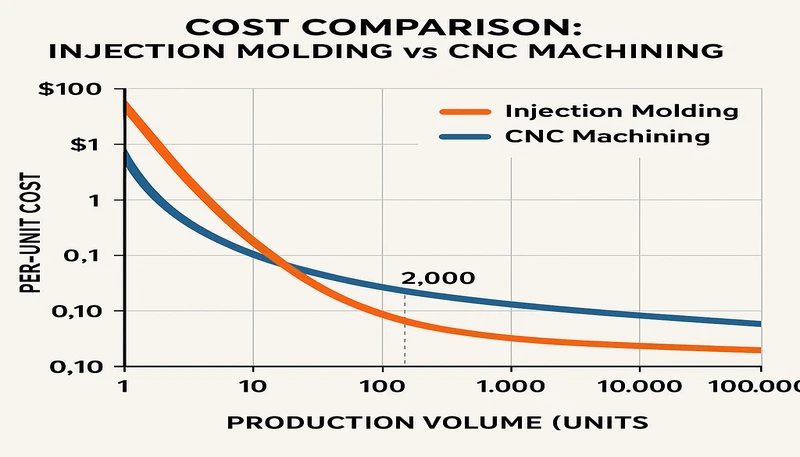
Volume is the great equalizer in injection molding economics. Amortizing a 20,000 dollar mold across 100,000 parts adds just 0.20 dollar per piece. Across 1,000 parts, that same mold adds 20 dollar per piece. In our experience running parts at Zetar, the crossover point where a hardened steel mold becomes cheaper on a per-part basis than aluminum tooling usually falls between 5,000 and 10,000 units. Below that threshold, the tooling savings from aluminum outweigh the shorter mold life. Above it, the longer service life and tighter tolerances of steel tooling deliver a clear per-part cost advantage.
Multi-cavity layouts amplify this effect further: a four-cavity mold may cost two to three times more than a single cavity, but it produces four parts per cycle, cutting the processing cost per part by roughly 75 percent. For programs exceeding 100,000 annual units, the per-part savings from a multi-cavity hardened mold typically recover the tooling premium within the first production run.
“A multi-cavity hardened steel mold can reduce per-part processing cost by 75 percent compared to a single-cavity mold.”True
Correct. Four cavities produce four parts per cycle, so the machine-hour rate is spread across four parts. The tooling costs more upfront, but the per-part savings recover the investment at volumes above 50,000 units.
“Material cost is the single largest cost component in injection molding at all volume levels.”False
False. At low volumes (under 5,000 parts), tooling amortization dominates per-part cost. At high volumes, processing cost (machine time and labor) typically exceeds material cost for commodity resins.
What Are the Typical Cost Benchmarks by Part Size?
For a quick sanity check, here are typical mold tooling ranges for a moderate-complexity, single-cavity production mold (P20 steel2, polished finish):
| Part Size | Typical Mold Cost Range | Cycle Time Estimate |
|---|---|---|
| Small (< 50 mm) | $1,800 – $3,000 | 12–18 seconds |
| Medium (50–150 mm) | $3,200 – $5,500 | 20–30 seconds |
| Large (150–300 mm) | $6,000 – $10,500 | 34–44 seconds |
| Extra Large (> 300 mm) | $12,000 – $22,000+ | 50–66 seconds |

These ranges assume moderate complexity with some undercuts, standard side-action, and a polished VDI 3400 surface finish3 [fn:3]. Adding multi-cavity layouts, precision tolerances (below plus or minus 0.05 mm), or unscreging cores for threaded features pushes costs into the next tier. Hot runner systems, which eliminate runner waste and reduce cycle time, add 3,000 to 8,000 dollar per cavity but pay for themselves quickly at volumes above 50,000 parts. Lifter mechanisms for internal undercuts and collapsible cores for reverse-draft features are additional cost drivers that toolmakers quote on a case-by-case basis.
How Is the Per-Part Cost Calculated?
Per-part cost is the sum of material, processing, and overhead. For commodity resins at mid-volume, the typical split is roughly 30 percent material, 50 percent processing, and 20 percent overhead. The calculator breaks each component out so you can see where the money goes and identify the biggest cost-reduction lever for your specific program.
Material cost follows a simple formula: resin price per kilogram times part weight in kilograms times a 1.15 waste factor to account for runners, sprue, and start-up scrap. For ABS at 2.50 dollar per kg and a 60-gram part, material cost works out to roughly 0.17 dollar per part. Switching to a glass-filled nylon at 4.00 dollar per kg doubles that to 0.33 dollar per part. For PEEK at 55 dollar per kg, material alone reaches 3.80 dollar per shot — a twenty-two-fold increase over commodity PP at the same part weight. This is why material selection has such a dramatic effect on per-part pricing, especially for heavier parts.
Processing cost is driven by machine-hour rate, cycle time, and cavity count. The formula is: machine-hour rate divided by 3600, times cycle time in seconds, divided by number of cavities. A 75-ton press at 75 dollar per hour running 25-second cycles on a single cavity costs roughly 0.52 dollar per part. Upgrading to a four-cavity mold on the same press drops processing cost to about 0.13 dollar per part — a 75 percent reduction. We routinely see customers achieve this kind of savings when they move from prototype single-cavity tooling to multi-cavity production molds at Zetar.
Overhead typically adds 20 to 30 percent on top of material plus processing, covering QC inspection, packaging materials, secondary trimming or assembly operations, and logistics handling. For medical or automotive parts requiring incoming inspection certificates, first-article inspection reports, or statistical process control documentation, overhead can climb to 35 percent or higher. The calculator uses a default 25 percent overhead margin, which covers standard commercial-grade production.

“Aluminum molds can reduce cycle times by 15 to 30 percent compared to steel molds due to faster heat dissipation.”True
Correct. Aluminum thermal conductivity is roughly four times higher than P20 steel, allowing faster cooling and shorter cycle times. This advantage is most significant for parts with thick wall sections.
“Hardened steel molds (H13/S136) are always the most cost-effective choice for any injection molding project.”False
False. For volumes under 5,000 parts, the higher tooling cost of hardened steel is never recovered. Aluminum or P20 tooling delivers lower total program cost at low to mid volumes.
The calculator applies a 25 percent overhead margin and then layers on volume discounts: 5 percent at 5,000 pieces, 10 percent at 10,000, 15 percent at 50,000, and 20 percent at 100,000 or more. These thresholds reflect common industry pricing tiers where suppliers begin offering meaningful per-part reductions. For custom or engineered resins, the volume effect is even more pronounced because material cost represents a larger share of total per-part price. The discount curve flattens above 200,000 pieces in most cases, because processing cost rather than tooling amortization becomes the dominant factor.
When Should You Upgrade from Prototype to Production Tooling?
If your annual volume is below 5,000 parts and the design is still changing, an aluminum prototype mold is almost always the right call. Tooling costs 40 to 70 percent less than steel, lead time is shorter (typically 2 to 4 weeks versus 5 to 8 for steel), and modifications are cheaper. In our toolroom at Zetar, we can adjust an aluminum mold cavity in as little as one day for simple geometry changes. The trade-off: mold life is typically under 100,000 shots, tolerances are looser, and surface finish options are limited compared to hardened steel tooling [fn:2].
Aluminum also dissipates heat faster than steel, which can reduce cycle times by 15 to 30 percent — a meaningful cost advantage for short-run production.
For programs above 10,000 parts per year with a stable design, a production steel mold in P20 tool steel pays for itself within the first run. Better surface finish, tighter tolerances, longer mold life, and multi-cavity options all reduce per-part cost. At 50,000 or more parts per year, hardened steel (H13 or S136) becomes cost-effective because the extended mold life of 500,000 to over one million shots eliminates retooling downtime and maintains consistent part quality across the entire production run.
We have seen customers reduce their total program cost by 30 to 40 percent simply by moving from a single-cavity P20 mold to a two-cavity H13 mold on parts running above 200,000 annual units — the higher tooling investment is recovered within the first production lot.

How Do You Get a Precise Injection Mold Quote?
A precise quote is typically returned within 24 hours of submitting your 3D model and part specifications.
Submit your 3D model and requirements for a precise, itemized quote within 24 hours. Our engineers evaluate part geometry, recommend mold steel and cavity layout, and return a full cost breakdown so you can make an informed decision fast.
Frequently Asked Questions
Frequently Asked Questions
How accurate is the injection mold cost calculator?
Injection mold costs span a wide range depending on part size, complexity, and tooling grade. A single-cavity prototype aluminum mold for a simple part typically starts around $800 to $2,000. A single-cavity production mold in P20 steel with moderate complexity often lands around $1,800 to $3,000 for small parts, $3,200 to $5,500 for medium parts, and roughly $6,000 to $10,500 for large parts. Extra-large multi-cavity hardened steel molds (H13/S136) for high-volume production with tight tolerances can exceed $30,000 and reach $60,000+ for complex builds. Geographic location, lead time, validation scope, and sampling inclusion also affect pricing. –section 28
What is the typical cost of an injection mold?
Injection mold costs span a wide range depending on part size, complexity, and tooling grade. A single-cavity prototype aluminum mold for a simple part typically starts around $800 to $2,000. A single-cavity production mold in P20 steel with moderate complexity often lands around $1,800 to $3,000 for small parts, $3,200 to $5,500 for medium parts, and roughly $6,000 to $10,500 for large parts. Extra-large multi-cavity hardened steel molds (H13/S136) for high-volume production with tight tolerances can exceed $30,000 and reach $60,000+ for complex builds. Geographic location, lead time, validation scope, and sampling inclusion also affect pricing.
Does the mold cost per part decrease with higher volume?
Yes, mold tooling amortization is one of the most significant cost factors in injection molding. A $15,000 production mold spread across 10,000 parts adds $1.50 to each piece. The same mold across 100,000 parts adds only $0.15 per piece. Across one million parts, the tooling contribution drops to just $0.015. This relationship is the primary reason that high-volume programs can justify expensive, multi-cavity hardened steel molds — the per-part savings from faster cycles and higher cavity counts quickly outweigh the higher upfront tooling investment.
What material is cheapest for injection molding?
Among common injection molding resins, polypropylene (PP) at approximately $1.80 per kilogram and polyethylene (PE) are the lowest-cost commodity materials. ABS at roughly $2.50/kg is also widely used and competitively priced. Moving up the cost ladder, nylon (PA6/PA66) and POM are mid-range at $3.50–$4.00/kg. High-performance engineering resins like PEEK ($55/kg) and LCP ($18/kg) are significantly more expensive and are selected only when their mechanical, thermal, or chemical properties are required by the application. Material cost per part depends on both the resin price per kilogram and the part weight, which is determined by part size and wall thickness — always run the numbers for your specific geometry before making a final material selection.
How can I reduce my injection molding costs?
Three main levers control injection molding cost: design optimization, volume strategy, and mold steel selection. Design for manufacturability (DFM) reduces undercuts, maintains uniform wall thickness, and minimizes side-action complexity, which directly lowers tooling cost. Increasing production volume amortizes the mold investment over more parts, reducing the per-part tooling contribution. Finally, selecting the right mold steel — prototype aluminum for runs under 50K, production P20 for mid-volume, and hardened H13/S136 for 500K+ shots — avoids both under-investment (mold failure) and over-investment (unnecessary tooling expense).
Can I use an aluminum mold for production runs?
Aluminum molds are a practical choice for low to mid-volume production runs, typically up to 50,000 shots with moderate part complexity. They cost 40 to 70% less than steel tooling and have shorter lead times (2–4 weeks vs. 5–8 weeks for steel). Aluminum also dissipates heat faster than steel, which can reduce cycle times by 15–30%. However, for tight tolerances (below ±0.05 mm), high-polish surface finishes (SPI A-1), abrasive or glass-filled resins, or production volumes exceeding 100,000 shots, hardened steel tooling is the more reliable and cost-effective long-term choice.
- SPI: SPI Surface Finish Standards is a classification system developed by the Society of the Plastics Industry that categorizes mold cavity surface textures from A-1 (mirror polish, diamond buffed) through D-3 (fine blasted stone). Higher finish grades require progressively more polishing time and d
- P20 steel: P20 mold steel is a pre-hardened chromium-molybdenum alloy tool steel (AISI P20 / DIN 1.2311) widely used for production injection molds rated for 100K to 500K shots. It is supplied at 28–36 HRC hardness, machines readily, and accepts standard surface treatments including polishing, textu
- VDI 3400 surface finish: VDI 3400 is a surface texture standard published by the Verein Deutscher Ingenieure that defines EDM (electrical discharge machining) finishes by average roughness depth, ranging from VDI 0 (smoothest, Ra < 0.1 μm) to VDI 45 (Ra ~18 μm). It is commonly used alongside SPI gra
SPI: SPI Surface Finish Standards is a classification system developed by the Society of the Plastics Industry that categorizes mold cavity surface textures from A-1 (mirror polish, diamond buffed) through D-3 (fine blasted stone). Higher finish grades require progressively more polishing time and directly increase mold manufacturing cost. ↩
P20 steel: P20 mold steel is a pre-hardened chromium-molybdenum alloy tool steel (AISI P20 / DIN 1.2311) widely used for production injection molds rated for 100K to 500K shots. It is supplied at 28–36 HRC hardness, machines readily, and accepts standard surface treatments including polishing, texturing, and plating. ↩
VDI 3400 surface finish: VDI 3400 is a surface texture standard published by the Verein Deutscher Ingenieure that defines EDM (electrical discharge machining) finishes by average roughness depth, ranging from VDI 0 (smoothest, Ra < 0.1 μm) to VDI 45 (Ra ~18 μm). It is commonly used alongside SPI grades to specify mold surface texture. ↩

