

For complete mold manufacturing guidance, see our Services de moulage par injection.
For comprehensive process guidance, see our injection molding complete guide covering materials, parameters, and defect troubleshooting.
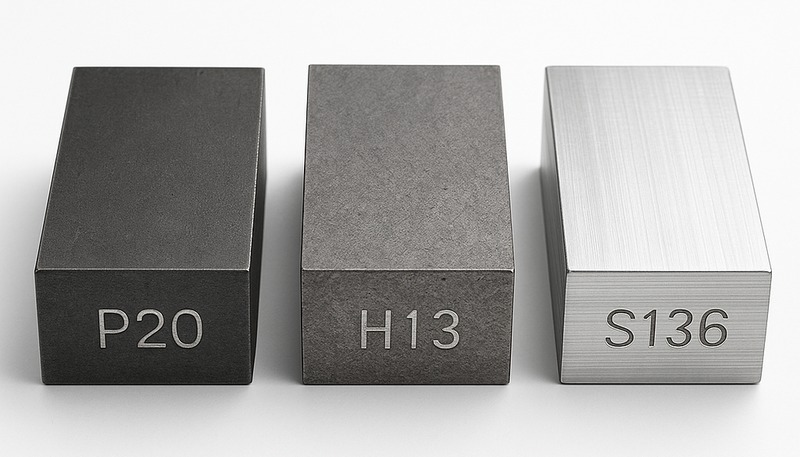
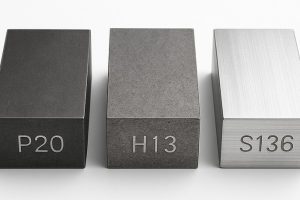
- P20 (HRC 28–33, pre-hardened) is ideal for prototype and medium-volume molds up to 500,000 shots with commodity resins — lowest tooling cost.
- H13 (HRC 48–52, heat-treated) handles glass-filled, abrasive, or high-temperature resins (PPS, PEI) and survives more than 1 million shots.
- S136 (HRC 48–52, stainless) is mandatory for corrosive resins (PVC, POM, flame-retardant ABS) and optical or medical parts requiring mirror-polished surfaces.
- Steel grade drives 30–40% of tooling cost: upgrading from P20 to S136 typically adds $3,000–$8,000 to a single-cavity mold.
- Match steel to three factors: production volume, resin chemistry, and surface finish requirement — in that priority order.
Why Does Mold Steel Selection Determine Part Quality and Tooling Cost?
The spec sheet looked fine. The resin was approved. The wall thickness passed DFM1. But when the first shots came off the press, the surface looked like someone had dragged sandpaper across it. We traced it back to a P20 cavity that had been specified for a 30% glass-filled nylon job. The mold shop had used what they had on the shelf. Three weeks of re-polishing later, the customer had moved to a competitor. That was the last time my team skipped a steel conversation at kickoff.
For complete injection molding process coverage, see our injection molding complete guide.
| Acier | Dureté | Meilleur pour |
|---|---|---|
| P20 | 28–32 HRC | Low-mid volume, general use |
| H13 | 48–52 HRC | High volume, high temp resins |
| S136 | 48–52 HRC | Corrosive resins, medical |
When Is P20 the Right Mold Steel Choice?
P20 is a pre-hardened chromium-molybdenum tool steel3 delivered at HRC 28–33, which means you can machine it directly without a heat-treat cycle after roughing. That saves 5–10 days on the build schedule and eliminates the distortion risk that comes with post-machining heat treatment. At our factory, we run P20 on roughly 60% of consumer-product tooling where the resin is unfilled ABS, PP, or PE and the annual volume is below 500,000 shots per cavity.
The trade-off is hardness. At HRC 30, P20 will show visible wear on parting lines and gate areas after roughly 300,000–500,000 shots with mildly abrasive resins. For fully unfilled commodity resins, the same tool can reach 800,000–1,000,000 shots before requiring a re-polish or gate repair. P20 also accepts textured finishes (EDM grain, VDI 24–36) reasonably well, but mirror polishing below VDI 12 is difficult because the lower carbon content limits achievable surface hardness.
| Propriété | P20 Value | Practical Implication |
|---|---|---|
| Hardness (as-supplied) | HRC 28–33 | No post-machining heat treat needed |
| Tensile strength | ~1,000 MPa | Good for standard injection pressures up to 1,400 bar |
| Max recommended volume | 500,000–1,000,000 shots | Depends on resin abrasiveness |
| Polishability | VDI 12–18 (satin) | Not suitable for optical or Class A mirror finish |
| Résistance à la corrosion | Faible | Requires rust preventive in storage; avoid PVC/POM |
| Relative tool cost (single cavity) | 1.0× (baseline) | Most economical steel grade |
One decision point that catches engineers off guard: P20 is often available in a nitrided variant (P20+Ni or P20H) where the surface is case-hardened to HRC 50–55 while the core stays soft. This gives better wear resistance at gates and parting lines without adding a full heat-treat cycle. We specify this variant on P20 tools expected to run 600,000–900,000 shots with lightly filled resins (up to 10% glass fiber).
“P20 can be machined and used without a post-machining heat treatment cycle.”Vrai
P20 steel is supplied in a pre-hardened condition at HRC 28–33, meaning it is ready to machine and finish without additional heat treatment. This saves 5–10 days on tool build time compared to tool steels like H13 or S136 that require vacuum hardening and tempering after machining.
“P20 steel is suitable for molding PVC or flame-retardant ABS long-term.”Faux
This is false. P20 has minimal corrosion resistance and will degrade when exposed to the hydrochloric acid off-gas produced by PVC decomposition or the bromine compounds in flame-retardant ABS. The cavity surface pits within 50,000–100,000 shots, creating surface defects on parts. Stainless mold steel (S136 or 2316) is required for these resins.
When Should You Use H13 Tool Steel?
H13 is a chromium-molybdenum-vanadium hot-work tool steel that reaches HRC 48–52 after vacuum hardening and tempering. The vanadium content forms hard carbides that resist abrasive wear from glass fiber, mineral filler, and carbon fiber reinforcements. When a customer comes to us with a 30% GF nylon 66 part that needs 2 million shots, H13 is almost always the steel we specify — not because it is the only option, but because it hits the best balance of wear resistance, toughness, and machinability at that volume tier.
H13’s other strength is thermal fatigue resistance. The molding temperature for PPS, PEI (Ultem), and LCP often exceeds 300°C. At these temperatures, the repeated thermal cycling of injection and cooling can crack a softer steel at thin ribs or sharp corner radii within 200,000 cycles. H13’s high chromium and molybdenum content reduces thermal expansion coefficient variation, giving it roughly 3× better thermal fatigue life than P20 under identical conditions. In our factory, we run H13 on any mold where the melt temperature exceeds 280°C or the glass-fiber content is above 15%.
| Propriété | H13 Value | Practical Implication |
|---|---|---|
| Hardness (heat-treated) | HRC 48–52 | High wear resistance at gate and parting line |
| Tensile strength | ~1,600 MPa | Handles high injection pressures and clamping forces |
| Max recommended volume | 1,000,000–2,000,000+ shots | Ideal for high-volume production with abrasive resins |
| Polishability | VDI 6–12 (semi-gloss) | Good but not optical-grade mirror finish |
| Résistance à la corrosion | Modéré | Not suitable for PVC; acceptable for most other resins |
| Relative tool cost (single cavity) | 1.5×–2.0× P20 | Higher steel + heat treat cost, lower per-shot maintenance |
One practical note from the shop floor: H13 requires a proper stress-relief cycle after rough machining and before final hardening. Skipping this step is the single most common cause of H13 mold cracking we see from tooling shops trying to cut lead time. The stress relief cycle (550–600°C for 2 hours per 25 mm section thickness) adds 2–3 days but prevents distortion during vacuum hardening. We have seen tools crack at rib roots within the first 50,000 shots when this step was skipped — a $15,000+ repair bill that makes the time saving look absurd.
“H13 is the preferred mold steel for glass-fiber-filled resins above 15% loading.”Vrai
H13 at HRC 48–52 contains vanadium carbides that resist the abrasive cutting action of glass fibers against the cavity surface. At 30% GF loading, P20 cavities typically show measurable wear (>0.02 mm depth at gate) after 200,000–300,000 shots, while H13 maintains dimensional tolerance beyond 1 million shots under identical conditions. The wear resistance advantage of H13 over P20 increases proportionally with filler content and injection velocity.
“H13 and S136 have the same hardness and can be used interchangeably.”Faux
While both H13 and S136 are heat-treated to HRC 48–52, they are engineered for different failure modes. H13 is a hot-work steel optimized for thermal fatigue and abrasive wear resistance, containing 5% chromium and 1% molybdenum plus vanadium. S136 is a stainless tool steel with 13% chromium for corrosion resistance and superior polishability. Substituting H13 where S136 is required — such as in PVC or transparent part molds — will result in corrosion pitting and surface defects.
When Is S136 Stainless Mold Steel Required?
S136 (equivalent to AISI 420 modified stainless steel) contains approximately 13% chromium, which provides passive oxide layer corrosion protection against acidic off-gases from PVC, halogenated flame retardants, POM (acetal), and some polyurethanes. The corrosion resistance is not just cosmetic — acid attack on a cavity surface creates micro-pitting that transfers directly to the part surface, generating defects that cannot be polished out without re-machining the cavity.
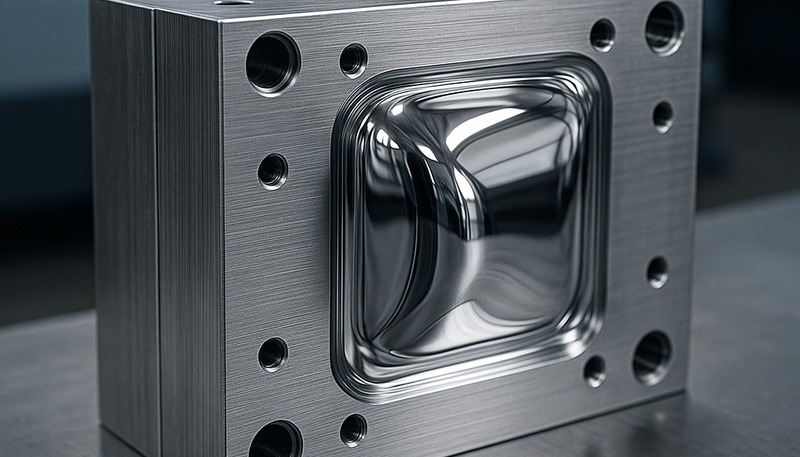
S136 also achieves the highest polishability of any common mold steel, reaching VDI 0–3 (mirror finish, Ra 0.01–0.02 µm) when processed correctly. This is essential for optical lenses, light guides, medical device housings, and any part requiring Class A cosmetic transparency. At our factory, we use S136 exclusively for all medical device tooling, transparent PC and PMMA parts, and any application involving PVC or POM resins. The mirror-polish surface on an S136 cavity can be maintained for 500,000–1,000,000 shots with proper mold release and cleaning protocols.
| Propriété | S136 Value | Practical Implication |
|---|---|---|
| Hardness (heat-treated) | HRC 48–52 | Same hardness as H13, better corrosion resistance |
| Chromium content | ~13% | Passive oxide layer resists acid off-gas from PVC, POM, FR-ABS |
| Max polishability | VDI 0–3 (mirror, Ra 0.01 µm) | Required for optical lenses, light guides, transparent housings |
| Résistance à la corrosion | High (stainless) | Suitable for PVC, POM, medical-grade resins |
| Max recommended volume | 500,000–1,000,000 shots | Slightly lower toughness than H13 at high cycle counts |
| Relative tool cost (single cavity) | 2.0×–2.8× P20 | Highest material cost; offset by lower surface repair frequency |
The trade-off with S136 is toughness. It is slightly more brittle than H13 at the same hardness level, which means it is more susceptible to chipping at thin rib edges (below 0.5 mm) or in deep narrow slots. We design S136 molds with a minimum rib-to-depth ratio of 1:6 (rib thickness:depth) and add a 0.3 mm radius on all internal sharp corners. These design changes add 2–4 hours of machining time but prevent brittle failure in service. For the conception de moules d'injection4 team, this is a critical DFM checkpoint.
How Do P20, H13, and S136 Compare Side by Side?
When engineers ask us which steel to use, the answer almost always comes down to three questions in this order: How many shots? What resin? What surface finish? The table below codifies our 20 years of factory experience into a direct comparison. Notice that no single grade is universally superior — each occupies a distinct operational niche.
| Criterion | P20 | H13 | S136 |
|---|---|---|---|
| Dureté (HRC) | 28–33 (pre-hardened) | 48–52 (heat-treated) | 48–52 (heat-treated) |
| Best for volume | Up to 500K shots | 500K–2M+ shots | Up to 1M shots |
| Abrasion resistance | Low–Medium | Haut | Medium–High |
| Résistance à la corrosion | Faible | Modéré | High (stainless) |
| Mirror polishability | Medium (VDI 12–18) | Good (VDI 6–12) | Excellent (VDI 0–3) |
| Thermal fatigue life | Bon | Excellent | Bon |
| Recommended resins | ABS, PP, PE, PS (unfilled) | GF Nylon, PPS, PEI, LCP, PC | PVC, POM, FR-ABS, PMMA, optical PC |
| Post-machining heat treat | Not required | Required (vacuum) | Required (vacuum) |
| Lead time impact | Shortest (+0 days) | Moderate (+5–10 days) | Moderate (+5–10 days) |
| Relative cost index | 1.0× | 1.5×–2.0× | 2.0×–2.8× |
A common trap: engineers see that H13 and S136 have the same HRC range and conclude they are interchangeable. They are not. H13’s vanadium carbides make it superior against abrasive wear; S136’s 13% chromium makes it immune to corrosive attack. Running PVC in an H13 mold will produce pitting corrosion within 50,000 shots. Running 40% GF nylon in an S136 mold will cause accelerated surface wear because S136 lacks the vanadium carbide phase that gives H13 its abrasion edge.
How Do You Select the Right Mold Steel in 3 Steps?
Step 1: Qualify the Resin Chemistry
The first filter is always chemistry. Check the resin’s technical data sheet for off-gas products, recommended processing temperature, and any corrosion warnings. PVC, halogen-containing flame retardants, acetal (POM), and moisture-absorbing engineering resins that decompose at high temperatures all produce acids during processing. Any resin that generates HCl, HBr, HF, or formaldehyde off-gases during normal processing requires S136 or at minimum 2316 stainless steel. No exceptions — we have never seen P20 or H13 survive 200,000 shots in a PVC application without visible cavity pitting.
For optical or medical applications, even if the resin is not chemically aggressive, the surface finish requirement drives you to S136. Polycarbonate for light guides, PMMA for lenses, and COC/COP for medical vials all require Ra values below 0.025 µm — a level only achievable with S136 and a skilled polisher with 6–8 hours on the cavity surface.
Step 2: Establish the Production Volume Target
Volume defines how much wear resistance you need to pay for. If the program is a bridge tool for 50,000–100,000 shots while the production tool is being built, P20 is almost always the right call — the savings on tooling cost fund the production tool. If the program is 3 million shots over 5 years, H13 or S136 is not optional: rebuilding a P20 mold at 500,000 shots would cost more in downtime and re-tooling than the original price differential. At our factory, the break-even calculation for upgrading from P20 to H13 generally favors H13 at annual volumes above 250,000 shots per cavity for abrasive resins.
Step 3: Match Surface Finish to Steel Grade
Surface finish requirements flow directly from the part specification. SPI A1/A2 (mirror) requires S136. SPI B1 (semi-gloss) can use H13. SPI C1/C2 (matte) can use P20. When the part drawing calls for ‘as-molded gloss’ without specifying SPI grade, ask for clarification before quoting steel — the difference between a vague ‘glossy’ spec and an SPI A1 spec can add $4,000–$6,000 to a single-cavity tool cost. In our DFM reviews, we always confirm the surface finish grade before selecting steel because clients often do not realize their ‘shiny part’ requirement translates into optical-grade polishing work.

What Is the Real Cost and Timeline Impact of Steel Grade Choices?
Numbers help settle arguments about steel grade faster than theory. Here is actual data from our factory’s recent tooling builds, anonymized for client confidentiality. These figures represent single-cavity family tools for consumer and industrial parts with a surface area of approximately 150 cm² per cavity.
| Qualité de l'acier | Material Cost (steel only) | Total Tool Cost | Délai d'exécution | Recommended For |
|---|---|---|---|---|
| P20 | $400–$800 | $8,000–$15,000 | 4–6 weeks | Prototype, low-volume, unfilled commodity resins |
| H13 | $800–$1,600 | $12,000–$22,000 | 6–8 weeks | High-volume, abrasive resins, high-temp engineering plastics |
| S136 | $1,200–$2,400 | $15,000–$28,000 | 6–8 weeks | PVC, POM, optical, medical, FR resins |
The lead time difference reflects both heat treatment scheduling and the additional EDM and polishing work required for H13 and S136. Vacuum hardening furnaces at most tool shops run on a batch schedule — if your tool misses the weekly run, you add 5–7 days. This is why we advise clients to commit to steel grade in the first week of tooling kickoff, not after the mold has been roughed out in whatever steel was on the shelf.
Factory Insight: Mold Material Selection at ZetarMold
At our Shanghai facility, our 8 senior engineers select mold steel based on the specific production volume, part geometry, and resin being processed. With 20+ years of mold manufacturing experience and 100+ molds per month, we process 400+ materials and have built tooling in P20, H13, S136, and aluminum across different program types. The most common mistake we see in steel selection is over-specifying hardened steel for prototype or low-volume programs where P20 would perform adequately—adding lead time and cost without a quality benefit.
Frequently Asked Questions About Injection Mold Steel Selection?
What is the best mold steel for transparent plastic parts?
S136 stainless mold steel is the industry standard for transparent injection molded parts. It achieves mirror-polish surface finish (SPI A1/A2, Ra ≤ 0.025 µm) required for optical-grade clarity in PC, PMMA, and COC resins. The 13% chromium content also resists staining from mold release agents that could cloud a polished cavity surface. P20 and H13 can reach SPI B1 but cannot sustain the Ra 0.01–0.02 µm values needed for lens or light-guide applications. For medical optical parts, S136H (pre-hardened variant at HRC 38–42) provides a faster build schedule while still meeting polishability requirements.
Can I use P20 steel for a high-volume production mold?
P20 can handle production volumes up to 500,000–1,000,000 shots for unfilled commodity resins (ABS, PP, PE, PS) at injection pressures below 1,200 bar. Above these volumes, or when running filled resins with more than 10% glass fiber, P20 will develop visible wear at gate areas and parting lines that transfers to parts as flash or dimensional drift. For annual volumes above 500,000 shots per cavity with any abrasive resin, upgrading to H13 typically pays for itself within the first year by eliminating mid-production cavity repairs. Always confirm resin type and annual volume before fixing the steel grade.
What mold steel should I use for PVC injection molding?
PVC injection molding requires S136 (or 2316) stainless mold steel without exception. During processing, PVC decomposes slightly and releases hydrochloric acid (HCl) gas, which attacks non-stainless cavity steel surfaces within 50,000–100,000 shots, causing pitting corrosion that destroys surface finish and creates part defects. S136’s 13% chromium forms a passive oxide layer that resists HCl attack. All cooling lines, core pins, and slides in contact with the PVC melt zone should also be made from stainless steel or chrome-plated to prevent internal corrosion. Even short-run PVC prototype tools should use S136 — HCl damage accumulates rapidly.
How does mold steel hardness affect surface finish quality?
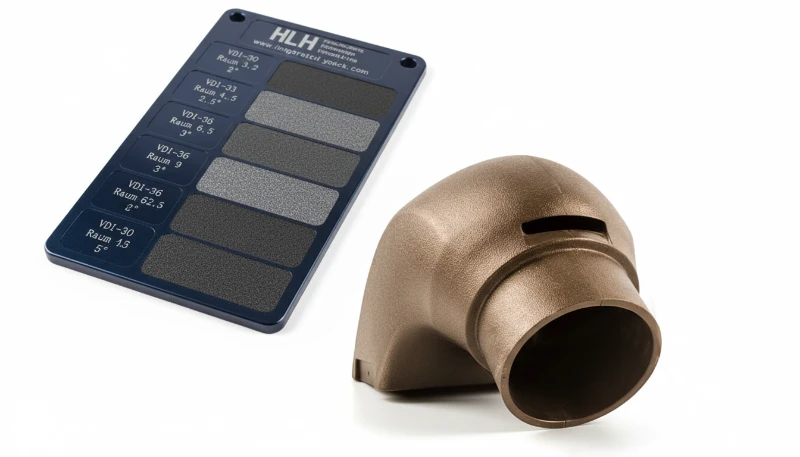
Harder steels (HRC 48–52, H13 and S136) can be polished to finer surface finishes than softer steels (HRC 28–33, P20) because the high carbide content of hardened steels allows the polishing abrasive to produce a uniform, scratch-free surface. P20 at HRC 30 has softer matrix regions that tear during diamond polishing, limiting achievable Ra to approximately 0.05–0.10 µm (SPI B1). S136 at HRC 50 can reach Ra 0.01 µm (SPI A1) with progressive diamond polishing from 6 µm down to 0.25 µm grit. H13 at HRC 50 reaches Ra 0.03–0.05 µm (SPI A2–B1). Hardness also determines how long the polished finish lasts under production conditions.
Is H13 or S136 better for a medical device mold?
S136 is the preferred choice for medical device molds in most cases. Medical parts typically require mirror-polished surfaces for cleanability and cosmetic inspection compliance, and many medical resins — including LDPE for drug packaging, PC for device housings, and various drug-eluting polymers — may contain additives that cause corrosion in non-stainless steels. S136 satisfies both the surface finish requirement (VDI 0–3) and corrosion resistance needed in a medical production environment. H13 is used in medical tooling only when the part geometry has thin ribs or deep cores where S136’s slightly lower toughness creates chipping risk, and where the resin is not corrosive.
What is the typical lead time difference between P20 and hardened H13 or S136 molds?
P20 pre-hardened steel (28–32 HRC) can be machined directly without post-heat treatment, reducing mold build time by 1–2 weeks compared to H13 or S136 which require heat treatment after rough machining to reach 48–54 HRC. For programs where time-to-first-part matters more than long-term mold life, P20 provides a significant schedule advantage. For production molds expected to run 500,000+ shots, the additional lead time for hardened steel is justified by the extended tool life.
Bottom line: P20 for volumes under 300,000 shots and non-aggressive resins. H13 when you’re running glass-filled, mineral-filled, or high-temperature engineering resins above 500,000 shots. S136 when the resin is corrosive (PVC, POM, halogenated FR grades) or the part requires optical surface quality. Getting this wrong adds weeks of rework and mold repair costs that far exceed the initial steel premium.
Need help selecting mold steel for your program? Explore our moulage par injection capabilities or contact us for a tooling review.
-
Entreprises de Moulage par Injection en Inde : Pourquoi les Grands Acheteurs Choisissent ZetarMold - DFM (Design for Manufacturability) refers to an engineering review process applied before tooling begins, identifying features in a part design such as thin walls, sharp corners, or insufficient draft that would cause molding defects or increase tool cost. ↩
-
mold steel: Mold steel refers to a category of tool steels used to fabricate injection mold cores and cavities, selected based on hardness (HRC), polishability, corrosion resistance, and thermal fatigue strength for the target production volume and resin type. ↩
-
tool steel: Tool steel is a category of carbon and alloy steel specifically formulated for the manufacture of cutting and forming tools, including injection mold cavities, measured in hardness on the Rockwell C (HRC) scale, typically ranging from HRC 28 to HRC 65 depending on application. ↩
-
injection mold design: Injection mold design is an engineering discipline that defines the cavity geometry, gating system, cooling circuit layout, and ejection mechanism of a mold, directly determining cycle time, part quality, and tool life. ↩


 EN
EN  ES
ES  FR
FR  DE
DE  PT
PT  AR
AR  RU
RU  JA
JA  KO
KO  IT
IT  NL
NL  TR
TR  PL
PL 