 Skip to content

- charge externe appliquée—uniquement due à la contrainte de moulage + exposition chimique
- ESC is the leading cause of field failure in polyethylene, polycarbonate, ABS, and polystyrene products—responsible for an estimated 15–25% of all plastic part service failures.
- Les contraintes résiduelles de moulage sont souvent la composante « mécanique » cachée de l'ESC : des pièces qui semblent exemptes de contraintes après moulage peuvent tomber en panne rapidement lorsqu'elles sont exposées à des agents chimiques même dilués.
- The ESCR (Environmental Stress Cracking Resistance) value for a polymer must be matched to the specific chemical agent in the application environment—generic ESCR ratings are not transferable between different chemicals.
- Eliminating ESC requires a three-pronged approach: material selection with appropriate ESCR, residual stress reduction through molding process optimization, and design modifications that minimize mechanical stress concentrations.
What Is Environmental Stress Cracking and Why Does It Cause Plastic Part Failures?
Environmental stress cracking (ESC) is the brittle failure of a plastic component caused by the combined action of mechanical stress (tensile or residual) and a chemical agent (surfactant, solvent, lubricant, or cleaning agent) that the plastic would normally resist in the absence of stress. ESC is not a simple chemical attack—it is a synergistic phenomenon where stress and chemistry together produce failure that neither alone would cause at the same magnitude.
The mechanism of ESC proceeds in three stages:
- Crazing initiation: The chemical agent reduces the surface energy of the polymer, allowing sub-yield microcracks (crazes) to form at stress concentrations—notches, flow lines, knit lines, insert transitions, or residual stress zones—at stresses well below the yield strength.
- Crack nucleation: Les crazes se développent et finalement la frontière entre la craze et le polymère massif devient un véritable noyau de fissure. Le facteur d'intensité de contrainte à l'extrémité de la fissure commence à dépasser la valeur critique du polymère.
- Fracture fragile : The crack propagates catastrophically, producing a characteristic brittle fracture surface. Unlike ductile failure, there is essentially no plastic deformation—the part breaks suddenly without visible warning deformation—a key distinction from other injection molding defects1
| Polymère | ESC Susceptibility | Common Chemical Triggers | Typical Failure Mode |
|---|---|---|---|
| HDPE / LDPE | High (thin-wall) | Surfactants, soaps, oils | Slow crack growth, brittle fracture |
| PC (Polycarbonate) | Haut | Ketones, esters, alcohols | Rapid surface crazing to fracture |
| ABS | Moyenne-élevée | Esters, ketones, aromatic solvents | Crazing at residual stress zones |
| PS (Polystyrène) | Haut | Alcohols, esters, hydrocarbons | Crazing, surface whitening |
| PP (Polypropylène) | Low-Medium | Surfactants, mineral oils | Slow crack growth near inserts |
| Nylon (PA66) | Low in dry; higher when wet | Zinc chloride, calcium chloride | Hydrolysis-accelerated cracking |
ESC only occurs when plastic parts are immersed in chemical agents.Faux
ESC can be triggered by trace chemical exposure—including brief contact, vapor exposure, or residual film from a cleaning agent that evaporated hours earlier. The chemical agent does not need to remain present; it only needs to reduce surface energy at a critical stress concentration to initiate crazing. Parts cleaned with an incompatible solvent, then dried and assembled, can fail in ESC days or weeks later with no visible chemical present at the fracture site.
Quels facteurs déterminent la résistance à la fissuration sous contrainte environnementale (ESCR) d'un plastique ?
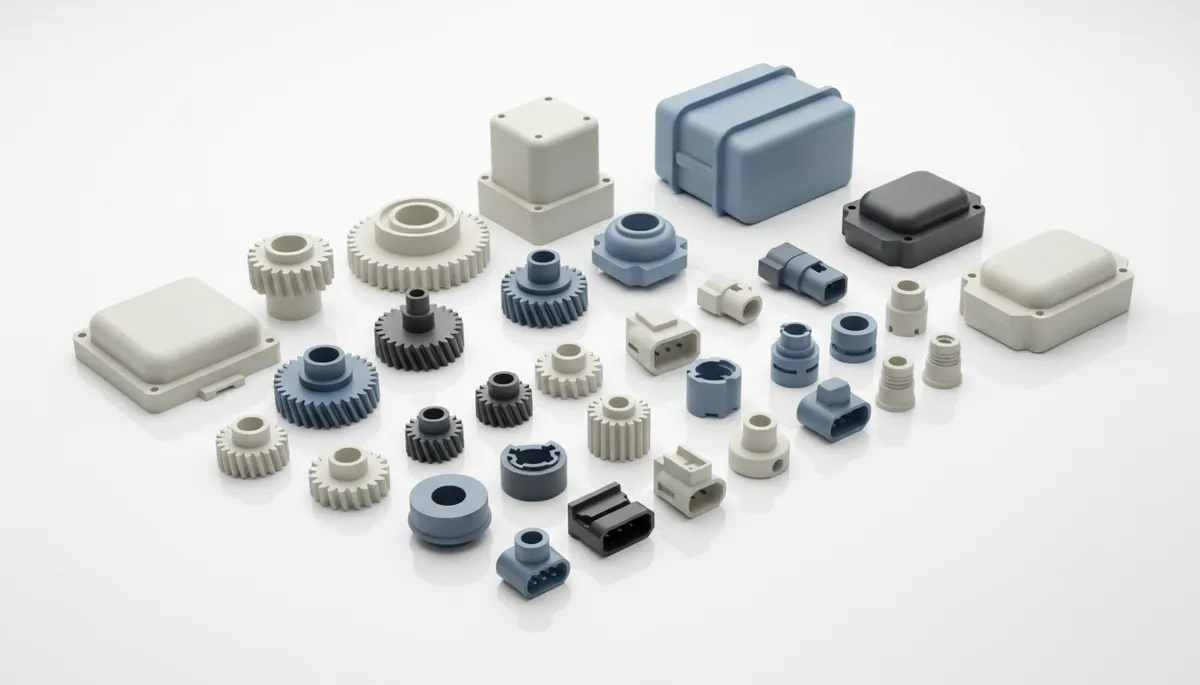
L'ESCR n'est pas une propriété matérielle unique — c'est une caractéristique multifactorielle qui dépend de l'architecture moléculaire du polymère, de l'agent chimique spécifique, du niveau de contrainte appliqué et de la température. Comprendre ces facteurs permet aux ingénieurs de sélectionner les matériaux et les conditions de transformation qui minimisent le risque d'ESC.
Molecular weight (MW) and molecular weight distribution (MWD): Les polymères à poids moléculaire plus élevé ont des réseaux d'enchevêtrement de chaînes plus longs qui résistent à l'initiation des crazes. Le HDPE avec un PM > 200 000 g/mol montre une ESCR nettement meilleure que les nuances avec un PM < 100 000 g/mol dans des environnements de surfactants. L'UHMWPE (polyéthylène à ultra-haut poids moléculaire) a été spécifiquement développé pour des applications résistantes à l'ESC, y compris les implants médicaux et les revêtements industriels — son poids moléculaire extraordinaire (typiquement 3 à 6 millions de g/mol) en fait l'un des polymères les plus résistants à l'ESC, comme détaillé dans le UHMWPE injection molding guide2
Cristallinité : Les polymères semi-cristallins avec des degrés de cristallinité plus élevés montrent généralement une meilleure résistance à l'ESC car les domaines cristallins sont plus résistants à la pénétration chimique et à la formation de crazes. Cependant, un refroidissement rapide lors du moulage par injection peut supprimer la cristallinité, réduisant l'ESCR en dessous de ce que le poids moléculaire du matériau laisserait prédire.
Polymer morphology and orientation: Molecular orientation from injection molding creates anisotropic ESC resistance—parts are typically more susceptible to ESC in the direction perpendicular to flow (transverse) than in the flow direction. This explains why ESC cracks often appear aligned with the flow direction in injection-molded components.
Chemical agent properties: Les agents ESC les plus efficaces ont des paramètres de solubilité proches de celui du polymère et une tension superficielle inférieure à l'énergie critique de surface du polymère. Cette combinaison favorise un mouillage rapide des surfaces de craze sans dissoudre le polymère massif — exactement les conditions nécessaires à l'ESC. Les surfactants sont des agents ESC particulièrement puissants pour les polyoléfines car ils réduisent efficacement la tension superficielle à de très faibles concentrations (parties par million).
Température : ESC rate increases with temperature for two reasons: increased molecular mobility allows faster craze growth, and chemical diffusion into the polymer accelerates at higher temperatures. Components operating above 60°C must have their ESCR re-evaluated at the actual service temperature, not room temperature test data.
How Does Residual Molding Stress Contribute to Environmental Stress Cracking?

Residual stress is stress that remains in a part after molding without any external load applied. It arises from differential cooling between the hot melt interior and the rapidly quenched surface layers, from differential shrinkage between thick and thin sections, and from molecular orientation frozen during rapid injection fill. For ESC, residual stress is critically important because:
- It adds to any applied mechanical stress, so the total stress at a critical location = (applied stress) + (residual stress)
- It can be sufficient to trigger ESC without any applied external load—purely from molding stress + chemical exposure
- L'augmentation de l'épaisseur des parois et l'élimination des angles internes aigus réduisent considérablement la sensibilité à la fissuration sous contrainte.
Quantifying residual stress: The standard test for ESC-relevant residual stress is the bent strip test (ISO 22088), where a part is bent to a controlled strain and exposed to the chemical agent. The strain at which crazing or cracking occurs is compared to the expected part residual strain from molding. Parts with high residual stress from aggressive molding conditions (high injection speed, high hold pressure, low mold temperature) consistently fail at lower chemical concentrations—a critical consideration when optimizing paramètres de moulage par injection3
Process optimization to reduce residual stress:
- Increase mold temperature to allow more molecular relaxation before solidification
- Reduce injection speed, particularly in the early fill phase
- Reduce hold pressure; extend hold time at lower pressure to compensate for shrinkage
- Ensure uniform wall thickness to minimize differential cooling-induced stress gradients
- Anneal parts after molding at 60–80% of Tg for 30–120 minutes to relieve residual stress
Annealing injection-molded parts can significantly reduce their susceptibility to environmental stress cracking.Vrai
Le recuit après moulage à des températures inférieures à la température de déformation sous charge (HDT) du polymère permet aux segments de chaîne polymère de se relaxer et de réduire la contrainte résiduelle de 30 à 60 %. Pour les applications sensibles à l'ESC — notamment le PC en contact avec des agents nettoyants ou le HDPE en contact avec des surfactants — le recuit est une pratique standard. La réduction de la contrainte résiduelle diminue directement la contrainte totale aux concentrations de surface, augmentant le seuil d'initiation de l'ESC.
Which Chemicals Most Commonly Trigger ESC in Plastic Parts?

ESC chemical agents span a wide range of substance classes. The following table identifies the most common ESC triggers by polymer type and application environment:
| Chemical Agent Category | Examples | Most Susceptible Polymers | Application Context |
|---|---|---|---|
| Surfactants | Dish soap, detergents, wetting agents | HDPE, LDPE, PP | Packaging, containers, plumbing |
| Alcohols | Isopropanol, ethanol, methanol | PC, PS, PMMA | Medical device cleaning, electronics |
| Ketones | Acetone, MEK, cyclohexanone | PC, ABS, PS | Industrial cleaning, adhesive carriers |
| Esters | Ethyl acetate, propylene glycol | ABS, PS, PC | Coatings, printing, adhesives |
| Aromatic hydrocarbons | Toluene, xylene, benzene | PS, ABS, PC | Fuels, solvents, industrial |
| Mineral oils / lubricants | Machine oil, grease | PP, PE, PS | Automotive, industrial equipment |
| Inorganic salt solutions | Zinc chloride, calcium chloride | Nylon, POM | Road salt, metalworking fluids |
Sunscreen and skin care products deserve special mention as a frequently overlooked ESC trigger in consumer products. PC enclosures (eyeglass frames, safety goggles, electronic device cases) are particularly susceptible to ESCR from contact with UV filters (benzophenones, octocrylene) commonly used in sunscreen formulations. This is a well-documented failure mode in PC eyewear and has driven formulation changes in both sunscreen products and PC grades, as documented in the PC injection molding process4
How Should Engineers Design Parts to Minimize ESC Risk?

Environmental stress cracking only occurs with aggressive chemical exposure in industrial settings.Faux
ESC can occur with common household chemicals, mold release agents, cleaning solvents, and even skin oils. Residual molding stress makes parts vulnerable even to mild chemical contact under sustained load.
Increasing wall thickness and eliminating sharp internal corners significantly reduces ESC susceptibility.Vrai
Les directives de conception des pièces pour la prévention des ESC—incluant les rayons de coin, l'épaisseur des parois et le placement des portes—sont intégrales aux principes de conception fiable de moules d'injection plastique pour les applications critiques en matière de fiabilité.
Part design is the most durable ESC prevention strategy because it addresses the mechanical stress component of the synergistic mechanism. The following design practices reduce ESC risk:
Generous corner radii: Sharp internal corners (r ≤ 0.5 mm) generate stress concentration factors (Kt) of 3–5×. Increasing corner radius to 1.5–3 mm reduces Kt to 1.2–1.5×, dramatically lowering the local stress magnitude available to drive ESC. For PC components—where ESC from alcohols or ketones is common—minimum internal radius of 1.5× wall thickness is the standard design rule.
Épaisseur de paroi uniforme : Abrupt section changes create differential cooling stresses (residual stress) and stress concentrators in service. Designing parts with wall thickness variations of ≤ 25% of nominal wall eliminates the largest source of molding-induced residual stress.
Gate location relative to stress: Weld lines formed by merging flow fronts at or near the gate area have lower strength and are priority ESC initiation sites. Gates should be located so that weld lines form in low-stress regions away from chemical exposure zones.
Minimize assembly stress: Les assemblages par pression, par encliquetage et les fixations filetées appliquent tous une contrainte mécanique au composant plastique. Pour les conceptions sensibles à l'ESC, calculez la contrainte combinée (assemblage + service + moulage résiduel) à chaque emplacement critique et vérifiez qu'elle est inférieure à la contrainte admissible du matériau dans les conditions d'exposition chimique attendues.
Surface texture: Rough surfaces with sharp asperities provide more potential craze nucleation sites than smooth, polished surfaces. For ESC-critical components, specifying fine surface finishes (Ra ≤ 0.8 µm) reduces the density of potential craze initiation sites per conception de moules pour l'injection de matières plastiques5
Frequently Asked Questions About Environmental Stress Cracking of Plastic Parts

Q: How is ESC distinguished from pure mechanical fracture or pure chemical attack?
A: ESC fracture surfaces are characteristically brittle with crazing marks radiating from the crack origin—no evidence of ductile deformation (necking, whitening, stretch marks). Pure mechanical fracture in ductile polymers shows significant deformation before fracture. Pure chemical attack typically produces surface dissolution, discoloration, or swelling without the sharp crack morphology. Combining fracture surface analysis with knowledge of chemical exposure history is usually sufficient for diagnosis.
Q: What is the standard test method for measuring ESCR?
A: The primary standard test is ASTM D1693 (bent strip test) for polyethylene in surfactant solutions. ISO 22088 provides a broader framework covering multiple polymers and loading conditions. The ball-and-socket test (ASTM D5419) and constant tensile load test (ISO 22088 Part 3) are used for engineering resins. Results are reported as time-to-failure (F50, F100) at specified stress and chemical exposure conditions.
Q: Can surface coatings protect against ESC?
A: Barrier coatings can delay ESC initiation by reducing the rate of chemical contact with the polymer surface. Hard coatings (silicone-based, ceramic-based) effectively exclude chemicals from the surface. However, coatings must be compatible with the substrate, free of pinholes, and remain intact under the service conditions—coating delamination exposes the polymer to concentrated chemical stress at delamination sites, which can accelerate rather than prevent ESC.
Q: Does UV stabilization affect ESC resistance?
A: Indirect effect. UV degradation reduces molecular weight and introduces surface oxidation products that provide additional ESC craze initiation sites. UV-stabilized polymers maintain their MW and surface quality over time, preserving their original ESCR for longer. For outdoor applications, UV stabilization is therefore an indirect ESC prevention measure.
Q: If a part survives an initial ESC test, is it safe for long-term use?
A: Not necessarily. ESC is a time-dependent phenomenon with incubation periods that can range from hours to years depending on stress level and chemical concentration. Standard short-duration tests may not reveal long-term slow crack growth behavior. For safety-critical applications (pressure vessels, medical devices, structural components), accelerated testing at elevated temperature or chemical concentration is required to predict long-term performance with sufficient confidence.
Q: Is ESC more common in injection-molded parts than in extruded or blow-molded parts?
A: Yes, typically. Injection molding generally produces higher residual stress than extrusion or blow molding due to the high injection pressures, rapid fill rates, and abrupt cooling. The combination of high residual stress and the complex part geometries typical of injection molding creates more potential ESC initiation sites. However, all plastic parts can experience ESC if the right combination of stress and chemical agent is present.
Summary: How to Prevent Environmental Stress Cracking in Plastic Parts

Environmental stress cracking is a synergistic failure mechanism that remains one of the most common and preventable causes of plastic part field failures. Its insidious nature—brittle fracture at loads and chemical concentrations that would individually be harmless—makes it frequently misdiagnosed and underestimated during product development.
The three-dimensional prevention framework:
1. Material selection: Adaptez l'ESCR du polymère à l'agent chimique spécifique et à la concentration attendus dans l'environnement d'application. Ne vous fiez pas aux classements ESCR génériques — testez avec les produits chimiques réels. Envisagez des nuances à poids moléculaire plus élevé, des copolymères résistants à l'ESC, ou des polymères alternatifs lorsque la nuance standard présente une ESCR insuffisante. Pour les exigences extrêmes, l'UHMWPE, le PEEK et les fluoropolymères offrent la plus haute résistance intrinsèque à l'ESC.
2. Design optimization: Eliminate sharp internal corners (minimum r = 1.5× wall thickness), design uniform wall sections, locate gates and weld lines away from high-stress chemical exposure zones, and minimize assembly-induced stress at insert transitions and fastener bosses.
3. Process optimization: Reduce residual stress through higher mold temperatures, lower injection speeds, optimized hold pressure, and post-mold annealing. Verify process consistency with periodic ESCR testing of production samples from the beginning, middle, and end of each production run.
When all three dimensions are addressed systematically, ESC failure rates in production parts can be reduced to near-zero, replacing a leading cause of field failures with a well-managed and reliably preventable mechanism.
-
Environmental stress cracking is documented as a leading failure mechanism in injection molding defects literature, particularly for polyolefin and polycarbonate components in chemical environments. ↩
-
La résistance extraordinaire de l'UHMWPE à l'ESC est liée à son poids moléculaire ultra-élevé ; les paramètres de transformation détaillés pour l'UHMWPE sont disponibles dans les guides spécialisés de transformation des matériaux. ↩
-
Residual stress quantification and its relationship to ESC risk are core topics in injection molding process parameter optimization, particularly for high-performance engineering resin applications. ↩
-
La vulnérabilité du polycarbonate à la fissuration sous contrainte environnementale (ESC) face à des agents chimiques spécifiques nécessite un examen attentif du choix de la nuance de matériau et des conditions de transformation pour les applications exigeant une résistance chimique. ↩
-
Part design guidelines for ESC prevention—including corner radii, wall thickness, and gate placement—are integral to the principles of reliable plastic injection mold design for reliability-critical applications. ↩
Need a Quote for Your Injection Molding Project?
Get competitive pricing, DFM feedback, and production timeline from ZetarMold’s engineering team.
Request a Free Quote → See our Injection Molding Complete Guide for a comprehensive overview. See our Injection Mold Complete Guide for a comprehensive overview. See our Injection Molding Complete Guide for a comprehensive overview.


 EN
EN  ES
ES  FR
FR  DE
DE  PT
PT  AR
AR  RU
RU  JA
JA  KO
KO  IT
IT  NL
NL  TR
TR  PL
PL 