 Ir al contenido

You need 200 large polyurethane1 housings for an industrial enclosure project. Traditional injection molding quotes came back at $45,000 for tooling alone — amortized over 200 parts, that is $225 per unit just for the mold. Reaction Injection Molding (RIM) can cut that tooling cost by 60–80% while delivering parts with comparable structural performance. This guide covers the chemistry, process parameters, material options, cost trade-offs, and real decision criteria for choosing RIM over conventional injection molding.
- RIM forms parts through chemical reaction, not melting and cooling
- Tooling costs 60–80% less than traditional injection molding
- Ideal for large parts (>12 inches) at low-to-medium volumes (50–5,000 units)
- Limited primarily to polyurethane-based thermoset materials
- Injection pressures are 90–95% lower than thermoplastic injection molding
| Parámetro | Typical Value |
|---|---|
| Presión de inyección | 50–200 psi (3.4–13.8 bar) |
| Temperatura del molde | 100–180 °F (40–80 °C) |
| Primary Material | Poliuretano (PU) |
| Ideal Part Size | > 12 inches (300 mm) |
| Typical Volume Range | 50–5,000 units/year |
| Tooling Cost vs IM | 60–80% lower |
What Is Reaction Injection Molding (RIM)?
Reaction injection molding (rim) is defined by the function, constraints, and tradeoffs explained in this section. If you are comparing vendors or planning procurement, our injection molding supplier sourcing guide covers RFQ prep, qualification, and commercial risk checks.
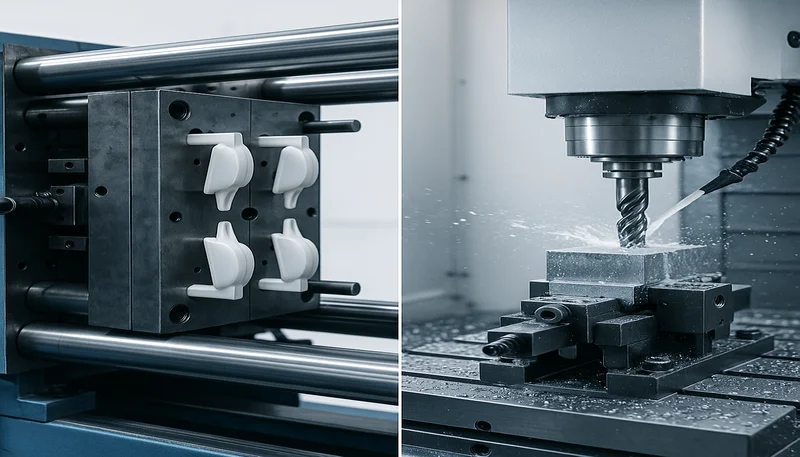
Reaction Injection Molding (RIM) is a low-pressure manufacturing process where two liquid chemical components — typically a polyol and an isocyanate — are metered, mixed under high-pressure impingement, and injected into a closed mold where they react to form a solid thermoset2 part. Unlike conventional injection molding, which melts solid plastic pellets and forces them into a mold at 5,000–20,000 psi, RIM relies on chemistry, not heat and pressure, to create the part.
The key distinction: traditional injection molding is a physical process (melt → fill → cool → eject). RIM is a chemical process (mix → react → cure → demold). This fundamental difference drives every advantage and limitation that follows.
RIM was developed in the late 1960s and gained widespread adoption in the automotive industry during the 1970s and 1980s for producing bumper fascias, body panels, and interior components. Today, it remains the go-to process for large, complex polyurethane² parts at volumes where traditional injection molding tooling is not economically justified.
How Does the RIM Process Work Step by Step?
The RIM process is a five-step sequence: meter, mix, fill, cure, and demold a reactive polyurethane part. The sequence below contrasts RIM with a máquina de moldeo por inyección de tornillo workflow so engineers can diagnose quality issues and optimize cycle times.
Step 1: Material Storage and Temperature Control. The two components — usually a polyol blend (Component A) and an isocyanate (Component B) — are stored in separate heated tanks at controlled temperatures, typically 80–120 °F (27–49 °C). Temperature stability matters because viscosity changes directly affect mix quality. A 10 °F deviation can shift viscosity by 15–25%, leading to incomplete mixing.
Step 2: High-Pressure Metering and Mixing. When the cycle initiates, precision metering pumps deliver the two components at a specified ratio (commonly 1:1 by volume, but ranges from 100:30 to 100:200 depending on the formulation). The streams meet in a high-pressure impingement mixing head at 1,500–3,000 psi. This impingement energy creates turbulent mixing in milliseconds — no mechanical agitator is needed.
Step 3: Mold Filling. The mixed liquid flows into a closed mold at relatively low pressure (50–200 psi). Because the reacting mixture has low viscosity (similar to water), it fills complex geometries and thin-wall sections easily. The mold is typically heated to 100–180 °F to accelerate the cure reaction.
Step 4: Chemical Reaction and Curing. Inside the mold, an exothermic reaction3 occurs as the polyol and isocyanate cross-link. The material expands slightly (foaming action in structural foam RIM), fills all mold details, and cures to its final solid state. Depending on the formulation, cure time ranges from 1–10 minutes. The exotherm can reach 250–350 °F internally, even though the mold itself stays relatively cool.
Step 5: Demolding and Post-Processing. After demold time⁴ is reached, the mold opens and the part is removed. RIM parts typically require post-curing (24–48 hours at ambient temperature) to achieve full mechanical properties. Flash trimming, surface finishing, and painting are common secondary operations.
What Materials Are Used in RIM?
The material landscape for RIM is far narrower than for thermoplastic injection molding. While thermoplastic IM offers thousands of resin grades across dozens of polymer families, RIM is dominated by polyurethane chemistry. This is both its strength (deep optimization within PU) and its limitation (you cannot run nylon, polycarbonate, or PEEK through a RIM machine).

Polyurethane (PU) Elastomers. The workhorse of RIM. Solid elastomeric PU parts range from Shore A 50 (soft, rubbery) to Shore D 80 (hard, rigid). Used for bumper fascias, fender extensions, and industrial housings. Typical flexural modulus: 5,000–300,000 psi.
Structural Foam⁵ PU. By introducing a blowing agent (often water reacting with excess isocyanate to form CO₂), RIM produces parts with a cellular core and solid skin. This cuts weight by 10–30% while maintaining stiffness. Wall thickness can reach 0.5 inches without sink marks — something thermoplastic injection molding struggles with.
Reinforced RIM (RRIM). Adding milled glass fibers (typically 10–25% by weight) or mineral fillers to the polyol component increases stiffness, dimensional stability, and thermal resistance. RRIM parts have 2–4× higher flexural modulus than unfilled PU, making them suitable for semi-structural automotive components like pickup truck bed liners and door panels.
Non-PU Systems. Less common but commercially available: polyurea (faster cure, better thermal stability), nylon block copolymers (for higher-temperature applications), and dicyclopentadiene (DCPD, used for extremely large parts like agricultural equipment panels). These account for less than 15% of total RIM production.
| Material System | Densidad (g/cm³) | Flexural Modulus (psi) | Typical Use |
|---|---|---|---|
| Solid PU Elastomer | 1.0–1.2 | 5,000–50,000 | Bumper fascias, seals |
| Structural Foam PU | 0.4–0.8 | 20,000–100,000 | Panels, enclosures |
| RRIM (20% glass) | 1.2–1.4 | 100,000–300,000 | Door panels, fenders |
| Poliurea | 1.0–1.1 | 15,000–80,000 | High-temp covers |
| DCPD | 1.0–1.1 | 200,000–350,000 | Large equipment panels |
What Are the Advantages of RIM?
The advantages of rim are the main categories or options explained in this section. RIM offers specific advantages that make it the correct engineering choice for certain applications — and the wrong one for others. Here is what it genuinely does well, based on real production data, not marketing claims.
Low Tooling Cost. RIM molds operate at 50–200 psi, compared to 5,000–20,000 psi for thermoplastic injection molding. This means molds can be built from aluminum, cast epoxy, or even 3D-printed resins for prototyping. A steel production RIM mold costs $5,000–$25,000 for a medium-complexity part, versus $30,000–$150,000 for a comparable injection mold. At volumes below 1,000 units, this difference alone often makes RIM the economically rational choice.
Large Part Capability. RIM handles parts that are impractical for standard injection molding. Automotive bumper fascias up to 6 feet long, agricultural equipment panels, and medical equipment enclosures are routine RIM applications. The low fill pressure means clamping force requirements are minimal — a 10-ton clamp can produce parts that would need a 500-ton clamp in thermoplastic IM.

Design Freedom. Because the reacting liquid has water-like viscosity, RIM fills undercuts, thin ribs, and complex geometries without the high-pressure packing that thermoplastic IM requires. Wall thickness variations of 3:1 within the same part are manageable. You can mold in inserts, threaded bosses, and structural reinforcements in a single shot.
Encapsulation. RIM naturally encapsulates metal inserts, electronic components, and reinforcement structures. The low injection pressure (under 200 psi) does not damage sensitive electronics. This makes it ideal for medical device housings with embedded PCBs, automotive components with metal brackets, and industrial enclosures with integrated EMI shielding.
Low Volume Economics. For production runs of 50–2,000 units per year, RIM often delivers lower total cost per part than low-volume injection molding when you factor in tooling amortization. The break-even point versus thermoplastic IM typically falls between 2,000–5,000 units, depending on part geometry and material.
At ZetarMold, we regularly encounter customers who request low-volume injection molding quotes for parts that would be better served by RIM. When a client needs 300 units of a 500 mm enclosure and quotes come back at $40,000+ for steel tooling, we explain the honest trade-off: our 45 injection molding machines running 90T–1850T are optimized for thermoplastic production volumes of 1,000+ units. For sub-1,000 unit runs of large polyurethane parts, RIM is the economically correct choice, even though we would refer that work to a specialized RIM shop. Helping customers find the right process — even when it is not ours — builds longer-term trust and often brings them back for production-scale thermoplastic programs.
What Are the Limitations of RIM?
The limitations of rim are the main categories or options explained in this section. Every manufacturing process has constraints. Understanding RIM’s limitations is as important as knowing its strengths, because choosing the wrong process is far more expensive than choosing the right one.
Material Narrowness. RIM is overwhelmingly limited to polyurethane-based systems. If your application requires the chemical resistance of PPS, the transparency of PMMA, the dimensional stability of PEEK, or the cost efficiency of polypropylene, RIM cannot deliver. This is the single most common reason engineers abandon RIM after initial evaluation.
Cycle Time. RIM cycle times range from 2–10 minutes, compared to 10–60 seconds for thermoplastic injection molding. The chemical reaction simply takes longer than cooling molten plastic. For high-volume production (above 5,000 units/year), this makes RIM uneconomical regardless of tooling savings.
Surface Finish. While RIM parts can be painted to Class A automotive standards, the raw molded surface typically shows flow marks, porosity, and color variation. Achieving cosmetic-quality surfaces requires priming, filling, and painting — adding cost and lead time. If you need a cosmetic surface straight from the mold, thermoplastic injection molding with polished steel tools is the better choice.
Recyclability. Thermoset polyurethanes cannot be remelted and reprocessed. Unlike thermoplastic scrap, which can be reground and reused, RIM runners, flash, and rejected parts go to landfill or require specialized chemical recycling. For companies with sustainability mandates, this is a real limitation.
“RIM tooling costs 60–80% less than thermoplastic injection molding tooling for equivalent part geometries.”Verdadero
RIM operates at 50–200 psi versus 5,000–20,000 psi for thermoplastic IM, allowing aluminum or epoxy molds instead of hardened steel. A medium-complexity RIM mold costs $5,000–$25,000 versus $30,000–$150,000 for an injection mold.
“RIM can produce parts in any polymer, including engineering thermoplastics like PEEK, PPS, and polycarbonate.”Falso
RIM is fundamentally limited to thermosetting polymers that cure through chemical reaction — primarily polyurethanes, polyureas, and a few specialty systems. Engineering thermoplastics require melting and cooling, which is the domain of traditional injection molding.
How Does RIM Compare to Traditional Injection Molding?
Rim is more competitive than traditional injection molding when the cost, lead time, and quality tradeoffs below match your program needs. RIM compares to traditional injection molding by trading slower cycle time and narrower material choice for much lower tooling pressure, lower mold cost, and easier large-part production. In our factory quoting work, we found the decision usually turns on volume, part size, material requirements, and surface finish standards. For cycle-time benchmarks, compare RIM’s 2-10 minute cure with standard tiempo de producción del moldeo por inyección.
| Factor | RIM | Traditional IM |
|---|---|---|
| Presión de inyección | 50–200 psi | 5,000–20,000 psi |
| Typical Tooling Cost | $5,000–$25,000 | $30,000–$150,000 |
| Duración del ciclo | 2–10 minutes | 10–60 seconds |
| Opciones de material | PU, polyurea, DCPD | 100+ thermoplastics |
| Max Part Size | 6+ feet (2m) | Limited by press tonnage |
| Volume Sweet Spot | 50–5,000 units/year | 1,000–1,000,000+ units/year |
| Surface Finish (as-molded) | Requires painting | Class A achievable |
| Wall Thickness Range | 0.125–0.5 inches | 0.02–0.5 inches |
| Reciclabilidad | Not recyclable (thermoset) | Reground and reused |
The critical breakpoint is volume. Below 2,000 units, RIM’s tooling savings usually offset its slower cycle time and higher per-part material cost. Above 5,000 units, thermoplastic injection molding’s faster cycles and lower material costs win decisively. Between 2,000–5,000 units, the decision depends on part complexity, material requirements, and surface finish needs.
Part size is the second key variable. For parts larger than 12 inches (300 mm), RIM often has no viable thermoplastic alternative at low volumes. The cost of a large-format injection mold (requiring a 1,000+ ton press) can exceed $200,000, while a comparable RIM mold stays under $30,000. This is why automotive has used RIM for decades for bumper fascias, even on mass-produced vehicles.

“For production volumes below 2,000 units per year, RIM typically delivers a lower total cost per part than thermoplastic injection molding.”Verdadero
A $20,000 RIM mold amortized over 1,000 units adds $20/unit in tooling cost. A $100,000 injection mold amortized over the same volume adds $100/unit. Even with RIM’s higher per-part material cost, the total unit cost is lower at sub-2,000 volumes.
“RIM produces parts with identical dimensional accuracy and surface finish to steel-mold injection molding.”Falso
RIM parts typically achieve ±0.010–0.030 inch tolerances versus ±0.002–0.005 inch for precision injection molding. As-molded RIM surfaces require priming and painting for cosmetic quality, while polished steel injection molds can deliver Class A surfaces directly.
What Are the Most Common RIM Applications?
The most common rim applications are the main categories or options explained in this section. RIM has carved out specific niches where its combination of low tooling cost, large part capability, and design freedom create clear advantages. These are not theoretical applications — they represent where RIM is actively used in production today.
Automotive. Bumper fascias remain the single largest RIM application globally. Other automotive uses include fender extensions, spoilers, instrument panel substrates, door panels, and pickup truck bed liners. The automotive industry accounts for approximately 65% of total RIM production volume.
Medical Equipment. Large equipment housings for MRI machines, CT scanners, and surgical robot enclosures are prime RIM candidates. These parts are typically large (over 300 mm), required in low volumes (100–500 units/year), and need to encapsulate electronic components. The low injection pressure prevents damage to embedded wiring and sensors.
Industrial Enclosures. Control panel housings, electrical junction boxes, and equipment covers for construction and agricultural machinery. RIM’s ability to mold in metal inserts for mounting hardware and its resistance to impact and chemicals make it well-suited for harsh environments.
Aerospace. Interior panels, ducting, and fairings for aircraft. Polyurethane’s inherent flame retardancy (when formulated with appropriate additives) and ability to meet FAA smoke and toxicity requirements make RIM a practical choice for low-volume aerospace interior components.
Consumer Electronics. Large-format housings for gaming machines, ATM enclosures, and kiosk cabinets. When production runs are under 1,000 units and parts exceed standard injection molding size envelopes, RIM provides a cost-effective middle ground between moldeo por inyección and hand-laid fiberglass.
When Should You Choose RIM for Your Project?
After reading the advantages, limitations, and comparisons above, the decision framework simplifies to a practical checklist. Here is when RIM is the right answer — and when it is not.
Choose RIM when: Your annual volume is below 5,000 units, your part is larger than 12 inches in any dimension, you need material properties that polyurethane delivers (impact resistance, flexibility, or foam insulation), and tooling budget is constrained. If three of these four conditions are true, RIM deserves serious evaluation.
Do not choose RIM when: You need more than 10,000 units per year (cycle time kills the economics), you require engineering thermoplastics like molde de inyección materials such as PEEK, PPS, or polycarbonate, you need Class A surface finish without painting, or you need tight tolerances (±0.005 inch or better). In these cases, thermoplastic injection molding is the correct process.
Gray zone (2,000–5,000 units): Aquí la decisión requiere un modelado de costos detallado. Construye una hoja de cálculo comparando: (1) costo del molde amortizado sobre el volumen proyectado de vida útil, (2) costo de material por pieza, (3) tiempo de ciclo × tasa de máquina, y (4) operaciones secundarias (pintura para RIM, posibles modificaciones del molde para inyección). En nuestra experiencia, el punto de inflexión para la mayoría de piezas de complejidad media se encuentra alrededor de 3,000–3,500 unidades.
What Are the Most Frequently Asked Questions About Reaction Injection Molding?
¿Cuál es la diferencia entre RIM y moldeo por inyección?
El RIM usa componentes químicos líquidos — generalmente un poliol y un isocianato — que reaccionan y curan dentro del molde para formar piezas termoestables sólidas, operando a solo 50–200 psi de presión de inyección. El moldeo por inyección tradicional funde pellets termoplásticos sólidos y los fuerza dentro de un molde a 5,000–20,000 psi, luego los enfría para solidificar. El RIM ofrece costos de molde sustancialmente más bajos (60–80% menos) y maneja piezas mucho más grandes que el moldeo por inyección estándar, pero está limitado a materiales basados en poliuretano y tiempos de ciclo de 2–10 minutos versus 10–60 segundos para la inyección termoplástica. El moldeo por inyección proporciona una selección más amplia de materiales entre más de 100 termoplásticos, ciclos de producción más rápidos y tolerancias dimensionales más estrechas.
¿Cuánto cuesta la fabricación de moldes para RIM comparado con el moldeo por inyección?
La fabricación de moldes para RIM generalmente cuesta entre $5,000 y $25,000 para piezas de complejidad media, comparado con $30,000 a $150,000 para moldes de inyección termoplástica equivalentes — una reducción de 60–80%. Esta dramática diferencia de costo proviene de la baja presión de operación del RIM (menos de 200 psi versus 5,000–20,000 psi para la inyección), lo que permite construir moldes de aluminio, epoxi fundido o materiales compuestos en lugar de acero endurecido para moldes. Para prototipos y series muy cortas, los moldes RIM impresos en 3D pueden costar menos de $1,000. La compensación es que los moldes RIM se deterioran más rápido que los moldes de inyección de acero, generalmente durando 5,000–20,000 ciclos versus 100,000+ para herramientas de acero endurecido.
¿Qué tipos de piezas son las más adecuadas para el moldeo por inyección de reacción (RIM)?
Los mejores candidatos para RIM son piezas grandes que superen las 12 pulgadas (300 mm) en cualquier dimensión, necesarias en volúmenes de producción bajos a medios de 50 a 5.000 unidades al año, donde las propiedades del material de poliuretano cumplen con los requisitos de la aplicación. Ejemplos comunes incluyen paragolpes y paneles de carrocería automotrices, carcasas de equipos médicos para máquinas de resonancia magnética y tomografía computarizada, envolventes de paneles de control industrial y componentes interiores aeroespaciales. Las piezas que requieren encapsulación de insertos metálicos, componentes electrónicos o refuerzos estructurales también son fuertes candidatas para RIM porque la baja presión de inyección (menos de 200 psi) no dañará el hardware embebido durante el moldeo.
¿El RIM puede producir piezas con tolerancias estrechas?
El RIM alcanza tolerancias típicas de ±0.010–0.030 pulgadas (0.25–0.75 mm), lo que es adecuado para muchas carcasas estructurales, envolventes y aplicaciones de paneles. Sin embargo, esto es inferior a lo que el moldeo por inyección termoplástica con moldes de acero endurecido puede entregar — ±0.002–0.005 pulgadas (0.05–0.13 mm). Si tu aplicación requiere ajustes precisos de cojinetes, superficies de sellado para juntas, interfaces de unión estrechas entre múltiples piezas, o indicaciones de dimensionamiento geométrico y tolerancias (GD&T) más estrechas que ±0.010 pulgadas, el moldeo por inyección tradicional con moldes de acero es el proceso de manufactura más apropiado.
¿Es el RIM respetuoso con el medio ambiente?
El RIM tiene un perfil ambiental mixto que requiere una evaluación honesta. En el lado positivo, el RIM produce un desperdicio de material mínimo durante el procesamiento porque los reactivos líquidos llenan el cavidad del molde precisamente, y el proceso usa significativamente menos energía por pieza debido a temperaturas (100–180 °F) y presiones (50–200 psi) de operación más bajas comparadas con el moldeo por inyección termoplástica. Sin embargo, los poliuretanos termoestables no pueden ser reciclados mediante medios mecánicos convencionales — material de desecho, canales, rebabas y piezas al final de su vida útil no pueden ser remolidas y reprocesadas como los termoplásticos. Existen procesos de reciclaje químico para poliuretanos pero aún no están ampliamente disponibles a escala comercial, lo que significa que la mayoría del desperdicio de RIM actualmente va a vertederos.
¿Cuánto tiempo toma curar una pieza de RIM?
Los tiempos de ciclo del RIM oscilan entre 2 y 10 minutos por inyección, dependiendo del grosor de la pieza, la formulación del material, la temperatura del molde y la complejidad de la pieza. Las piezas de pared delgada con un grosor inferior a 6 mm pueden desmoldarse en 2-3 minutos con formulaciones de poliurea de reacción rápida, mientras que las piezas estructurales de espuma gruesa que superen los 12 mm pueden requerir 8-10 minutos para alcanzar suficiente resistencia en verde antes de su extracción segura. Tras el desmoldeo, las piezas de RIM suelen requerir un postcurado a temperatura ambiente durante 24-48 horas para alcanzar sus propiedades mecánicas especificadas completas. Este paso de postcurado es esencial: las piezas manipuladas o cargadas antes de completar el postcurado pueden presentar deformación permanente o menor resistencia al impacto.
¿Se puede sobremoldear o moldear con insertos usando RIM?
Sí, el RIM naturalmente permite encapsular insertos metálicos, componentes electrónicos, sujetadores roscados y reforzamientos estructurales en una sola operación de moldeo. La baja presión de inyección (menos de 200 psi) no desplaza ni daña los insertos preposicionados durante el llenado del molde. A diferencia del sobremoldeo termoplástico, que requiere una segunda unidad de inyección, control preciso de temperatura y gestión cuidadosa de compatibilidad de materiales, la encapsulación RIM ocurre en un solo ciclo sin necesidad de unión química entre capas. Esto hace que el RIM sea particularmente efectivo para carcasas de dispositivos médicos con electrónica embebida, componentes automotrices con soportes metálicos precolocados y envolventes industriales con blindaje EMI integrado o puntos de montaje roscados.
-
poliuretano: El poliuretano (PU) es un polímero versátil formado por la reacción de diisocianatos con polioles, disponible en forma de foam flexible, foam rígido y elastómeros con una amplia gama de dureza y propiedades mecánicas. ↩
-
termoestable: Un termoestable es un polímero que sufre una reacción química irreversible durante el curado, formando una estructura molecular reticulada permanentemente que no puede volver a fundirse ni reformarse. ↩
-
reacción exotérmica: Una reacción exotérmica es un proceso químico que libera energía en forma de calor hacia su entorno, con la energía total de los productos siendo menor que la de los reactivos. ↩



 EN
EN  ES
ES  FR
FR  DE
DE  PT
PT  AR
AR  RU
RU  JA
JA  KO
KO  IT
IT  NL
NL  TR
TR  PL
PL 