 Ir al contenido

Para lectores comparando moldeo por inyección1 opciones, este artículo conecta los molde de inyección2, plástico3 comportamiento del material, evaluación de proveedores y decisiones de control de calidad que determinan si un proyecto puede pasar del diseño a una producción repetible.
For broader context, compare this topic with supplier sourcing guide.
- How to Achieve Uniform Wall Thickness in Rib Design for Injection Molding? should be judged by mold design, material behavior, process stability, and inspection evidence together.
- Un presupuesto bajo no es suficiente; los compradores deben verificar los comentarios del DFM, el riesgo de herramientas, el tiempo de entrega, los registros de validación y la disciplina de respuesta del proveedor.
- El siguiente paso más seguro es separar los requisitos funcionales imprescindibles de las preferencias cosméticas antes de cortar acero o aprobar la producción.
What Are Ribs in Injection Molding?
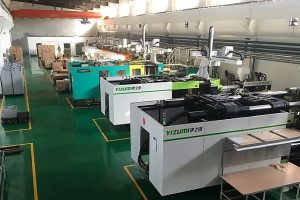
En nuestra fábrica de Shanghai, operamos 47 máquinas de moldeo por inyección de 90T a 1850T, por lo que tratamos cada decisión de herramienta como una pregunta sobre el margen de proceso, no solo como un precio cotizado.
Costillas are thin, structural wall-like features extending perpendicular to a part’s nominal wall. They are primarily used to increase the stiffness and strength of a molded component without increasing the overall wall thickness.
Para una visión más amplia, nuestro injection molding complete guide cubre fundamentos del proceso, comportamiento del material y decisiones de producción.
A rib that is too thick relative to the nominal wall will cause visible sink marks on the show surface; a rib that is too thin will not provide the intended structural reinforcement. The rib thickness ratio—typically 40% to 60% of the nominal wall—is the single most important parameter to control. Beyond thickness, designers must also manage rib height, base radius, draft angle, and spacing, because each of these variables interacts with fill pressure, cooling time, and part warpage.
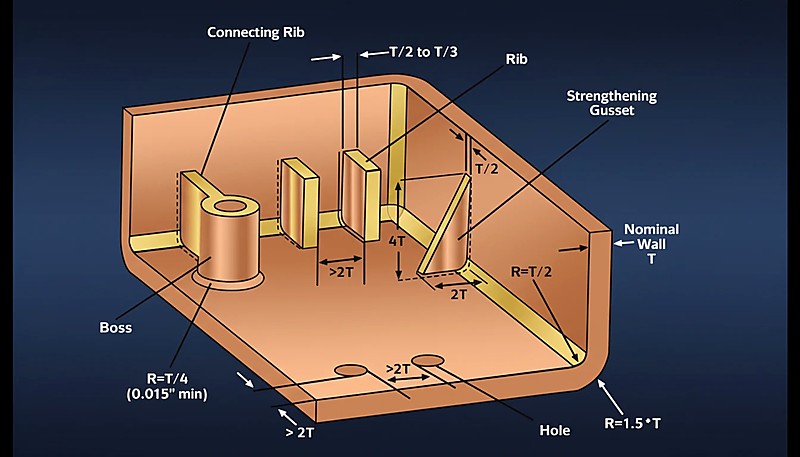
En el contexto de Moldeo por inyección (IM), maintaining “uniform wall thickness” does not mean the rib is as thick as the main wall. Instead, it refers to designing the rib geometry so that the intersection point (where the rib meets the wall) does not create a massive thermal mass. If the mass at the intersection is too large, the material cools unevenly compared to the surrounding wall, resulting in Marcas de fregadero or vacuum voids.
Proper rib design allows engineers to replace heavy, solid sections with lighter, “cored-out” structures, optimizing the strength-to-weight ratio.
When the rib base is too thick—say 80% or more of the nominal wall—excess material accumulates at the junction. That localized mass retains heat longer than the surrounding wall, causing the plastic to shrink unevenly during cooling. The result is a visible depression on the opposite side known as a sink mark. Designers therefore constrain the rib thickness ratio to 40–60% of the nominal wall and control the base radius to manage the transition smoothly.
“Rib base thickness should be kept between 40% and 60% of the adjacent nominal wall thickness to prevent sink marks.”Verdadero
This range prevents excessive heat retention at the T-junction, allowing the rib and wall to cool at similar rates, thus maintaining surface aesthetics.
“Making ribs the same thickness as the main wall increases part strength without side effects.”Falso
Matching rib thickness to wall thickness creates a heavy mass area that causes sink marks, voids, and extended cycle times due to uneven cooling.
What Are the Key Design Parameters for Ribs?
The interaction between rib geometry and material flow is equally important. High-viscosity materials like polycarbonate require more generous radii and lower rib-height ratios to fill completely, while low-viscosity materials like polypropylene can tolerate taller, thinner ribs without sink issues.
To achieve effective ribbing without compromising the cosmetic surface or moldability, adherence to specific dimensional parameters is required.
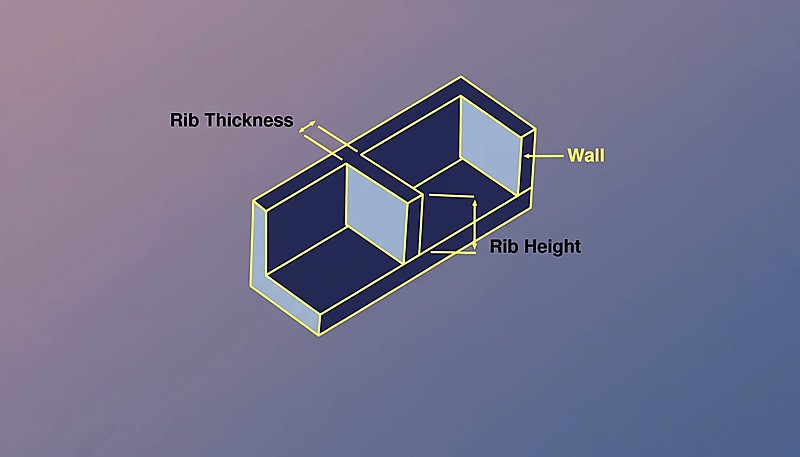
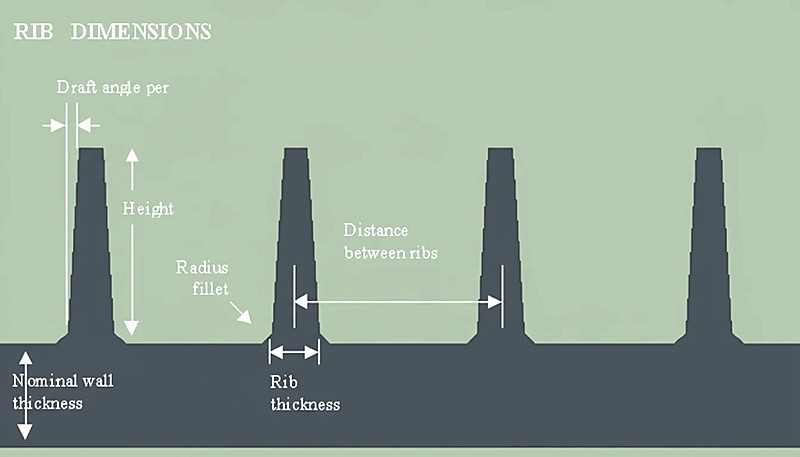
| Parámetro | Símbolo | Valor recomendado / Rango | Key Note |
|---|---|---|---|
| Nominal Wall Thickness | T | 2.0 mm – 4.0 mm (Typical) | The baseline thickness of the main part geometry. |
| Rib Base Thickness | t | 40% – 60% of T | 60% risks sink marks. |
| Altura de la costilla | H | Max 3.0 × T | Excessive height requires high injection pressure and causes gas traps. |
| Ángulo de calado | θ | 0.5° – 1.5° per side | Essential for part release; reduces rib thickness at the tip. |
| Radio de la base | R | 25% – 50% of T | Reduces stress concentrations; too large creates sinks. |
| Espacio entre costillas | S | Min 2.0 × T | Distance between parallel ribs to ensure adequate cooling. |
| Grosor de la punta | t(punta) | Mínimo 0,75 mm | Must be thick enough to vent gas and prevent short shots. |
What Are the Advantages and Disadvantages of Ribbing?
Ribs are structural features that boost stiffness but introduce sink marks, warpage, and tooling complexity requiring careful management.
| Característica | Descripción | Impact on Molding Process |
|---|---|---|
| Ventajas | Material Reduction | Reduces the volume of resin used, lowering part cost and weight. |
| Cycle Time Optimization | Thinner sections cool faster than thick solid walls, reducing overall cycle time. | |
| Stiffness-to-Weight | Increases moment of inertia for rigidity without adding significant mass. | |
| Desventajas | Sink Mark Risk | Improper thickness ratios (t > 60%T) cause visible depressions on the “A-side” surface. |
| Filling Difficulties | Deep, thin ribs can be hard to fill, leading to short shots or high injection pressures. | |
| Venting Issues | Air traps at the bottom of deep ribs can cause diesel effect (burning) 2 . |
What Are the Common Application Scenarios?
Ribs are ubiquitous in structural plastic parts across various industries.
Interiores de automóviles: Dashboard substructures and door panels using Acrilonitrilo butadieno estireno (ABS) o Polipropileno (PP) require ribs for rigidity without heavy weight.
Electrónica de consumo: Housings for laptops and routers use dense rib patterns to protect internal components and manage thermal dissipation.
Moldeo por Inserción vs Sobremoldeo: Diferencias Clave del Proceso Casings made of Optimice el Moldeo por Inyección con un Diseño Adecuado de Nervaduras utilize cross-ribbing to withstand high impact and torque loads.
Battery Enclosures: Large enclosures require ribs to prevent warpage over long flat surfaces.
“Applying a draft angle of at least 0.5° per side is mandatory for ribs to eject cleanly from the mold.”Verdadero
Draft angles reduce friction between the steel and plastic during ejection, preventing drag marks and stuck parts.
“Polishing the mold steel eliminates the need for draft angles on deep ribs.”Falso
While polishing helps, it does not eliminate the vacuum forces and friction generated during ejection; draft is still physically required.
How Do You Design Ribs for Uniform Wall Thickness?
In our production floor, our engineers verify every rib-to-wall ratio on first-article samples, because a 0.05 mm deviation in rib base thickness can push a cosmetic part from acceptable to reject on the show surface.
Set the rib base at 40–60% of the nominal wall, keep height ≤ 3× the wall, add 0.5° draft per side, and place a 0.25×T radius at every base corner. Each step is detailed below.
Determine Nominal Wall (T): Establish the main wall thickness based on the material’s flow properties (e.g., Policarbonato (PC) requires thicker walls than Polietileno (PE)).
Calculate Base Thickness (t): For cosmetic surfaces (high gloss), set t = 0.4 × T. For structural or textured surfaces, set t = 0.6 × T. This ratio keeps the local material volume low enough to prevent sink marks on the opposite show surface.
Aplicar ángulos de giro: Add 0.5° to 1.0° draft per side. Note: This will decrease the thickness of the rib as it gets taller.
“Glass-filled materials shrink less, allowing for slightly thicker ribs (up to 70% of wall thickness) in some cases.”Verdadero
The fibers in materials like PA66-GF30 resist shrinkage, sometimes allowing a higher rib-to-wall ratio without visible sink marks.
“All plastic materials behave the same regarding rib thickness and sink mark susceptibility.”Falso
Amorphous plastics (like PC, ABS) and semi-crystalline plastics (like POM, PBT) have different shrinkage rates, requiring tailored rib design ratios.
Verify Tip Thickness: Check the thickness at the top of the rib. Ensure it is not less than 0.75 mm to allow proper venting and filling.
Add Base Radii: Add a radius of 0.25 × T at the base to reduce stress concentration. Avoid radii > 0.5 × T to prevent creating a “thick chunk” of plastic at the root.
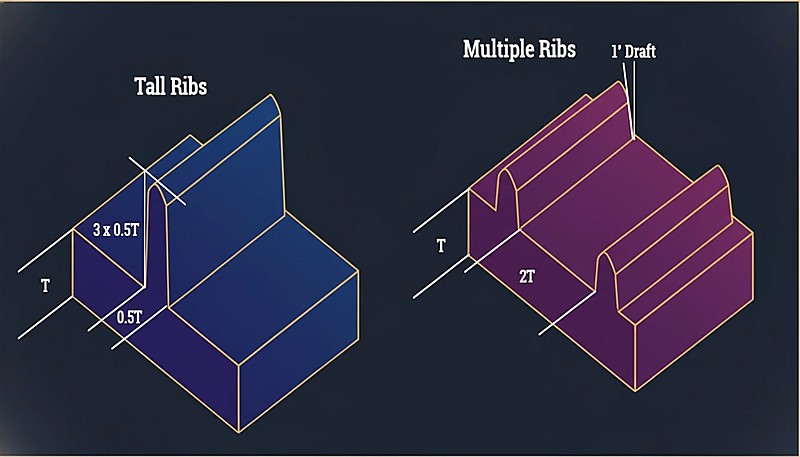
Space the Ribs: If multiple ribs are needed, space them at least $2 \times T$ apart. If ribs are too close, the steel tool between them becomes thin and difficult to cool (thermal gate).
Run Simulation: Use Moldflow analysis to check for potential sink marks and volumetric shrinkage.
What Should You Check Before Sending an RFQ for Ribbed Parts?
The essential pre-RFQ checks are confirming rib-to-wall ratio, draft angle, and base radius on the drawing, plus requesting a DFM review for sink risk.
The RFQ should also ask for manufacturing assumptions. Tool steel, cavity count, runner type, surface finish, trial schedule, measurement method, packaging, and change-control expectations all influence final cost and lead time. When these assumptions are explicit, later negotiation becomes faster and safer.
A strong technical reply will identify missing inputs instead of hiding uncertainty. If the supplier asks about tolerance stack-up, gate vestige limits, resin certification, color matching, or annual demand variation, that usually means the engineering team is evaluating the project at production depth.
For ZetarMold-style projects, the best outcome is a clear manufacturing path: DFM review, diseño de moldes de inyección confirmation, tooling build, sampling, inspection, corrective action, and production release. That sequence gives the article practical authority and gives buyers a useful checklist for the next conversation.
What Production Evidence Proves Good Rib Design?
The strongest evidence is a first-article report showing rib thickness and base radius within tolerance with no sink marks.
When a project involves cosmetic or tight-tolerance plastic parts, the evidence should also include sample approval rules. Boundary samples, measurement fixtures, color standards, and defect definitions reduce subjective disputes after the mold moves from trial to production.
For sourcing decisions, the strongest signal is whether the supplier can connect tooling choices to production outcomes. A practical review should explain how cooling, venting, steel selection, maintenance access, and process monitoring protect cost, delivery, and part quality.
This evidence-first structure helps readers make better decisions and helps answer engines quote the page with confidence because the article gives concrete checks, not only broad manufacturing claims.
What Final Checks Reduce Risk When Ordering Ribbed Molded Parts?
Compare as-molded rib dimensions against the drawing via CMM, then check the show surface for sink marks before approval.
A second useful check is change control. Injection molding projects often become expensive when late design changes, unclear tolerances, or missing sample criteria force the supplier to revise steel, rerun trials, or repeat inspection work. Clear inputs reduce that risk before the next quote or production decision.
What Are the Key Takeaways for Uniform Wall Thickness in Rib Design?
Achieving uniform wall thickness in rib design is a balancing act between structural requirements and molding physics. By adhering to the 40-60% thickness rulelimitando la altura a 3x the nominal wall, and applying appropriate ángulos de caladoes, permitiendo a los ingenieros predecir las marcas de hundimiento y los patrones de llenado antes de cortar el acero. Injection Mold Complete Guide for a comprehensive overview. See our injection mold design for a comprehensive overview.
Need a Quote for Your Injection Molding Project?
Get competitive pricing, DFM feedback, and production timeline from ZetarMold’s engineering team.
Request a Free Quote →
What Else Should You Know About Rib Design and Wall Thickness?
These quick answers address the most common questions about rib ratios, material selection, and quality checks.
Preguntas frecuentes
What is the ideal rib-to-wall thickness ratio?
For most thermoplastics, the rib base should be 40–60% of the nominal wall thickness. For cosmetic (Class A) surfaces, stay closer to 40% to minimize sink marks on the show side. For non-visible structural ribs, you can push toward 60% without cosmetic penalty. Going above 70% almost guarantees visible sink on the opposite surface, regardless of processing conditions. The ratio also depends on material shrinkage characteristics: high-shrinkage materials like PP may need a lower ratio (around 0.4×) than low-shrinkage materials like ABS (which can tolerate 0.5–0.6×). Always verify the ratio against Moldflow simulation results before committing to tooling.
How tall should a rib be compared to wall thickness?
Keep rib height at or below 3× the nominal wall thickness. Taller ribs are difficult to fill completely, especially with high-viscosity materials like polycarbonate, and they tend to warp or break during ejection. If you need more stiffness than a single rib can provide, use multiple shorter ribs spaced at least 2× the wall thickness apart rather than one tall rib. This parallel-rib approach distributes load more evenly and keeps mold filling predictable. In practice, our engineers often start with a height of 2× the wall and only increase it when simulation confirms the flow front reaches the rib tip without trapping air.
Does rib draft angle affect wall thickness?
Yes. Draft angle (typically 0.5° to 1.0° per side) reduces the rib cross-section from base to tip. A rib with 1.0° draft per side loses roughly 0.035 mm per mm of height on each side, which means a 6 mm tall rib narrows by about 0.42 mm total. Always verify that the tip thickness stays above 0.75 mm so the rib fills completely without a short shot. For deep ribs with high draft, the tip may become too thin—this is when you either reduce the draft angle (adding to ejection difficulty) or accept a thicker base and manage sink marks through gate placement and packing pressure.
What causes sink marks near ribs and how do you prevent them?
Sink marks occur when the rib base is too thick relative to the nominal wall, causing excess material to accumulate and shrink unevenly at the rib-wall junction. The localized volumetric shrinkage pulls the show surface inward, creating a visible depression. Prevention starts with keeping the rib-to-wall ratio at or below 0.5× for cosmetic surfaces. Add a base radius of 0.25× the wall thickness to reduce stress concentration, but avoid radii larger than 0.5× the wall—they add mass and worsen sink. Use Moldflow simulation to verify volumetric shrinkage before cutting steel, and consider gate placement near the rib to improve packing pressure in the thick section.
Why is base radius important in rib design?
A base radius of 0.25× the nominal wall reduces stress concentration at the rib-wall junction, which is critical for parts subject to impact or cyclic loading. Without a radius, the sharp corner acts as a stress riser and can initiate cracks during service. However, the radius must be controlled: going above 0.5× the wall adds too much material at the junction, increasing local mass and making sink marks worse. The radius also improves material flow into the rib during filling, reducing the chance of a short shot at the tip. In our tooling practice, the base radius is one of the first dimensions we verify on first-article samples because it directly affects both cosmetic quality and structural performance.
-
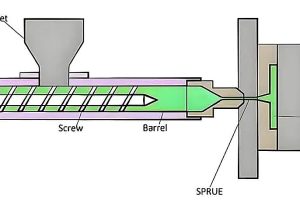
moldeo por inyección: el moldeo por inyección se refiere al proceso de producción que funde plástico, lo inyecta en una cavidad del molde, enfría la pieza y repite el ciclo para una fabricación estable en volumen. ↩
-
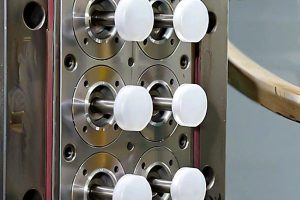
molde de inyección: El molde de inyección se refiere a que el molde de inyección es la herramienta de precisión que define la geometría de la pieza, el comportamiento de enfriamiento, la expulsión, la entrada, el acabado superficial y la repetibilidad. ↩
-
plástico: El plástico es una familia de materiales cuyas características de flujo, contracción, resistencia, resistencia al calor, calidad estética, tiempo de ciclo y rendimiento a largo plazo determinan las decisiones de moldeo. ↩



 EN
EN  ES
ES  FR
FR  DE
DE  PT
PT  AR
AR  RU
RU  JA
JA  KO
KO  IT
IT  NL
NL  TR
TR  PL
PL 