

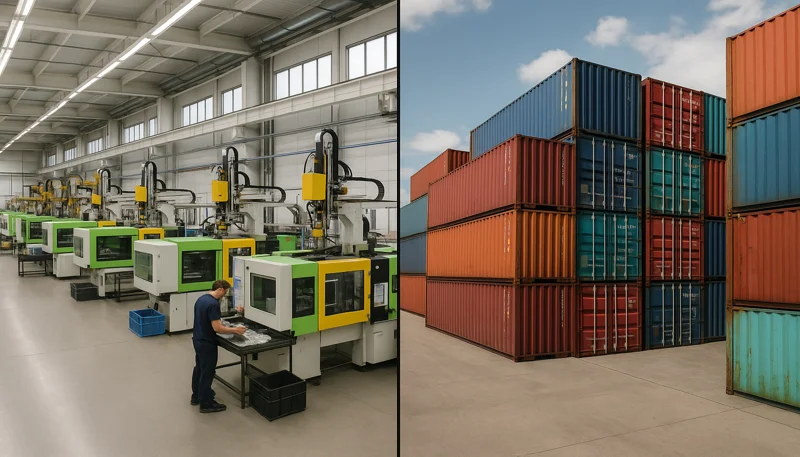
- Canadian injection molding manufacturers deliver lead times of 4 to 8 weeks for production tooling, roughly 50% faster than offshore suppliers in Asia.
- Nearshore molding from Canada eliminates tariff risk and reduces total landed cost by 15 to 25% compared to offshore manufacturing when logistics and duties are included.
- Canadian facilities serving automotive, medical, and aerospace sectors typically hold ISO 9001, IATF 16949, and ISO 13485 certifications, ensuring regulatory compliance without added overhead.
- ZetarMold operates 47 injection molding machines with a 92% first-pass quality rate, supporting Canadian-market clients from prototype through high-volume production.
- Material selection in Canadian injection molding spans over 200 engineering-grade resins, from commodity PP and ABS to high-performance PEEK and nylon composites.
What Makes Injection Molding in Canada a Strategic Choice for North American Manufacturers?
Injection molding in Canada delivers a nearshore advantage that offshore alternatives cannot match: parts reach North American assembly lines within 1 to 2 weeks of shipment, compared to the 10 to 14 weeks typical of transoceanic freight from Asia. This proximity reduces inventory carrying costs by 20 to 30% and eliminates the currency-hedge complexity that comes with CNY-denominated contracts.
| Metrik | Canada / Nearshore | Asia Offshore |
|---|---|---|
| Production Lead Time | 2–4 weeks | 8–12 weeks |
| Import Duty (CUSMA) | 0% | 7.5–25% |
| Transit Distance | 1–3 days truck | 4–6 weeks ocean |
| Safety Stock Needed | 2–4 weeks | 10–16 weeks |
Canada’s manufacturing sector is governed by the same CUSMA (formerly NAFTA) trade framework as the United States, meaning zero-tariff movement of qualifying plastic components across the border. In our experience working with Canadian-market clients, this single policy factor eliminates the 7.5 to 25% import duty that applies to comparable parts sourced from China or Vietnam, fundamentally changing the total cost equation for procurement teams evaluating sourcing options.
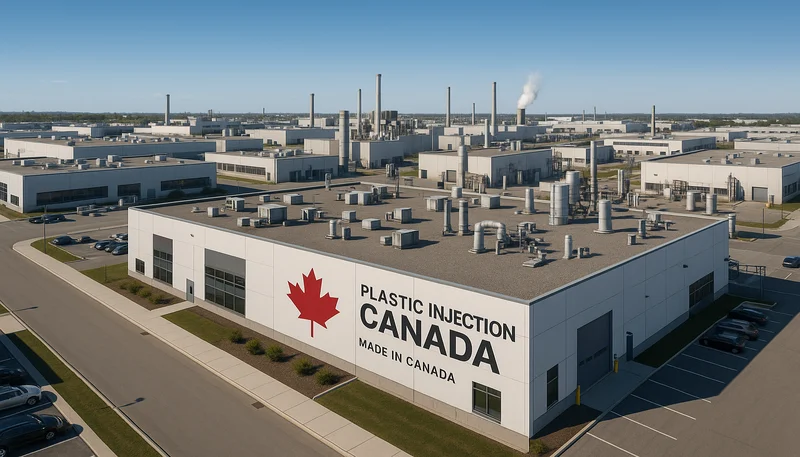
The Canadian plastics industry contributes over CAD 35 billion annually to the national economy, supported by a skilled workforce trained in precision toolmaking, robotics, and quality systems. Facilities cluster around Ontario’s Golden Horseshoe, Greater Vancouver, and the Montreal corridor, providing access to major automotive OEMs, medical device manufacturers, and aerospace integrators within a one-day delivery radius for most of Eastern Canada.
Supply chain resilience has become a decisive factor since 2020, when COVID-related port disruptions exposed the vulnerability of long ocean-transit supply chains. Canadian manufacturers sourcing injection molded components locally or nearshore maintained production continuity while competitors waited 16 to 22 weeks for backlogged ocean containers. This experience has permanently shifted procurement strategies toward regional supply chain redundancy as a risk management requirement.
What Industries Drive Demand for Injection Molding in Canada?
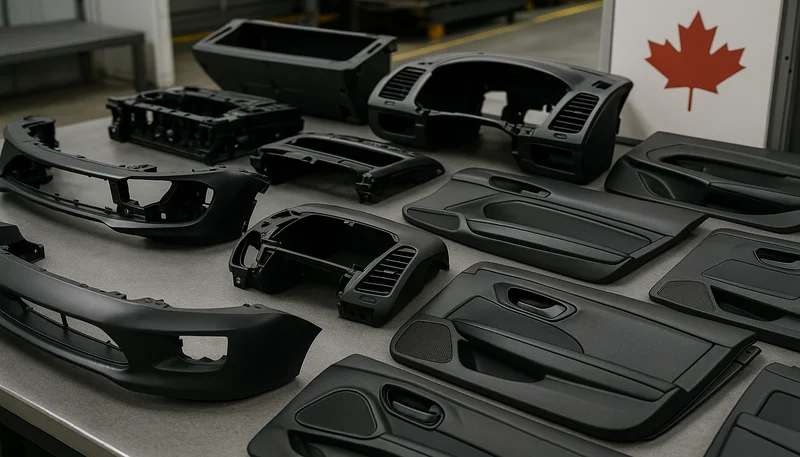
Automotive manufacturing accounts for approximately 40% of Canadian plastic injection molding volume, driven by OEM suppliers to Ford, GM, Stellantis, and Toyota plants concentrated in Ontario. Parts range from interior trim panels and HVAC ducts to under-hood components molded in glass-filled PA66 or PBT, requiring tolerances of ±0.05 mm and IATF 16949 process control. The transition to electric vehicles is further expanding demand for battery enclosure components, thermal management parts, and high-voltage connector housings.
Medical device production represents the fastest-growing segment in Canadian injection molding. Facilities serving this sector operate ISO Class 7 or Class 8 cleanrooms and hold ISO 13485 certification. Typical parts include surgical instrument housings, diagnostic cartridges, intravenous fluid connectors, and implant trial components molded in USP Class VI polycarbonate or polypropylene, with full material traceability from resin lot through finished part shipment to the healthcare facility receiving the device.
| Endüstri | Volume Share | Key Certification | Typical Tolerance |
|---|---|---|---|
| Otomotiv | ~40% | IATF 16949 | ±0.05 mm |
| Tıbbi Cihazlar | ~20% | ISO 13485 | ±0.02 mm |
| Tüketim Malları | ~18% | ISO 9001 | ±0.10 mm |
| Havacılık ve Uzay | ~10% | AS9100 | ±0.03 mm |
| Elektronik | ~8% | ISO 9001 | ±0.08 mm |
| Other | ~4% | ISO 9001 | ±0.15 mm |
Aerospace and defense applications demand tight process documentation, AS9100 compliance, and traceability to raw material lot level. Consumer electronics, packaging, and agriculture equipment round out the demand base, giving Canadian molders deep cross-sector expertise that directly benefits new product introductions requiring expert DFM analysis. Design for manufacturability reviews conducted by experienced application engineers early in the development cycle identify and prevent costly late-stage design changes that would otherwise delay program launch, increase NRE expenditure, and require re-qualification of already-approved tooling at significant cost.
The electric vehicle transition is reshaping Canadian injection molding demand across all industry sectors. Battery pack housings require large-format thin-wall polypropylene or nylon components molded on 1,500 to 3,000-ton presses. Thermal interface material overmolds for battery cell frames demand precise bond line thickness control within ±0.10 mm. Charging port enclosures and sensor housings specify UV-stabilized polycarbonate with IP67 sealing surfaces, challenging both mold design and process consistency across high-volume programs that require zero-defect supply into automated assembly lines.
“Canadian injection molding facilities can hold dimensional tolerances of ±0.05 mm for automotive-grade components.”Doğru
Modern CNC-machined P20 and H13 tool steel molds combined with closed-loop process control allow Canadian manufacturers to routinely achieve ±0.05 mm on critical features, meeting IATF 16949 automotive requirements without additional inspection overhead. CMM verification at first article confirms dimensional compliance before any production run is released.
“Sourcing injection molding from Canada always costs more than equivalent parts from China.”Yanlış
When total landed cost is calculated including ocean freight at $3,000 to $6,000 per container, import duties of 7.5 to 25%, customs brokerage, and 6 to 14 weeks of inventory buffer, Canadian parts typically cost 15 to 25% less on a fully loaded basis for orders under 500,000 pieces annually. The hidden cost of quality escapes and supply disruptions further favors nearshore sourcing.
What Materials Are Most Commonly Used in Canadian Injection Molding Operations?
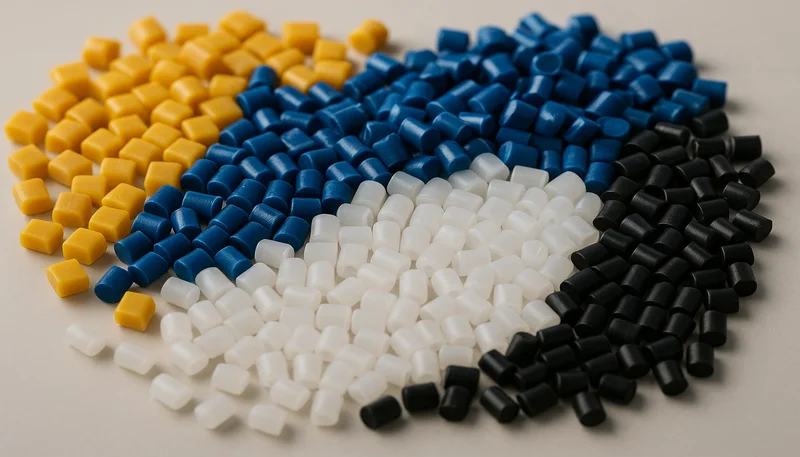
Canadian injection molders process over 200 resin grades, but five material families dominate production volume. Polypropylene (PP) leads at roughly 35% of volume due to its chemical resistance, low density (0.90 g/cm³), and cost-effectiveness at CAD 1.20 to 1.80 per kg. ABS and PC-ABS blends follow closely, valued for their impact strength and surface finish quality required in consumer electronics and automotive interior applications where Class A surfaces are specified and paint adhesion is a critical design requirement.
Engineering-grade termoplastikler1 such as PA6, PA66, and POM are essential for structural and tribological applications. Glass-filled variants (10 to 50% GF) raise tensile strength from 70 MPa to over 180 MPa while reducing shrinkage from 1.5% to under 0.5%, improving dimensional stability for precision assemblies. Processing temperatures for these resins range from 230°C to 290°C, requiring barrel and screw designs rated for abrasive service, as well as mold temperature control units capable of 80 to 120°C coolant supply to ensure proper crystallization and dimensional stability in the finished part.
| Resin | Çekme Dayanımı | Service Temp | Key Application |
|---|---|---|---|
| PP | 25–40 MPa | Up to 100°C | Automotive, packaging |
| ABS | 40–50 MPa | Up to 90°C | Electronics, consumer goods |
| PA66 GF30 | 180 MPa | Up to 150°C | Automotive structural |
| PC | 55–75 MPa | Up to 135°C | Medical, optical |
| PEEK | 100 MPa | Up to 260°C | Aerospace, implants |
High-performance resins including PEEK, PEI (Ultem), and PPS are increasingly specified for aerospace and medical parts where continuous service temperatures exceed 150°C. These materials require mold temperatures of 160 to 200°C and specialized screw geometries, capabilities that differentiate Tier 1 Canadian molders from standard commodity shops. Material selection should always be validated through simulation before tooling is ordered.
Recyclability and sustainability requirements are reshaping material selection for Canadian buyers. Post-consumer recycled (PCR) content mandates are emerging in packaging and automotive applications, requiring suppliers to qualify resin lots with variable MFI and color consistency. Bio-based resins including PLA and PHAs are gaining acceptance for consumer goods, though their processing windows are narrower and moisture sensitivity demands dedicated material handling. Canadian injection molders investing in dryer and conveying infrastructure for these emerging materials are well-positioned for the decade ahead.
How Does Tooling and Mold Design Affect Lead Times for Canadian Projects?
Tooling lead time is the dominant schedule variable in any injection molding program. In Canada, a single-cavity production mold in P20 steel typically requires 4 to 6 weeks from approved DFM drawings to first article inspection. Multi-cavity family molds or complex side-action tools with hydraulic cores extend this to 8 to 12 weeks. Compare this to offshore tooling at 12 to 18 weeks including ocean transit, and the schedule advantage becomes decisive for product launches with fixed market windows.
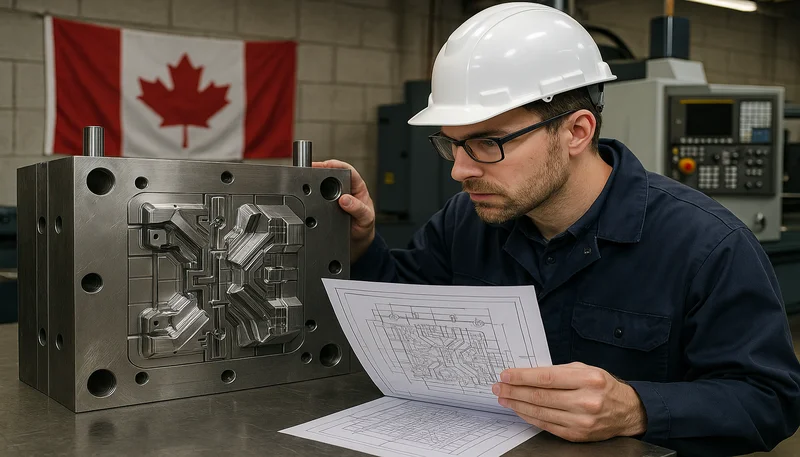
Canadian tool shops invest heavily in 5-axis CNC machining centers, EDM spark erosion equipment, and CMM coordinate measurement systems. Injection mold design reviews using simulation software identify gate location, cooling circuit routing, and ejector pin placement before steel is cut, reducing engineering change iterations by 30 to 50% compared to quote-to-build approaches that skip simulation entirely and rely on trial-and-error sampling to resolve filling, cooling, and ejection problems that should have been solved in the design phase.
| Çelik Sınıfı | Sertlik (HRC) | Tool Life (cycles) | İçin En İyisi |
|---|---|---|---|
| P20 | 30–36 | Up to 500K | Medium volume, low-wear resins |
| H13 | 48–52 | 1M+ | High volume, abrasive resins |
| 420 SS | 50–54 | 500K+ | Corrosive resins (PVC, GF) |
| Aluminum 7075 | 15–20 HRC equiv. | Up to 50K | Prototype / bridge tooling |
Gate design critically influences part quality and cycle efficiency. Fan gates distribute melt across wide surfaces to prevent stress concentration. Pin gates minimize gate vestige on visible surfaces. Submarine and tunnel gates enable automatic de-gating at part ejection, eliminating manual trimming labor for high-volume programs. Canadian mold designers with deep application engineering experience select gate type, location, and size as part of the initial DFM package rather than leaving these decisions to trial and error.
Cooling system design accounts for 60 to 70% of total injection molding döngü süresi2, making it the highest-leverage area for productivity improvement. Canadian tool designers use conformal cooling channels following the cavity contour to deliver uniform heat extraction. Uniform cooling reduces differential shrinkage across the part surface, minimizing warpage in flat or thin-walled components. Cycle time reductions of 20 to 35% versus conventional straight-drilled cooling have been documented in production programs for automotive trim panels and consumer electronics enclosures.
“Running kalıp akış analizi3 before cutting steel reduces tooling revision costs by 30 to 50%.”Doğru
Simulation identifies weld line location, air trap zones, and gate imbalance problems before any metal is machined. Fixing these issues in software costs a few hours of engineer time; correcting them after steel is cut costs $2,000 to $15,000 per revision depending on mold complexity. Pre-cut analysis is a mandatory investment for any professional toolroom handling complex geometry.
“All injection molds for Canadian projects must be built locally in Canada.”Yanlış
Many Canadian OEMs and tier suppliers use a hybrid model: molds are built in China or Taiwan at 20 to 40% lower tooling cost, then shipped to a Canadian or US facility for ongoing production runs. This approach captures tooling cost savings while keeping production nearshore for lead time and quality control benefits. ZetarMold supports this hybrid model with global tooling plus North American production coordination.
How Does Injection Molding in Canada Compare to Offshore Sourcing in Total Cost?
The offshore-versus-nearshore cost comparison must analyze total landed cost, not just piece price. A part quoted at $0.45 USD from a Chinese molder may arrive at the Canadian customer’s dock at an effective cost of $0.68 to $0.82 per piece after adding ocean freight ($0.08–0.12 per part on a 50,000-piece container), import duties (7.5% on plastics under HTS 3926), customs brokerage fees ($0.02–0.04 per part), and the capital carrying cost of 3 months of safety stock inventory required to buffer ocean transit variability.
Nearshore production at $0.58 per part with 2-week truck delivery, zero import duty under CUSMA, and only 2 weeks safety stock requirement often results in 12 to 20% net landed cost savings for annual volumes below 2 million pieces. The crossover point where offshore economics become favorable is typically around 3 to 5 million pieces annually for simple commodity parts, significantly higher for complex or quality-sensitive components requiring close oversight and rapid engineering response.
| Faktör | Canadian / Nearshore | Offshore (China/Asia) |
|---|---|---|
| Tooling Lead Time | 4–8 weeks | 12–18 weeks |
| Production Lead Time | 2–4 weeks | 8–12 weeks |
| Import Duty (CUSMA) | 0% | 7.5–25% |
| Safety Stock Required | 2–4 weeks | 10–16 weeks |
| Defect Rate (typical) | <1% | 2–5% |
| IP Protection Risk | Düşük | Medium–High |
| Total Landed Cost Index | 1.00 | 0.90–1.25 |
Quality escapes add a cost dimension that simple price comparisons miss entirely. In our factory, rework and scrap rates run below 0.8% with 100% CMM first-article inspection and SPC monitoring. An offshore supplier with 3 to 5% defect rate escaping into the supply chain can trigger assembly line shutdowns costing $15,000 to $50,000 per hour in automotive production, warranty recalls, or regulatory non-compliance in medical applications. These risks are not reflected in piece price quotes but represent real components of total supplier cost.
Tariff exposure has become a significant variable following recent North American trade policy shifts. Canadian suppliers operating under CUSMA provide a stable, tariff-exempt sourcing option that US-adjacent manufacturers and Canadian buyers can rely on without the unpredictability of annually changing duty schedules or trade dispute surcharges. This regulatory stability adds strategic option value to Canadian sourcing that does not appear in today’s price comparison but has proven its worth repeatedly during periods of trade disruption.
What Quality Standards Govern Injection Molding Operations in Canada?
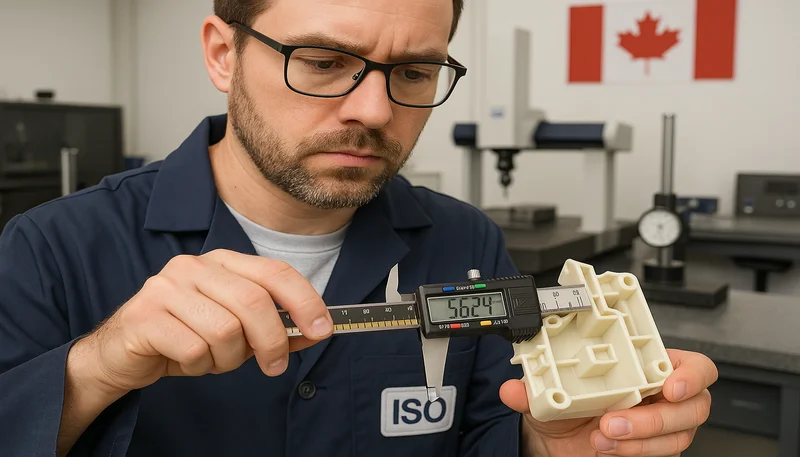
Canadian injection molding facilities serving regulated industries operate under a layered quality framework. ISO 9001:2015 provides the base quality management system, covering corrective action processes, document control, and management review cycles. The automotive supply chain adds IATF 16949:2016 requirements including Statistical Process Control (SPC) charting of critical dimensions, PPAP (Production Part Approval Process) documentation, and measurement system analysis (MSA) Gage R&R studies confirming that inspection equipment is capable of measuring the required dimensions.
Medical device molders must comply with ISO 13485:2016, which mandates design history files, risk management per ISO 14971, and formal validation protocols including IQ (Installation Qualification), OQ (Operational Qualification), and PQ (Performance Qualification). Cleanroom molding environments are classified under ISO 14644-1, with Class 7 (fewer than 352,000 particles ≥0.5 µm per cubic meter) being the standard for Class II medical devices in Canada and the United States.
| Sertifikasyon | Endüstri | Key Requirement |
|---|---|---|
| ISO 9001:2015 | All industries | Quality management system baseline |
| IATF 16949:2016 | Otomotiv | SPC, PPAP, MSA, control plans |
| ISO 13485:2016 | Tıbbi cihazlar | Cleanroom, validation, traceability |
| AS9100 Rev D | Havacılık ve Uzay | Design control, risk, traceability |
| ISO 14644 | Medical / Pharma | Cleanroom particle classification |
Mold flow analysis reports and cycle time optimization studies are documented as part of the process validation package, creating an auditable trail from initial simulation to qualified production process. This documentation discipline reduces FDA 483 observations for medical device manufacturers and IATF audit non-conformances for automotive suppliers, directly protecting the business relationship and enabling faster regulatory submissions.
First article inspection reports generated by Canadian suppliers provide dimensional data for all drawing callouts, material certifications with full lot traceability, process capability indices (Cpk ≥ 1.67 for critical automotive dimensions), and appearance approval records. These documents are retained for the production program lifetime plus a contractually defined period, typically 10 to 15 years for automotive parts and the device lifetime plus 2 years for medical components, meeting Health Canada and FDA records requirements.
Supplier audits by Canadian OEMs evaluate corrective action effectiveness, preventive maintenance completeness, and calibration record currency. Canadian molders with robust quality systems welcome customer audits as a differentiator, using the process to demonstrate control plan discipline and continuous improvement maturity that offshore suppliers with less transparent management systems often cannot match on a verifiable basis.
What Are the Key Process Capabilities Canadian Injection Molders Offer?
Shot capacity in Canadian production facilities ranges from 5 grams for micro-molding of medical components to over 50 kilograms for large structural parts in agricultural and construction equipment. Clamp tonnage covers 15 to 3,000 metric tons, accommodating everything from hearing aid housings to heavy-duty tractor fender panels. In our factory, we operate 47 machines spanning 80 to 1,200-ton clamp force, enabling same-facility production across diverse program types without supplier handoffs.
Üst kalıplama ve ekleme kalıplama capabilities allow Canadian suppliers to deliver complete subassemblies rather than individual components, reducing downstream assembly labor. Two-shot molding creates rigid-soft combinations such as PP with TPE grip surfaces in a single machine cycle. Gas-assist injection molding reduces wall thickness and material consumption by 10 to 30% in hollow structural sections while maintaining part rigidity.
| Capability | Range / Spec | Uygulama |
|---|---|---|
| Clamp Force | 80–1,200 tons | Small to large structural parts |
| Atış Boyutu | 5g – 5kg | Micro to medium components |
| Machines | 47 units | Dedicated production cells |
| First-Pass Quality Rate | 92% | All programs |
| Defect Rate | <0.8% | With CMM + SPC monitoring |
| Overmolding / Insert | Yes | Subassembly delivery |
Secondary operations performed in-line or adjacent to presses include ultrasonic welding, pad printing, heat staking, decorative painting, and sub-assembly. This vertical integration compresses the supply chain, reducing part-travel distance and the number of vendor quality interfaces that create defect opportunities. Turnkey programs from resin procurement through packaged finished goods are increasingly the standard for major Canadian OEM accounts seeking to simplify their supplier management workload.
How Can Canadian Companies Work With ZetarMold for Injection Molding Projects?
ZetarMold provides Canadian clients with a full-service injection molding partnership that bridges offshore tooling economics with North American production responsiveness. Our workflow begins with a free DFM report delivered within 24 hours of receiving a 3D CAD model, identifying moldability issues, gate location recommendations, and material guidance before any financial commitment is required from the customer.
| Adım | What Happens | Zaman Çizelgesi |
|---|---|---|
| 1. Submit CAD | Free DFM review + material recommendations | 24 hours |
| 2. Tooling Quote | Mold design + flow analysis + cost estimate | 48 hours |
| 3. Prototype | Aluminum mold + first functional parts | 2–3 weeks |
| 4. Production Mold | P20/H13 steel tool + PPAP submission | 4–8 weeks |
| 5. Production | CMM-verified parts + real-time dashboards | Ongoing |
For prototype and low-volume requirements, low-volume injection molding programs using aluminum tooling deliver functional parts in 2 to 3 weeks at 50 to 70% lower tooling cost than production steel molds. This allows Canadian engineering teams to validate design intent and process parameters before committing to full production tooling investment, substantially reducing program risk in regulated markets where design changes after validation are expensive.
Production programs transition seamlessly to our 47-machine floor, where dedicated cells with robots and vision inspection systems maintain defect rates below 0.8%. Real-time production dashboards accessible to Canadian buyers provide live shot counter data, scrap tracking, and OEE metrics without requiring on-site visits. Monthly business reviews with dedicated account managers ensure capacity planning aligns with customer forecast changes, preventing supply disruptions.
Frequently Asked Questions About Injection Molding in Canada?
What is the typical lead time for injection molding projects sourced from Canada?
For Canadian injection molding suppliers, production tooling in P20 steel typically requires 4 to 6 weeks from approved drawings to first article samples, while complex multi-cavity molds with side actions may take 8 to 12 weeks. Once tooling is qualified, production lead times for repeat orders run 2 to 4 weeks from purchase order to shipment. This compares favorably to offshore tooling at 12 to 18 weeks including ocean transit, making Canadian or nearshore suppliers the preferred choice for time-sensitive product launches and just-in-time supply chain programs. Rush tooling options are available at premium cost for urgent programs.
What certifications should I look for when choosing a Canadian injection molding supplier?
The minimum certification baseline for a serious Canadian injection molder is ISO 9001:2015. Automotive suppliers should hold IATF 16949:2016 and be capable of submitting complete PPAP documentation including process capability studies with Cpk values of 1.67 or higher on critical dimensions. Medical device suppliers require ISO 13485:2016 and validated cleanroom environments classified to ISO 14644. Aerospace applications call for AS9100 Rev D certification with full material traceability. Always request a current certificate copy, verify the certification scope matches your product category, and confirm the certifying body is ANAB or UKAS accredited for the specific standard.
How does the total cost of Canadian injection molding compare to offshore manufacturing?
Total landed cost analysis shows that Canadian or nearshore injection molding is cost-competitive with offshore sourcing for annual volumes below approximately 2 million pieces. The offshore piece price advantage of 20 to 40% is substantially offset by ocean freight ($3,000 to $6,000 per container), import duties (7.5 to 25% depending on HTS classification), 3 months of safety stock carrying cost, and quality escape risk. Canadian sourcing also eliminates currency exposure, intellectual property risk, and the management bandwidth cost of cross-Pacific supplier oversight. A proper total cost model typically shows Canadian sourcing saves 12 to 25% for sub-2-million-unit annual programs.
Can Canadian injection molding suppliers handle both prototype and production volumes?
Yes, most professional Canadian injection molders offer a full continuum from prototype to high-volume production. Aluminum bridge tooling programs deliver first functional parts in 2 to 3 weeks at 50 to 70% of production tooling cost. These tools support 10,000 to 50,000 cycle lifespans, enough to validate design and process before committing to production tooling investment. ZetarMold manages this transition systematically, transferring all validated process parameters from bridge to production tooling to maintain dimensional consistency across the program lifecycle, eliminating the need to re-qualify parts from scratch when tooling transitions occur at full production launch.
What plastic materials are available for injection molding in Canada?
Canadian injection molders can source and process virtually any commercial thermoplastic resin. Commodity grades include PP, PE, PS, ABS, and SAN for high-volume consumer and packaging applications. Engineering resins include PA6, PA66, PC, POM, PBT, and PET for structural and precision applications. High-performance materials include PEEK, PEI, PPS, LCP, and PTFE-filled grades for extreme temperature and chemical resistance requirements. Glass-filled, carbon-fiber-filled, and mineral-filled variants are available in most base resin families. Material selection should be guided by the part’s thermal, mechanical, and chemical service requirements, with a DFM review confirming compatibility with available processing equipment and tooling configuration.
How do Canadian injection molding suppliers ensure quality for exported parts?
Professional Canadian injection molding facilities operate quality systems on a preventive rather than reactive model. Statistical Process Control (SPC) monitors critical dimensions in real time with automatic alerts when process parameters approach specification limits. First article inspection using CMM verifies all drawing callouts before any production batch is released. Control plans document monitoring frequency, measurement method, and reaction plans for each critical characteristic at every process step. Final inspection may include 100% vision system checks, pressure-decay leak testing, or functional assembly verification depending on part criticality. All non-conforming material is quarantined and dispositioned under a formal NCR process, with corrective actions tracked to verified closure before resuming production.
-
thermoplastics: Thermoplastics refers to a class of polymer resins that soften and become moldable when heated above their glass transition or melt temperature and solidify upon cooling, enabling repeated processing cycles without chemical degradation — the fundamental property enabling injection molding. ↩
-
cycle time: Cycle time is defined as the total elapsed time to complete one injection molding cycle, including injection, cooling, and ejection phases, measured in seconds and directly determining production output per hour. ↩
-
mold flow analysis: Mold flow analysis refers to computer simulation software used to predict how molten plastic fills a mold cavity, identifying potential defects such as weld lines, sink marks, and short shots before tooling is cut. ↩




 TR
TR  EN
EN  ES
ES  FR
FR  DE
DE  PT
PT  AR
AR  RU
RU  JA
JA  KO
KO  IT
IT  NL
NL  PL
PL 