Injection Molding Supplier DFM Review: How to Catch Design Risks Before Mold Build

• ZetarMold Engineering Guide
• Plastic Injection Mold Manufacturing Since 2005
• Built by ZetarMold engineers for buyers comparing mold and molding solutions.

You just spent weeks perfecting your part design in CAD. Then your injection molding supplier comes back with a two-page list of changes—and you realize the part cannot be molded reliably. That list is the DFM1 review, and it just saved you significant rework costs.\n\nA Design for Manufacturability (DFM) review is the most important technical handshake between you and your 사출 성형 공급업체 before steel is cut. This guide covers what a real DFM review includes and how to evaluate your supplier’s process.

In this guide, we walk through what a real DFM review covers, the most common design risks it catches, and how to tell whether your supplier is doing a thorough job or just rubber-stamping your files.

주요 내용
  • A DFM review catches moldability problems before steel is cut, saving significant rework costs.
  • Wall thickness, draft angles, undercuts, and gate placement are the top four risk areas.
  • A competent supplier returns a marked-up drawing with specific recommendations.
  • Request the DFM report at the quoting stage, not after mold design kickoff.
  • Suppliers who skip DFM or return vague notes are a red flag for quality risk.

What Is a DFM Review in Injection Molding?

A DFM review is a structured engineering analysis where your 사출 성형 supplier evaluates your part design against molding process realities. The reviewer examines wall thickness, draft angles, rib proportions, undercuts, gate placement, and material flow. At ZetarMold, roughly 70 percent of first-submission designs have at least one feature that would cause a defect or require mold action.

In our experience at ZetarMold, roughly 70 percent of first-submission part designs have at least one feature that would cause a molding defect or require expensive mold action such as lifters, side cores, or collapse cores. The DFM review exists to find those issues when changing a CAD file takes hours, not weeks and thousands of dollars in tooling rework.

Why Should You Demand a DFM Review Before Mold Build?

Skipping the DFM review is the most expensive mistake in an injection molding project. Once the mold is built, every design change means modifying hardened steel. A simple wall-thickness adjustment that takes 30 minutes in CAD can cost thousands in mold rework, plus weeks of lead time.

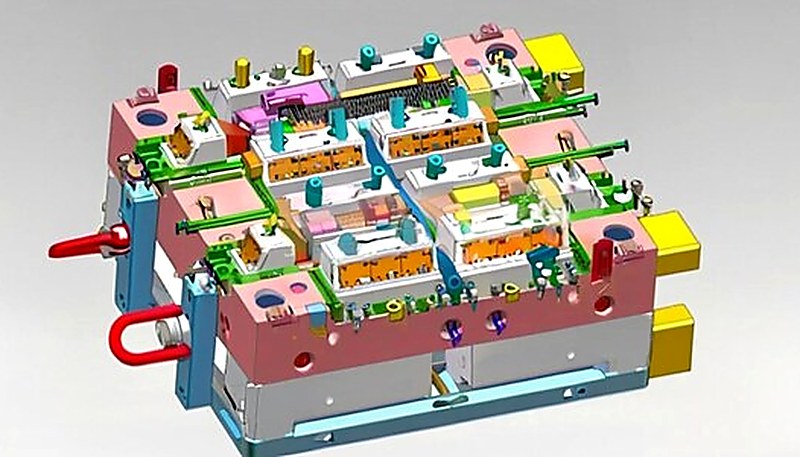
Injection mold design diagram
Mold design review catches risks early

The financial exposure scales with part complexity. A simple bracket might need one or two tweaks. But a multi-cavity mold with thin-wall features, living hinges, or integrated fasteners? Without DFM, you are gambling on first-shot success—a bet you will lose more often than not. We have seen projects where the total rework cost exceeded the original mold price because the DFM step was treated as optional.

A proper DFM review also protects your production timeline. Catching a sink-mark risk before molding means you can adjust rib proportions in CAD instead of discovering cosmetic defects on your first production parts.

What Do Suppliers Check During a DFM Review?

A thorough DFM review covers eight key areas that are critical to part quality and mold longevity. Suppliers examine wall thickness, draft, ribs, undercuts, gate placement, tolerances, material fit, and assembly features.

1. Wall Thickness Uniformity — Wall thickness variation greater than 10 to 15 percent between adjacent features creates flow imbalances, 싱크 마크2, and warpage. The reviewer checks whether your nominal wall is consistent and whether transitions between thick and thin sections are properly filleted.

2. Draft Angles — Every vertical surface needs draft—typically 0.5 to 2 degrees per side depending on surface finish and texture depth. Polished surfaces can get away with less; textured surfaces need 1.5 degrees or more per 0.025 mm of texture depth. The DFM reviewer flags any surfaces with zero or insufficient draft angle.

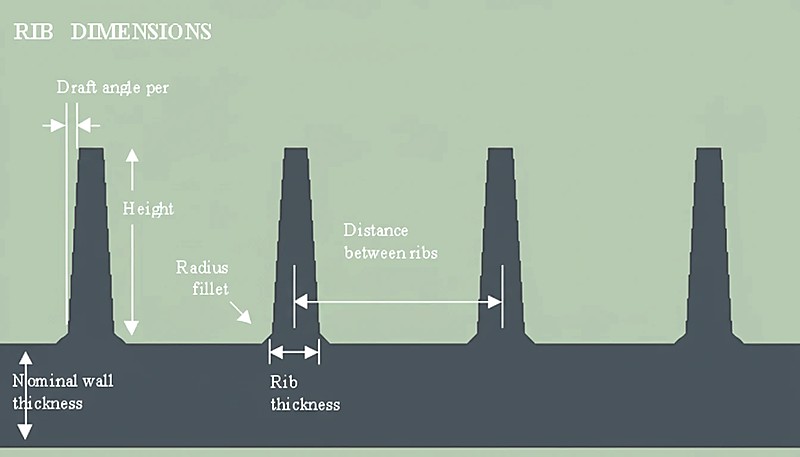
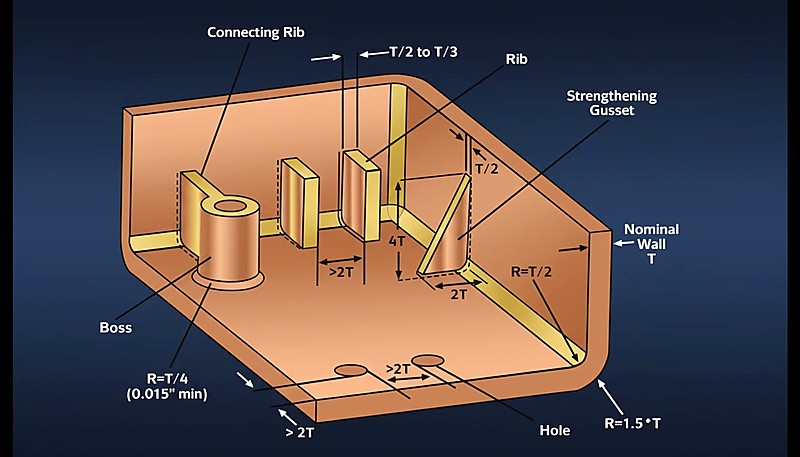
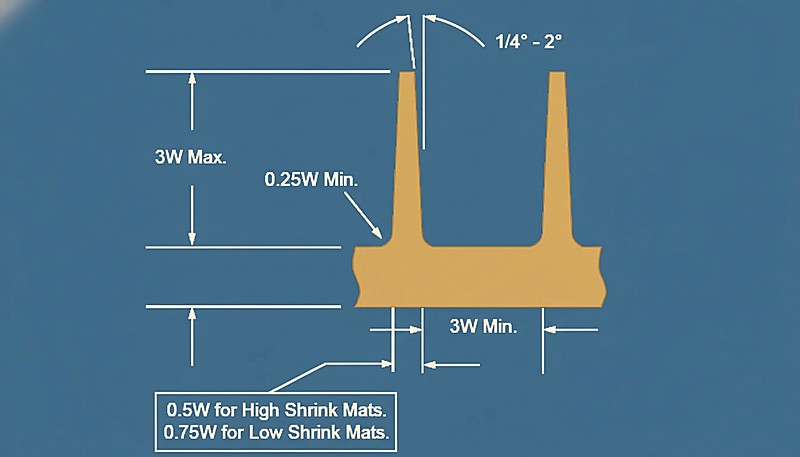
3. Rib and Boss Proportions — Ribs should be 50 to 60 percent of the nominal wall thickness to avoid sink marks on the opposite face. Bosses need proper wall proportions and gusset radii. The reviewer calculates the thickness ratio at every rib-wall and boss-wall junction.

4. undercut3 Detection — Undercuts prevent the part from ejecting in a straight pull. The reviewer identifies every undercut and recommends either a design change to eliminate it or a mold action such as a lifter, slide, or collapse core, along with the associated cost impact.

5. Gate Location and Flow Analysis — Where the material enters the cavity affects weld-line placement, air-trap risk, packing pressure, and cosmetic appearance. A good DFM review includes a basic flow simulation or at minimum an experienced-based gate placement recommendation.

🏭 ZetarMold Factory Insight
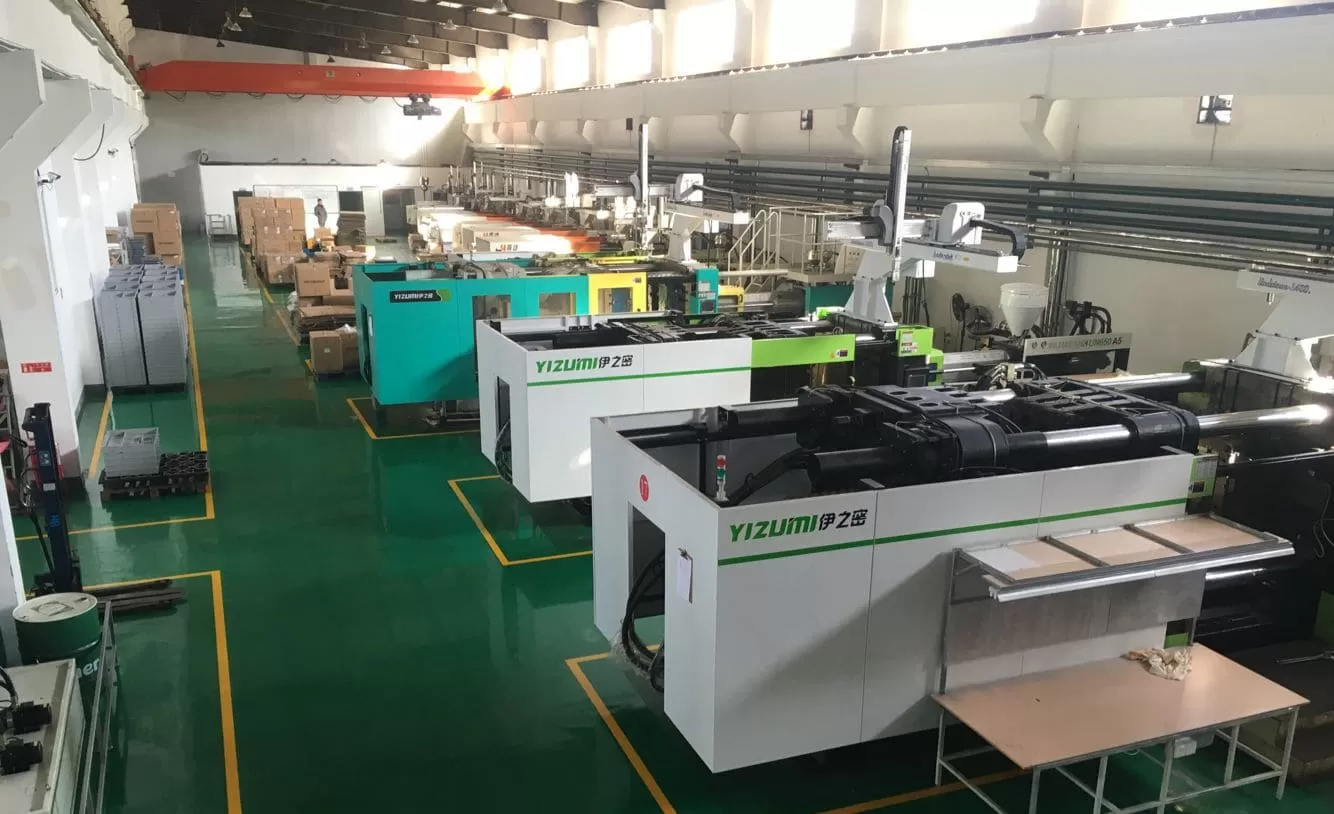
With 20+ years of experience and engineers using SOLIDWORKS and Moldflow, our DFM reviews cover simulation-backed analysis and real-world process knowledge across 47 machines.
Rib dimensions diagram
Rib design prevents sink marks

6. Tolerance Feasibility — Not every dimension can be held to tight tolerance in 사출 금형 production. The reviewer flags dimensions that fall outside standard molding tolerance (typically plus or minus 0.1 mm for critical features up to 25 mm) and suggests design fixes or process controls.

7. Material Selection Validation — The reviewer checks whether your chosen material is compatible with the part geometry, wall thickness, and functional requirements. Some materials—like glass-filled nylon or PEEK—have specific flow and shrink behaviors that constrain design options.

8. Assembly and Functional Features — Snap fits, living hinges, press-fit bosses, and ultrasonic weld ribs each have design rules.

The DFM reviewer checks whether these features follow established proportions and will function reliably in production.

How Do You Evaluate a Supplier’s DFM Capability?

Not all DFM reviews are created equal. A supplier who truly invests in DFM will demonstrate it in several concrete ways:

Ask for a sample DFM report. A competent supplier can show you a redacted DFM report from a previous project. Look for specificity: does the report reference exact feature locations, dimensions, and recommended changes with rationale? Or does it contain vague statements like review wall thickness with no actionable detail?

Check their software tools. DFM should involve more than eyeballing your STEP file. Ask whether they use Moldflow or similar simulation software for flow analysis. If a supplier says they just check in CAD, that tells you the depth of their analysis.

Evaluate response time and detail level. A real DFM review takes two to five business days for a moderately complex part. If a supplier returns DFM comments in four hours, they either have extraordinary engineering bandwidth or they are not looking very hard. The best suppliers return a marked-up drawing or annotated 3D model where each comment is pinned to a specific feature.

Look for cost-impact transparency. Strong DFM reports do not just flag problems—they tell you the cost and lead-time impact of each issue. For example, stating that a particular undercut requires a side core adding approximately four to six thousand dollars to tooling cost is a useful DFM comment. Merely noting undercut detected is not useful.

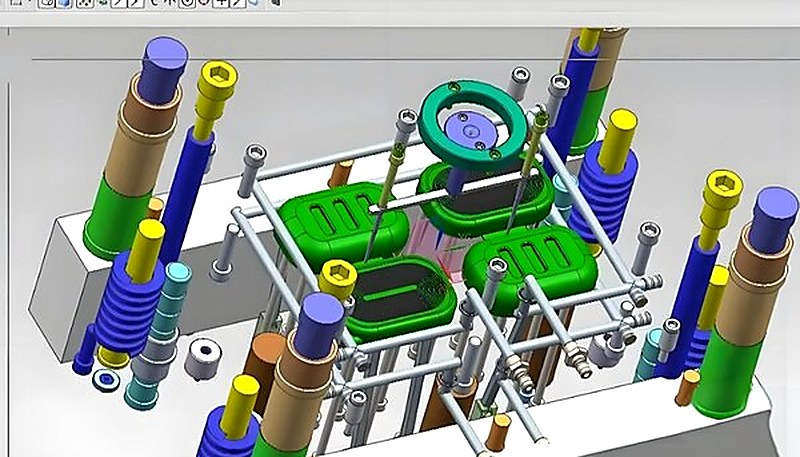
Injection mold design cross section
Mold design affects DFM outcomes

What Are the Most Common DFM Issues Found in Injection Molding?

The most common DFM issues are non-uniform wall thickness, insufficient draft, and overly thick ribs. These six problems account for the majority of design rework we see:

1. Non-uniform wall thickness (found in approximately 65 percent of first submissions) — Designers thicken walls around mounting bosses or structural ribs without transitioning smoothly. The result: sink marks on cosmetic surfaces, internal voids, and warpage after ejection. Fix: maintain consistent nominal wall with gradual transitions using a fillet radius of at least three times the thickness difference.

2. Insufficient draft (approximately 50 percent) — Even a 10 mm pocket needs at least 0.5 degree draft angle. Textured surfaces need 1.5 degrees or more per 0.025 mm texture depth.\n\n3. Overly thick ribs (approximately 40 percent) — Ribs over 60 percent of nominal wall cause sink marks on the cosmetic surface.

4. Sharp internal corners (approximately 35 percent) — Every internal corner needs a fillet radius of at least 0.5 mm. For structural parts, target 0.5 times wall thickness.\n\n5. Undercuts without mold action (approximately 30 percent) — Snap-fit hooks and lateral holes need lifters, slides, or collapse cores. DFM must flag each and propose fixes.

6. Impractical tolerance specifications (found in approximately 25 percent of submissions) — Some designs specify extremely tight tolerances on features that span 100 mm or more of part geometry. Standard injection molding tolerance for dimensions up to 25 mm is approximately plus or minus 0.1 mm; larger dimensions are proportionally looser. Specifying tighter than the process can deliver only increases inspection cost without improving function.

When Should You Request a DFM Review in Your Project Timeline?

The best time for a DFM review is at the quoting stage, before you commit to a supplier. Starting early lets you compare suppliers by engineering quality, not just price. Here is the typical timeline:

Stage 1: Quoting (Week 0 to 1) — Send your 3D CAD files to two or three shortlisted suppliers. A serious supplier will perform a preliminary DFM review as part of their quotation process. This initial pass catches the major issues—wall thickness violations, missing draft, critical undercuts—and gives you a basis for comparing suppliers by the quality of their engineering feedback, not just price.

Injection molding design diagram
DFM validates mold design
🏭 ZetarMold Factory Insight
With 8 senior engineers and an in-house mold manufacturing facility, we typically complete 2–3 DFM iterations before mold design begins—ensuring the geometry is production-ready before any steel is cut.

Stage 2: Supplier Selection and Detailed DFM (Week 1 to 2) — Once you select a supplier, they perform the full DFM review. This takes two to five business days and produces the comprehensive report with annotated drawings, simulation results, and cost-impact analysis for each finding. You iterate on the design together until all critical issues are resolved.

Stage 3: Mold Design Kickoff (Week 2 to 4) — Only after DFM sign-off should the supplier begin mold design. The approved DFM becomes the baseline for mold design—if the mold designer encounters issues that the DFM missed, that is a gap in the DFM process.

Stage 4: T1 Sampling (Week 6 to 10) — At first sampling, the DFM predictions are validated against real parts. A good DFM review should produce first-shot parts that are dimensionally close and cosmetically acceptable. If T1 parts show defects that the DFM report should have predicted, the review was insufficient.

What Happens After the DFM Review?

The post-DFM process is straightforward: review findings, classify changes, update CAD, re-submit, and sign off. Here are the steps in detail:

Step 1: Review the findings together. Schedule a call with your supplier’s engineer to walk through each DFM comment. This is where experience matters—an experienced engineer can explain why a feature is problematic and propose alternatives you may not have considered. Step 2: Classify changes. Some findings are must-fix; others improve yield but the part functions either way. Separate these for informed trade-offs. Step 3: Update CAD and re-submit. Most suppliers include one or two re-check cycles. At our Shanghai facility, we typically run two to three iterations before mold design begins.

Step 4: Formal DFM sign-off. Both parties agree the design is approved for mold build.

Step 4: Formal DFM sign-off. Both parties agree the design is approved for mold build.

Step 2: Classify changes as critical or optional. Some DFM findings are must-fix—the part will not mold reliably without the change. Others are nice-to-have—they improve yield or cosmetic quality but the part will function either way. Separate these so you can make informed trade-offs.

Step 3: Update your CAD and re-submit. Make the agreed changes and send the revised model back for a DFM re-check. Most suppliers include one or two re-check cycles in their DFM process. At our Shanghai facility, we typically run two to three DFM iterations before mold design begins, because getting the geometry right upfront costs a fraction of what mold rework costs.

Step 4: Formal DFM sign-off. Both parties agree that the design is approved for mold build. This sign-off is important—it documents the agreed-upon geometry and protects both sides if issues arise later.

Molding design consultation
Supplier DFM consultation process

How Can You Prepare for a Better DFM Review?

The best preparation is sending native CAD files, specifying your material, and sharing your assembly context. These three inputs are the biggest drivers of DFM review quality:

Send native CAD files, not just PDF drawings. STEP or IGES files let the reviewer measure exact dimensions, check draft angles digitally, and run flow simulation. A PDF drawing only shows what you chose to dimension—it hides the undimensioned features that often cause problems.

Specify your material early. DFM recommendations change significantly between materials. A rib proportion acceptable in PP may cause sink in polycarbonate. Tell your supplier the top two or three candidates so they can review against the most restrictive one.\n\nHighlight cosmetic surfaces. Mark which surfaces are Class A and which dimensions are critical. This helps prioritize gate location and ejector placement.

Share your assembly context. If the part mates with other components, share the full assembly or at least the mating parts. Undercut and tolerance decisions depend on how the part fits in the final product.

What Red Flags Should You Watch for in a Supplier’s DFM Process?

Red flags in a supplier’s DFM process include no written report, zero recommended changes, and inability to explain reasoning behind each finding. Here are the specific warning signs:

Red flag 1: No written report. If the DFM review consists of a phone call saying looks good or a one-line email, you are not getting a real analysis. A proper DFM produces a documented report you can reference later.

Red flag 2: Everything is approved with no changes. If your supplier returns a DFM with zero recommended changes on a complex part, be suspicious. In more than 20 years of injection molding, we have never seen a first-submission design that was perfect. A DFM that finds no issues probably was not thorough.

Red flag 3: The reviewer cannot explain the reasoning. If you ask why a feature was flagged and the answer is vague, the reviewer may be running a checklist without real engineering understanding.

Understanding what a proper DFM review looks like is essential for protecting your project. The questions above highlight common misconceptions from buyers new to custom injection molding. A thorough DFM review is one of the strongest indicators of a supplier’s engineering capability. Always ask to see a sample DFM report with feature-specific recommendations.

“A proper DFM review should produce a written report with specific, feature-level recommendations.”True

Correct. A meaningful DFM report references exact locations on your part geometry with actionable change recommendations and rationale, not vague general guidance.

“If your supplier approves your design with zero changes, it means your part design is perfect.”False

Unlikely. In more than 20 years of injection molding, almost no first-submission design is flawless. A DFM that finds zero issues on a complex part usually indicates the review was not thorough, not that the design is perfect.

Understanding what a proper DFM review looks like—and what a fake one looks like—is essential for protecting your project budget and timeline. The questions above highlight the most common misconceptions we encounter from buyers who are new to custom injection molding. In practice, a thorough DFM review is one of the strongest indicators of a supplier’s engineering capability and their commitment to getting your part right the first time. When evaluating potential suppliers, always ask to see a sample DFM report and verify that it contains feature-specific recommendations with measurable dimensions, not just generic guidance.

“Non-uniform wall thickness is the most common DFM issue found in first submissions.”True

Correct. Wall thickness variation is consistently the top finding across thousands of part design reviews, causing sink marks, warpage, and flow imbalances that require costly rework if not caught early in the design phase.

“DFM reviews can be safely skipped for simple parts like brackets and flat covers.”False

Wrong. Even simple parts can have hidden issues—insufficient draft on a through-hole, an unsharpened internal corner, or a gate location that leaves a visible mark on a cosmetic surface. Skipping DFM on any custom part is a gamble with your budget and timeline.

Injection molding draft angle diagram
Draft angle prevents ejection issues

자주 묻는 질문

How long does a DFM review take?

A standard DFM review takes two to five business days for a moderately complex part. Simple parts may take one to two days, while multi-cavity molds with tight tolerances can take up to a week. The timeline depends on part complexity, the number of features to analyze, and whether flow simulation is required. Rushing the DFM step often leads to missed issues that surface during T1 sampling and end up costing far more to fix in hardened steel than they would have cost to address in CAD.

What does a DFM report include?

A comprehensive DFM report includes an annotated drawing or 3D model with numbered findings, specific recommendations for each issue with dimension changes and feature modifications clearly stated, the cost and lead-time impact of each proposed mold action such as slides or lifters, gate location analysis with flow simulation results showing predicted weld lines and air traps, and a material compatibility assessment that validates your chosen resin against the part geometry. Reports without feature-level specificity should be considered incomplete and a sign of superficial analysis.

Is DFM review free or do I pay extra?

For custom mold projects at most established injection molding suppliers, the initial DFM review is included in the quotation process at no additional charge. It protects both the buyer and the supplier from costly rework loops that waste time and money on both sides. If a supplier treats DFM as a billable extra on a new mold project, consider it a warning sign about their engineering-first approach to manufacturing. The cost of a DFM review is trivial compared to even a single round of mold steel rework.

Can I skip DFM if my part has been molded before elsewhere?

Transferring a mold or copying a previously molded design does not eliminate the need for a DFM review. Different machines, materials, and process conditions can produce significantly different results even with identical tooling. A new supplier should always perform at least a baseline DFM to validate that the existing design will perform well on their equipment and with their specific process parameters, even if the part was previously successful at another facility. Skipping this step risks surface defects, dimensional drift, and warpage that only appear after production starts and can be extremely costly to correct at that stage.

What software do suppliers use for DFM analysis?

Professional DFM analysis typically uses Moldflow by Autodesk for fill simulation and weld-line prediction, SOLIDWORKS Plastics for integrated CAD-based design analysis, and manual geometry review against established design rules for rib proportions, draft angles, and boss wall dimensions. At ZetarMold, eight senior engineers combine SOLIDWORKS and Moldflow simulation with more than twenty years of hands-on production experience across forty-seven injection molding machines to deliver thorough and practical DFM reviews that blend simulation accuracy with real-world manufacturing expertise and process knowledge.

What is the difference between DFM and mold flow analysis?

DFM is the broader engineering review covering all manufacturability aspects including wall thickness uniformity, draft angles, rib proportions, undercuts, tolerance feasibility, and material selection. Mold flow analysis is one specific tool within DFM that simulates how molten plastic fills the mold cavity, predicting weld lines, air traps, fill pattern, and packing pressure distribution. Flow analysis alone is not a full DFM—both the holistic geometry review and the flow simulation are needed for a thorough assessment of your part design before committing to mold build.

How many DFM iterations are normal?

Most projects require two to three DFM iterations before mold design begins. The first review flags all issues, the customer updates the CAD model, and the supplier re-checks the revised geometry. Complex parts with many undercuts or tight cosmetic requirements may need an additional round. More than four iterations usually signals a fundamental design problem that needs a concept-level rethink rather than incremental fixes to individual features. At ZetarMold, our in-house mold manufacturing facility allows us to iterate quickly and keep the DFM-to-mold-design handoff seamless.


  1. DFM: Design for Manufacturability (DFM) is an engineering practice that evaluates a part design for manufacturing feasibility before tooling investment, identifying features that may cause defects, increase cost, or delay production.

  2. 싱크 마크: A sink mark is a surface depression caused by localized shrinkage at thicker sections such as ribs or bosses, appearing as a visible blemish on the cosmetic surface of an injection-molded part.

  3. undercut: An undercut is a recessed or protruding feature that prevents straight-line ejection from the mold, requiring side actions such as lifters, slides, or collapse cores to release the part.

최신 게시물
Facebook
트위터
LinkedIn
Pinterest
Mike Tang 사진
마이크 탕

Hi, I'm the author of this post, and I have been in this field for more than 20 years. and I have been responsible for handling on-site production issues, product design optimization, mold design and project preliminary price evaluation. If you want to custom plastic mold and plastic molding related products, feel free to ask me any questions.

나와 연결하기 →

빠른 견적 요청하기

다음을 통해 도면 및 세부 요구 사항을 보내세요. 

Emial:[email protected]

또는 아래 문의 양식을 작성하세요:

빠른 견적 요청하기

다음을 통해 도면 및 세부 요구 사항을 보내세요. 

Emial:[email protected]

또는 아래 문의 양식을 작성하세요:

빠른 견적 요청하기

다음을 통해 도면 및 세부 요구 사항을 보내세요. 

Emial:[email protected]

또는 아래 문의 양식을 작성하세요:

빠른 견적 요청하기

다음을 통해 도면 및 세부 요구 사항을 보내세요. 

Emial:[email protected]

또는 아래 문의 양식을 작성하세요:

빠른 견적 요청하기

다음을 통해 도면 및 세부 요구 사항을 보내세요. 

Emial:[email protected]

또는 아래 문의 양식을 작성하세요:

브랜드에 대한 빠른 견적 요청하기

다음을 통해 도면 및 세부 요구 사항을 보내세요. 

Emial:[email protected]

또는 아래 문의 양식을 작성하세요:

댓글 작성하기

이 도움말에 대한 자세한 내용을 보려면 "[email protected]"으로 이메일 주소를 입력하세요.

빠른 견적 요청하기

다음을 통해 도면 및 세부 요구 사항을 보내세요. 

Emial:[email protected]

또는 아래 문의 양식을 작성하세요:

빠른 견적 요청하기

다음을 통해 도면 및 세부 요구 사항을 보내세요. 

Emial:[email protected]

또는 아래 문의 양식을 작성하세요: