...

プラスチック製品のリブはどのようにデザインするのか?

• ZetarMold Engineering Guide
• Plastic Injection Mold Manufacturing Since 2005
• Built by ZetarMold engineers for buyers comparing mold and molding solutions.

リブ設計は、経験豊富なプラスチックエンジニアと初心者を分ける重要なスキルの一つです。私は、リブが厚すぎたり、高すぎたり、完全に間違った場所に配置されたために、数え切れないほどのプロジェクトが頓挫するのを見てきました。20年にわたるトラブルシューティングの経験から シンク跡1、反り部品、離型不良を何度も見てきた経験から、適切なリブ設計がプラスチック製品設計の成否を分けると言えます。良いニュースは?基本的な規則と比率を理解すれば、効果的なリブ設計は第二の天性になります。時間、材料、そして多くの頭痛を節約するエンジニアリング原則と実践的なガイドラインをご紹介します。

要点
  • リブの厚さを名目肉厚の40〜60%に保ち、シンクマークや内部ボイドを防止します
  • リブの高さは、リブの厚さの最大3倍に制限し、ほとんどの用途では2〜2.5倍が最適です
  • 片側あたり最低0.5°の抜き勾配を適用しますが、生産用金型では1〜2°を強く推奨します
  • 平行なリブの間隔は少なくとも肉厚の2倍以上とし、成形性の観点からは3〜4倍が理想的です
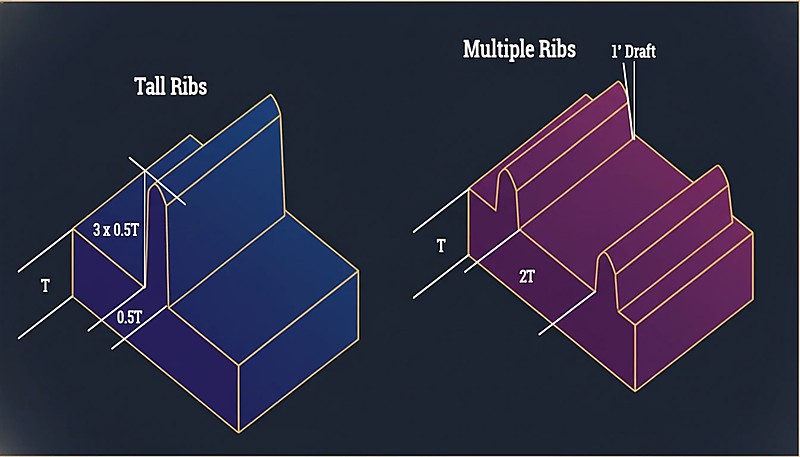
  • 高いリブを少数配置する代わりに、複数の短いリブを使用して応力を分散させ、成形性を向上させます

プラスチック製品設計におけるリブとは何ですか?

リブは、プラスチック部品に大幅な材料や重量を追加することなく構造剛性を高めるために設計された、薄く突出した壁状の特徴です。リブを設計の背骨と考えてください — それらは戦略的な補強材であり、 断面二次モーメント2 重要な領域でのたわみを防止します。 射出成形、リブは部品の片面に現れる隆起した形状で、主壁面から垂直または角度を持って伸びています。

工学的観点から、リブは材料を曲げの中立軸から遠ざけることで機能します。これにより断面二次モーメントが増加し、剛性に直接関連します。適切に配置されたリブは、単に全体の肉厚を増やす場合と比べて材料を10-15%しか追加せずに、局所剛性を300-500%向上させることができます。

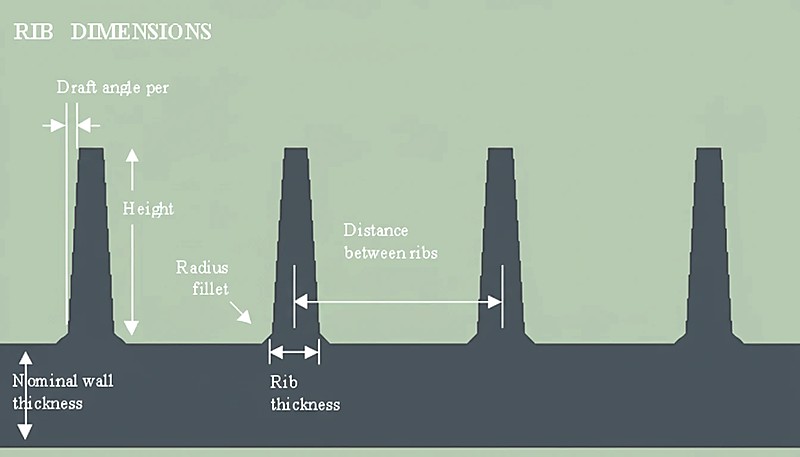
射出成形リブの主な特徴: ベース厚さ:公称肉厚の40〜60%。高さ:通常、リブ厚さの2〜3倍。 抜き勾配3:片側あたり最低0.5°、できれば1〜2°。フィレット半径:ベース接合部で0.2〜0.5mm。

リブは、構造要件に応じて直線状、曲線状、または複雑な格子パターンで配置できます。最も一般的な用途には、大きな平坦面の剛性向上、取付ボスの補強、リビングヒンジの作成、コスト重視設計における厚肉断面の置き換えなどがあります。これらの特徴を適切にサイズ設定し配置する方法を理解することは、プラスチック製品を扱うすべてのエンジニアにとって不可欠です。

なぜプラスチック製品にはリブが必要なのですか?

リブは、肉厚を増やすことなくプラスチック部品に剛性を加える構造補強要素です。エンジニアリングプラスチックの弾性率は金属よりも50〜200倍低く(1〜4 GPa対200 GPa)、荷重下でのたわみがはるかに大きくなります。リブは、最小限の追加材料で、最も重要な場所の断面二次モーメントを増加させ、サイクルタイムを短く保つことでこの問題を解決します。

リブ設計の4つの主な理由は:

材料効率: リブ付き設計は、均一な厚肉壁と同等の剛性を、20〜40%少ない材料で実現できます。大量生産では、これは相当なコスト削減につながります。例えば、4mmの厚肉壁を2mmの壁と最適化されたリブに置き換えると、曲げ強度を維持しながら材料使用量を35%削減できます。

サイクルタイムの短縮: 肉厚が厚いと冷却が遅く、生産のボトルネックとなります。冷却時間は肉厚の二乗に比例します — 肉厚を2倍にすると冷却時間は4倍になります。厚肉断面の代わりにリブを使用することで、サイクルタイムを15〜25%短縮でき、生産性を直接向上させることができます。

寸法安定性: 厚い部分は冷却中に不均一に収縮し、反り、シンクマーク、内部応力を引き起こします。リブを使用することで、構造性能を維持しながら壁断面を薄く均一に保ち、より優れた寸法制御と表面品質を実現できます。

設計の柔軟性: リブを使用すると、必要な場所に正確に剛性を調整できます。部品全体を過剰設計する代わりに、高応力領域に戦略的に補強を配置し、低応力領域は薄く軽量に保つことができます。

適切なリブ設計により部品重量を30%削減しながら剛性を200%向上させたプロジェクトを担当しました。重要なのは、リブが単なるコスト削減策ではなく、総合的な設計性能を高める高度なエンジニアリングツールであると理解することです。当社の工場では、生産用金型を承認する前に、金型流動解析と初回射出測定でリブ変更を検証しています。
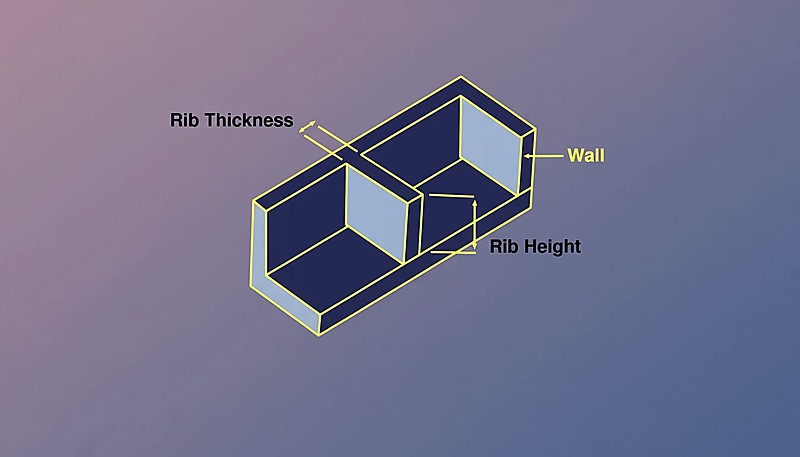
射出成形用リブ厚さと高さの図
リブの厚さと高さを示す図

リブ設計の主要なガイドラインは何ですか?

リブ設計の主要なガイドラインは、厚さ比率、高さ制限、抜き勾配、フィレット半径、間隔です。それぞれが構造強度と成形性のバランスを取る必要があり、一つでも誤るとシンクマーク、反り、または離型不良の原因となります。

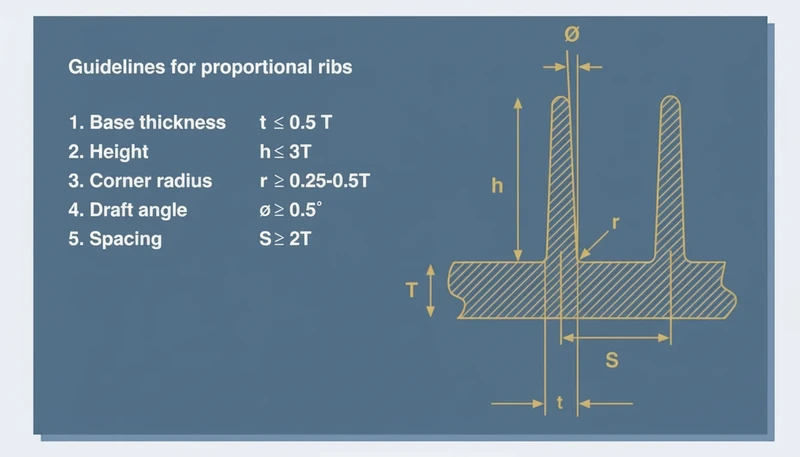
厚さ比率(40〜60%ルール): リブの厚さは、公称肉厚の40〜60%であるべきです。この比率は、十分な強度を維持しながらシンクマークを防ぎます。2mmの壁の場合、リブの厚さは0.8〜1.2mmであるべきです。正確な割合は、材料と外観要件によって異なります:化粧部品はシンクマークを最小限にするため40〜50%を使用します。構造部品は最大強度のために50〜60%を使用します。半結晶性材料は収縮率が高いため40%に近い値を維持すべきです。非晶質材料はリスクが少ないため60%に向けて押し上げることができます。

高さのガイドライン:
リブの高さは、リブの厚さの3倍を超えてはならず、2〜2.5倍が最適です。厚さ1mmのリブは、高さ3mmを超えず、できれば2〜2.5mmであるべきです。この比率を超えると、リブは充填が困難になり、荷重下で座屈する可能性があります。剛性の利点は高さと立方関係にあり、高さを2倍にすると剛性は8倍になりますが、リブが適切に成形され、圧縮で破損しない場合に限ります。

抜き勾配の要件:
最低でも側面あたり0.5°が必要ですが、量産用金型では1-2°を強く推奨します。深いリブは側面あたり少なくとも1°必要です。金型キャビティにテクスチャーを施す場合は、側面あたりさらに1°追加してください。滑らかな表面の場合、抜き勾配 = 0.5° + 0.035° × (高さ mm) が良い出発点の公式です。

フィレット半径:
リブがベース壁面に接する部分には常に小さな半径(0.2-0.5mm)を設けてください。鋭角は応力集中を生み、金型加工も困難です。半径は射出成形時の材料流動にも役立ちます。

間隔の考慮事項:
平行なリブは、少なくとも肉厚の2倍間隔で配置し、3-4倍が理想的です。間隔が狭すぎるとリブ間に厚い部分が生まれ、リブの利点が損なわれます。肉厚2mmの場合、リブ間隔は少なくとも4mm、できれば6-8mm離してください。

適切なリブの厚さはどのように決定しますか?

適切なリブ厚は、材料、外観、構造要求に応じて、公称肉厚の40–60%です。標準的な40-60%ルールは出発点を提供しますが、材料特性、部品形状、品質要求が最終決定に影響します。

材料分類から始めます:
Amorphous materials (ABS, PC, PVC) shrink 0.3-0.7% and can tolerate rib thicknesses up to 60% of wall thickness without severe sink marks. Semi-crystalline materials (PE, PP, POM, Nylon) shrink 1.5-3% and should stay closer to 40-50% to prevent surface defects.

Calculate the maximum allowable thickness:
For visible surfaces, use this formula: Maximum rib thickness = 0.4 × wall thickness for first-pass design. For hidden or textured surfaces where sink marks are less critical, you can push to 0.6 × wall thickness.

Consider the part’s function:
Structural components can use thicker ribs (55-60% range) because appearance is secondary to performance. Cosmetic housings should stay in the 40-45% range to maintain surface quality. If the part will be painted or textured, slight sink marks may be acceptable, allowing you to use the upper end of the thickness range.

Account for wall thickness variation:
Real injection molded parts have thickness variation of ±0.05-0.15mm depending on the process control. When the base wall runs thick, your rib becomes a higher percentage of the actual thickness, increasing sink mark risk. I recommend designing ribs based on the nominal wall thickness minus one standard deviation to account for this variation.

Validate with moldflow analysis:
For critical applications, run moldflow analysis to predict sink mark severity. The software can model cooling patterns and predict where surface defects will occur. This is especially valuable for complex rib patterns where manual calculations become difficult.

A practical approach I use: Start at 45% for new designs, then adjust based on prototype results. If sink marks appear, reduce by 0.05-0.1mm increments. If structural performance is insufficient, increase thickness or add more ribs rather than exceeding 60% of wall thickness.

高リブ対複数リブの比較
Comparison of tall ribs versus multiple

リブの高さと構造強度の関係は何ですか?

Rib height and structural strength are linked by the cubic power law — doubling height gives roughly 8× stiffness. This only holds if the rib remains stable and properly filled during molding, making height optimization critical for efficient design.

The cubic relationship explained:
Stiffness scales with the cube of the distance from the neutral axis. When you double a rib’s height, you’re moving material farther from the bending centerline, resulting in dramatic stiffness gains. However, this theoretical benefit assumes the rib maintains its full cross-section and doesn’t buckle or fail in compression.

Practical height limitations:
While taller ribs offer better stiffness, manufacturing constraints limit practical heights to 3x the rib thickness. Beyond this ratio, several problems emerge: incomplete filling during 射出成形金型 processing, increased tendency to buckle under compressive loads, difficulty achieving proper draft angles, and challenges with mold ejection.

The multiple-rib advantage:
Using several shorter ribs typically outperforms fewer tall ribs for both structural and manufacturing reasons. Three ribs at 2mm height provide more uniform stress distribution than one rib at 6mm height, even though the material usage is similar. The shorter ribs are easier to mold, less prone to buckling, and create fewer sink mark issues.

Optimal height-to-thickness ratios by application: Cosmetic parts use a 2:1 ratio to minimize sink marks. General structural parts use a 2.5:1 ratio for balanced performance. High-strength applications can reach 3:1 ratio as the maximum allowable. Deep draw parts use 1.5-2:1 ratio due to ejection concerns.

Height distribution strategies:
For complex loading conditions, vary rib heights based on local stress requirements. Use taller ribs in high-stress areas and shorter ribs for general stiffening. This approach optimizes material distribution while maintaining manufacturability. Always remember that a rib’s effectiveness depends on the entire system — height, thickness, spacing, and orientation must work together to achieve your structural goals.

リブの位置は部品性能にどのように影響しますか?

Rib location is the primary factor in load distribution — correct placement boosts stiffness by 300-500%. Poor positioning wastes material, adds cycle time, and may provide minimal structural benefit.

Strategic placement principles:
Position ribs perpendicular to the primary stress direction for maximum effectiveness. If your part experiences bending loads, place ribs parallel to the neutral axis of bending. For torsional loads, use ribs that run diagonally or in crossing patterns. The key is understanding your loading conditions through stress analysis or testing.

Staggered vs. uniform patterns:
Staggered rib patterns generally outperform uniform spacing because they distribute stress more evenly and reduce the risk of crack propagation along parallel lines. Instead of placing ribs every 10mm consistently, vary the spacing between 8-12mm to break up stress concentration patterns. This approach also provides better buckling resistance under compressive loads.

Avoiding stress concentrators:
Never terminate a rib abruptly in the middle of a wall — this creates stress concentration points that can initiate cracks. Instead, gradually taper the rib height to zero over a distance equal to 2-3 times the rib height. At intersections where ribs meet other features, maintain smooth transitions with adequate fillet radii.

Material flow considerations:
Rib placement affects how plastic flows during injection molding. Ribs perpendicular to flow direction can create weld lines and trapped air, while ribs aligned with flow help guide material and improve filling. Consider gate location when positioning ribs — place critical structural ribs in areas that fill early in the molding cycle.

Assembly and mounting integration:
Use ribs to reinforce mounting points, snap-fit features, and assembly interfaces where concentrated loads occur. A common mistake is designing mounting bosses without adequate ribbing support, leading to stress cracking around fasteners. Surround mounting features with ribs that distribute loads into the main structure.

比例リブ設計ガイドライン図
Proportional rib design guidelines for injection

避けるべき一般的なリブ設計のミスは何ですか?

The most common rib design mistakes include ignoring thickness ratios, inadequate draft angles, and poor understanding of material behavior. These errors consistently cause production issues, quality problems, and costly design revisions.

Oversized rib thickness: Ribs exceeding 60% of wall thickness cause visible sink marks on cosmetic surfaces and internal voids in structural parts. The material piles up at the rib-wall junction, cooling unevenly.

Insufficient draft angle: Minimal or zero draft creates ejection problems, scraping rib surfaces and damaging the mold. Most production ribs need at least 1° per side, with deep ribs requiring 1.5° or more for clean release.

Ignoring material shrinkage: Semi-crystalline materials like nylon and POM shrink 1.5-3%, while amorphous resins like ABS and PC shrink only 0.3-0.7%. Designing ribs without accounting for this difference leads to dimensional failures and assembly problems.

Poor rib termination:
Abruptly ending ribs creates stress concentrations that initiate cracks. Always taper ribs gradually or connect them to other structural features. Sharp transitions are manufacturing weak points that will cause field failures.

Opposing ribs on both sides: Placing ribs directly opposite each other doubles the effective wall thickness, creating severe sink marks and extended cooling times. Always offset opposing ribs by at least one rib width to avoid this issue.

Inadequate spacing: Ribs placed too close together create thick sections that cause sink marks and extend cycle time. Maintain at least 2x wall thickness between parallel ribs, with 3-4x being ideal for most applications.

🏭 ZetarMold Factory Insight
In our Shanghai factory, we’ve processed over 400+ materials across 47 injection molding machines ranging from 90T to 1850T. Our 8 senior engineers review every rib design during DFM analysis — catching thickness issues, draft problems, and sink mark risks before steel is ever cut. After 20+ years of injection molding and tooling experience, we’ve seen firsthand how a 10% rib thickness reduction can eliminate sink marks entirely and save a production run.

材料特性はリブ設計にどのように影響しますか?

Material properties are the main drivers of rib design — shrinkage, modulus, and crystallinity set the parameters. Understanding these fundamentals prevents costly tooling revisions and production failures.

Amorphous vs. semi-crystalline behavior:
Amorphous materials (ABS, PC, PMMA) shrink uniformly at 0.3-0.7% and can accommodate rib thicknesses up to 60% of wall thickness. Their predictable shrinkage makes rib design more forgiving. Semi-crystalline materials (PE, PP, POM, Nylon) shrink 1.5-3% with less predictable patterns, requiring conservative rib thickness of 40-50% maximum.

Modulus considerations:
High-modulus materials like glass-filled nylons (8-15 GPa) may not need aggressive ribbing since the base material provides substantial stiffness. Low-modulus materials like polyethylene (0.2-0.4 GPa) require extensive ribbing for structural applications. The return on investment from ribbing decreases as base material modulus increases.

Shrinkage-specific rib ratios: ABS and PC can use up to 60% wall thickness. PP and PE should stay at 45-50% maximum. POM and Nylon work best at 40-45% recommended. Glass-filled materials require a 5-10% reduction due to anisotropic shrinkage.

“Using more shorter ribs is generally better than fewer tall ribs.”

Multiple shorter ribs distribute stress more evenly and reduce the risk of sink marks and warpage compared to tall, thick ribs.

“Rib thickness should equal the nominal wall thickness for maximum strength.”

Ribs should be 40-60% of wall thickness. Full-thickness ribs cause sink marks, warpage, and internal voids — they actually weaken the part.

Flow characteristics impact:
High-flow materials can fill thin ribs more easily, allowing you to use the lower end of thickness ratios while maintaining adequate strength. Low-flow or high-viscosity materials may require slightly thicker ribs to ensure complete filling, but this must be balanced against sink mark risk.

Working with your supplier:
Material selection significantly impacts rib design feasibility and cost. When working with an 射出成形サプライヤー, discuss material-specific rib guidelines during the design phase. Experienced suppliers can provide material-specific recommendations based on their processing experience and help optimize rib designs for both performance and manufacturability.

Temperature considerations:
High-temperature materials may require different rib designs due to thermal expansion and creep behavior. Materials used above their glass transition temperature need more conservative rib spacing and thickness to maintain long-term dimensional stability.

Understanding these fundamental truths about rib behavior helps you avoid the most common design errors. The difference between theoretical guidelines and production reality is where most projects encounter problems. In practice, material selection, gate placement, and cooling channel design all interact with rib geometry in ways that simple rules of thumb cannot fully capture. This is why experienced tooling engineers always validate rib designs through mold flow simulation before committing to steel. The cost of catching issues during simulation is roughly one percent of the cost of reworking a finished mold.

プラスチック部品のリブ寸法図
Rib dimensions showing thickness, height

“Ribs can replace thick wall sections to reduce material usage while maintaining stiffness.”

This is the primary purpose of ribbing. A well-designed rib pattern can achieve equivalent stiffness with 20-40% less material compared to a uniform thick wall.

“A draft angle of 0.5° is sufficient for all rib designs.”

While 0.5° is the absolute minimum, most applications benefit from 1°-2° draft. Deep ribs or textured surfaces may need even more draft to ensure clean ejection.

FAQ:リブ設計に関する最も一般的な質問は何ですか?

What is the recommended rib thickness ratio for injection molding?

The standard recommendation is 40-60% of the nominal wall thickness. For cosmetic parts where sink marks are critical, stay at 40% or below. For structural parts where appearance is less important, you can push toward 60%. The exact ratio also depends on the material — amorphous materials like ABS tolerate slightly thicker ribs than semi-crystalline materials like nylon. Always consult with your tooling manufacturer during the DFM phase to validate rib dimensions against the specific material grade and production conditions you plan to use. The interaction between rib geometry, gate location, and cooling time is complex enough that generic guidelines should be treated as starting points, not final specifications.

How tall should a rib be compared to its thickness?

A rib should typically be no taller than 3 times its base thickness. Beyond this ratio, the rib becomes difficult to fill during molding and may buckle under load. In practice, most successful designs use a height-to-thickness ratio of 2:1 to 2.5:1, balancing structural gain against manufacturability. Always consult with your tooling manufacturer during the DFM phase to validate rib dimensions against the specific material grade and production conditions you plan to use. The interaction between rib geometry, gate location, and cooling time is complex enough that generic guidelines should be treated as starting points, not final specifications.

What draft angle is needed for ribs in injection molding?

Ribs need a minimum draft angle of 0.5° per side, but 1° to 2° is strongly recommended for production tooling. Deep ribs (height over 20mm) should use at least 1.5° draft. If the mold surface is textured, add at least 1° extra draft per side to prevent scraping during ejection. Always consult with your tooling manufacturer during the DFM phase to validate rib dimensions against the specific material grade and production conditions you plan to use. The interaction between rib geometry, gate location, and cooling time is complex enough that generic guidelines should be treated as starting points, not final specifications.

How do you prevent sink marks near ribs?

Sink marks appear when rib thickness causes localized thick sections that cool unevenly. To minimize them: keep rib thickness at or below 50% of wall thickness, add a small radius (0.2-0.5mm) at the rib-wall junction, and consider using a foaming agent or gas-assist molding for thick-walled parts. Moving the gate closer to the rib area can also help by maintaining pack pressure. Always consult with your tooling manufacturer during the DFM phase to validate rib dimensions against the specific material grade and production conditions you plan to use. The interaction between rib geometry, gate location, and cooling time is complex enough that generic guidelines should be treated as starting points, not final specifications.

What spacing should be used between parallel ribs?

Parallel ribs should be spaced at least 2 times the nominal wall thickness apart, with 3-4 times being ideal for most applications. Spacing that is too narrow creates thick sections between ribs, leading to sink marks, warpage, and extended cycle times. Staggered rib patterns generally perform better than uniformly spaced parallel ribs. Always consult with your tooling manufacturer during the DFM phase to validate rib dimensions against the specific material grade and production conditions you plan to use. The interaction between rib geometry, gate location, and cooling time is complex enough that generic guidelines should be treated as starting points, not final specifications.

Can ribs be used on both sides of a wall simultaneously?

Yes, but with caution. When ribs appear on both sides of a wall, they must be offset — never directly opposite each other. Directly opposing ribs create an effective wall thickness equal to the wall plus both ribs, causing severe sink marks and very long cooling times. Offset the ribs by at least one rib width to avoid this issue. Always consult with your tooling manufacturer during the DFM phase to validate rib dimensions against the specific material grade and production conditions you plan to use. The interaction between rib geometry, gate location, and cooling time is complex enough that generic guidelines should be treated as starting points, not final specifications.

Need Expert DFM Review for Your Rib Design?

ZetarMold’s engineering team provides free Design for Manufacturing (DFM) analysis on every project. With 20+ years of experience across 400+ materials, we catch rib design issues before tooling begins — saving you time and money. Request a Free Quote and get expert feedback within 24 hours.


  1. シンク跡: sink marks refers to surface depressions on injection molded parts caused by uneven cooling and material shrinkage at thick sections like rib-wall junctions.

  2. 断面二次モーメント: moment of inertia refers to a measure of a cross-section’s resistance to bending. Adding ribs increases the moment of inertia without significantly increasing material usage.

  3. 抜き勾配: draft angle refers to the taper applied to vertical surfaces of a mold cavity to allow the part to be ejected without damage. Ribs typically need 0.5°-2° draft per side.

最新の投稿
フェイスブック
ツイッター
LinkedIn
ピンタレスト
Mike Tangの写真
マイク・タン

Hi, I'm the author of this post, and I have been in this field for more than 20 years. and I have been responsible for handling on-site production issues, product design optimization, mold design and project preliminary price evaluation. If you want to custom plastic mold and plastic molding related products, feel free to ask me any questions.

私とつながる

クイック見積もり

図面および詳細要件を下記までお送りください。 

Emial:[email protected]

または下記のお問い合わせフォームにご記入ください:

クイック見積もり

図面および詳細要件を下記までお送りください。 

Emial:[email protected]

または下記のお問い合わせフォームにご記入ください:

クイック見積もり

図面および詳細要件を下記までお送りください。 

Emial:[email protected]

または下記のお問い合わせフォームにご記入ください:

クイック見積もり

図面および詳細要件を下記までお送りください。 

Emial:[email protected]

または下記のお問い合わせフォームにご記入ください:

クイック見積もり

図面および詳細要件を下記までお送りください。 

Emial:[email protected]

または下記のお問い合わせフォームにご記入ください:

ブランドのクイック見積もり

図面および詳細要件を下記までお送りください。 

Emial:[email protected]

または下記のお問い合わせフォームにご記入ください:

Спроситебыструюцитату。

Мы свяжемся с вами в течение одного рабочего дня, обратите внимание на письмо с суффиксом "[email protected]".

クイック見積もり

図面および詳細要件を下記までお送りください。 

Emial:[email protected]

または下記のお問い合わせフォームにご記入ください:

クイック見積もり

図面および詳細要件を下記までお送りください。 

Emial:[email protected]

または下記のお問い合わせフォームにご記入ください: