 Ir al contenido

You are sourcing injection-molded parts and wondering whether Poland is the right manufacturing base for your project. The country has built a solid plastics industry over three decades, attracting OEMs from Germany, Scandinavia, and the UK. But does that make it the best choice for your specific part, volume, and timeline?
This guide breaks down Poland’s mercado del moldeo por inyección1, lists the top 10 manufacturers with verified details, compares costs with China, and tells you exactly when Poland makes sense — and when it does not.
- Poland’s injection molding sector benefits from EU membership, competitive labor costs (~€13/hr vs €48/hr in Germany), and proximity to Western European OEMs.
- The top 10 Polish injection molding companies range from global contract manufacturers (Rosti) to family-run specialists (ŚLIWA, SPLAST).
- Tooling costs in Poland run 20–40% lower than Western Europe but 30–60% higher than China for comparable mold complexity.
- Poland works best for low-to-medium volumes with tight delivery windows to European markets; China wins on high-volume unit cost and mold variety.
- Always verify ISO certifications, request sample parts, and confirm English communication capability before signing a contract.
What Does Poland’s Injection Molding Market Look Like?
Poland’s injection molding market is a market defined by supplier mix, regional clusters, and sourcing constraints summarized in this section. Poland has become Central Europe’s manufacturing powerhouse since joining the EU in 2004. The country’s plastics processing sector now includes over 1,000 companies, with moldeo por inyección accounting for the largest share of production capacity. The global injection molded plastics market2 was valued at $362.47 billion in 2025 and is projected to reach $481.42 billion by 2033.² Poland captures a growing slice of that demand, particularly from automotive, consumer electronics, packaging, and medical device OEMs.
Several factors drive this growth. First, Poland’s geographic location puts it within a one-day truck drive of Germany, the Czech Republic, and Scandinavia — three of Europe’s largest manufacturing hubs. Second, labour costs3 average roughly €13 per hour, about one-third of Germany’s €48 per hour.³ That cost advantage, combined with EU regulatory alignment (CE marking, REACH compliance), makes Poland attractive for nearshore production.¹
The industry structure is a mix of large multinational subsidiaries and mid-size Polish-owned firms. Major players like Rosti (Denmark-headquartered) operate large-scale contract manufacturing⁵ plants, while domestic companies such as FORMET S.A. and SPLAST have built multi-decade track records supplying automotive and industrial clients. Most Polish injection molders hold ISO 9001 certification, and a growing number maintain ISO 13485 for medical or IATF 16949 for automotive work. The global injection molding market⁴ continues to expand, and Polish firms are capturing an increasing share.
What Trends Are Shaping Poland’s Injection Molding Industry?
Poland’s injection molding sector is not standing still. Several trends are reshaping how companies operate and compete.
Automation and Industry 4.0 Adoption
Polish molders are investing heavily in robotic part removal, automated quality inspection (vision systems), and real-time monitoring of injection molding machine processes. Companies like Rosti Poland have integrated Industry 4.0 platforms into their Białystok facility, enabling predictive maintenance and reducing scrap rates by 15–25%. This trend is driven by rising wages — Poland labor costs have tripled since 2004 — forcing manufacturers to offset higher personnel expenses with efficiency gains.
Medical and Cleanroom Expansion
Several Polish injection molders have added ISO Class 7 and Class 8 cleanroom capability in the past five years. The medical device segment is growing at roughly 8% annually in Central Europe, and Polish firms are positioning themselves as lower-cost alternatives to Swiss and German medical molders. Companies like ŚLIWA and SPLAST have expanded their quality systems to serve this market.
Materiales sostenibles y economía circular
EU regulations on single-use plastics and recycled content are pushing Polish molders toward bio-based polymers, post-consumer recycled (PCR) resins, and lightweight part designs. The Polish Plastics Pact, aligned with the EU Plastics Strategy, targets 50% recycled content in plastic packaging by 2030. Injection molders serving the packaging sector — including AKSON and Molanderplast — are adapting their processes to handle recycled material blends.
Nearshoring from Western Europe
Supply chain disruptions from 2020–2023 accelerated nearshoring trends. German and Scandinavian OEMs increasingly split production between Asian suppliers (for cost) and Polish suppliers (for speed and flexibility). Poland’s EU membership eliminates customs delays and tariff uncertainty, making it a reliable backup or primary source for time-sensitive programs.
How Do You Choose an Injection Molding Supplier in Poland?
Selecting the right Polish injection molding partner requires looking beyond the company website. Here is a practical framework covering the five dimensions that matter most.
1. Certificaciones y Sistemas de Calidad
At minimum, your supplier should hold ISO 9001:2015. If you are in automotive, IATF 16949 is non-negotiable. For medical devices, ISO 13485 is required. Ask for copies of current certificates and verify the scope covers injection molding — not just trading. Polish companies like ŚLIWA have maintained ISO 9001 since 1999 and ISO 14001 since 2003, which signals long-term quality commitment.
2. Machine Tonnage and Part Size Range
Match your part requirements to the supplier’s equipment. A molder with 50–200T machines cannot produce large housings efficiently, just as a shop running 500–1000T presses is overkill for small precision gears. Ask for a machine list with tonnage ranges. The molde de inyección complexity your project requires should align with the supplier’s tooling capabilities — not every Polish molder has in-house mold making.
3. Communication and Project Management
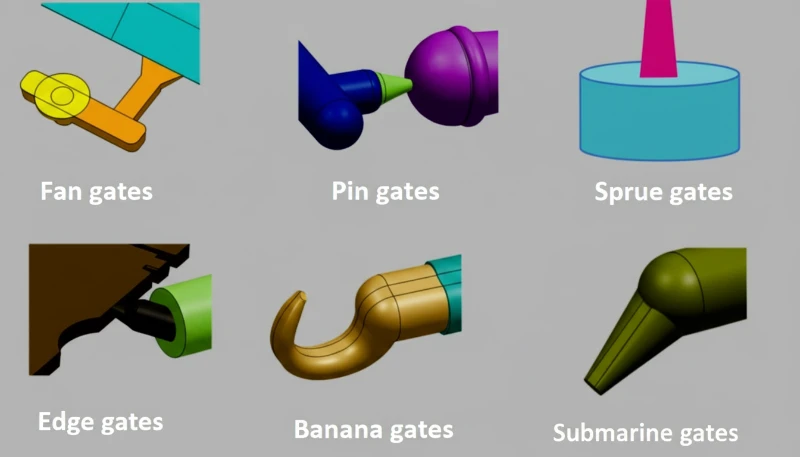
Most Polish molders speak functional English, but the depth of communication varies. For complex projects, you need engineers — not just sales staff — who can discuss draft angles, gate placement, and material trade-offs in English. Ask to speak with the project engineer who would handle your account during the initial evaluation, not only the business development representative.
4. Minimum Order Quantities and Lead Times
Polish injection molders typically require MOQs of 1,000–5,000 pieces for production runs, which is higher than what Chinese manufacturers often accept. Tooling lead times range from 6 to 12 weeks depending on complexity. If your project demands sub-1,000 unit runs or needs shorter injection molding production time, confirm the supplier flexibility before committing.
5. Red Flags to Avoid
Watch for these warning signs: a supplier who cannot provide recent customer references in your industry; quotes that seem too low (they often hide extra charges for sampling, modifications, or logistics); reluctance to let you audit the facility; and contracts that lack clear warranty terms on tooling life. A legitimate Polish molder will welcome a video call facility tour and provide detailed quotations within 5–10 business days.
Which Are the Top 10 Injection Molding Companies in Poland?
The top 10 injection molding companies in poland are the suppliers compared below based on capability, industry fit, and sourcing reliability. The following list covers the most established injection molding companies operating in Poland, selected based on years in business, range of services, certifications held, and industry reputation. Each entry includes verified details to help you shortlist candidates for your specific project.
1. Rosti Polonia
Rosti Poland is the largest and most internationally connected injection molder on this list. As part of the Denmark-based Rosti Group (founded in 1944), the Polish subsidiary operates from Białystok in northeastern Poland, where it recently consolidated two plants into one of the largest plastic injection moulding facilities in Europe. Rosti Poland specializes in full contract manufacturing⁵ — from design and tooling through production, assembly, and packaging.
The company serves demanding sectors including medical devices, consumer electronics, home automation, battery technology, and packaging. Clients include major brands like Whirlpool, Roche Diagnostics, and Tetra Pak. Rosti holds ISO 9001, ISO 14001, and ISO 13485 certifications. With 200–300 employees and state-of-the-art automation, Rosti is the go-to choice for high-precision, medium-to-high volume production with full regulatory compliance.
| Detail | Information |
|---|---|
| Ubicación | Białystok, Poland |
| Founded | 1999 (planta polaca); Grupo fundado en 1944 |
| Employees | 200–300 |
| Sectores clave | Médico, Electrónica, Envase, Domótica |
| Certifications | ISO 9001, ISO 13485, ISO 14001 |
| Sitio Web | rosti.com |
2. FORMET S.A.
FORMET S.A. ha sido un referente en la fabricación de moldes y el moldeo por inyección en Polonia durante más de 45 años. Con sede en Kobielice en la región de Silesia — el corazón industrial de Polonia — FORMET diseña y fabrica moldes de inyección y produce piezas moldeadas por inyección para las industrias de automoción, electrónica, artículos para el hogar y equipos de jardinería. La empresa exporta a Alemania, Bélgica y Rusia, lo que refleja su capacidad para cumplir con las expectativas de calidad internacional.
La fortaleza de FORMET radica en su capacidad interna de herramental: diseñan y construyen moldes, luego ejecutan la producción en sus propias máquinas. Esta integración vertical acorta los plazos de entrega y les da control directo sobre la calidad del molde. Su equipo de ingeniería maneja todo, desde estudios de viabilidad hasta producción en serie.
| Detail | Information |
|---|---|
| Ubicación | Kobielice (Silesia), Polonia |
| Founded | Finales de los años 1970 (más de 45 años) |
| Sectores clave | Automoción, Electrónica, Artículos para el Hogar |
| Fortaleza Central | Diseño y fabricación de moldes internos |
| Mercados de Exportación | Alemania, Bélgica, Rusia |
| Dirección | ul. Polna 135, 43-262 Kobielice |
3. ŚLIWA Plastic Injection Molding Ltd
ŚLIWA es una empresa familiar de moldeo por inyección fundada en 1981 en Kielno, al norte de Polonia. Con aproximadamente 120 empleados, la empresa se especializa en moldeo por inyección de precisión, ensamblaje y tampografía. ŚLIWA ha mantenido la certificación ISO 9001 desde 1999 e ISO 14001 desde 2003 — uno de los historiales de certificación más largos entre los moldeadores polacos.
Su base de clientes abarca los sectores automotriz y energético, ambos demandan rigurosos estándares de calidad. Los más de 40 años de operación continua de ŚLIWA y la inversión constante en equipos modernos de moldeo por inyección los convierten en una opción confiable para piezas de plástico técnico que requieren tolerancias ajustadas y calidad consistente.
| Detail | Information |
|---|---|
| Ubicación | Kielno, Polonia |
| Founded | 1981 |
| Employees | ~120 |
| Sectores clave | Automoción, Energía |
| Certifications | ISO 9001 (desde 1999), ISO 14001 (desde 2003) |
| Servicios | Moldeo por inyección, ensamblaje, impresión por tampografía |
4. AKSON
AKSON, fundada en 1996, está estrechamente vinculada a la industria del embalaje. Con sede en Grunwaldzka, la empresa es principalmente fabricante de moldes de inyección personalizados para elementos de embalaje, pero también opera su propio departamento de procesamiento de plásticos para componentes de embalaje moldeados por inyección. La capacidad distintiva de AKSON es su oferta de diseño integral: manejan el desarrollo de conceptos de embalaje, estudios de forma, análisis de viabilidad, documentación 3D/2D y especificaciones técnicas.
Un logro notable es su desarrollo y producción de mandriles de soplado estandarizados para moldeo por soplado de extrusión (EBM), un producto de herramientas especializado que demuestra su profundidad técnica. Con 200–299 empleados, AKSON tiene la escala para manejar proyectos sustanciales mientras se mantiene enfocada en su especialidad de embalaje.
| Detail | Information |
|---|---|
| Ubicación | Grunwaldzka, Polonia |
| Founded | 1996 |
| Employees | 200–299 |
| Sectores clave | Envase, Fabricación de Moldes |
| Specialty | Diseño de envases y mandriles de soplado |
| Servicios | Diseño de Moldes, Moldeo por Inyección, Herramental EBM |
5. SPLAST
SPLAST se fundó en 1989 y sigue siendo una empresa polaca 100% de propiedad privada — un negocio familiar con profundas raíces locales. La empresa se especializa en piezas técnicas de plástico producidas por moldeo por inyección y se ha convertido en una de las empresas más avanzadas en su categoría en Polonia. SPLAST es también un fabricante líder europeo de equipos profesionales de limpieza manual utilizados en oficinas, hoteles, hospitales y fábricas.
SPLAST sirve como proveedor estratégico para importantes clientes industriales, combinando experiencia en moldeo por inyección con capacidades de desarrollo de productos. Sus décadas de operación e inversión en equipos modernos los convierten en una opción sólida para compradores que buscan un socio polaco bien establecido con propiedad totalmente nacional.
| Detail | Information |
|---|---|
| Ubicación | Polonia |
| Founded | 1989 |
| Propiedad | Capital privado polaco 100%, propiedad familiar |
| Sectores clave | Piezas técnicas, equipos de limpieza |
| Specialty | Piezas técnicas de plástico moldeadas por inyección |
| Sitio Web | splast.com.pl |
6. WM
WM opera desde 1989 desde Łódź, en el centro de Polonia. La empresa combina el moldeo por inyección de plástico con el procesamiento de metales, ofreciendo soluciones integrales desde el concepto hasta el producto terminado. WM opera un taller de inyección moderno y computarizado y una sala de herramientas bien equipada, lo que les permite manejar tanto el mantenimiento de moldes como la fabricación de nuevas herramientas.
WM se especializa en piezas con requisitos de calidad exigentes y geometría avanzada. Su proceso de producción sigue un sistema de control de calidad basado en la norma PN-EN ISO 9001. La combinación de procesamiento de plástico y metal bajo un mismo techo convierte a WM en un socio conveniente para ensamblajes que combinan ambos tipos de materiales.
| Detail | Information |
|---|---|
| Ubicación | Łódź, Polonia |
| Founded | 1989 |
| Employees | 100–199 |
| Sectores clave | Partes industriales y técnicas |
| Certifications | ISO 9001 |
| Capacidad única | Moldeo por inyección de plástico combinado + procesamiento de metales |
7. Molanderplast
Molanderplast, fundada en 1983 y con sede en Szczecin (cerca de la frontera alemana), es una empresa de diseño y producción especializada en productos plásticos moldeados por inyección. Destacan especialmente en aplicaciones de manipulación de materiales y logística: sus bandejas y soluciones de embalaje están diseñadas para una manipulación eficiente y un volumen de transporte mínimo.
La propuesta de valor de Molanderplast se centra en sustituir materiales desechables caros por alternativas moldeadas por inyección reciclables. Trabajan en múltiples industrias, ofreciendo aportaciones de diseño para fabricación que pueden reducir el número de piezas y disminuir los costes totales de producción. Su proximidad a la frontera alemana los convierte en un socio natural de nearshoring para compradores alemanes y escandinavos.
| Detail | Information |
|---|---|
| Ubicación | Szczecin, Polonia (cerca de la frontera alemana) |
| Founded | 1983 |
| Employees | 100–199 |
| Sectores clave | Logística, Embalaje, Manipulación de Materiales |
| Specialty | Alternativas moldeadas por inyección reciclables a los desechables |
| Servicios | Diseño, Prototipado, Producción |
8. Frohe Ltd
Frohe Ltd aporta aproximadamente 25 años de experiencia en moldeo por inyección de plástico de precisión. La empresa atiende a clientes internacionales, con un enfoque particular en la industria automotriz. Frohe mantiene dos espaciosas salas de producción modernas con altos estándares de limpieza, reflejando su compromiso con una fabricación controlada en calidad.
Además del sector automotriz, Frohe atiende a clientes en agricultura, procesamiento de alimentos y electrónica. Sus capacidades de moldeo de precisión abarcan una variedad de complejidades de piezas y tipos de materiales. El enfoque constante de la empresa en clientes internacionales significa que su comunicación en inglés y sus procesos de gestión de proyectos suelen estar bien desarrollados.
| Detail | Information |
|---|---|
| Ubicación | Polonia |
| Founded | ~2001 (25 años de experiencia) |
| Sectores clave | Automotriz, Agricultura, Alimentación, Electrónica |
| Specialty | Moldeo por inyección de plástico de precisión |
| Instalaciones | Dos salas de producción modernas |
| Sitio Web | frohe.pl |
9. Larkis
Larkis, fundada en 1989 y con sede cerca de Cracovia, se especializa en productos de caucho y silicona moldeados por inyección. Aunque no es un moldeador por inyección termoplástico tradicional, Larkis se gana un lugar en esta lista por sus capacidades integrales en juntas de silicona, sellos, productos de silicona extruida y componentes de LSR (caucho de silicona líquida) moldeados por inyección.
Sus productos sirven a las industrias automotriz, de electrodomésticos de cocina, médica, farmacéutica y de almacenamiento de alimentos. Larkis gestiona pedidos complejos con procesos de fabricación de vanguardia y ha obtenido reconocimiento como uno de los principales fabricantes de productos de silicona en Polonia. Si su proyecto involucra componentes de silicona o caucho junto con piezas termoplásticas, Larkis es un socio valioso para conocer.
| Detail | Information |
|---|---|
| Ubicación | Cerca de Cracovia, Polonia |
| Founded | 1989 |
| Sectores clave | Automotriz, Médico, Alimentación, Electrodomésticos |
| Specialty | LSR moldeado por inyección, juntas y sellos de silicona |
| Capacidad única | Portafolio completo de productos de silicona/caucho |
| Sitio Web | larkis.pl |
10. ALEX Tools
ALEX Tools cierra la lista como una empresa de fabricación de moldes y moldeo por inyección en rápido desarrollo. Combinan el moldeo por inyección de plástico con el mecanizado de precisión de metales utilizando equipos CNC, posicionándose como un socio versátil para proyectos que requieren tanto la fabricación de moldes como la producción de piezas moldeadas.
Su inversión en tecnología CNC garantiza una precisión dimensional ajustada tanto en moldes como en piezas terminadas. Aunque más nueva y más pequeña que algunas entradas en esta lista, ALEX Tools representa el nivel creciente de fabricantes polacos que invierten en equipos modernos para competir por contratos internacionales.
| Detail | Information |
|---|---|
| Ubicación | Polonia |
| Sectores clave | Industrial, Piezas de Precisión |
| Specialty | Moldeo por inyección + mecanizado de precisión CNC |
| Equipamiento | Máquinas CNC para la producción de moldes y piezas |
| Posicionamiento | Fabricante en crecimiento con equipos modernos |
| Servicios | Fabricación de Moldes, Moldeo por Inyección, Mecanizado CNC |
How Does Poland’s Injection Molding Cost Compare to China?
El coste suele ser el factor decisivo al elegir entre Polonia y China para el moldeo por inyección. Aquí tiene una comparación directa con números reales.
Costes de utillaje
Un molde de inyección de complejidad media (2 cavidades, con acción lateral) suele costar entre 8.000 y 15.000 € en Polonia. El mismo molde de un fabricante chino cuesta entre 4.000 y 8.000 yuanes (aproximadamente 3.700–7.400 €). Esto supone una diferencia de precio del 40–60%. La herramientería polaca suele construirse según los estándares HASCO o DME, lo que facilita el mantenimiento y la obtención de repuestos en Europa, mientras que los moldes chinos suelen utilizar estándares LKM o locales.
Costes Unitarios por Pieza
Para una pieza de polipropileno de 50 gramos en 10.000 unidades, espere pagar entre 0,35 y 0,55 € por pieza de un moldeador polaco frente a 0,15–0,30 yuanes (0,14–0,28 €) de China. La brecha se reduce en volúmenes más altos porque los costes de producción automatizada convergen, pero los pasos intensivos en mano de obra (montaje, inspección, embalaje) siguen siendo más baratos en China.
“Poland’s manufacturing labor costs (~€13/hr) are roughly one-third of Germany’s (~€48/hr), giving Polish injection molders a significant cost advantage within the EU.”Verdadero
Poland’s hourly manufacturing labor cost of approximately €13 in 2023 compares favorably to Germany’s €48, France’s €45, and Italy’s €33. This cost gap is the primary reason Western European OEMs nearshore injection molding work to Poland.
“Injection molded parts from Poland are always cheaper than parts from China on a per-unit basis.”Falso
Chinese manufacturers typically offer 40–60% lower per-unit prices for injection molded parts compared to Poland. Poland’s cost advantage applies to total landed cost when factoring in shipping, customs duties, and inventory carrying costs for low-to-medium volumes shipped to European destinations.
Beyond cost, the sourcing decision depends on what you are actually producing. Medical device housings, automotive interior trim, and consumer electronics enclosures each have different requirements for tolerances, material certifications, and regulatory documentation. Polish suppliers tend to specialize — few offer the breadth of a large Chinese mold-making operation. If your project needs multi-cavity tools for a new consumer product with aggressive pricing, the economics tilt toward China. If you need certified Class 7 cleanroom molding for a medical device sold in the EU, Poland’s proximity and regulatory familiarity become decisive advantages.
“Many sourcing managers use a dual-source strategy: China for high-volume cost-sensitive parts and Poland for time-critical regulated components.”Verdadero
This approach hedges against supply chain disruption while optimizing cost. Poland provides EU regulatory compliance and fast delivery for regulated products, while China delivers lower unit costs for high-volume commodity parts where lead times are flexible.
“All Polish injection molding companies can handle medical-grade production with cleanroom facilities.”Falso
Only a subset of Polish injection molders have invested in cleanroom facilities and hold ISO 13485 certification for medical device production. Companies like Rosti and ŚLIWA offer medical-grade molding, but many Polish molders focus on automotive, consumer, or industrial applications without cleanroom capability.
Hidden Costs That Tip the Balance
The sticker price does not tell the whole story. Sourcing from China adds customs duties (typically 3–6.5% for plastic articles entering the EU), ocean freight ($2,000–$4,000 per container), and 4–6 weeks of shipping time. For Poland-based production, there are no customs duties within the EU, freight is a fraction of intercontinental shipping, and lead times are measured in days, not weeks.
Communication costs also differ. Polish suppliers operate in the CET time zone, overlapping fully with Western European business hours. China’s 6–7 hour time difference with Central Europe means your emails get answered overnight, and real-time problem solving requires early mornings or late evenings.
When the Math Favors Each Option
If your total order value exceeds €30,000 and delivery speed matters, the all-in cost of Polish production is often competitive once you factor in logistics, duties, and inventory carrying costs. If you are ordering high volumes (>50,000 units) where unit price dominates, China’s 40–60% part-cost advantage usually wins despite the added logistics overhead.
When Is Poland the Right Sourcing Choice for Injection Molding?
Poland is the right sourcing choice when communication, regional proximity, and mid-volume production matter more than the lowest unit price. Not every project should go to Poland, and not every project should go to China. Here is when each option makes more sense.
Choose Poland When:
Your end customers are in the EU and delivery time is critical (automotive JIT, medical device restocking). You need EU regulatory compliance built into the manufacturing process (CE marking, REACH, medical device class I–II). Your volumes are low-to-medium (1,000–50,000 units/year) where tooling cost savings from China do not offset higher logistics costs. You want to audit the factory in person — flights to Warsaw or Kraków from any European hub are under 3 hours and cost €100–€300.
Choose China When:
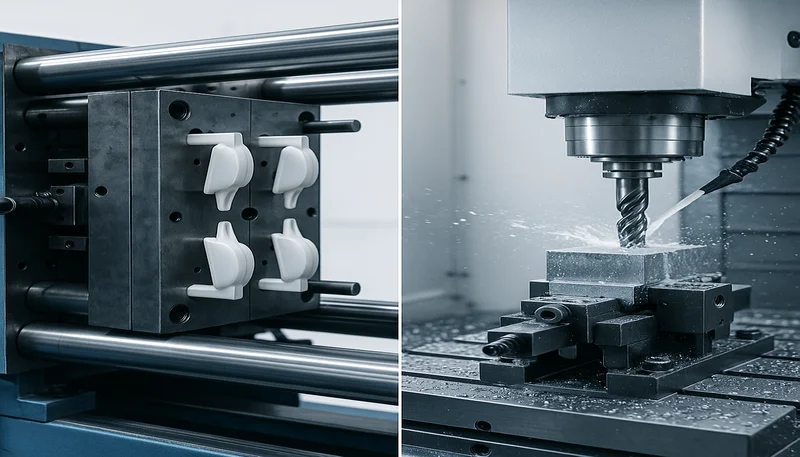
You need the lowest possible unit cost for high-volume production (50,000+ units). Your project requires a supplier with extensive material options (400+ materials) and tonnage range (90T–1850T) under one roof. You are building a multi-cavity high-production mold where the 40–60% tooling savings directly impact your project ROI.
Many sourcing managers use a dual-source strategy: China for high-volume cost-sensitive parts, and Poland for time-critical or regulated components.
Frequently Asked Questions About Injection Molding in Poland
Is injection molding in Poland cheaper than in Germany?
Yes, significantly. Manufacturing labor costs in Poland average roughly €13 per hour compared to Germany’s €48 per hour, representing a cost advantage of approximately 70%. Tooling and unit costs are typically 30–50% lower in Poland, while still maintaining EU quality and regulatory standards including CE marking and REACH compliance. This cost gap makes Poland especially attractive for low-to-medium volume production runs where the per-part savings compound across the full order quantity. The trade-off is that Germany offers deeper specialized expertise in certain high-precision and micro-molding sectors that may justify the premium.
What certifications do Polish injection molders typically hold?
Most established Polish injection molders hold ISO 9001:2015 as a baseline quality management certification. Companies serving the automotive sector maintain IATF 16949, while medical device molders hold ISO 13485 for regulated production. Environmental certification (ISO 14001) is also common among larger firms such as ŚLIWA, which has maintained both ISO 9001 and ISO 14001 for over two decades. Always request current certificate copies during supplier evaluation and verify that the certification scope specifically covers injection molding operations, not just trading activities. This due diligence step can prevent costly quality issues later in the production process.
What is the typical lead time for an injection mold in Poland?
Tooling lead times in Poland range from 6 to 12 weeks for a standard mold, depending on complexity, cavity count, and the supplier’s current workload. Add 1–2 weeks for T1 sampling, dimensional verification, and first-article inspection reporting. Complex multi-cavity molds with side actions, lifters, or unscrewing cores can take 14–16 weeks. Compared to China, Polish lead times are similar for tooling but offer faster delivery to European destinations since finished parts ship by truck in days rather than by ocean freight in weeks. Rush orders are sometimes possible at a premium but should be discussed during the initial quotation phase.
Can Polish molders handle medical-grade injection molding?
Several Polish companies, including Rosti and ŚLIWA, have invested in cleanroom facilities and hold ISO 13485 certification for medical device production. Cleanroom capabilities range from ISO Class 7 to Class 8, suitable for most Class I and Class II medical devices. These companies can produce components for drug delivery systems, diagnostic equipment housings, and surgical instrument handles with validated production processes. Verify cleanroom classification, material biocompatibility testing capabilities, and sterilization compatibility (EtO, gamma, autoclave) with each supplier before committing to a production partnership.
Do Polish injection molders offer in-house mold making?
Some do, some do not. Companies like FORMET S.A. and WM operate in-house tool rooms equipped with CNC machining centers, EDM (electrical discharge machining), and wire-cut equipment, enabling them to design, build, and maintain molds entirely under one roof. Other Polish molders outsource mold fabrication to specialized tool shops and focus solely on production runs. If mold quality, maintenance speed, design iteration time, or intellectual property protection is critical for your project, prioritize suppliers with dedicated in-house mold manufacturing capability. In-house tooling also reduces the risk of communication errors between the mold designer and the production team.
What materials do Polish injection molders commonly process?
Polish molders work with standard engineering thermoplastics including PP (polypropylene), PE (polyethylene), ABS, PA (nylon), PC (polycarbonate), POM (acetal), and PMMA (acrylic). Some companies also process high-performance technical materials like PEEK, PPS, and LCP for specialized automotive and electronics applications. LSR (liquid silicone rubber) molding is available from specialists like Larkis near Kraków. Material selection should be confirmed during the quotation phase, including availability, lead time for specialty grades, and any material certification requirements. Some Polish molders also offer color matching and masterbatch compounding services for custom color requirements.
What are the typical MOQs for injection molding in Poland?
Most Polish injection molders require minimum order quantities of 1,000–5,000 pieces per production run. Some may accept lower volumes for prototyping or pilot runs, but at a premium per-piece price that reflects setup costs amortized over fewer parts. For sub-1,000 unit quantities, consider whether 3D printing (FDM or SLA) or vacuum casting (silicone tooling) might be more cost-effective for your initial production phase before committing to full injection mold tooling. Starting with a smaller pilot run also lets you validate the supplier’s quality before investing in full production quantities.
How do I verify a Polish injection molder’s capabilities?
Request a video facility tour — most suppliers will accommodate this within a few days. Ask for recent customer references in your industry and follow up with those contacts to discuss actual delivery performance and quality consistency. Verify certifications through the issuing body (TÜV, BSI, SGS) rather than relying on scanned copies. Order a sample part before committing to full production to evaluate surface finish, dimensional accuracy, and material quality firsthand. A factory audit checklist covering equipment age, quality systems, and environmental controls will reveal capabilities that a website cannot. Many experienced sourcing professionals also request a trial production run of 100–200 pieces to validate process stability before committing to a full order.
Why Is ZetarMold the Right Partner for Poland-Based Buyers?
If your analysis points toward China for cost or scale advantages, ZetarMold offers a compelling combination that many Polish-only sourcing strategies cannot match. Based in Shanghai with 20+ years of injection molding experience, ZetarMold operates 45 injection molding machines ranging from 90T to 1850T — a tonnage range few Polish molders can match. This means we can produce everything from small precision clips to large housings up to 10 kg in a single shot.
ZetarMold’s in-house mold manufacturing facility builds 100+ sets of injection molds per month, with 8 senior engineers (10+ years experience each) and 30+ English-speaking project managers who provide ≤24-hour response times. Our team handles DFM feedback, mold flow analysis, and design optimization before steel is ever cut — reducing costly revisions.
For Poland-based buyers, the key advantages are: access to 400+ material options (critical for specialized industrial and consumer applications), ISO 9001/13485/14001/45001 certifications covering quality, medical, environmental, and safety standards, and competitive pricing that typically saves 30–60% on tooling compared to European molders.
In our factory, we know that sourcing from China raises concerns about communication and quality. That is why every project gets a dedicated English-speaking project manager, real-time progress updates with photos, and full dimensional reports on T1 samples. ZetarMold ships globally, with established logistics partnerships for reliable delivery to European destinations including Poland.
Ready to compare? Get a free quote for your injection molding project — we will respond within 24 hours with pricing, DFM feedback, and a production timeline.
-
mercado de moldeo por inyección: injection molding market refers to the global injection molding market was valued at $365.22 billion in 2024 and is expected to grow to $580.44 billion by 2033 at a 4.74% CAGR. ↩
-
injection molded plastics market: injection molded plastics market refers to the global injection molded plastics market was valued at $362.47 billion in 2025 and is projected to reach $481.42 billion by 2033 at a 4.0% CAGR. ↩
-
labour costs: manufacturing labor costs refers to eU average manufacturing hourly labor cost was €33.70 in 2024; Germany recorded €48.30 compared to Poland’s €13 per hour, based on Eurostat data. ↩



 EN
EN  ES
ES  FR
FR  DE
DE  PT
PT  AR
AR  RU
RU  JA
JA  KO
KO  IT
IT  NL
NL  TR
TR  PL
PL 