

- Injection molding excels at high volumes (10,000+ parts); CNC machining is better for low volumes and prototypes.
- CNC machining tolerances reach ±0.005 mm; injection molding typically achieves ±0.05–0.3 mm.
- Injection molding supports a limited range of plastics; CNC machining works with metals, plastics, composites, and ceramics.
- Tooling cost for injection molding is $5,000–$100,000; CNC machining requires no dedicated tooling per part.
- The crossover point where injection molding becomes cheaper than CNC machining typically falls at 1,000–5,000 parts.
Injection Molding vs CNC Machining: Which Should You Choose?
Choose injection molding when production volume exceeds 10,000 parts per year, the material is a thermoplastic or thermoset, and part geometry conforms to molding design rules (uniform wall thickness, adequate draft). Choose CNC işleme when volume is below 1,000 parts, Toleranslar1 tighter than ±0.05 mm are required, the material is metal, or rapid iteration between design versions is needed.
In our factory, we evaluate both processes for every new project. The correct answer depends on five variables: production volume, material, geometry complexity, tolerance requirements, and time-to-first-part. We see many products start with CNC machining for prototyping and engineering validation, then transition to injection molding at production scale—this hybrid approach extracts the best of both processes.

How Do Injection Molding and CNC Machining Compare on Cost?
Injection molding has high fixed costs (tooling: $5,000–$100,000) and low variable costs ($0.05–$5.00 per part at production volume). CNC machining has zero fixed costs but high variable costs ($5–$500+ per part depending on geometry and material). The crossover point where injection molding becomes cheaper typically falls at 1,000–10,000 parts, depending on part complexity and mold cost.
Amortization2 of tooling cost is the central economic driver. A $20,000 mold producing 100,000 parts adds only $0.20 per part to tooling cost. The same $20,000 mold producing only 1,000 parts adds $20 per part—making CNC-machined parts at $15 each far more economical. Engineers must always calculate tooling amortization before committing to either process.
Secondary and Material Costs
Secondary costs also differ significantly. Injection molded parts often need no secondary operations—flash trimming, surface treatment, and assembly features are built into the mold. CNC machined parts frequently require deburring, thread tapping, surface finishing, and heat treatment. These secondary operations add $2–$50 per part depending on part complexity and finishing requirements. For high-volume production, the absence of secondary operations in injection molding is a significant cost advantage.
Material cost is another differentiator. Injection molding uses plastic pellets at $1–$10 per kg. CNC machining of metals uses aluminum bar stock at $3–$8 per kg, but material utilization is only 30–70%—the rest becomes chips. Injection molding has near-zero material waste (apart from sprue and runner in cold runner systems). Over a production run of 500,000 parts, this material efficiency difference compounds substantially.
“Injection molding becomes more cost-effective than CNC machining at volumes above 10,000 parts.”Doğru
At high volumes, mold tooling cost amortizes to fractions of a dollar per part, and the rapid döngü süresi3 of injection molding (10–60 seconds per shot) produces parts far faster and cheaper than CNC machining the same quantity one at a time.
“CNC machining and injection molding produce identical surface finishes on plastic parts.”Yanlış
CNC machined plastics show tool marks (Ra 0.8–3.2 μm unless polished) and require deburring. Injection-molded parts replicate the mold surface at Ra 0.05–1.6 μm depending on mold polish grade, and complex surface textures can be molded-in permanently without post-processing.
How Do the Two Processes Compare on Tolerances and Precision?
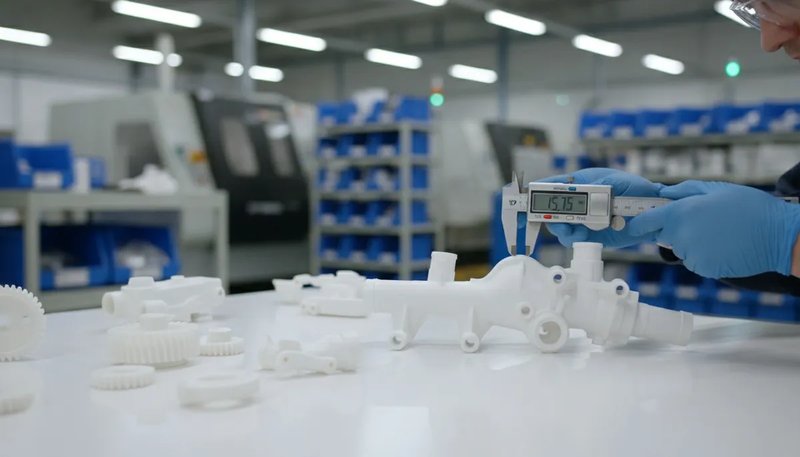
CNC machining achieves tolerances of ±0.005–0.025 mm on metals and ±0.025–0.1 mm on plastics. Injection molding typically achieves ±0.05–0.3 mm for general dimensions, with precision tooling and controlled processing reaching ±0.025–0.05 mm for tight-tolerance features. The tolerance gap is largest for thin-section features and tall, slender walls where injection-molded plastic experiences differential shrinkage that CNC machining avoids.
Plastic shrinkage is the primary source of injection molding dimensional uncertainty. Semi-crystalline polymers (nylon, POM, PP) shrink 1.5–2.5% after ejection; amorphous polymers (ABS, PC, PS) shrink 0.4–0.8%. The mold is machined oversized to compensate, but shrinkage varies with wall thickness, injection pressure, and cooling rate, creating dimensional variation that CNC machining does not face. For parts requiring sub-0.05 mm tolerances on all features, CNC machining is almost always the correct choice.

Part-to-part repeatability also differs. Injection molding, once optimized, produces statistically consistent parts with Cpk > 1.33 achievable for many dimensions, making it excellent for high-volume production where consistency is critical. CNC machining shows slightly more setup-to-setup variation when parts are repositioned for different operations, but individual part accuracy is higher. For medical devices and aerospace components where every part must meet tight tolerances, CNC machining’s superior per-part accuracy justifies its higher cost.
Which Materials Can Each Process Handle?
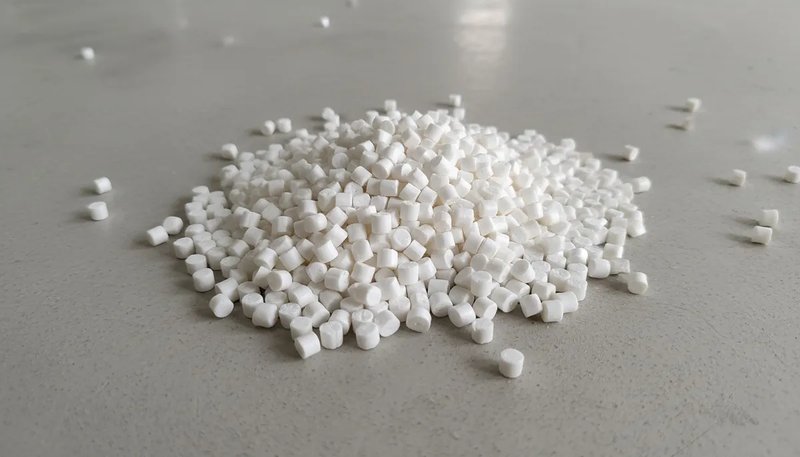
Injection molding processes thermoplastics and thermosets—a wide but defined material set. Common materials include ABS, PP, PE, PC, nylon, POM, TPU, and engineering resins. Metals cannot be injection molded in standard equipment (though metal injection molding—MIM—handles fine metal parts). Material changes require machine purging, which adds downtime and cost. Highly filled or fiber-reinforced materials can be injection molded but require hardened tooling.
CNC machining works with essentially any solid material: aluminum, steel, titanium, copper, brass, PEEK, UHMW-PE, Delrin, carbon fiber composites, ceramics, and more. This material flexibility makes CNC machining indispensable for metal prototypes, final metal parts, and specialty polymers that cannot be injection molded. When a design requires both plastic housing and metal brackets, CNC machining provides a unified manufacturing path.
“CNC machining is suitable for metal parts while injection molding is limited to plastics and thermosets.”Doğru
Standard injection molding cannot process bulk metals. CNC machining handles aluminum, steel, titanium, and specialty alloys with equal facility. For products requiring metal components—structural brackets, heat sinks, precision shafts—CNC machining or casting is the correct process.
“CNC machined plastic parts always outperform injection-molded plastic parts mechanically.”Yanlış
Mechanical performance depends on material grade and processing, not manufacturing method. Injection-molded nylon or PEEK parts can exceed the strength of CNC-machined ABS. The key factor is material selection, not whether the part was molded or machined.
How Do Lead Times and Throughput Compare?
CNC machining provides parts in 1–10 days for simple to moderately complex parts—no tooling fabrication required. Injection molding requires 4–12 weeks for mold fabrication before the first part is produced. However, once the mold is ready, injection molding produces parts at cycle times of 10–120 seconds per shot, enabling 500–5,000 parts per shift. CNC machining of the same part may take 5–60 minutes per part, making high-volume production impractical.
For iterative product development, CNC machining’s instant-on capability is a decisive advantage. Engineering changes can be implemented and new parts produced within days. Injection molding requires mold modification (days to weeks) for each design change. Products with frequent design iterations should remain in CNC machining until the design is frozen, then transition to injection molding for production scale.
Injection Molding vs CNC Machining: Side-by-Side Comparison
| Faktör | Enjeksiyon Kalıplama | CNC İşleme |
|---|---|---|
| Best volume | 10,000–millions | 1–10,000 |
| Tooling cost | $5,000–$100,000 | None (per part) |
| Part cost (high vol) | $0.05–$5.00 | $5–$500+ |
| Toleranslar | ±0.05–0.3 mm | ±0.005–0.05 mm |
| Lead time | 4–12 weeks (first part) | 1–10 days |
| Malzemeler | Plastics, thermosets | Metals, plastics, composites |
| Geometry complexity | Limited by draft/undercuts | High (5-axis capability) |
| Surface finish | As-molded, texture options | Tool marks, requires finishing |
| Tasarım esnekliği | Low (costly to change) | High (file change only) |
At our Shanghai facility, we operate 45–47 injection molding machines (90T–1,850T clamping force) and process 400+ material grades. With 20+ years of experience since 2005, our 8 engineers and 120+ production staff evaluate both processes for every new project. Our 30+ English-speaking team recommends CNC machining for prototype validation (5–50 parts), then transitioning to injection molding above 1,000 units—a workflow refined across thousands of customer projects.
The right choice is almost never absolute. In our factory, we recommend a phased approach: use CNC machining for pre-production prototypes and engineering validation (< 500 parts), then transition to low-volume injection molding tools for bridge production (500–10,000 parts), and finally high-cavitation production molds for volumes above 10,000 parts per year. See our complete injection molding guide for in-depth process coverage.
Bottom line: Choose injection molding for high-volume production where per-part cost matters most. Choose CNC machining for low volumes, tight tolerances, or when you need parts in days, not months.
Frequently Asked Questions: Injection Molding vs CNC Machining
When should I use injection molding instead of CNC machining?
Choose injection molding over CNC machining when: (1) production volume exceeds 10,000 parts per year, making tooling cost amortization favorable; (2) part geometry suits molding design rules (uniform wall thickness, 1°–3° draft, limited undercuts); (3) the material is a standard thermoplastic or thermoset available in injection molding grades; (4) per-part cost reduction is the primary objective; (5) part-to-part consistency across hundreds of thousands of units is required. Injection molding’s rapid cycle time (10–120 seconds), high repeatability, and ability to produce complex geometries with molded-in features (threads, snaps, ribs) at no additional cost make it the clear choice for mature, high-volume production.
What is the minimum quantity that makes injection molding cost-effective?
The break-even quantity depends on mold cost and part design. For a simple $10,000 mold producing parts that cost $1.00 each via CNC machining, injection molding at $0.30 per part breaks even at approximately 14,300 parts. For a complex $50,000 mold with CNC parts at $25 each and injection parts at $1.50 each, break-even is around 2,150 parts. Low-volume injection molding using aluminum tooling ($2,000–$8,000) lowers the minimum economic quantity to 500–2,000 parts. Always calculate break-even before choosing, as the answer varies significantly by part and volume.
Can injection molding achieve the same tolerances as CNC machining?
Injection molding cannot consistently match CNC machining tolerances for all dimensions. CNC machining achieves ±0.005–0.025 mm on metals; injection molding typically achieves ±0.05–0.2 mm on general dimensions. However, specific injection-molded features—precision bore diameters, snap-fit deflections, boss heights—can achieve ±0.02–0.05 mm with optimized tooling and processing. For parts where only a subset of features requires tight tolerances, injection molding often qualifies; for parts where every feature must hold ±0.01 mm, CNC machining is necessary. Post-molding machining of critical surfaces is a common hybrid strategy.
Can the same design be used for both CNC machining and injection molding?
The same CAD model cannot typically be used for both processes without modifications. CNC machining allows sharp internal corners, deep pockets, 0° draft walls, and variable wall thickness—features that cause tooling failure in injection molding. Injection molding requires draft angles (1°–3°), uniform wall thickness (within 25% of nominal), radiused corners, and no locked undercuts in the pull direction. To transition from CNC prototype to injection mold, designers must apply DFM modifications: adding draft, coring out thick sections, eliminating deep sharp pockets, and adding draft-aligned ribbing for structural reinforcement. Our DFM service helps customers make this transition efficiently.
What are the key advantages of CNC machining over injection molding?
CNC machining’s key advantages are: (1) no tooling investment or lead time—parts are available in days from a CAD file; (2) superior dimensional tolerances (±0.005–0.025 mm) for precision components; (3) material flexibility—metals, ceramics, and specialty polymers that cannot be injection molded; (4) design flexibility—changes cost nothing except programming time; (5) suitable for prototype and low-volume (1–10,000 parts) applications; (6) enables complex geometries with deep pockets, 0° walls, and undercut features that injection molding cannot produce without expensive side actions. For defense, aerospace, medical, and semiconductor applications requiring metal components with tight tolerances, CNC machining is irreplaceable.
How do I decide between injection molding and CNC machining for a new product?
Follow this decision framework: (1) Estimate total lifetime production volume—if above 50,000 units, injection molding is almost always more economical for plastic parts; (2) Check material—if metal is required, CNC machining or casting; (3) Review tolerances—if any critical dimension requires better than ±0.05 mm, evaluate CNC machining or post-mold machining; (4) Assess design maturity—if the design will change frequently, stay in CNC machining until frozen; (5) Calculate break-even quantity using actual mold and CNC quotes; (6) Consider time-to-market—if first parts are needed in 2 weeks, CNC machining; 4–12 weeks is acceptable, injection molding. When in doubt, start with CNC machining for validation, then transfer to injection molding at production scale.
References and Sources
- Bryce, D.M. (1996). Plastic Injection Molding: Manufacturing Process Fundamentals. Society of Manufacturing Engineers. Provides tolerance ranges, cycle time data, and material shrinkage rates used throughout this guide.
- Todd, R.H., Allen, D.K., & Alting, L. (1994). Manufacturing Processes Reference Guide. Industrial Press. Source for CNC machining tolerance capabilities (±0.005–0.025 mm) and comparative cost benchmarks.
- Rosato, D.V. & Rosato, M.G. (2012). Injection Molding Handbook (3rd ed.). Springer. Basis for tooling cost ranges ($5,000–$100,000) and per-part production cost data.
-
tolerances: Tolerances refers to the permissible dimensional variation defined in engineering drawings, typically measured in millimeters or inches, that a manufactured part must achieve. ↩
-
amortization: Amortization is a financial concept defined as the distribution of a fixed upfront cost—such as mold tooling—across the total quantity of parts produced to calculate per-unit cost. ↩
-
cycle time: Cycle time is the total duration of one injection molding production cycle measured in seconds, including injection, packing, cooling, and ejection phases. ↩





 EN
EN  ES
ES  FR
FR  DE
DE  PT
PT  AR
AR  RU
RU  JA
JA  KO
KO  IT
IT  NL
NL  TR
TR  PL
PL 