

- Współczynnik
- Metal die-cast enclosures excel at thermal management: aluminum conducts heat 1,000× faster than plastic, critical for high-power battery modules requiring active cooling.
- Plastic injection-molded enclosures achieve faster cycle times (15–45 seconds) compared to die-cast metal (30–120 seconds), enabling higher production rates and faster time-to-market.
- Electromagnetic interference (EMI) shielding is simpler in plastic when conductive fillers are compounded into the resin, avoiding secondary coating operations required for non-conductive plastics.
- For battery enclosures under 1,000 units/year or with custom geometry, plastic injection molding offers lower entry cost; for high-temperature or thermally intensive applications (>120 °C sustained), metal die casting becomes cost-competitive.
Plastic vs Metal Battery Enclosures: Why the Choice Matters for Your Design
The decision between plastic and metal battery enclosures is one of the most consequential engineering choices in battery pack design, affecting tooling cost, production volume economics, thermal performance, weight, and regulatory compliance. Plastic formowanie wtryskowe1 dominates the battery enclosure market at volumes above 5,000 units per year, while die-cast aluminum remains the choice for high-power modules requiring superior thermal management. Neither material is universally superior—the optimal choice depends on seven critical variables: production volume, thermal dissipation requirements, operating temperature, electromagnetic interference (EMI) shielding needs, dimensional tolerance requirements, weight constraints, and regulatory certifications such as UL 94 flame retardancy.
Implementation Guidelines
The plastic vs. metal decision is made early in battery module development, and changing enclosure materials at the certification or production stage incurs costs exceeding $50,000–$500,000 in engineering rework, regulatory re-testing, and tooling changes. In our factory, we guide customers through this decision in the first design phase by modeling both material pathways side-by-side: calculating tooling costs, per-unit material costs, secondary operation costs, production cycle time, and time-to-first-part for each approach. This analysis typically reveals the economically optimal choice for the customer’s production volume and technical requirements.
| Czynnik | Formowanie wtryskowe tworzyw sztucznych | Metal Die Casting2 |
|---|---|---|
| Tooling cost | $5,000–$50,000 | $30,000–$200,000 |
| Per-unit material cost | $0.20–$2.00 | $1.00–$5.00 |
| Czas cyklu | 15–45 seconds | 30–120 seconds |
| Przewodność cieplna3 | Low (0.2 W/m·K) | High (150–200 W/m·K) |
| EMI shielding4 | Inherent with conductive fillers | Requires coating or plating |
| Waga | Light (1–10 mm wall) | Heavy (3–8 mm wall) |
| Economic breakeven volume | ~5,000–10,000 units/year | ~50,000+ units/year |
| Typical application | Consumer Li-ion packs | High-power EV modules |

How Do Tooling Costs and Production Economics Compare?
Tooling cost is the primary economic driver of the plastic vs. metal decision. A high-quality plastic injection mold for a battery enclosure typically costs $5,000–$50,000 depending on cavity count, wall thickness uniformity, cooling complexity, and insert locations. A comparable die-cast aluminum mold costs $30,000–$200,000 because aluminum die-casting molds require multiple inserts, hardened cavity surfaces, and precision gate systems to withstand 5,000–50,000 shots before tool maintenance. The higher die-cast tooling cost is amortized only when production volume exceeds 50,000–100,000 units per year.
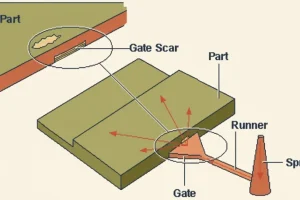
Material cost per unit also favors plastic at low to medium volumes. Plastic pellets for battery enclosure-grade resins cost $1–$10 per kilogram; a typical 300 g enclosure requires $0.30–$3.00 in raw material. Die-cast aluminum ingot costs $3–$8 per kilogram, but die-cast parts typically have 40–60% material waste from the runner and gate system, making the effective material cost $1.20–$6.00 per finished enclosure. At 10,000 units/year, the plastic enclosure total material cost is $3,000–$30,000; die-cast is $12,000–$60,000, a 4× premium.
Cost and Volume Analysis
Secondary operations also differ significantly. Plastic injection-molded enclosures require only flash trimming and assembly—typically $0.10–$0.50 per part. Die-cast metal enclosures require deflashing, impregnation (to seal porosity), surface finishing (polishing or passivation), and often plating or powder coating for EMI shielding, adding $0.50–$3.00 per part. For 10,000 units, secondary operation costs total $1,000–$5,000 for plastic vs. $5,000–$30,000 for die-cast metal.
| Cost Element | Plastic (per unit) | Die-Cast Metal (per unit) | Ratio |
|---|---|---|---|
| Materiał | Formowanie wtryskowe osiąga znacznie krótsze czasy cyklu niż odlewanie ciśnieniowe, co stanowi kluczową przewagę w produkcji masowej i szybkim wprowadzaniu na rynek. Typowa obudowa akumulatora z tworzywa sztucznego ma cykl 20–45 sekund: napełnianie formy (5–8 sekund) + chłodzenie (10–30 sekund w zależności od grubości ścianki) + usuwanie (2–5 sekund). Ta szybka cykliczność oznacza, że pojedyncza forma 32-gniazdowa produkuje 3 000–5 000 jednostek na 8-godzinną zmianę. Obudowy odlewane ciśnieniowo z aluminium wymagają dłuższych czasów cyklu wynoszących 30–120 sekund, ponieważ krzepnięcie aluminium jest wolniejsze niż chłodzenie tworzywa sztucznego, a złożoność narzędzi wymaga dodatkowego przetwarzania: podgrzewania tulei wtryskowej, regulacji ciśnienia, usuwania części z wielogniazdowego gniazda. | $1.20–$6.00 | 1:2–4 |
| Tooling amortized | $0.50–$5.00 | $3.00–$20.00 | 1:4–6 |
| Secondary operations | $0.10–$0.50 | $0.50–$3.00 | 1:3–5 |
| Total per unit | $0.90–$8.50 | $4.70–$29.00 | 1:3–5 |
| Annual production cost | $9,000–$85,000 | $47,000–$290,000 | 1:3–5 |
Which Material Wins on Thermal Management: Plastic or Metal?
Thermal management is where metal enclosures demonstrate a decisive advantage. Aluminum die-cast enclosures have thermal conductivity of 150–200 W/m·K, allowing direct heat dissipation from battery cells through the enclosure wall to the mounting surface or cooling system. A 3 mm aluminum wall can dissipate approximately 150–200 watts of continuous heat from a typical pouch cell battery module. Plastic enclosures, even with conductive fillers, achieve thermal conductivity of only 0.2–0.5 W/m·K, meaning they must rely on internal heat-transfer interfaces—thermal pads or metal inserts—to move heat from cells to the enclosure surface.
For battery modules operating above 120 °C continuous temperature or requiring active thermal management of more than 50 watts, aluminum die-cast enclosures become technically necessary. Electric vehicle high-power battery modules (400 V, 200+ amp systems) routinely generate 500–2,000 watts of heat during DC fast charging; a 3–5 mm aluminum enclosure wall is required to conduct this heat away from the cells and prevent internal temperature gradients that accelerate cell degradation. Plastic enclosures cannot meet this thermal requirement regardless of additive loading—they would require active liquid cooling channels molded into the plastic, adding cost and complexity.
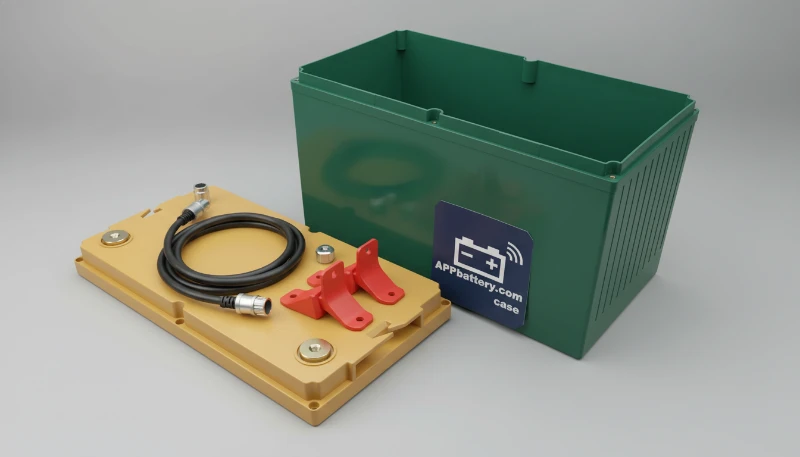
Conversely, for portable consumer battery packs (power banks, portable tools, solar storage) operating at ambient temperature with ≤50 watts of sustained heat dissipation, plastic enclosures with thermally conductive fillers or internal thermal pads are sufficient and significantly more cost-effective than metal die-casting. The decision threshold is typically 100–150 watts of continuous heat dissipation; above this, aluminum becomes superior; below this, plastic dominates economically.
| Zastosowanie | Continuous Heat (W) | Optimal Enclosure | Powód |
|---|---|---|---|
| Power bank | 5–20 | Tworzywo sztuczne | Low thermal load, cost-sensitive |
| Portable tool battery | 30–50 | Plastic + thermal pad | Moderate heat, weight-critical |
| Stationary backup power | 50–100 | Plastic or metal | Borderline; either material works |
| EV battery module (12V) | 100–300 | Aluminum die-cast | High sustained heat |
| EV battery module (400V) | 500–2,000 | Aluminum die-cast | Extreme thermal load, must conduct |
In practice, most consumer battery applications fall below the 50-watt threshold and are best served by plastic enclosures. Portable power banks dissipate 10–30 watts; cordless tool batteries dissipate 20–40 watts; home backup power systems dissipate 30–50 watts. Only when battery size exceeds 100 Ah or continuous discharge current exceeds 200 amps does sustained heat dissipation approach the aluminum-required threshold. Sizing your enclosure material to your actual thermal load, not worst-case assumptions, is critical to cost optimization.
Compliance and Certification Notes
Quality assurance and testing costs also differ. Plastic enclosures require routine UL 94 flame retardancy verification testing (5–10 specimens per lot, ~$200–$500 per lot) to ensure material compliance. Aluminum enclosures require surface inspection for defects, porosity testing (X-ray or fluorescent penetrant inspection), coating thickness verification, and corrosion resistance testing—adding $300–$800 per lot. Over 10,000 units delivered in 12 lots per year, the QA cost difference is $600–$3,600 annually, a 20–50% premium for aluminum in terms of total lifecycle cost.
The economic analysis doesn’t end with material cost and tooling amortization. The total cost of ownership must include secondary operations, quality assurance, logistics, and supply chain complexity. Plastic enclosures from a single mold supplier are simpler to manage; aluminum enclosures require coordination between die-caster, plating vendor, anodizer, and quality lab—introducing supply chain risk and potential delays. For a 10,000-unit annual volume distributed across 12 monthly shipments, the supply chain complexity of plastic (single supplier) is significantly simpler and lower-risk than aluminum (multi-vendor coordination).
“Aluminum die-cast battery enclosures conduct heat 1,000 times faster than unfilled plastic enclosures.”Prawda
Aluminum thermal conductivity is ~150–200 W/m·K; unfilled plastic is ~0.2 W/m·K. The ratio is 750–1,000:1. This difference is so large that metal enclosures are necessary for high-power applications (>100 watts continuous), while plastic suffices for low-heat applications. Conductive fillers in plastic increase conductivity to ~0.5–1.0 W/m·K, but still remain 150–300× slower than aluminum.
“Adding thermal pads to a plastic battery enclosure can match the heat dissipation performance of aluminum die-casting.”Fałsz
Thermal pads (typically 2–5 W/m·K) only improve surface conductivity at the interface—they don’t change the bulk plastic conductivity. A 3 mm aluminum wall dissipates continuous heat efficiently across its entire thickness; a plastic enclosure with pads dissipates only at the pad interface, limiting total heat flow. For applications >100 watts continuous, aluminum remains superior; plastic + pads is a cost compromise for 50–100 watt applications, not a performance equivalent.
What About Production Speed and Cycle Time?
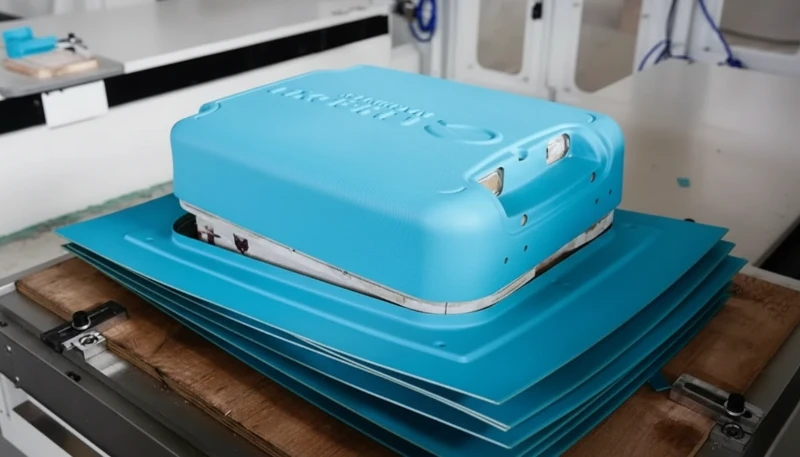
Injection molding achieves significantly faster cycle times than die-casting, a critical advantage for high-volume production and time-to-market. A typical plastic battery enclosure cycles in 20–45 seconds: mold fill (5–8 seconds) + cooling (10–30 seconds based on wall thickness) + ejection (2–5 seconds). This rapid cycling means a single 32-cavity mold produces 3,000–5,000 units per 8-hour shift. Die-cast aluminum enclosures require longer cycle times of 30–120 seconds because aluminum solidification is slower than plastic cooling, and the tooling complexity requires extra processing: shot sleeve heating, pressure adjustment, part removal from the multi-cavity nest.
Kompromisy Wydajności
Engineering Summary
Time-to-first-part is another dimension where plastic wins. Plastic molds are typically fabricated in 4–8 weeks; die-cast molds require 10–16 weeks due to the additional complexity of insert machining and testing. For customers needing to launch a new battery pack in a compressed timeline, plastic injection molding can reduce tool lead time by 4–6 weeks, a significant commercial advantage.
| Metryczny | Formowanie wtryskowe tworzyw sztucznych | Die-Cast Metal |
|---|---|---|
| Typical cycle time | 20–45 seconds | 30–120 seconds |
| Parts per 8-hr shift (single cavity) | 640–1,440 | 240–960 |
| Mold lead time | 4–8 weeks | 10–16 weeks |
| Mold cost | $5,000–$50,000 | $30,000–$200,000 |
| Machine utilization (10k units/yr) | 6–8 hours/day | 15–20 hours/day |
How Do EMI Shielding Requirements Affect Material Selection?
Electromagnetic interference (EMI) shielding requirements strongly favor plastic injection molding for battery enclosures. Most consumer battery packs (power banks, electric vehicle chargers, portable solar systems) require 40–60 dB of EMI attenuation to meet FCC Part 15 or CE standards. This is easily achieved in plastic by compounding the resin with conductive fillers—carbon fiber, stainless steel fiber, or nickel-coated particles—during the material manufacturing stage, at a cost premium of $1.50–$4.00 per kilogram. The finished plastic part has inherent shielding; no secondary operations are required.
Die-cast aluminum enclosures require a secondary coating or plating process to achieve EMI shielding: electroplating (nickel or copper), conductive painting, or anodizing with conductive particles. These secondary operations add $0.50–$2.00 per part, 20–50% of the die-cast part cost. Additionally, coating processes introduce process complexity, yield loss, and environmental handling costs. For shielded enclosures, plastic injection molding is economically superior and requires fewer process steps.
Material Selection Criteria
The only scenario where metal enclosures offer a shielding advantage is when the shielding requirement exceeds 80 dB (very high attenuation, rare for battery packs). At these levels, a direct metal shell provides superior performance over any plastic composite. However, even at 80+ dB, plastic enclosures can achieve compliance by pairing conductive-filled plastic with a thin (~0.1 mm) interior copper foil layer applied during assembly—a hybrid approach that retains most of the plastic cost advantage while meeting extreme shielding requirements.
“Conductive-filled plastic injection-molded enclosures achieve EMI shielding without secondary coating operations.”Prawda
When conductive fillers (carbon fiber, stainless steel fiber) are compounded into the plastic resin before molding, the finished part has inherent electrical conductivity distributed throughout its material. No secondary electroplating, painting, or anodizing is required. This eliminates post-molding operations, reducing per-unit cost by $0.50–$2.00 per part compared to bare aluminum that requires shielding treatment.
“Die-cast metal enclosures are always superior for EMI shielding compared to plastic injection molding.”Fałsz
For typical battery pack applications requiring 40–60 dB of shielding, conductive-filled plastic is both superior and more cost-effective: superior because shielding is inherent and uniform throughout the material; more cost-effective because no secondary coating process is needed. Metal enclosures require secondary operations (plating, painting) that add cost and process complexity. Metal is only preferred for extreme shielding requirements (>80 dB), which are rare in battery applications.
Tolerance and Dimensional Stability: Plastic vs Metal
Dimensional tolerance and stability favor metal die-casting for tight tolerance requirements.
Surface Finish and Post-Processing
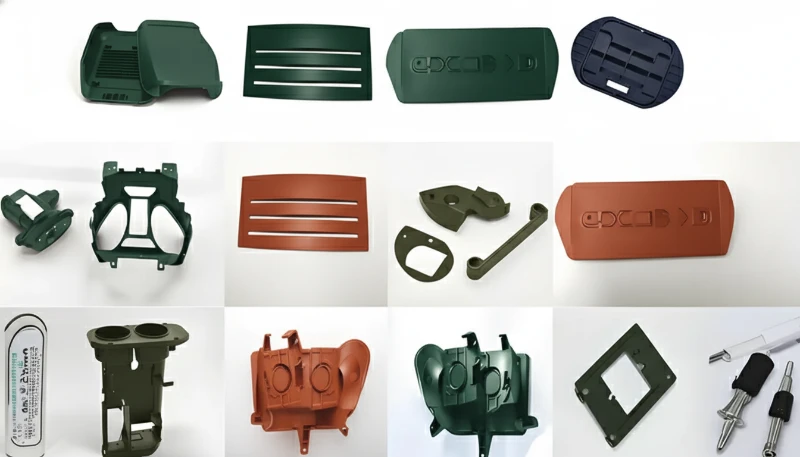
Die-cast aluminum achieves tolerances of ±0.10–0.20 mm on critical dimensions because the metal solidification process is highly repeatable and the tooling rigidity is exceptional. Plastic injection molding typically achieves ±0.20–0.30 mm depending on wall thickness, part geometry, and cooling uniformity. For battery pack applications where the enclosure must interface with precise electronic modules, coin cell springs, or connector stubs, the tighter tolerance of die-cast metal can eliminate secondary machining operations.
However, plastic injection molding’s tolerance capability is adequate for 90% of battery enclosure applications. With proper projekt formy, cooling optimization, and process control, plastic can consistently achieve ±0.15–0.25 mm, sufficient for battery cells, BMS modules, and connector interfaces. When tighter tolerances are required, plastic enclosures can be molded oversized and finished with CNC drilling or reaming of critical holes (±0.05 mm), a secondary operation costing $0.20–$0.80 per part—typically cheaper and faster than tightening the primary mold tolerances.
Application-Specific Guidelines
Thermal stability of enclosure dimensions is another consideration. Plastic enclosures can shrink or warp if stored in warm environments or exposed to elevated sustained temperatures (above the glass transition temperature of the resin, typically 100–140 °C for battery-grade plastics). Die-cast aluminum is dimensionally stable across all temperature ranges, a key advantage for battery enclosures used in automotive environments where ambient temperature can exceed 80 °C. For consumer applications with controlled environments, plastic’s thermal stability is adequate; for automotive and industrial applications, aluminum’s dimensional stability is a technical advantage worth the cost premium.
| Aspekt | Formowanie wtryskowe tworzyw sztucznych | Die-Cast Metal |
|---|---|---|
| Typical tolerance | ±0.20–0.30 mm | ±0.10–0.20 mm |
| Achievable with tight mold | ±0.10–0.15 mm (added cost) | ±0.05–0.10 mm (standard) |
| Thermal stability | Limited >100 °C | Excellent to 200+ °C |
| Dimensional drift (12 months) | ±0.05–0.10 mm | ±0.01–0.02 mm |
| Cost of tight tolerance control | $0.20–$0.50 extra per part | Standard, no premium |
Regulatory Compliance: UL 94, Safety Certifications, and Material Standards
Both plastic and metal battery enclosures must meet regulatory flame retardancy standards—primarily UL 94 V-0 for consumer electronics and higher ratings for automotive and industrial applications. Plastic enclosures achieve UL 94 V-0 by compounding flame-retardant additives into the resin, a material specification issue that doesn’t affect die-casting. Die-cast aluminum enclosures do not inherently meet UL 94 requirements; they must be coated with a flame-retardant epoxy or polyester powder coating, a secondary operation adding $0.50–$1.50 per part.
Material certifications differ as well. Plastic resins suitable for battery enclosures must be UL-listed, with specific certifications for electrical properties, flammability, and thermal stability. Common battery-grade plastics include PC (polycarbonate), PA66 (polyamide 66) with glass fiber, and specialized halogen-free flame-retardant compounds. Die-cast aluminum enclosures must meet ASTM B26 (sand castings) or ASTM B26 equivalents for aerospace-grade aluminum, plus surface treatment specifications for corrosion resistance and EMI shielding. The regulatory pathway for aluminum is more stringent—a single material change can trigger re-certification, adding weeks to the development schedule.
Performance Trade-offs
Elementy obudowy baterii wskazujące obszary interfejsu termicznego
“Plastic enclosures achieve UL 94 V-0 flame retardancy during material compounding; aluminum enclosures require secondary coating processes.”Prawda
Flame-retardant plastic resins are specified and tested as a single material unit by the resin supplier and UL. A qualified V-0 plastic enclosure requires no post-molding treatment—the flame retardancy is integrated into the material. Aluminum enclosures are inherently not flame-retardant and must be coated with epoxy or polyester powder containing flame retardants. This secondary operation adds cost, introduces yield loss, and requires additional quality control and certification testing.
“Aluminum die-cast battery enclosures are universally more compliant with safety and regulatory standards than plastic.”Fałsz
Both materials can meet UL 94, UL 2580, and IEC 62133 certifications. Plastic often certifies faster because material specifications are simpler and more stable during development. Aluminum enclosures require coordination of multiple vendors (die-caster, plater, powder coater, anodizer) and more rigorous surface treatment quality control. For automotive applications, aluminum may offer advantages (thermal management, dimensional stability), but not regulatory superiority.
When Should You Choose Plastic? When Should You Choose Metal?
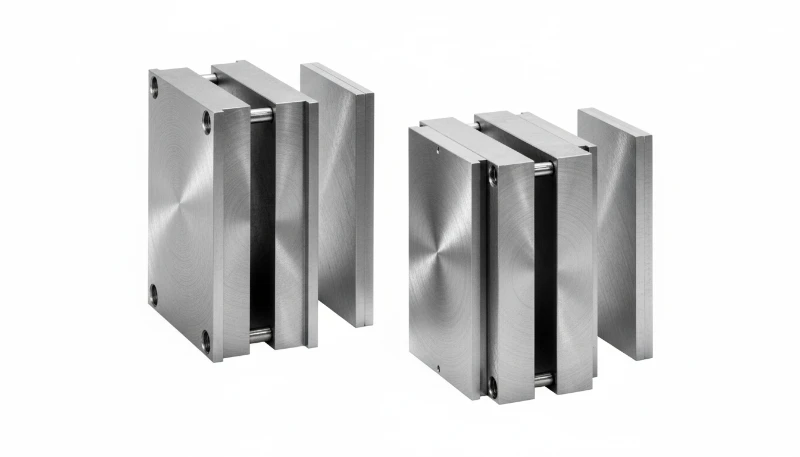
Choose plastic injection molding for battery enclosures when: production volume is 1,000–100,000 units per year; sustained operating temperature is below 100 °C; continuous heat dissipation is below 50 watts; EMI shielding is required (conductive-filled plastic is cost-effective); weight is a constraint; and time-to-market is critical. Plastic excels at low-to-medium volumes and offers unmatched speed and flexibility. For consumer portable batteries, power banks, backup power supplies, and low-power tool batteries, plastic injection molding is the economically optimal choice in >95% of cases.
Choose die-cast aluminum for battery enclosures when: production volume exceeds 50,000 units per year; sustained operating temperature exceeds 100 °C; continuous heat dissipation exceeds 100 watts; tight dimensional tolerances (±0.05–0.10 mm) are required on critical interfaces; thermal cycling or environmental durability is extreme; and weight is less critical than thermal performance. Die-cast metal is the optimal choice for high-power EV battery modules, industrial stationary batteries, and aerospace/defense applications where thermal management and structural rigidity are paramount.
Key Design Considerations
In our factory, we recommend plastic injection molding for the initial battery enclosure development and prototype phase, regardless of ultimate production volume. The lower tooling cost ($5,000–$20,000), faster lead time (4–6 weeks), and flexibility to iterate on design make plastic an ideal choice for design validation and certification testing. Once the design is frozen and production volume is confirmed, customers can transition to aluminum die-casting if thermal or volume requirements justify it. This hybrid approach—plastic for prototyping and early production, aluminum for high-volume production—balances risk, cost, and performance.
| Criterion | Choose Plastic If: | Choose Metal If: |
|---|---|---|
| Objętość | <50,000 units/year | >50,000 units/year |
| Operating temperature | <100 °C sustained | >120 °C sustained |
| Heat dissipation | <50 watts continuous | >100 watts continuous |
| EMI shielding required? | Yes (cost-effective via fillers) | Yes (requires coating) |
| Tolerance needs | ±0.20 mm adequate | ±0.05–0.10 mm required |
| Time-to-market critical? | Yes (4–6 week mold lead) | No (10–16 week lead) |
| Weight constraint? | Yes (prefer lightweight) | No (weight acceptable) |
| Typical cost per unit | $0.90–$8.50 | $4.70–$29.00 |
Frequently Asked Questions About Plastic vs Metal Battery Enclosures?
Czy obudowy akumulatorów formowane wtryskowo z tworzyw sztucznych mogą osiągnąć taką samą wydajność termiczną jak obudowy odlewane ciśnieniowo z aluminium?
No. Aluminum conducts heat 150–1,000 times faster than unfilled plastic (150–200 W/m·K vs. 0.2 W/m·K). Even with conductive fillers, plastic achieves only 0.5–2.0 W/m·K, still 75–400× slower than aluminum. For applications requiring >50 watts of continuous heat dissipation, aluminum is necessary. For <50 watts, plastic with thermal interface pads is adequate and more cost-effective. Plastic enclosures can achieve moderate thermal performance through internal copper spreader plates or thermally conductive adhesive layers, but this hybrid approach is more complex and expensive than solid aluminum.
Jaka jest minimalna wielkość produkcji, przy której odlewanie ciśnieniowe aluminium staje się bardziej opłacalne niż formowanie wtryskowe tworzyw sztucznych?
The breakeven volume is approximately 50,000–100,000 units per year, depending on enclosure complexity and secondary operation costs. At 10,000 units/year, plastic costs $0.90–$8.50 per unit while aluminum costs $4.70–$29.00—a 4–5× premium for metal. At 100,000 units/year, the amortized tooling cost for metal ($0.30–$2.00) becomes competitive with plastic ($0.90–$8.50 remaining cost). However, this breakeven assumes equivalent thermal design and secondary operation costs. If plastic requires expensive secondary operations (CNC finishing, secondary coating) and metal does not, the breakeven volume can shift lower. A detailed cost model specific to your part geometry and volume plan is always recommended before making a material selection.
Czy plastikowe obudowy akumulatorów formowane wtryskowo wymagają powłoki wtórnej do ekranowania EMI?
No, not if the plastic is compounded with conductive fillers (carbon fiber, stainless steel fiber, nickel-coated particles) during the material manufacturing stage. Conductive-filled plastic is inherently shielded throughout its material and requires no post-molding coating. However, if you choose non-conductive plastic and then need EMI shielding, you must apply a secondary conductive coating such as electroless nickel plating, copper electroplating, or conductive paint, adding $0.50–$2.00 per part. For most battery pack applications, the material is specified as conductive-filled from the start to avoid secondary coating costs and simplify the manufacturing process.
Który materiał jest lepszy do zastosowań w akumulatorach samochodowych: plastik czy metal?
Metal die-cast aluminum is preferred for automotive battery applications because operating temperatures in EV battery modules can sustain 80–120 °C, which can degrade or warp plastic enclosures (especially those lacking flame-retardant additives). Additionally, automotive thermal requirements (300+ watts continuous for high-power modules) exceed what plastic can handle without active liquid cooling—prohibitively expensive. Die-cast aluminum provides superior thermal management, dimensional stability across temperature cycling, and proven durability in harsh automotive environments. For low-power auxiliary battery applications (12V backup systems), plastic is acceptable; for main battery modules, aluminum is mandatory.
Jak szybciej formowanie wtryskowe plastiku może produkować obudowy w porównaniu do odlewania pod ciśnieniem?
Plastic injection molding cycles in 20–45 seconds; die-casting cycles in 30–120 seconds. For a 32-cavity plastic mold, a single machine produces 3,000–5,000 units per 8-hour shift. A comparable aluminum mold produces 800–2,400 units per shift—approximately 2–4× slower. Across 10,000 units annual production, plastic requires ~8 production hours; aluminum requires ~20 production hours. This speed advantage translates to lower manufacturing lead times (typically 2–4 weeks for plastic vs. 4–8 weeks for aluminum at the same volume), enabling faster product launches and more flexible response to demand changes.
Czy plastikowe obudowy akumulatorów można poddać recyklingowi? A co z aluminiowymi?
Both materials are recyclable, but aluminum has a significant advantage: it is infinitely recyclable without property degradation. Aluminum die-cast scrap is worth $0.50–$1.00 per pound and is automatically recovered by recyclers. Plastic enclosures can be recycled, but most battery-grade plastics (especially flame-retardant compounds with additives) have limited value in secondary applications—typically $0.10–$0.30 per pound—and require separation by resin type. From a circular economy perspective, aluminum die-cast enclosures have superior environmental credentials if volume justifies die-casting. For plastic, end-of-life recovery is less economical, making plastic primarily suitable for single-use or long-lifecycle applications (10+ years in service).
-
injection molding: Injection molding is a manufacturing process in which molten plastic material is injected under high pressure into a mold cavity, cooled, and ejected to produce a finished part in a single cycle, typically taking 10–90 seconds. ↩
-
die casting: Die casting is a manufacturing process in which molten metal is forced under high pressure into a hardened steel mold, producing metal parts with high precision and repeatability, commonly used for aluminum and zinc-based alloys. ↩
-
thermal conductivity: Thermal conductivity is a material property measured in watts per meter-kelvin (W/m·K) that indicates how quickly heat is transferred through a substance from hot to cold regions. ↩
-
EMI shielding: Electromagnetic interference (EMI) shielding is the containment of electromagnetic radiation using conductive materials or coatings to prevent signal disruption between devices, measured in decibels (dB) of attenuation. ↩





 PL
PL  EN
EN  ES
ES  FR
FR  DE
DE  PT
PT  AR
AR  RU
RU  JA
JA  KO
KO  IT
IT  NL
NL  TR
TR 