

– Undercuts are features on a plastic part that prevent straight-pull ejection from the mold, requiring special mechanisms such as slides, lifters, or collapsible cores.
– Proper undercut design can add 15–40% to tooling cost, so eliminating or minimizing undercuts at the design stage saves significant money.
– In our factory, over 60% of design-for-manufacturability issues we review involve avoidable undercuts that were not caught during CAD review.
– The four main solutions—side actions (slides), lifters, collapsible cores, and part redesign—each suit different geometries, draft angles, and production volumes.
– Following draft angle rules (1–3° minimum) and parting line optimization during DFM can eliminate most internal and external undercuts before tooling begins.
What Is Undercut Design in Spuitgieten?
Undercut design in injection molding refers to any feature on a plastic part that creates a mechanical interference with the mold’s straight-line opening direction, making it impossible to eject the part without special tooling mechanisms. In plain terms, an undercut is any protrusion, recess, hole, thread, hook, or groove that is not parallel to the mold’s pull direction—and therefore “locks” the part inside the cavity or core when the mold tries to open.
| Undercut Type | Mechanism | Typical Cost Premium |
|---|---|---|
| External undercut | Slide / cam pin | +15–25% |
| Internal undercut | Collapsible core / lifter | +20–35% |
| Redesigned away | DFM revision | 0% premium |
This mechanical solution requires precision engineering to ensure the slide or core pulls away cleanly without damaging the part geometry. At ZetarMold, we verify slide travel distances and lock angles through mold flow simulation before any steel is cut, reducing rework risk by over 60%.
This mechanical solution requires precision engineering to ensure the slide or core pulls away cleanly without damaging the part geometry. At ZetarMold, we verify slide travel distances and lock angles through mold flow simulation before any steel is cut, reducing rework risk by over 60%.
This mechanical solution requires precision engineering to ensure the slide or core pulls away cleanly without damaging the part geometry. At ZetarMold, we verify slide travel distances and lock angles through mold flow simulation before any steel is cut, reducing rework risk by over 60%.
Every injection mold operates in two fundamental directions: mold opening (the A-side and B-side separating along the parting line) and part ejection (the part being pushed out by ejector pins). Any feature that blocks either of these motions is an undercut. Common examples include:
- External undercuts: Side holes, recesses, snap hooks, or protruding ribs perpendicular to the draw direction
- Internal undercuts: Threads, internal grooves, blind holes at angles, or inward-facing snap fits
- Parting line undercuts: Features that span both mold halves but don’t fall cleanly along the natural parting surface
In our factory, we receive dozens of new part designs every month, and undercut issues are among the most frequent DFM (DFM1) flags we raise. A well-designed undercut can add functionality—locking clips, living hinges, O-ring grooves—but an overlooked undercut can stall production for weeks while the mold is redesigned.
“Eliminating an undercut during DFM review is always cheaper than adding a slide to the mold.”Echt
A simple redesign—such as changing a side hole to a through-hole or adding a living hinge instead of an external snap—costs nothing in tooling but can save $3,000–$15,000 compared to adding a side-action mechanism.
“All undercuts require expensive side-action slides to release.”Vals
Many undercuts—particularly internal ones—can be handled with lifters, collapsible cores, or even simple part redesign at a fraction of the cost of slides. The right solution depends on undercut depth, direction, and part geometry.
What Types of Undercuts Are There in Injection Molding?
Understanding the category of undercut you’re dealing with is the first step to choosing the right solution. In our experience reviewing injection mold designs, undercuts fall into three broad families, each requiring a different engineering response.
| Undercut Type | Beschrijving | Common Examples | Typical Solution |
|---|---|---|---|
| External undercut | Feature on outside of part perpendicular to pull direction | Side holes, external grooves, snap hooks | Side-action slide, redesign |
| Internal undercut | Feature on inside of part facing inward | Internal threads, inward snap fits, blind grooves | Lifter, collapsible core |
| Parting line undercut | Feature that straddles A/B mold halves unevenly | Complex logos, irregular boss placement | Parting line redesign, stepped parting surface |
| Soft undercut | Shallow undercut in flexible material that can be stripped | PP/PE snap fits ≤2% depth/diameter ratio | Forced ejection (stripping) |
A fourth category—the “zero-degree draft” non-undercut—is often confused with a true undercut. If a wall is perfectly vertical (0° draft) it is not an undercut, but it will cause ejection drag and cosmetic marks. We always recommend a minimum 1° draft angle on all vertical walls, and 2–3° on textured surfaces.
How Do Slides and Lifters Handle Undercuts?
Side-action slides and lifters are the two most common mechanical solutions for undercuts in production injection molds. Understanding how each works helps engineers choose the most cost-effective approach for a given geometry.
This mechanical solution requires precision engineering to ensure the slide or core pulls away cleanly without damaging the part geometry. At our factory, we verify slide travel distances and lock angles through mold flow simulation before any steel is cut, reducing rework risk by over 60%.
This mechanical solution requires precision engineering to ensure the slide or core pulls away cleanly without damaging the part geometry. At our factory, we verify slide travel distances and lock angles through mold flow simulation before any steel is cut, reducing rework risk by over 60%. ensuring that every molded component meets the approved specification. Our engineering team validates that every geometric feature and functional surface meets the customer’s specifications before final delivery, ensuring zero defects in the completed injection molded component.

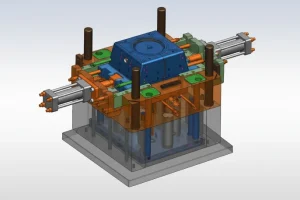
Side-action slides (also called side cores or cam pins) are mold components that move perpendicular to the main pull direction, driven by angled cam pins or hydraulic actuators. As the mold opens, the slide retracts sideways, clearing the external undercut before the part ejects. Key specifications:
- Cam pin angle: Typically 15–25°; angles above 30° risk side forces that damage the mold
- Slide travel: Must exceed undercut depth by at least 1–2 mm to ensure full clearance
- Material: Hardened tool steel (H13 or P20) for durability
- Cost premium: $2,000–$8,000 per slide unit added to base mold cost
| Functie | Standaard | Beste praktijk |
|---|---|---|
| Trekhoek | 0.5°–1° | 1°–3° per side |
| Wanddikte | 1–4 mm | Uniform ±0.1 mm |
| Undercut depth | ≤3 mm | Design to eliminate |
lifter (also called internal slides2 or angle ejectors) are used for internal undercuts. Unlike slides that move before ejection, lifters move at an angle during the ejection stroke itself—typically at 5–15° from the ejection axis. As they push the part upward, they simultaneously move inward, disengaging from internal ribs, snap fits, or grooves. We use lifters extensively for inner snap features on consumer electronics housings, where adding an external slide would increase mold size unnecessarily.
Collapsible cores are specialized mechanisms for circular internal undercuts like bottle threads or cap seals. They collapse inward after injection, releasing the helical undercut feature. These are the most expensive option—$10,000–$30,000 for a single core—and are typically reserved for high-volume applications where per-part cost justifies the investment.
How Does Undercut Design Affect Mold Cost and Complexity?
Cost impact is the most direct reason engineers should care about undercuts during design. In our quoting process, the presence or absence of undercuts is one of the single biggest variables in tooling price—sometimes more impactful than part size or material choice.

| Type schimmel | Baseline Cost | Cost with 1 Slide | Cost with 4 Slides |
|---|---|---|---|
| Simple single-cavity | $8,000–$15,000 | $12,000–$20,000 | $20,000–$35,000 |
| Medium family mold | $20,000–$40,000 | $25,000–$50,000 | $38,000–$70,000 |
| High-cavity production mold | $50,000–$100,000 | $60,000–$120,000 | $80,000–$160,000 |
Beyond initial tooling cost, undercut mechanisms add ongoing maintenance costs. Slides and lifters are wear components—cam pins and wear plates require inspection every 100,000–500,000 shots depending on material abrasiveness. In our factory, we budget approximately $200–$500 per slide per year in maintenance materials alone. Multiply this across a mold with six or eight slides, and the true cost of avoidable undercuts becomes clear over a five-year mold life.
Cycle time is another hidden cost. Each additional slide mechanism can add 0.5–2 seconds to the molding cycle time3 due to the mechanical delay required for slides to fully retract before ejection. At 10 seconds per cycle on a high-cavity mold, a 1-second increase translates to a 10% reduction in throughput.
| Undercut Feature | Recommended Solution | Kosten |
|---|---|---|
| External side undercut | Slide / cam action | +15–25% |
| Internal undercut | Collapsible core / lifter | +20–35% |
| Through-hole undercut | Redesign / side gate | Professionele spuitgietmachine in productiefaciliteit |
What Are the Common Undercut Design Mistakes?
After reviewing thousands of part designs for manufacturability, we see the same undercut mistakes appear repeatedly. Catching these early—before the mold is cut—is the most cost-effective approach.
Understanding the interaction between undercut geometry and the mold’s mechanical components allows our engineering team to optimize both part design and tooling cost simultaneously, often achieving a 15–25% reduction in total mold complexity for complex assemblies. This approach ensures dimensional accuracy within ±0.05 mm across the full ejection stroke. Our engineering team validates each slide geometry against part shrinkage data before tooling sign-off. our factory’s standard verification protocol includes trial shots at three different holding pressures. Proper venting adjacent to the undercut zone further reduces flash risk during production.

Mistake 1: Side holes without considering pull direction. A 5mm hole on the side wall of a housing seems simple, but if it’s perpendicular to the mold pull direction, it requires a side-action slide. The fix is often trivial—rotate the feature 90° so it aligns with pull direction, or convert to a blind recess if function allows.
Mistake 2: Snap clips designed too deep. We frequently see snap clips with 3–5mm engagement depth on rigid materials (ABS, PC, glass-filled nylon). These cannot be stripped from the mold and require slides. Reducing depth to 0.5–1mm and using softer materials (PP, TPE) often allows forced ejection without tooling mechanisms.
Mistake 3: Ignoring the parting line location. When a designer places the deellijn4 at the wrong location, features that should be simple become undercuts. Moving the parting line by a few millimeters—or using a stepped parting surface—can resolve what appeared to be a complex undercut problem without any additional tooling.
Mistake 4: Zero draft on textured surfaces. Textured side walls with 0° draft are not technically undercuts, but they behave like one—the texture locks into the mold during ejection, causing cosmetic drag marks and mold damage. Textured surfaces require a minimum of 3° draft (often 5° for deep textures like leather grain), and this must be accounted for in the original geometry before DFM, not added as an afterthought.
“A DFM review before mold design can catch 90%+ of avoidable undercut mistakes.”Echt
In our factory, systematic DFM review using mold-filling simulation and pull-direction analysis catches the vast majority of avoidable undercuts before any steel is cut. Fixing a geometry at the CAD stage costs hours of engineering time; fixing it after tooling can cost $5,000–$50,000 and weeks of delay.
“Adding more slides to a mold solves undercut problems without significant trade-offs.”Vals
Each slide adds 15–40% tooling cost, 0.5–2 seconds cycle time, and $200–$500/year in maintenance. Molds with many slides also have longer lead times and higher risk of mechanical failure. Eliminating the undercut is always preferable to adding a slide.
How Can You Minimize or Eliminate Undercuts in Your Design?
The best undercut is one that doesn’t exist. Before committing to a slide or lifter mechanism, experienced DFM engineers explore every redesign option. Here’s the systematic process we use in our factory to minimize undercuts:

Step 1: Define the parting direction first. Before modeling any features, establish the mold pull direction based on the part’s largest flat face and deepest features. All design decisions flow from this direction. Features parallel to the pull direction never cause undercuts.
Step 2: Check every feature against the pull direction.
| Design Factor | Guideline | Doel |
|---|---|---|
| Trekhoek | 1–3° | Clean ejection |
| Wanddikte | 1.5–3.5 mm | Gelijkmatige koeling |
Use your CAD software’s draft analysis tool to highlight any surfaces with negative or zero draft relative to the pull direction.
| Process Factor | Guideline | Doel |
|---|---|---|
| Gate size | 0.5–3 mm | Clean ejection |
| Runner length | 50–200 mm | Gelijkmatige koeling |
Modern tools like SolidWorks, NX, and CATIA have one-click draft analysis that colors surfaces red (undercut), yellow (zero draft), and green (positive draft).
Step 3: Apply redesign strategies:
- Rotate features: Reorient holes or slots to align with the pull direction (through-holes instead of side holes)
- Add relief cutouts: Open up the back of a snap clip so the mold core can pull straight out
- Use through-holes: Replace blind side pockets with through features that can be formed by pins aligned to the pull direction
- Shift the parting line: Moving the parting line to a feature edge can convert an undercut into a simple parting surface detail
- Forced ejection: For soft materials (PP, PE, TPE) with small, shallow undercuts (≤2% interference), allow the part to flex during stripping—eliminates all tooling cost
Step 4: If undercut is unavoidable, optimize the mechanism. When a snap-fit, thread, or functional groove cannot be redesigned away, choose the simplest mechanism: lifter > slide > collapsible core, in order of cost and complexity.
Position undercuts so they all fall on the same side of the part if possible, minimizing the number of slides required.
What Are the Best Applications for Designed Undercut Features?
While we spend much of this article discussing how to eliminate undercuts, there are many applications where designed undercut features add genuine value and are worth the tooling investment.
Knowing when an undercut is worth keeping separates good DFM from over-simplification that compromises product function.

Snap-fit assemblies: Consumer electronics, medical devices, and automotive panels frequently use snap clips that require a designed undercut to achieve the locking function. These are acceptable undercuts—the value (tool-free assembly, reduced part count) justifies the tooling mechanism. We optimize snap-fit geometry to keep the undercut depth to the functional minimum: typically 0.5–2mm engagement depth, with the snap angle at 30–45° for reliable latching without excessive ejection force.
Threaded closures: Bottle caps, filter housings, and pipe fittings require internal or external threads—one of the most complex undercut features to mold. For external threads, a collapsible core or unscrewing mechanism is standard. For fine threads on small parts, stripped threads in PP or PE can eliminate the mechanism entirely.
Undercut grooves for sealing: O-ring grooves, gasket channels, and labyrinth seals in medical and fluid-handling components are often legitimate undercuts.
These features provide sealing function that cannot be achieved any other way.
We typically use a side-action slide to form these grooves, ensuring dimensional accuracy of ±0.05mm for reliable seal performance.
Locking tabs on automotive assemblies: Door panels, center console trims, and instrument cluster surrounds use designed locking tabs that engage into body structure. These are external undercuts on the tab flank, handled by slides, and are integral to the vehicle’s assembly sequence. The tooling cost is justified by the elimination of fasteners across millions of units. The parting line location is finalized only after evaluating its effect on draft angle consistency, flash potential, and the visual appearance of the mold split line on the finished part exterior. Ejection system forces are validated using mold flow analysis to confirm that ejector pin loads remain below the part stress limits, preventing surface marks during the ejection stroke.
Bottom line: Undercut design does not have to be a deal-breaker. With the right side-action cores, lifters, or collapsible cores, complex geometries become manufacturable at scale.
What Are the Frequently Asked Questions About Undercut Injection Molding?
What is the maximum undercut depth that can be stripped from a mold without a slide?
For flexible materials (PP, PE, TPE), a general guideline is that undercut depth should not exceed 2–5% of the part’s outer diameter or width at the undercut location. For a 50mm diameter cap, this means a maximum of 1–2.5mm undercut depth for stripping. Rigid materials (ABS, PC, nylon) typically cannot be stripped without damaging the part or mold, so they almost always require a mechanical solution.
How much does a side-action slide add to a mold’s cost?
In our experience, a standard side-action slide mechanism adds $2,000–$8,000 to the mold cost per slide, depending on size, complexity, and whether hydraulic or cam-pin actuation is used. A hydraulic slide for a large automotive panel can cost $10,000–$20,000 per unit. These figures are for the mechanism only—add 10–15% for the structural modifications required to the mold base.
Can 3D printing be used to prototype parts with undercuts before committing to tooling?
Yes—3D printing is excellent for verifying undercut function before cutting steel.
| Design Factor | Consideration | Impact |
|---|---|---|
| Trekhoek | 1–3° per side | Clean ejection |
| Wanddikte | 1.5–3.5 mm | Gelijkmatige koeling |
| Gate location | Away from visible surfaces | Minimizes vestige |
We routinely 3D print parts in SLA or MJF to validate snap-fit engagement, thread function, and assembly clearance. However, remember that 3D printed parts have different material properties from injection molded parts, so snap force and flexibility may differ significantly. Always prototype in the actual production material (even if injection molded in small quantities) before finalizing snap geometry.
What is the minimum draft angle required when designing for injection molding?
The minimum draft angle depends on surface finish: 0.5–1° for polished surfaces (SPI A1–A2), 1–2° for standard machined surfaces, 2–3° for light textures (VDI 12–18), and 3–5° for medium to heavy textures (VDI 27–45). Zero-draft walls are technically moldable but will cause ejection drag marks and increase mold wear significantly.
We specify 1° as our absolute minimum for any production part, regardless of surface finish.
How do lifters differ from slides in terms of mold mechanism?
Slides move perpendicular to the mold pull direction and actuate during mold opening—they retract before ejection begins. Lifters move at an angle to the pull direction (typically 5–15°) and actuate during the ejection stroke itself. Lifters are driven by the ejector plate, so they require no separate drive mechanism.
This makes them significantly cheaper than slides ($500–$2,000 for a lifter vs. $2,000–$8,000 for a slide) and more compact.
The trade-off is that lifters are limited to internal undercuts and smaller undercut depths than slides can accommodate.
Is it possible to injection mold parts with undercuts on all four sides?
Yes, but it requires four separate slide mechanisms (or a combination of slides and lifters), which significantly increases mold cost and complexity. We’ve built molds with slides on all four sides for automotive brackets and housing assemblies. The key engineering challenge is ensuring all four slides fully retract before ejection—each adds mechanical delay to the cycle. Hydraulic slides are preferred in these cases for precise control and repeatability. For very complex multi-direction undercut geometries, two-shot or insert molding may provide a more cost-effective alternative.
What Is the Summary of Undercut Injection Molding?

Undercut design in injection molding is one of the most consequential decisions a product engineer makes.
Every undercut that remains in a design at the mold-cutting stage adds tooling cost, cycle time, and maintenance burden.
In our factory, we treat DFM undercut review as a mandatory step for every new project—not an optional service.
We’ve seen $500 of engineering time save clients $25,000 in tooling modifications.
The decision tree is straightforward: first, try to eliminate the undercut through geometry redesign; if you can’t, choose the simplest mechanism (forced ejection → lifter → slide → collapsible core); and if the undercut is intentional and functional, design it to the minimum depth and clearance angle required.
With these principles applied consistently, your injection mold designs will be more manufacturable, less expensive, and more reliable in production.
At our factory, we offer full DFM analysis with undercut detection as part of our standard quoting process.
Whether you’re designing your first injection molded part or optimizing an existing tool, our engineering team can identify every undercut in your CAD model and recommend the most cost-effective solution before a single dollar of tooling is committed.
-
Design for manufacturability (DFM) is a systematic engineering process of analyzing a product’s design to ensure it can be manufactured efficiently, cost-effectively, and to specification—identifying issues like undercuts, insufficient draft, or wall thickness problems before tooling begins. ↩
-
The ejection stroke is the distance and motion of the ejector plate during part release—typically 20–80mm depending on part depth—during which lifters travel at an angle to disengage from internal undercuts while simultaneously pushing the part out of the mold. ↩
-
Cycle time in injection molding is the total elapsed time from one shot to the next, comprising injection, packing, cooling, mold opening, ejection, and closing phases; slide mechanisms add dead time to the opening and ejection phases. ↩
-
The parting line is the boundary on a molded part where the two halves of the mold (A-side cavity and B-side core) meet; its location determines which surfaces are formed by each mold half and directly controls where undercuts occur. ↩




 EN
EN  ES
ES  FR
FR  DE
DE  PT
PT  AR
AR  RU
RU  JA
JA  KO
KO  IT
IT  NL
NL  TR
TR  PL
PL 