 콘텐츠로 건너뛰기

주요 내용
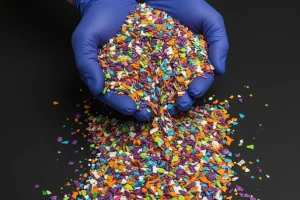
수천 가지의 수지 등급 제공 (충전재 포함, 식품 안전, 의료용).

What Are the Core Definitions?
사출 성형(IM)
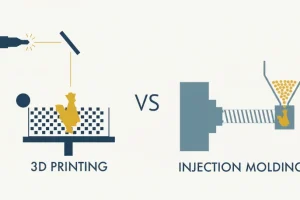
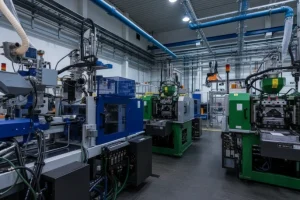
Injection Molding is a formative manufacturing process where molten material—typically thermoplastics like Acrylonitrile Butadiene Styrene (ABS) or Polycarbonate (PC)—is injected under high pressure (often 500–1500 bar) into a precision-machined metal mold. It is governed by standards such as ISO 294 (preparing test specimens).
3D Printing / Additive Manufacturing (AM)
Additive Manufacturing is a process of joining materials to make objects from 3D model data, usually layer upon layer. Common technologies include Fused Deposition Modeling (FDM), Stereolithography (SLA), and Selective Laser Sintering (SLS). It is increasingly standardized under ISO/ASTM 52900.
Injection molding produces parts with isotropic mechanical properties, meaning strength is equal in all directions.True
Because the molten plastic forms a cohesive solid under pressure, the molecular structure is generally uniform, unlike the layer-by-layer adhesion of 3D printing.
3D printing is always structurally weaker than injection molding regardless of the material used.False
While generally true for FDM, advanced AM methods like DMLS (metal) or continuous carbon fiber reinforced printing can produce parts exceeding the strength of standard molded plastics.

How Do Technical Parameters Compare?
To make a data-driven decision, engineers must compare the specific capabilities of standard Injection Molding against common industrial AM processes (SLS/SLA).
| 매개변수 | 사출 성형(IM) | 3D Printing (Industrial SLS/SLA) | Key Note |
|---|---|---|---|
| 생산량 | High (>1,000 to millions) | Low to Mid (1 to ~1,000) | IM requires volume to justify mold cost. |
| Cycle Time per Part | Seconds (15s – 60s) | Hours (depends on height/fill) | IM is exponentially faster for bulk runs. |
| Tolerance | High (±0.05 mm / ±0.002 in) | Moderate (±0.1 – 0.3 mm) | See ISO 2768 standard1 for generic IM tolerances. |
| 표면 마감 | Excellent (Ra 0.1 – 0.8 um) | Rough/Layered (Ra 5 – 20 um) | AM often requires post-processing (sanding/vapor smoothing). |
| Material Isotropy | Isotropic (Uniform strength) | Anisotropic (Weak Z-axis) | Critical for load-bearing structural parts. |
| Design Freedom | Limited (Draft angles, no undercuts) | High (Internal lattices, undercuts) | AM ignores traditional molding constraints. |
| Waste Material | Low (Runners can be reground) | Variable (Support structures are waste) | SLS powder can be recycled; FDM supports cannot. |

What Are the Advantages and Disadvantages?
사출 성형
| 장점 | 단점 |
|---|---|
| Economy of Scale: Unit cost drops drastically as volume increases. | High Initial CaPex: Molds cost $3,000 to $100,000+. |
| 소재의 다양성: Thousands of resin grades available (filled, food-safe, medical). | 디자인 제한 사항: 수용 가능합니다. |
| 일관성: High repeatability and identical part weights. | 리드 타임: Tooling fabrication takes 2–12 weeks. |
3D Printing (AM)
| 장점 | 단점 |
|---|---|
| Zero Tooling Cost: Start production immediately from a CAD file. | High Unit Cost: Price per part remains constant regardless of volume. |
| 복잡한 지오메트리: Can produce hollow structures and internal channels. | Surface Quality: Visible layer lines often require finishing. |
| Agility: Design changes can be implemented instantly without scrapping tools. | Throughput: Slow production rates bottleneck high-volume needs. |
3D printing is a viable alternative to injection molding for bridge production while waiting for steel molds.True
Bridge manufacturing uses AM to supply initial units to market while the long-lead-time injection molds are being machined.
Injection molding is cheaper than 3D printing for a production run of 50 units.False
For extremely low volumes like 50 units, the high cost of the mold makes the per-unit price of injection molding significantly higher than 3D printing.

What Are the Typical Application Scenarios?
When to Use Injection Molding
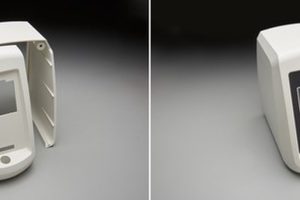
- Mass Consumer Electronics: Housings for phones, remotes, and laptops where surface finish and 대량 생산2 are critical.
- Automotive Components: Dashboards, bumpers, and connectors requiring specific ISO-certified material properties.
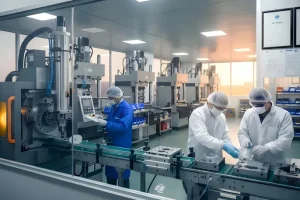
- Medical Consumables: Syringes and petri dishes requiring cleanroom sterility and millions of units.
- Packaging: Bottle caps and closures (using Polypropylene (PP) or Polyethylene (PE)).
When to Use 3D Printing
- Functional Prototyping: Verifying fit and form before cutting steel for a mold.
- 항공우주 부품: Lightweight lattice structures that reduce weight but are impossible to demold.
- Custom Medical Devices: Patient-specific prosthetics or dental aligners.
- Jigs and Fixtures: Manufacturing aids used on the assembly line.

How to Decide: A Step-by-Step Process
Follow this logic flow to determine the correct manufacturing method for your project:
-
Determine Production Volume:
- If <100 units: 3D 프린팅.
- If 100–2,000 units: Perform a cost-benefit analysis (Soft Tooling IM vs. SLS 3D Printing).
- If >2,000$ units: 사출 성형.
-
Analyze Geometry and Complexity:
- Does the part have internal cavities or impossible undercuts?
- Yes: 3D 프린팅 (or expensive collapsible cores in IM).
- No: 사출 성형 is viable.
-
Assess Mechanical Loads:
- Will the part withstand stress in multiple directions?
- Yes: 사출 성형 (due to isotropy).
- No/Low Stress: 3D 프린팅 is acceptable.
-
사출 성형 대 3D 프린팅: 주요 차이점
- Does the part require a glossy, Class A finish immediately?
- Yes: 사출 성형.
- No: 3D 프린팅 (or willing to pay for post-processing).
Modern simulation software can predict injection molding defects like warpage before the mold is cut.True
Moldflow analysis simulates the injection process, identifying potential air traps, weld lines, and warpage issues during the design phase.
You can use any injection molding thermoplastic in a standard FDM 3D printer.False
FDM printers require filament with specific viscosities and melting points. While some pellets can be used in specialized pellet printers, standard IM resins are not universally compatible with standard FDM machines.

자주 묻는 질문(FAQ)
Q: What is the "Breakeven Point" between 3D printing and injection molding?
A: generally, the breakeven point falls between 500 and 3,000 units depending on part size. Below this, 3D printing is cheaper due to zero tooling costs. Above this, the low variable cost of injection molding (pennies per part) offsets the tooling investment.
Q: Can 3D printing be used to make injection molds?
A: Yes. This is called Polymer Injection Molding3. 3D printed molds (using high-temperature resins) can produce 10–100 injection molded parts for prototyping the actual material, but they degrade quickly compared to aluminum or steel tools.
Q: Which process has tighter tolerances?
A: Injection molding generally holds tighter tolerances (±0.05 mm). 3D printing tolerances vary by machine and technology but typically range from ±0.1 mm to ±0.5 mm due to thermal shrinkage and layer resolution.
Q: Is 3D printed material as strong as injection molded material?
A: Generally, no. Injection molded parts are solid and isotropic. FDM prints have weak bonds between layers (Z-axis weakness). However, SLS and DMLS (metal) technologies are closing this gap, and carbon-fiber-reinforced prints can rival molded stiffness.
Q: Can I switch from 3D printing to injection molding later?
A: Yes, this is the standard product development lifecycle. However, the design must be "Design for Manufacturing" (DFM) compliant. Features that print easily (like overhangs without supports) may need redesigning (adding draft angles) to be moldable.

요약
Injection Molding and 3D Printing are complementary, not mutually exclusive. 3D 프린팅 dominates the early stages of product development and low-volume, high-complexity manufacturing. 사출 성형 remains the undisputed king of high-volume, consistent, and cost-efficient mass production. Successful engineers utilize 3D printing to validate designs quickly before committing capital to the high-quality, scalable output of injection molding.
-
ISO 2768 provides general tolerances for linear and angular dimensions without individual tolerance indications, serving as a baseline for machined and molded parts. ↩
-
High-volume injection molding is defined by automated cycles and multi-cavity tooling, reducing the piece-part price significantly as quantities rise. ↩
-
3D printed molds bridge the gap between prototyping and production, allowing engineers to test the actual end-use material before cutting metal tools. ↩


 KO
KO  EN
EN  ES
ES  FR
FR  DE
DE  PT
PT  AR
AR  RU
RU  JA
JA  IT
IT  NL
NL  TR
TR  PL
PL 