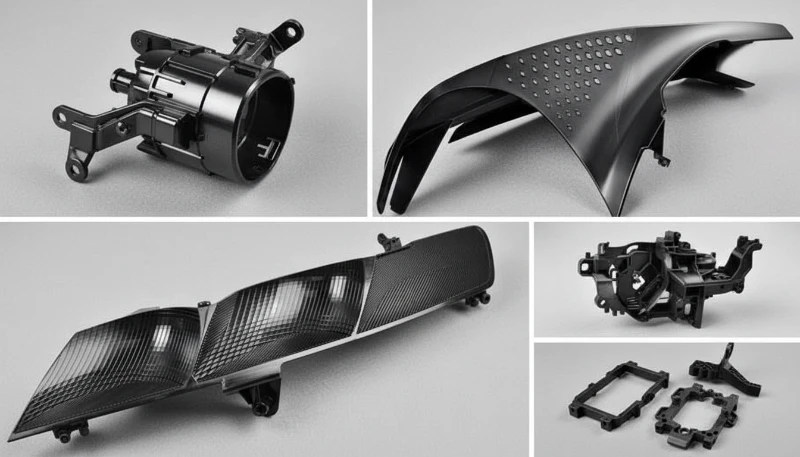
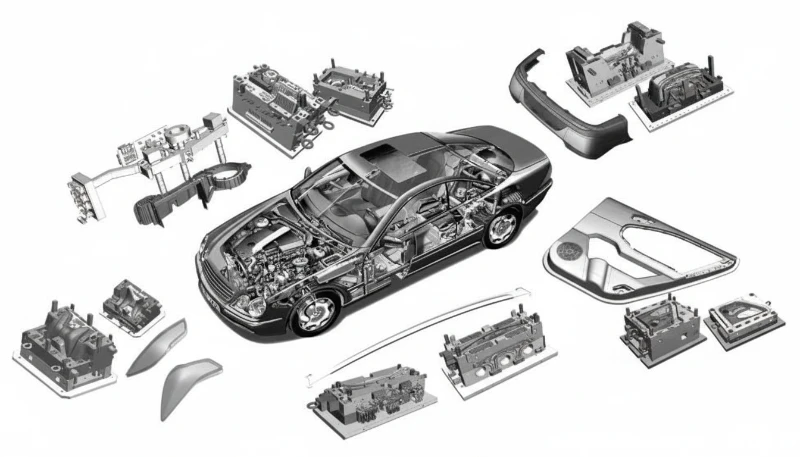
Yes — 射出成形 machines absolutely produce plastic parts for cars. In fact, a modern vehicle contains over 2,000 plastic components1, and the vast majority of them are made by injection molding. From the dashboard in front of you to the bumper that just took a parking-lot hit, injection-molded parts are everywhere in automotive manufacturing. This guide breaks down what gets molded, which materials work best, and what engineers should know before specifying an injection mold for automotive production.
For engineers and sourcing teams, the practical question is not whether automotive plastic parts can be molded, but which parts, materials, tolerances, and tooling choices make sense for production. Interior trim, clips, brackets, housings, connectors, and under-hood components each need a different resin and mold strategy, so the part function must drive the molding plan from the first DFM review.
- Injection molding produces 2,000+ plastic parts per vehicle
- PP, ABS, PA6, and PC are the top four automotive plastics
- Lightweighting saves ~0.3 L fuel per 100 km for every 100 kg removed
- EVs drive even higher demand for precision-molded plastic components
- Material selection must balance temperature, chemical, and impact requirements
What Plastic Auto Parts Are Made by Injection Molding?
内装部品
Instrument panels, door trim, center consoles, seat adjusters, cup holders, and airbag covers — these are all injection molded. A single dashboard module may combine 15–30 individual molded pieces. Polypropylene (PP) and ABS dominate here because they balance cost, impact resistance, and surface finish quality.

エクステリア・コンポーネント
Bumpers, grilles, fender liners, mirror housings, and light lenses come off injection molds by the millions. Exterior parts demand UV stability, impact toughness at both low and high temperatures, and Class-A surface finish. Thermoplastic polyolefins (TPO) and polycarbonate (PC) blends are common choices.
Under-the-Hood and Powertrain
Air intake manifolds, radiator end tanks, fluid reservoirs, connector housings, and engine covers are all molded from heat-resistant nylons (PA6, PA66) and PBT. These parts face continuous temperatures of 120–150 °C and exposure to fuel, oil, and coolant. Glass-fiber-reinforced grades push the heat ceiling even higher.
Electrical and Electronic
Modern cars pack 50–100 electronic control units (ECUs). Connector housings, sensor bodies, relay cases, and wiring harness clips are tiny but critical — and almost entirely injection molded. PBT and PPS handle the thermal and flame-retardancy requirements in these applications.
How Does the Injection Molding Process Work for Auto Parts?
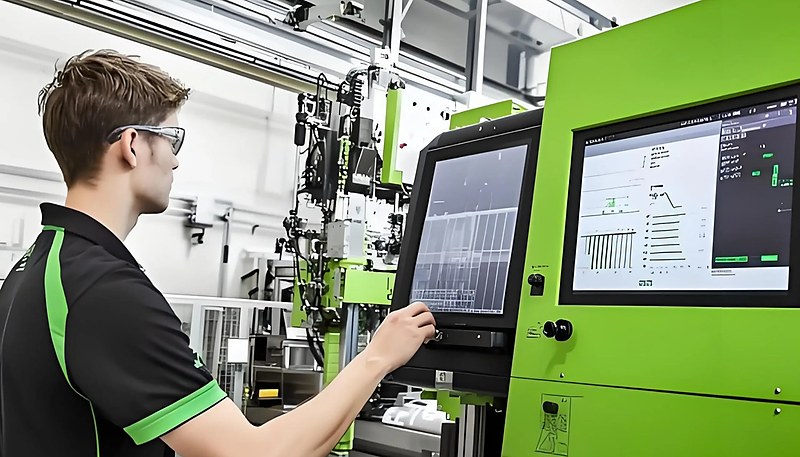
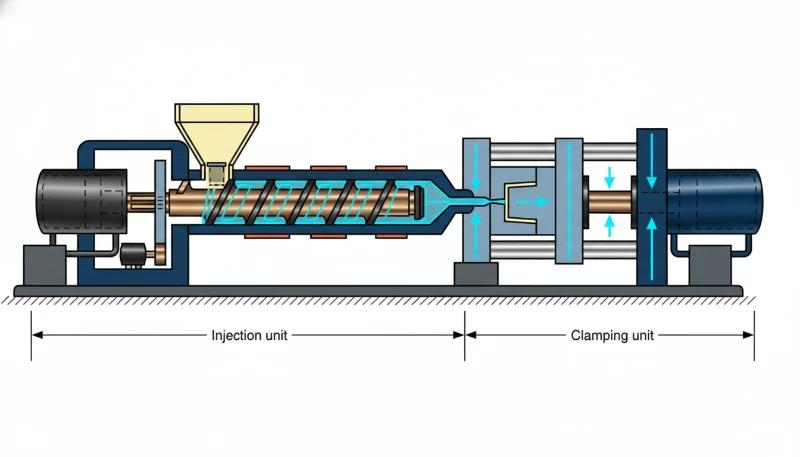
The automotive injection molding process is a four-step cycle: clamp the mold, inject the melt, cool the part, and eject it. For automotive work, the same 射出成形 cycle must also hold tight tolerance windows, often around ±0.05 mm, prevent flash on visible surfaces, and support production volumes that can reach 500,000+ shots per year for a single cavity.
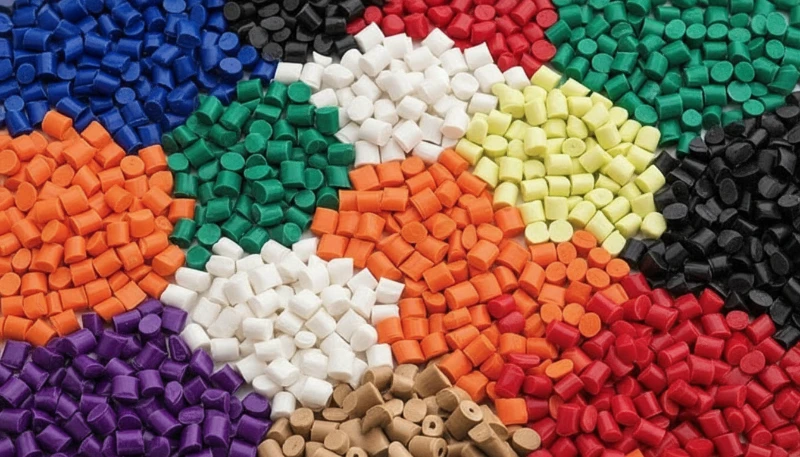
Here is what happens inside the machine: plastic pellets enter the heated barrel, where a reciprocating screw melts and homogenizes them. The screw then rams the melt into a precision-machined steel mold at pressures of 800–1,500 bar. The mold is temperature-controlled (usually 40–80 °C for automotive PP and ABS) to ensure consistent crystallinity and dimensional stability. After cooling for 10–60 seconds depending on wall thickness, the mold opens and robotic arms or sprue pickers remove the part. Cycle times for a typical 200-gram automotive clip run 15–25 seconds.
Multi-cavity molds (8-, 16-, or even 32-cavity) are standard for high-volume clips and fasteners. For large parts like bumpers or instrument panels, single-cavity molds with hot-runner systems keep material waste below 2%. In our experience at ZetarMold, the 金型設計 and gate placement decide 80% of whether an automotive part will pass the customer’s first-article inspection.
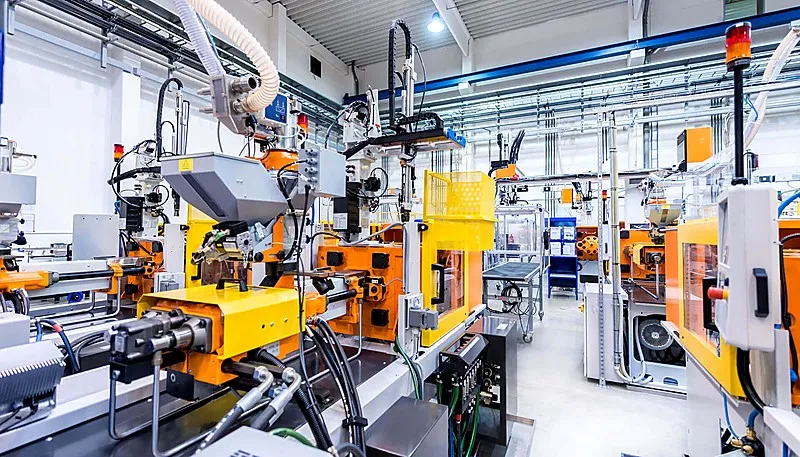
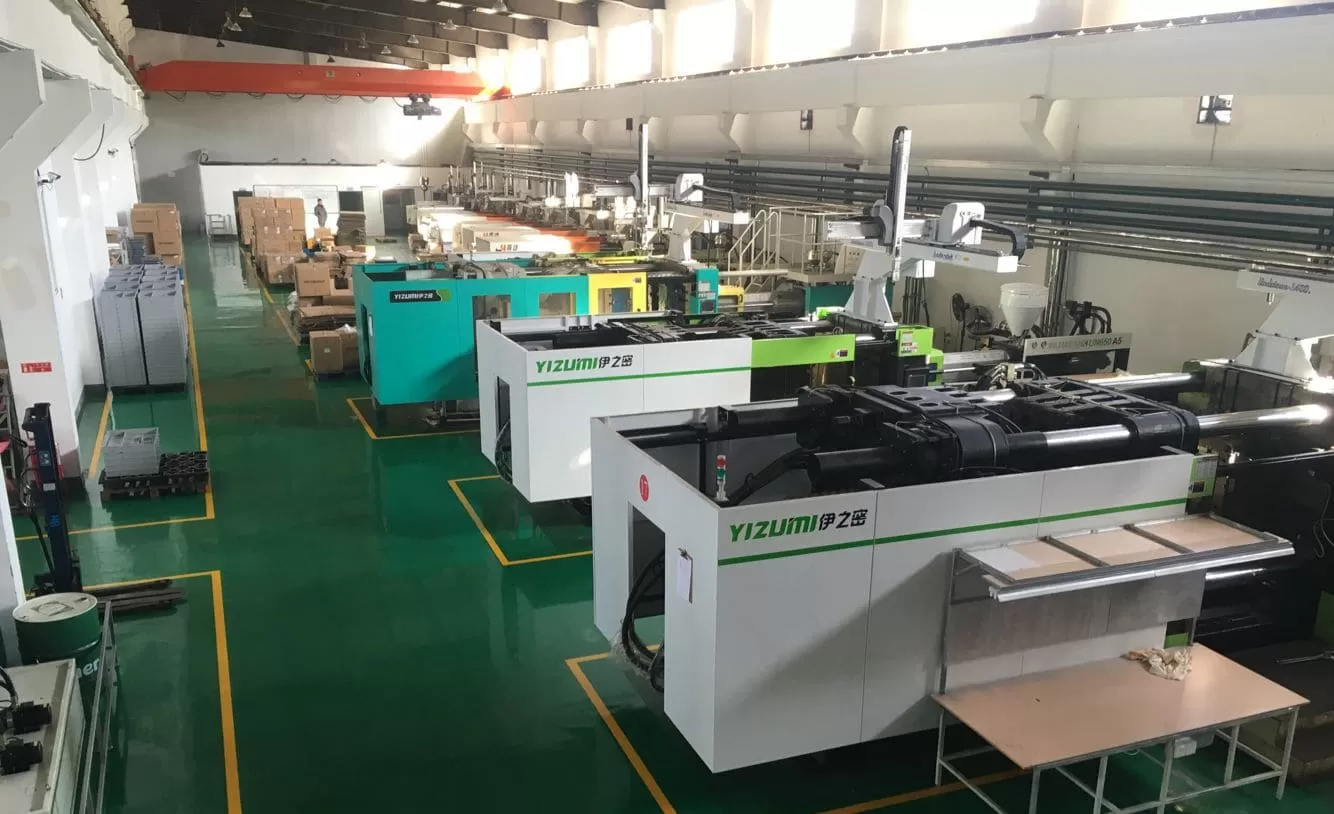
In our Shanghai factory, we run 47 injection molding machines from 90T to 1850T — enough range to cover everything from a 2-gram connector clip to a 10 kg under-hood component in a single facility.
Which Plastic Materials Are Common in Auto Parts?
Common automotive plastics are PP, ABS, nylon, PBT, PC, and PC/ABS because each balances heat, impact, cost, and surface requirements differently. Material selection in automotive injection molding is driven by three factors: the operating environment, the mechanical load, and the cost target. Below is a quick comparison of the most widely used automotive plastics.
Automotive Plastic Materials at a Glance
For quick comparison, PP is common in bumpers, battery cases, and interior trim; ABS is used for dashboards, consoles, and decorative trim; glass-filled PA6/PA66 is used for intake manifolds, engine covers, and gears; PC is used for transparent impact-resistant lenses; and PBT/PPS are common in electrical connectors and sensor housings.

Nylon (PA6 and PA66) deserves special attention because it appears in so many under-hood applications. glass-fiber-reinforced nylon2 66 can withstand continuous use above 150 °C and still deliver tensile strength above 180 MPa. That combination of heat resistance and mechanical performance is why air-intake manifolds migrated from die-cast aluminum to injection-molded nylon starting in the 1990s.
Polycarbonate blends (PC/ABS) are the go-to for parts that need both impact toughness and a high-quality surface — think of dashboard trim panels and chrome-plated decorative strips. Pure PC handles headlight lenses where optical clarity and rock-impact resistance are both non-negotiable.
Why Is Lightweighting So Important for Modern Vehicles?
Lightweighting is important because every kilogram removed helps fuel economy, EV range, emissions targets, and assembly efficiency. Every 100 kg removed from a vehicle saves roughly 0.3 liters of fuel per 100 km3 in an internal-combustion car, and extends EV range by about 2.5 km. Those numbers explain why automakers have been replacing metal with plastic for decades — and why the pace is accelerating with electric vehicles.
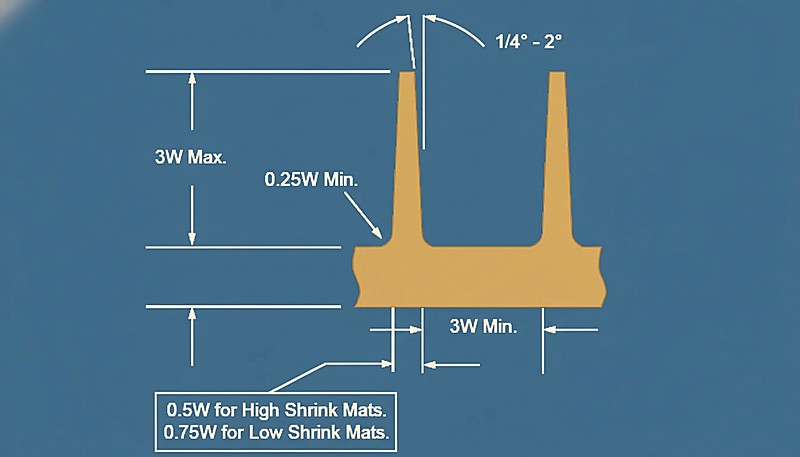
Injection molding is the enabler because it can produce complex, thin-wall parts that would be impossible (or prohibitively expensive) in sheet metal. A single molded plastic bracket can replace five stamped and welded steel pieces, cutting both weight and assembly cost. The key constraint is structural: plastics cannot match steel’s modulus, so engineers use rib patterns, glass-fiber reinforcement, and structural foam to close the gap.
What Makes Injection Molding Suitable for EV Components?
Injection molding is suitable for EV components because it forms flame-retardant, sealed, dimensionally stable plastic parts at scale. Battery module housings, thermal-management channels, high-voltage connector shields, and lightweight interior structures all need to be injection molded. The material requirements shift toward flame-retardant grades (UL94 V-0) and halogen-free compounds because of the fire-safety standards around high-voltage battery packs.
EVs also push molders toward tighter tolerances. Battery enclosures must seal against dust and moisture (IP67 is common), which means the mating surfaces of molded components need flatness and dimensional stability that legacy automotive interior molds never required. In our production experience at ZetarMold, we have seen tolerances tighten from ±0.1 mm to ±0.03 mm on EV structural brackets.
With 20+ years of molding experience and a material database covering 400+ plastic materials, our engineering team has seen the full evolution from ICE under-hood parts to EV battery components — and we know which resin grades actually deliver on their datasheet promises.
What Are the Challenges of Injection Molding Automotive Parts?
Injection molding automotive parts is not without headaches. Here are the three we see most often in production:
Material Selection Under Conflicting Requirements. A part may need to survive both -40 °C winter cold and 150 °C under-hood heat while resisting brake fluid and UV exposure simultaneously. Balancing all four constraints narrows your material options fast, and the cheapest resin rarely survives the full test matrix.
Mold Complexity and Cost. Automotive molds are expensive — $50,000 to $500,000+ for a single cavity is normal, and multi-cavity production tools run well above that. The mold must deliver consistent part quality over 500,000 to 2 million shots without significant wear. Getting gate placement, cooling-channel layout, and draft angles right the first time is critical, because mold modifications after T1 sampling are costly and schedule-breaking.
Process Window Control. Automotive OEMs demand Cpk ≥ 1.67 on critical dimensions. That means your injection pressure, melt temperature, holding pressure, and cooling time must be documented, locked, and repeatable — shot to shot, shift to shift. Any drift shows up as dimensional non-conformance during the customer’s incoming inspection.
“A typical car contains over 1,000 injection-molded plastic components.”真
Modern vehicles contain approximately 2,000 plastic parts, the majority of which are manufactured through injection molding. This number continues to grow as automakers replace metal components with lighter plastic alternatives.
“All plastic car parts can use the same injection molding parameters.”偽
Each material grade (PP, PA66, PC) requires a specific melt temperature, mold temperature, and injection pressure profile. Running PA66 at PP temperatures will produce short shots; running PP at PA66 temperatures degrades the resin.

How to Choose the Right Injection Molding Partner for Auto Parts?
The right auto-part molding partner is a supplier with matched tonnage, quality certs, in-house tooling, and real automotive experience. Evaluate these four areas before committing.
1. Do they have the right machine tonnage range? If you need a 1,500-ton shot for a bumper beam and the shop floor tops out at 650T, you are wasting time talking. Check tonnage range and clamp force against your projected part size.
2. Do they run automotive-grade quality systems? ISO 9001 is the floor. IATF 16949 is better if you supply directly to an OEM tier. Ask for their incoming material inspection protocol and their SPC capability data — not just the certificate on the wall.
3. Can they build the mold in-house? Outsourcing mold fabrication adds 2–4 weeks of lead time and a communication gap between the mold builder and the molder. An in-house tooling shop means faster iterations when (not if) the mold needs adjustments.
4. Do they have real automotive experience? General-purpose molding is different from automotive molding. Tighter tolerances, PPAP documentation, traceability requirements, and multi-year program commitments are standard in automotive but uncommon in consumer-goods molding.
Our in-house mold manufacturing facility produces 100+ mold sets per month under ISO 9001, ISO 13485, ISO 14001, and ISO 45001 systems. That vertical integration means we control the mold quality and the molding process in one loop — no finger-pointing between tool shop and molding floor.
“Every 100 kg reduction in vehicle weight can save approximately 0.3 L of fuel per 100 km.”真
Research from automotive engineering institutions confirms that removing 100 kg from a vehicle reduces fuel consumption by roughly 0.3 L per 100 km. This is one reason automakers increasingly substitute metal with injection-molded plastic components.
“Injection-molded auto parts always need secondary painting.”偽
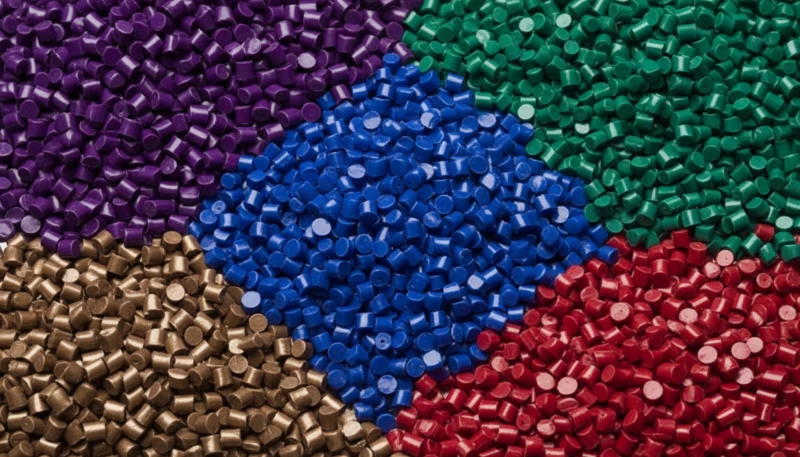
Many automotive resins (PP, TPO, ABS) accept pre-colored compounds, eliminating the need for painting. Color is mixed into the raw pellets before molding, producing consistent color throughout the part.

Frequently Asked Questions About Injection Molding in Auto Parts
Can injection molding produce both interior and exterior car parts?
Yes, injection molding handles both interior and exterior automotive parts seamlessly. Interior components like instrument panels, door trim, center consoles, and cup holders are typically molded from PP and ABS because those resins balance cost, impact resistance, and surface quality. Exterior parts — bumpers, grilles, mirror housings, and light lenses — require UV-stable grades such as TPO and polycarbonate blends. A single well-equipped molding facility can produce both categories, though exterior parts usually demand tighter surface-finish specs and weatherability testing.
What is the most commonly used plastic in automotive injection molding?
Polypropylene (PP) is the single most-used plastic in automotive injection molding, accounting for roughly 40 percent of all plastic content in a vehicle. Its low cost, excellent chemical resistance, and ease of processing make it the default choice for bumpers, battery cases, and interior trim components. ABS ranks second for interior appearance parts that require a high-quality surface finish. Nylon (PA6 and PA66) dominates under-hood and powertrain applications, while polycarbonate handles headlight lenses and transparent covers. Together, these four material families cover the vast majority of molded auto parts worldwide.
How precise can injection-molded auto parts be?
Injection-molded automotive parts routinely achieve tolerances of plus or minus 0.05 to 0.10 mm on critical dimensions during mass production. For high-precision applications such as electronic connector housings and EV battery components, tolerances as tight as plus or minus 0.03 mm are achievable with properly designed steel molds and tightly controlled process parameters. Surface finish quality can reach SPI A-2 grade, which is near-mirror quality, directly off the mold without any secondary finishing or polishing operations, saving both time and cost in the production workflow.
Is injection molding cost-effective for low-volume auto parts?
For production volumes below roughly 5,000 units, the mold tooling cost dominates the per-part price, making injection molding less economical than CNC machining or 3D printing for small batches. However, if the specific application demands material properties such as chemical resistance, flame retardancy, or long-term UV stability that only molded thermoplastics can reliably deliver, a soft-tooling approach using aluminum molds can bring the break-even volume down to approximately 1,000 to 2,000 pieces while still delivering genuine production-grade material performance and dimensional consistency.
What tolerances can automotive injection molding achieve?
Production automotive injection molding typically achieves plus or minus 0.05 mm on critical dimensions with a process capability index (Cpk) of 1.67 or higher, provided the mold is precision-machined and process parameters are locked down during qualification. Multi-cavity production molds for fasteners and clips maintain cavity-to-cavity dimensional variation below 0.02 mm across all cavities. Maintaining these tight tolerances consistently requires temperature-controlled molds, properly dried resin, and real-time statistical monitoring of injection pressure, melt temperature, holding pressure, and cooling time throughout the entire production run.
How does injection molding support electric vehicle manufacturing?
Electric vehicles increase the demand for injection-molded plastic parts because battery module housings, thermal-management channels, high-voltage connector shields, and lightweight structural brackets are all produced by molding. The material requirements shift toward flame-retardant grades rated UL94 V-0 and halogen-free compounds to meet the stringent fire-safety standards surrounding high-voltage battery packs. Dimensional tolerances also tighten significantly — to plus or minus 0.03 mm for sealing surfaces on battery enclosures that must meet IP67 ingress protection ratings, which is considerably tighter than traditional interior trim tolerances.
Can injection-molded auto parts replace metal structural components?
Glass-fiber-reinforced nylon and structural-foam parts can replace metal in many non-critical brackets, covers, and housings, and automakers continue expanding the list of approved plastic substitutions each model year. However, for primary load-bearing structures such as suspension control arms, roll cages, and crash-zone reinforcements, metals and carbon-fiber composites still dominate. Engineers close the stiffness gap using rib patterns, optimized wall thickness, and material reinforcement, but the fundamental modulus difference between plastic and steel remains a hard constraint for the most demanding structural applications.
What quality standards apply to automotive injection molding?
ISO 9001 is the baseline quality management system required for any injection molder supplying the automotive industry. IATF 16949 adds automotive-specific requirements including Production Part Approval Process (PPAP) documentation, Failure Mode and Effects Analysis (FMEA), and Statistical Process Control (SPC). For electrical and electronic components, UL94 flame-retardancy ratings apply. Material testing standards such as ASTM D638 for tensile properties and ASTM D256 for impact resistance are used for incoming material qualification and ongoing production validation to ensure consistent part quality over the life of the program.
Ready to start your automotive injection molding project? Get competitive pricing, DFM feedback, and a production timeline from ZetarMold’s engineering team. We have 20+ years of experience molding automotive-grade parts in our Shanghai facility. See our Injection Molding Supplier Sourcing Guide for a comprehensive evaluation checklist, or request a free quote today.
-
2,000 plastic components: Plastic content in vehicles refers to the total share of plastic materials by weight, typically 12 to 15 percent in a modern car comprising over 2,000 individual components. ↩
-
glass-fiber-reinforced nylon: Glass-fiber nylon reinforcement is a composite approach where glass fibers are added to nylon 66 resin to achieve tensile strength above 180 MPa and heat deflection temperatures above 150 degrees Celsius. ↩
-
0.3 liters of fuel per 100 km: Lightweight fuel savings is an estimate of fuel-consumption reduction achieved by removing vehicle mass, averaging approximately 0.3 L per 100 km for every 100 kg removed from an internal-combustion vehicle. ↩