 コンテンツへスキップ

- Injection molding produces discrete, three-dimensional parts in a closed mold under 500–2,000 bar; extrusion produces continuous extrusion profiles of constant cross-section through an open die under 100–400 bar.
- Extrusion tooling costs $500–$5,000; injection mold tooling costs $5,000–$100,000 — a 10–20× difference that only makes sense when geometry requires it.
- Choose extrusion when the part has a constant cross-section over its full length. Choose injection molding when the part has 3D features: bosses, ribs, clips, threads, shutoffs, or varying wall sections.
- Both processes use the same thermoplastic families, but extrusion grades need higher melt flow index for stable continuous flow; injection grades need lower MFI for packing pressure and dimensional control.
| パラメータ | 射出成形 | 押出 |
|---|---|---|
| Process type | Intermittent, closed mold | Continuous, open die |
| Operating pressure | 500–2,000 bar | 100–400 bar |
| サイクルタイム | 10–120 sec/shot | Continuous (kg/hr) |
| Dimensional tolerance | ±0.05–0.15 mm | ±0.1–0.5 mm |
| Tooling cost | $5,000–$100,000+ | $500–$5,000 |
| Material waste | 5–25% (runners, cold runner) | <1% (trim only) |
Both processes use the same thermoplastic materials and share similar barrel/screw machinery, but they differ fundamentally in how they shape the melt, what geometry they can produce, and what tooling they require.
A sourcing engineer comparing injection molding and 射出成形プロセス1 is usually not asking a process theory question. The real decision is whether the part geometry, tolerance target, tooling investment, and annual volume justify a closed-cavity molding process or a continuous-profile process. Choosing the wrong process does not simply raise cost — it can force secondary machining, introduce dimensional drift, or create tooling that never reaches payback.
The geometry question usually settles it first: if the part has a constant cross-section from end to end, extrusion stays in scope; if the part has any 3D feature that varies along its length, injection molding is the default answer. Cost comparisons only make sense after the geometry gate has been passed.
For a full reference on injection molding process selection, see our injection molding complete guide2. For mold tooling architecture and cavity design constraints, see our injection mold complete guide3.
What Is the Core Difference Between Injection Molding and Extrusion?
Injection molding produces discrete, three-dimensional parts by injecting molten plastic into a closed steel mold under 500–2,000 bar of pressure, then cooling and ejecting each part as a separate unit. Extrusion produces a continuous profile of constant cross-section by pushing molten plastic through an open die under 100–400 bar, then cooling the continuous extrudate and cutting it to length.
The fundamental distinction is geometry. Injection molding can produce any 3D shape the mold allows — parts with ribs, bosses, undercuts, varying wall thickness, integrated fasteners, and internal channels. Extrusion can only produce a profile that is geometrically identical at every point along its length. A pipe, a channel, a weatherstrip, a sheet — these are extrusion parts. A housing, a connector, a bracket, a fitting with integrated flanges — these are injection molding parts.

How Do the Two Processes Work Mechanically?
In injection molding, a reciprocating screw plasticizes the raw material and accumulates a measured shot in front of the screw tip.
When the mold is clamped, the screw translates axially, injecting the shot into the cavity under high pressure. The mold is water-cooled; the part solidifies in 5–40 seconds before the mold opens and the part is ejected. The entire cycle repeats every 10–120 seconds depending on part geometry and wall thickness.
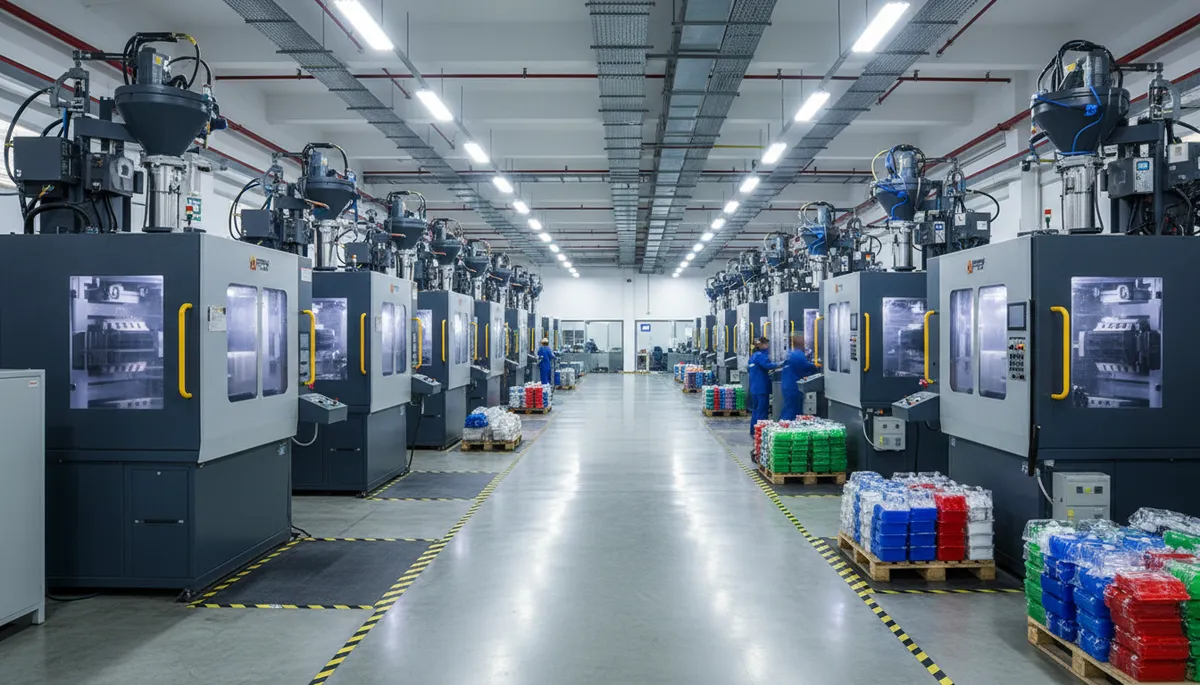
In extrusion, a continuously rotating screw conveys, melts, and pressurizes material against the die attached to the barrel end. The die shapes the continuous melt stream into the desired cross-section. After exiting the die, the extrudate passes through a calibration sizer and cooling tank, then a haul-off unit that pulls it at controlled speed. The process runs continuously at steady state — unlike the intermittent injection cycle — achieving 10–200 kg/hour throughput with minimal startup waste after the initial purge.
What Geometries Can Each Process Produce?
Extrusion produces pipes, tubes, channels, angles, sheets, films, weatherstripping, cable insulation, and window profiles. All of these share one characteristic: they are the same shape at every point along their length. Once any feature — a boss, a hole, a flange, a tapered section — appears at a discrete location rather than along the full length, extrusion alone cannot produce it.
Injection molding produces almost any discrete 3D shape: housings, brackets, connectors, fittings, living hinges, snap-fit assemblies, gears, impellers, and multi-cavity parts. The complexity is limited by the mold, not the process. Undercuts, side actions, lifters, and collapsible cores extend the geometric envelope considerably beyond simple prismatic shapes.
When Does Injection Molding Beat Extrusion on Economics?
Extrusion tooling costs 10–20× less than injection tooling for geometrically simple parts.
However, this comparison is only relevant when both processes can produce the required part. For parts with any 3D feature, the cost comparison is meaningless — extrusion cannot produce the geometry, so there is no real alternative.
When the geometry is compatible with both processes (e.g., a simple profile that could theoretically be either extruded or injection molded), the break-even calculation depends on annual volume, expected program life, and tolerance requirements. Below roughly 50,000 parts/year, extrusion tooling savings typically exceed any per-part cost premium. Above that volume, injection molding’s tighter tolerances and assembly-friendliness often justify the tooling investment even for simpler geometries.
| Situation | Recommended process |
|---|---|
| Part has constant cross-section, volume >10,000 m/yr | 押出 |
| Part has any 3D feature (ribs, bosses, clips, flanges) | 射出成形 |
| Prototype or pilot run, geometry still changing | Injection molding (soft tool) or 3D printing |
| Need ±0.05 mm on multiple features | 射出成形 |
| Continuous-length product (pipe, sheet, film) | 押出 |
A transition sentence: the table above covers the most common sourcing decisions; the section below addresses quality and defect management, which often determines the final process choice when tolerances are tight.
Factory Insight: How We Triage Injection vs. Extrusion RFQs
In our facility, the first screening question on any RFQ that mentions extrusion as an alternative is whether the part keeps a constant cross-section end to end. If it does not — and most parts that reach us do not — the discussion shifts immediately to injection molding without further cost comparison. Across our 45-machine injection molding operation, the most commonly misquoted parts as “extrusion candidates” are housings and fittings with integrated mounting flanges, snap-fit features, or variable boss patterns.
These look simple in a 2D drawing but require closed-cavity tooling as soon as any 3D feature appears. We encounter this situation in roughly 15–20% of early-stage RFQs from customers who have received extrusion quotes based on an oversimplified BOM description.
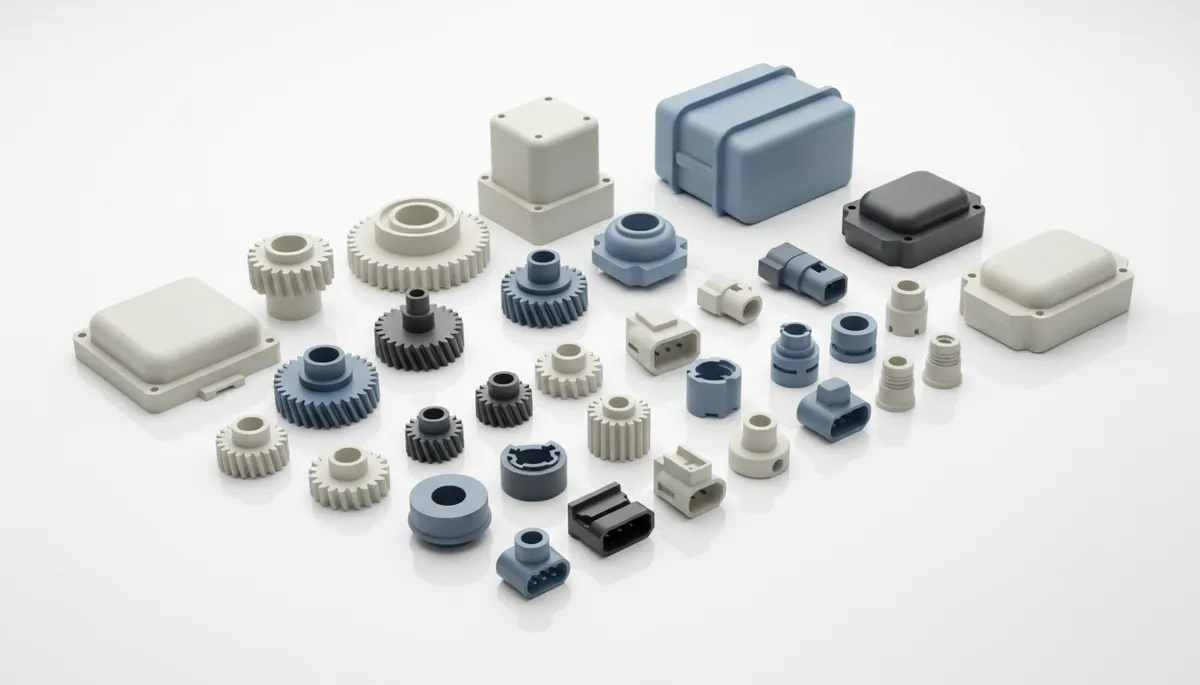
The selection between injection molding and extrusion depends primarily on whether the required part geometry can be represented as a constant cross-section. Parts that combine length with discrete 3D features—like end caps, integrated clips, or mounting bosses—require injection molding regardless of volume or tooling cost comparison.
Frequently Asked Questions About Injection Molding vs. Extrusion
Can the same plastic be used in both injection molding and extrusion?
Yes, the same polymer family works in both processes, but the specific grade usually differs. Extrusion requires higher MFI grades (2–10 g/10 min) for steady die flow at lower pressure. Injection molding uses lower MFI grades (0.5–5 g/10 min) for better packing and mechanical strength. Using the wrong grade in either process causes dimensional problems or processing instability.
Why can’t complex parts be extruded instead of injection molded?
Extrusion produces a constant cross-section — the die opening determines the shape, and that shape must be the same at every point along the part length. Any feature that appears at a discrete location (a boss, a slot, a flange, a hole) cannot be produced by extrusion alone. Secondary machining can add some of these features, but it adds cost, cycle time, and dimensional variability that typically exceeds the tooling savings.
What is the main advantage of extrusion over injection molding?
Tooling cost and throughput for geometrically compatible parts. An extrusion die for a standard profile costs $500–$3,000. An injection mold for a comparable complexity starts at $5,000–$10,000. For high-volume, constant-cross-section parts like pipes, profiles, and sheets, extrusion also runs continuously at 10–200 kg/hour with minimal downtime. These advantages disappear if the part geometry requires a 3D cavity.
What are the tolerance differences between injection molding and extrusion?
Injection molding typically achieves dimensional tolerances of ±0.05–0.15 mm on critical features because the part solidifies inside a fixed-geometry steel cavity under controlled pressure. Extrusion achieves ±0.1–0.5 mm on cross-sectional dimensions under standard conditions, because die swell, cooling rate, and haul-off speed all influence final dimensions after the material exits the open die. For applications requiring assembly precision or sealing interfaces, this tolerance difference usually determines process selection before cost becomes relevant.
When should I choose injection molding over extrusion for a new product?
Choose injection molding when any of these conditions apply: the part has 3D geometry or features that vary along its length; tolerances below ±0.15 mm are required on multiple features; the part needs integrated fasteners, threads, or assembly interfaces; or the program volume and expected life justify the tooling investment. If all of these conditions are absent and the part genuinely has a constant cross-section, extrusion deserves a cost comparison.
How do tooling lead times compare between injection molding and extrusion?
Extrusion tooling lead times are 2–4 weeks for standard profiles. Injection mold lead times range from 3–6 weeks for simple single-cavity tools to 10–16 weeks for complex multi-cavity production molds. The gap is partly offset by the fact that injection molds require less first-article iteration for dimensional stability — the closed cavity gives more repeatable results from the first shot than the open extrusion die, which often requires die adjustment before dimensional targets are met.
Is there a hybrid approach that uses both processes?
Yes. Many product systems use extruded profiles for the continuous-length sections and injection molded parts for the end caps, connectors, brackets, and fittings. Piping systems are the clearest example: extruded pipe body, injection molded elbows and tees. Window and door systems similarly use extruded frame profiles with injection molded corner keys and hardware interfaces. The two processes complement each other when the product system has both continuous and discrete geometry requirements.
Bottom Line: When Should You Choose Injection Molding vs. Extrusion?
Bottom line: The geometry decides first. If the part has a constant cross-section end to end, put extrusion in the cost comparison. If the part has any 3D feature — a boss, a rib, a snap, a shutoff — injection molding is the answer regardless of volume or tooling cost. In practice, most manufactured plastic parts need at least one 3D feature, which is why injection molding is the more common industrial process.
A quick rule: ask whether you could describe the part by extruding a 2D profile. If the honest answer is no — even for one feature — the process is injection molding. If you are comparing manufacturability for a specific part and want a process recommendation from manufacturing experience, review our 射出成形サービス and contact us with the drawing.
-
injection molding process: The complete sequence of melt preparation, injection, packing, cooling, and ejection that converts plastic pellets into finished discrete parts in a closed steel mold cavity. ↩
-
injection molding: A manufacturing process in which molten thermoplastic is injected under pressure into a closed steel mold cavity to produce discrete, dimensionally consistent parts. ↩
-
injection mold: A precision steel tool with a cavity shaped to produce a specific part geometry, through which molten thermoplastic is injected under pressure to form the part. ↩




 EN
EN  ES
ES  FR
FR  DE
DE  PT
PT  AR
AR  RU
RU  JA
JA  KO
KO  IT
IT  NL
NL  TR
TR  PL
PL 