 Vai al contenuto

- Scopri cosa causa macchie scure, segni di bruciatura e punti neri nelle parti stampate a iniezione—degradazione termica, effetto diesel, stampo a iniezioneed parts are caused by three primary mechanisms: material thermal degradation (burn marks), carbonized material from dead zones, and contamination from colorants, release agents, or foreign matter.
- The location of dark spots—at the gate, end-of-fill, along flow lines, or at ejector pins—is the fastest diagnostic indicator of the root cause.
- Excessive melt temperature, excessive residence time in the barrel, and high injection speed are the three most common process-related causes of dark spots.
- Regular purging of the barrel and screw is the single most effective preventive measure for dark spot defects.
- Dead zones in the runner system, gates, or barrel are the primary source of carbonized material that causes recurring dark spot patterns.
What Are Dark Spots on Injection Molded Products and Why Do They Matter?
Dark spots are among the most visible and quality-critical defects in injection-molded plastic products. They manifest as localized areas of discoloration—ranging from yellowish-brown degradation halos to hard black carbonized particles—embedded in or on the part surface. Unlike flow marks or sink marks that affect surface texture, dark spots represent material composition changes that cannot be removed through post-processing.
Understanding dark spots matters for three reasons:
- Aesthetic failure: Dark spots are immediately visible on consumer products, medical devices, and automotive interior components, leading to customer rejections and scrap.
- Structural compromise: Carbonized particles embedded in a part create stress concentrators. Parts with dark spots from degraded material may have 15–30% reduced impact strength at the defect location.
- Process signal: Dark spots indicate that something fundamental is wrong—with temperature control, material handling, machine maintenance, or mold design—that will worsen over time—identifiable through systematic injection molding defect diagnosis1
| Dark Spot Type | Aspetto | Typical Location | Primary Cause |
|---|---|---|---|
| Burn marks | Brown/black scorched area | End-of-fill, trapped air zones | Diesel effect (compressed air ignition) |
| Thermal degradation spots | Yellow-to-brown discoloration | Gate area, thin sections | Excessive melt temperature or residence time |
| Carbonized black particles | Distinct black specks | Scattered or near gate | Dead zones in barrel, screw, or hot runner |
| Colorant contamination | Random color specks | Distributed throughout part | Incompatible masterbatch or cross-contamination |
| Metal contamination | Metallic dark spots | Near gate or random | Screw/barrel wear debris |
Dark spots are always caused by excessive melt temperature alone.Falso
While high melt temperature is a common contributor, dark spots can also result from long residence time at normal temperatures, the diesel effect from trapped air, colorant incompatibility, screw wear, or dead zones in the hot runner system. Correctly diagnosing the type and location of the dark spot before adjusting temperature is essential—reducing temperature alone often fails to solve spots caused by other mechanisms.
How Does Thermal Degradation Cause Dark Spots in Injection Molded Parts?

Thermal degradation is the chemical decomposition of polymer chains when exposed to heat exceeding the material’s stability threshold. For injection molding, the relevant heat sources are: barrel heater zones, shear heat from the screw, and residence time in the hot barrel.
Mechanism of thermal degradation: At elevated temperatures, the polymer’s backbone bonds break (chain scission). The fragments recombine into lower-molecular-weight species that absorb different wavelengths of light, appearing yellow, brown, or black. For ABS, this process produces HCN-related discoloration. For PVC, dehydrochlorination releases HCl and produces conjugated polyene sequences that absorb visible light, turning parts progressively darker.
Critical temperature thresholds:
- ABS: Degradation begins above 270°C; parts typically molded at 210–250°C
- PP: Degradation above 280°C; process temperature 220–250°C
- PC: Degradation above 320°C; process temperature 280–310°C
- PVC: Degradation above 200°C; requires heat stabilizers to extend processing window
- Ridurre la velocità di riempimento negli ultimi 20–30% della corsa
Residence time effect: Even at temperatures within the safe processing range, extended residence time degrades the polymer. This occurs when: the machine is too large for the shot size (partial barrel fill), production is paused without purging, or the screw speed is set too low. The standard guideline is to ensure shot utilization of 40–80% of barrel capacity—shots smaller than 40% of barrel capacity require optimized parametri di stampaggio a iniezione2
Shear-induced degradation: Excessive screw rotation speed or back pressure generates frictional heat that adds to barrel heater temperatures. In thin-walled sections or restricted gates, shear rates can locally spike to levels that degrade even heat-stabilized materials. This produces dark spots specifically at the gate entry or in the thinnest sections of the part.
What Is the Diesel Effect and How Does It Cause Burn Marks?

The “diesel effect” (also called “burn marks from trapped air”) is a phenomenon where air trapped in a mold cavity is compressed by advancing melt and ignites, burning the polymer at the air pocket location. It gets its name from diesel engine combustion, where fuel self-ignites from compression heating alone.
How it happens: As melt fills the cavity, displaced air must escape through vents. If vents are absent, blocked, or undersized at the end-of-fill locations, the air becomes trapped and is progressively compressed. Air temperature under compression can reach 300–500°C—well above the ignition temperature of most polymers. The result is a charred black area precisely at the location where air was last trapped.
Identifying diesel effect burn marks: These marks appear at consistent, predictable locations on every part—typically at the end of fill, at corners, in blind pockets, or at weld line meeting points. The scorching is concentrated at the surface in contact with the trapped air, often with a slightly pitted texture from the combustion event.
Solutions for diesel effect:
- Add or deepen vents at the end-of-fill locations identified by flow simulation or part inspection
- Use vacuum-assisted venting for deep pockets or microstructured surfaces where conventional vents are impractical
- Reduce injection speed in the last 20–30% of fill to allow air more time to escape
- Redesign part geometry to eliminate blind pockets that trap air
- Check and clean existing vents—they clog over time from material outgassing
How Do Dead Zones in the Machine and Hot Runner Cause Dark Spots?

Dead zones are areas in the molding system where polymer flow is stagnant—material collects and remains at elevated temperature without being refreshed by new shots. Over hours or days, this stagnant material degrades and carbonizes into hard black particles that are eventually purged forward into the melt stream and deposited in subsequent parts as dark specks.
Common dead zone locations:
- Screw check ring: Worn or damaged check rings (non-return valves) allow backflow into the screw flights, where material lodges and carbonizes. This produces irregular black speck patterns that worsen as screw wear progresses.
- Barrel transition zones: Sudden diameter changes or improper screw flight geometry create local stagnation zones. Proper screw design for each resin type minimizes this risk.
- Hot runner manifold bends: Sharp 90° bends in hot runner manifolds are classic dead zones. Polymer moving through the main channel creates a stagnant eddy at the bend that degrades over time. Well-designed hot runners use streamlined flow paths with radiused bends.
- Hot runner gate tips: Open-gate hot runner nozzle tips can accumulate degraded material around the orifice perimeter if the gate temperature is too high or the thermal profile is not optimized.
- Adapter connections: Joints between the nozzle, sprue bushing, and manifold are prone to leakage and dead zones if machining tolerances are not maintained.
Addressing dead zones: Systematic purging with a purging compound at the start and end of production runs removes accumulated degraded material before it reaches critical concentration levels. When black speck counts increase over a production run, this is a strong indicator of accumulating dead zone deposits that require a planned purge—an essential aspect of injection mold cooling system3
What Process Parameter Adjustments Eliminate Dark Spots?

Process parameters are the first intervention point when dark spots appear, because they can be adjusted without tooling changes. The following adjustments address the most common parameter-related causes:
| Parametro | Dark Spot Mechanism | Corrective Adjustment | Expected Result |
|---|---|---|---|
| Temperatura di fusione | Thermal degradation | Reduce by 5–10°C increments | Reduce discoloration at gate/thin sections |
| Barrel residence time | Prolonged thermal exposure | Reduce shot size or increase cycle rate | Reduce yellow-brown degradation |
| Velocità di iniezione | Shear degradation / diesel effect | Reduce fill speed in last 20–30% of stroke | La eliminazione sistematica delle macchie scure richiede un'analisi parallela dei parametri termici, della pulizia della macchina, della ventilazione dello stampo e della gestione del materiale—affrontando le cause profonde piuttosto che i sintomi. |
| Contropressione | Shear heat generation | Reduce back pressure setting | Lower overall melt temperature from shear |
| Velocità di rotazione della vite | Frictional heat excess | Reduce to minimum adequate level | Reduce shear-generated heat input |
| Cushion (residual) | Dead zone formation in barrel front | Minimize cushion, purge if excessive | Reduce stagnant material at nozzle |
Step-by-step diagnostic process:
- Identify the dark spot type (burn mark, degradation, black speck, contamination)
- Note the location pattern (consistent end-of-fill = diesel effect; gate area = shear/temperature; random = dead zone/contamination)
- Run a purge cycle with commercial purging compound before adjusting parameters
- Adjust melt temperature downward in 5°C increments; assess each batch
- If no improvement after temperature reduction, investigate dead zones and vent condition
Purging the barrel and screw before a production run reduces dark spot defects significantly.Vero
Commercial purging compounds displace degraded and contaminated material from dead zones in the screw, check ring, and barrel. Starting a production run with a thorough purge—especially when changing materials or colors—removes accumulated carbonized deposits that would otherwise contaminate initial shots. This single practice eliminates the majority of black speck and random dark spot defects in well-maintained machines.
How Do Mold Design and Maintenance Affect Dark Spot Frequency?

Dark spots always indicate contaminated resin and require changing the entire material batch.Falso
Dark spots have multiple causes including degraded regrind, overheating at the nozzle, dead zones in the barrel, and air traps—contaminated resin is only one of many possible root causes.
Purging the barrel and nozzle assembly is a critical first diagnostic step when dark spots appear.Vero
Residual degraded material accumulates in dead zones of the barrel and nozzle; thorough purging with a commercial purging compound removes carbonized deposits that cause recurring dark spots.
While processing parameters address many dark spot causes, mold design and maintenance are critical for preventing defects that cannot be resolved through parameter tuning alone.
Venting design: Adequate venting is the primary mold design factor for preventing diesel-effect burn marks. Vent depth should be 0.02–0.05 mm for most thermoplastics (deep enough to allow air escape but shallow enough to prevent flash). Vent land length should be 1.5–2 mm, with relief behind to atmosphere. In complex parts, vacuum-assisted venting may be required for features that cannot be conventionally vented.
Runner system geometry: Cold runner systems with dead-end branches or inconsistent flow path lengths promote material stagnation and localized overheating. Balanced runner systems with consistent L/D ratios and smooth transitions minimize stagnation. For hot runner systems, specifying streamlined flow paths with radiused corners (radius ≥ tube diameter) at all direction changes eliminates the primary source of dead zone formation.
Gate design: Gates that are too restrictive create high shear rates that locally degrade material. Increasing gate cross-section area by 20–30% often resolves gate-area dark spots without compromising cosmetic appearance at the gate mark.
Mold cleaning and maintenance: Mold vents must be cleaned regularly—outgassed material, mold release residue, and colorant particles accumulate and eventually block vents, triggering diesel effect where previously there was none. A standard schedule of vent cleaning every 50,000–100,000 shots (or after each color change) prevents this progressive deterioration through consistent controllo della temperatura dello stampo a iniezione4
Frequently Asked Questions About Dark Spots on Injection Molded Products
Q: How do I tell the difference between a diesel burn mark and a thermal degradation dark spot?
A: Diesel burn marks appear at precisely consistent locations on every part—specifically where air is trapped (end-of-fill, corners, weld line junctions). They have a charred, often pitted texture at the surface. Thermal degradation spots appear in flow-dependent positions (gate area, thin sections) with a more diffuse yellowish-brown gradation rather than a sharp black boundary. The consistency of location is the primary diagnostic indicator.
Q: Why do dark spots appear only after the machine has been running for several hours?
A: This is a classic indicator of dead zone accumulation. Carbonized material builds up slowly in stagnant zones and is released intermittently in pulses. Early in a production run, the dead zone deposits are minimal; after hours of operation, they reach critical mass and begin contaminating shots. The progressive worsening of dark spot frequency over a production shift is pathognomonic of this mechanism.
Q: Can dark spots come from the masterbatch colorant?
A: Yes. Incompatible masterbatch carriers (the polymer base of the colorant concentrate) can degrade at the processing temperature of the base resin, producing dark specks in the colorant distribution pattern. This is especially common when a colorant designed for one resin family is used with a different base polymer. Always verify that the masterbatch carrier resin is compatible with the base material’s processing temperature range.
Q: How often should I purge the machine to prevent dark spots?
A: The frequency depends on the material and production schedule. For heat-sensitive materials (ABS, PVC, PC), purging is recommended at every startup, every planned shutdown, after any production interruption exceeding 15 minutes, and whenever black speck count increases. For more thermally stable materials (PE, PP), purging at startup and shutdown is typically sufficient unless dark spots appear.
Q: Can dark spots be sanded or polished off the part surface?
A: Only in rare cases where the dark spot is purely a surface deposit (e.g., mold contamination). If the discoloration originates from within the melt (degraded polymer or black specks), it is embedded in or throughout the wall section and cannot be removed by surface treatment. These parts must be rejected.
Q: What is the most effective single action to reduce dark spot frequency in an ongoing production run?
A: A thorough barrel purge with a reactive or mechanical purging compound followed by a temperature setpoint review. This two-step action removes accumulated dead zone deposits and corrects the primary thermal cause simultaneously—addressing the two most common dark spot mechanisms through optimized ABS injection molding5
Summary: A Systematic Approach to Eliminating Dark Spots in Injection Molding
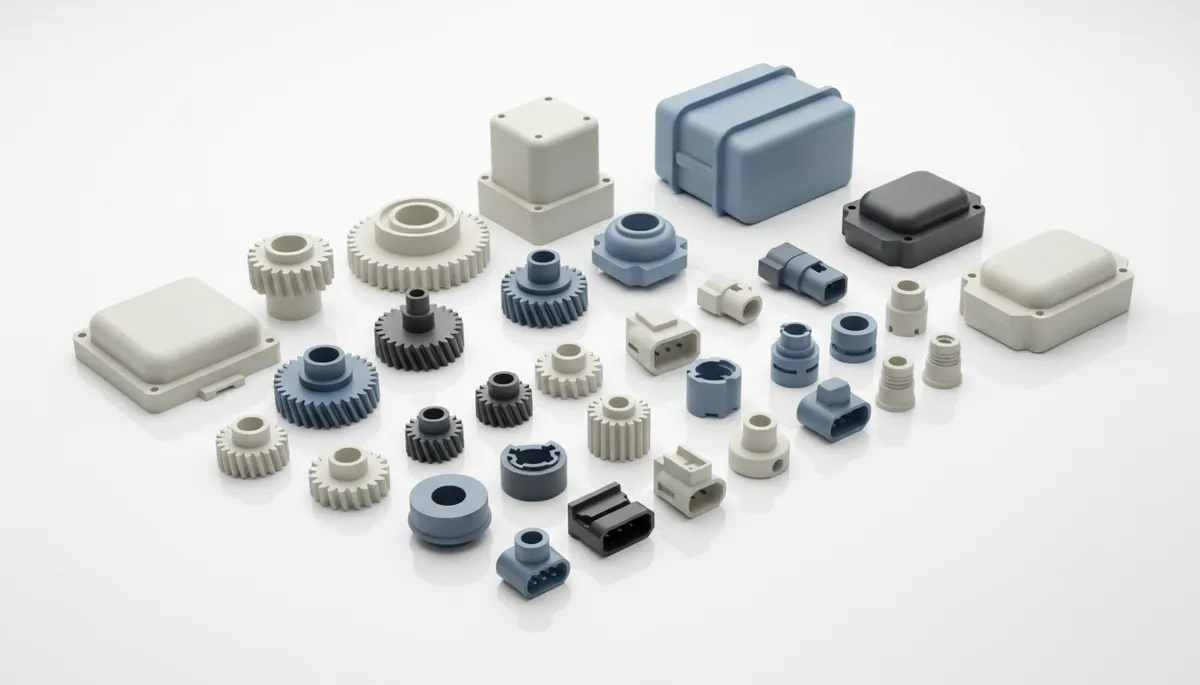
Riepilogo ispezione parti stampate a iniezione di precisione che rappresenta il processo sistematico di eliminazione delle macchie scure
The systematic approach:
- Classify by appearance and location: Sharp, pitted black marks at end-of-fill = diesel effect. Diffuse brown discoloration at gate = thermal degradation. Random black specks worsening over a shift = dead zone accumulation. Color-matched specks = masterbatch issue.
- Purge first: Run a barrel purge before any parameter changes to establish a clean baseline. This eliminates dead zone contamination as a confounding factor.
- Address process parameters: Reduce melt temperature in 5°C steps, check residence time, review back pressure and screw speed.
- Inspect and clean mold vents: Blocked vents are the most common undiagnosed cause of diesel-effect burn marks in mature production tooling.
- Evaluate hot runner system: If dark spots persist despite process and vent corrections, a hot runner flow path inspection and temperature profiling is warranted.
- Review material handling: Check masterbatch compatibility, drying protocol, and regrind contamination as final-layer causes.
-
Systematic diagnosis of injection molding defects using location and appearance classification is the most effective first step before applying any corrective action. ↩
-
Residence time and its contribution to dark spot formation are governed by shot utilization and cycle frequency—key injection molding parameters for heat-sensitive materials. ↩
-
Dead zone formation in the barrel and hot runner system is a primary driver of progressive black speck defects; injection mold cooling system design also helps minimize thermal gradient dead zones. ↩
-
Mold vent cleaning and maintenance schedules are integral to preventing diesel-effect burn marks; precise mold temperature control further reduces outgassing that clogs vents. ↩
-
Purging protocols and process optimization for dark spot prevention align with broader principles of ABS injection molding quality control, where heat sensitivity makes systematic process management especially critical. ↩
Need a Quote for Your Injection Molding Project?
Get competitive pricing, DFM feedback, and production timeline from ZetarMold’s engineering team.
Request a Free Quote → See our Injection Molding Complete Guide for a comprehensive overview. See our Injection Molding Complete Guide for a comprehensive overview.







 EN
EN  ES
ES  FR
FR  DE
DE  PT
PT  AR
AR  RU
RU  JA
JA  KO
KO  IT
IT  NL
NL  TR
TR  PL
PL 