 Ir al contenido

En vehículo eléctrico1 ya no es una curiosidad nicho — es el segmento de mayor crecimiento en la fabricación automotriz global. Pero esto es lo que la mayoría de las personas no percibe: detrás de cada vehículo eléctrico elegante que sale de la línea de ensamblaje, hay cientos de moldeo por inyeccióncomponentes plásticos producidos mediante moldeo por inyección. Desde la envolvente de batería que protege más de 4.000 células de litio hasta los pequeños pines de conector que transmiten corriente de alta tensión, el moldeo por inyección es el caballo de batalla silencioso de la producción de vehículos eléctricos.
Después de dos décadas operando máquinas de moldeo por inyección en Shanghái — desde unidades de banco de 90 toneladas hasta nuestra prensa pesada de 1,850 toneladas — hemos visto cómo la revolución de los VE ha remodelado toda nuestra planta de producción. Este artículo comparte lo que hemos aprendido: los materiales, los desafíos de diseño, las realidades de costos y las estrategias de producción que realmente funcionan cuando se moldean piezas para vehículos eléctricos a gran escala.
- El moldeo por inyección produce más de 200 componentes plásticos únicos por vehículo eléctrico, desde envolventes de batería hasta cubiertas de sensores.
- El PC/ABS retardante a la llama y el nailon con carga de vidrio dominan los componentes estructurales y eléctricos de los vehículos eléctricos.
- Los moldes multicavidad reducen el costo por pieza hasta en un 60% para conectores y clips de vehículos eléctricos de alto volumen.
- El sobremoldeo elimina el ensamblaje secundario para las juntas estancas de los puertos de carga de VE.
- La inversión en herramental para envolventes de baterías de VE típicamente oscila entre $50,000 y $150,000 por molde.
¿Qué Papel Juega el Moldeo por Inyección en la Fabricación de Vehículos Eléctricos?
El moldeo por inyección es la base de la fabricación de componentes para vehículos eléctricos. Un solo vehículo eléctrico contiene más de 200 piezas moldeadas por inyección — y ese número aumenta cada año con cada nuevo modelo, ya que los fabricantes de automóviles sustituyen el metal con polímeros ingenierizados para reducir peso. El proceso destaca aquí porque los componentes de vehículos eléctricos demandan tres cosas simultáneamente: precisión dimensional (a menudo ±0.05 mm para envolventes de módulos de batería), propiedades de aislamiento eléctrico y la capacidad de escalar desde series de prototipo de 500 piezas hasta volúmenes de producción superiores a 500.000 unidades por año.

Considere lo que sucede dentro de un paquete de baterías típico de VE. Cada módulo necesita un marco moldeado con precisión que mantenga las celdas individuales en su lugar mientras permite que pasen los canales de gestión térmica. Estos marcos se moldean por inyección con polipropileno ignífugo o mezclas de PC/ABS que cumplen con UL94 V-0. La tolerancia es ajustada — si el alojamiento de la celda es 0.1 mm demasiado pequeño, la celda no se asentará correctamente; si es 0.1 mm demasiado grande, la vibración durante la conducción causa daños a largo plazo. Este es exactamente el tipo de trabajo de precisión donde material fundido2 cumple consistentemente, con máquinas de moldeo por inyección funcionando 24 horas al día.
Más allá de las baterías, el moldeo por inyección produce carcasas de puertos de carga para vehículos eléctricos, aislantes de conectores de alto voltaje, carcasas de sensores para sistemas ADAS, paneles de revestimiento interior, clips de gestión de cables y conductos de gestión térmica. Cada uno de estos tiene sus propios requisitos de material, limitaciones de espesor de pared y estándares regulatorios que cumplir.
En nuestras propias instalaciones, hemos visto cómo los pedidos relacionados con VE han crecido de aproximadamente el 5% de nuestro programa de producción en 2020 a más del 30% para 2025. El cambio ha sido dramático — y no muestra señales de desaceleración. En nuestra fábrica, nuestros ingenieros verifican los requisitos de los proyectos de VE con certificados de resina, datos de prueba de disparo y registros de inspección antes de aprobar la producción.
¿Qué Componentes de VE se Fabrican por Moldeo por Inyección?
Los componentes de VE fabricados por moldeo por inyección son marcos de baterías, conectores de alta tensión, puertos de carga, sensores y conductos térmicos. La gama de componentes de VE moldeados por inyección sorprende a la mayoría de las personas ajenas a la industria. Aquí hay un desglose práctico de las principales categorías que producimos y lo que hace que cada una sea un desafío:
| Component Category | Example Parts | Material típico | Key Requirement |
|---|---|---|---|
| Sistema de Batería | Bastidores de módulos, separadores de células, envolventes de BMS | PP retardante de llama, PC/ABS | UL94 V-0, estabilidad dimensional a 60°C |
| Electrical Connectors | Conectores de AT, aisladores de barras colectoras, bloques de terminales | PA6-GF15, PBT | CTI > 600V, resistencia al arrastre |
| Sistema de Carga | Carcasas de puertos, glandes para cables, juntas de entrada | PC, sobremoldeo de TPE | Estanqueidad IP67, resistencia a UV |
| Gestión térmica | Colectores de refrigerante, conductos, cubiertas de ventilador | PPS, PA66-GF30 | Resistencia química al refrigerante de glicol |
| Interior y Estructural | Soportes de paneles de puertas, ajustadores de asientos, bastidores de consolas | PP con talco, ABS | Baja deformación, superficie Clase A cuando es visible |
| Sensores y Electrónicos | Cubiertas de radar, soportes de cámaras, envolventes de lidar | PEI (Ultem), LCP | Transparencia al radar, resistencia a altas temperaturas |
Lo que diferencia los componentes de vehículos eléctricos de los plásticos automotrices tradicionales es la dimensión eléctrica. Un automóvil con motor de combustión podría tener un colector de admisión plástico que solo necesita manejar calor y vibración. Pero en un vehículo eléctrico, esa misma área de colector ahora contiene cableado de alta tensión que requiere conectores clasificados para 600V o más, con resistencia al tracking (valores CTI) que previenen el arco eléctrico sobre la superficie del polímero. La selección de material se vuelve mucho más crítica.
Desde el molde de inyección Desde una perspectiva de diseño, los componentes de baterías para vehículos eléctricos son algunas de las herramientas más exigentes que construimos. Un molde para bastidor de módulo de batería podría tener más de 80 elevadores, 12 extracciones de núcleo y requerir diseños de canales de refrigeración que mantengan una temperatura uniforme de pared dentro de 2°C en una pieza de 400 mm de longitud. El costo de la herramienta refleja esta complejidad — pero también lo hace el ahorro por pieza cuando se producen más de 500.000 unidades mediante un molde multicavidad bien diseñado.
¿Por Qué es Crítica la Selección de Materiales para el Moldeo por Inyección de VE?
Material selection is critical because EV plastics must resist flame, insulate, and survive extreme heat. Choose the wrong material for an EV battery component and you are not just dealing with a part failure — you are creating a potential fire hazard due to flammability3. This is not hyperbole. Lithium-ion battery thermal runaway events reach temperatures above 700°C, and the polymers surrounding battery cells must resist flame propagation long enough for safety systems to respond.
Here are the workhorse materials we see most often in EV production, ranked by usage volume:
Flame-retardant PC/ABS blends — The default choice for battery enclosures, BMS housings, and structural components near electrical systems. The PC provides rigidity and heat resistance; the ABS improves processability and impact strength. Together with halogen-free flame retardants, they achieve UL94 V-0 at 1.5 mm wall thickness. The trade-off? They cost 30–50% more than standard grades, and they demand precise melt temperature control (240–270°C) during molding.
Glass-filled nylon (PA6-GF15 to PA66-GF30) — Used for structural brackets, connector housings, and any component carrying mechanical loads in hot environments. The glass fiber content dramatically improves stiffness and creep resistance — essential for parts that hold battery cells under constant compressive load. The catch is that glass-filled nylons are abrasive on molds; expect 15–20% shorter tool life compared to unfilled materials.
“All thermoplastics used in EV battery housings must meet UL94 V-0 flame retardancy rating.”Verdadero
Battery housing materials in EVs are required to achieve UL94 V-0 at the specified wall thickness, meaning they self-extinguish within 10 seconds of flame removal with no flaming drips. This is a mandatory safety threshold, not optional.
“Standard unfilled polypropylene is suitable for high-voltage EV connector insulators.”Falso
Unfilled PP lacks the tracking resistance (Comparative Tracking Index) and creep resistance required for high-voltage applications. Connectors rated above 400V typically require glass-filled nylon (PA6-GF15) or PBT with CTI values exceeding 600V.
Polyphenylene sulfide (PPS) — The go-to material for coolant-contacting components. PPS resists ethylene glycol at temperatures up to 200°C, making it ideal for thermal management manifolds and pump housings. It is also inherently flame-retardant without additives, which simplifies regulatory approval.
TPE and TPU elastomers — Used for seals, gaskets, and overmolded grips on charging handles and port covers. These soft materials provide the IP67 waterproofing that outdoor EV charging demands. Overmolding TPE onto a rigid PC substrate in a two-shot process eliminates the need for separate gasket assembly.
Material selection for EV applications is never just about the polymer properties on a datasheet. You also need to consider: Is the grade approved for automotive use under your customer’s specification? Does it have the required traceability documentation? Can your molder process it consistently on their existing equipment? These practical questions matter as much as the theoretical performance numbers.
¿Cómo Reduce el Moldeo Multicavidad los Costos de los Componentes de VE?
Multi-cavity molding is a cost-reduction method that produces multiple EV parts per cycle to spread tooling investment. The economics of EV injection molding come down to one fundamental question: how many good parts can you get out of a mold per hour? Multi-cavity molding is the answer, and it is where the cost savings really add up at EV production volumes.
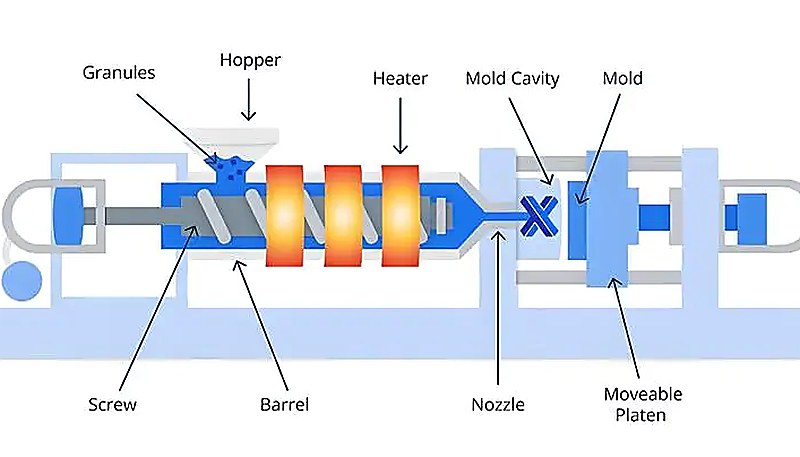
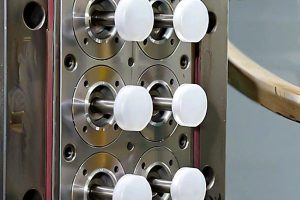
A single-cavity mold for an EV connector housing might produce one part every 20 seconds — that is 180 parts per hour. Switch to an 8-cavity mold on the same press, and you are suddenly at 1,440 parts per hour. The mold costs more (perhaps $40,000 vs. $12,000), but when you amortize that over a production run of 500,000 parts, the per-part tooling cost drops from $0.024 to $0.008. That is a 67% reduction in tooling cost per part. The schematic below shows a detailed operational stage of a typical injection molding machine.
But multi-cavity molding is not a free lunch. Here are the real-world trade-offs we navigate every day:
Balanced fill — Every cavity must fill at the same rate and pressure. If cavity #3 fills 0.3 seconds before cavity #7, you get flash on #3 and a short shot on #7. Achieving balanced fill requires sophisticated runner design and flow simulation (Moldflow analysis) before cutting steel.
Cycle time penalty — Larger molds take longer to cool. An 8-cavity mold might have a 25-second cycle vs. 20 seconds for a single cavity. You still win on throughput (8 parts in 25 seconds vs. 1 in 20 seconds), but the margin is not 8x.
Maintenance costs — More cavities mean more ejector pins, more cooling circuits, and more wear surfaces. Maintenance intervals are shorter, and when a cavity damages, you face a choice: shut down production to repair it, or run the remaining cavities at reduced output while the damaged one is fixed.
In practice, we find that 4- to 8-cavity molds are the sweet spot for most EV connector and bracket components. Battery enclosure molds typically stay at 1+1 (two cavities, left and right halves) because the part size itself fills the machine platen on our larger 1,200–1,850 ton presses.
¿Cuáles son las Reglas Clave de Diseño para las Piezas de VE Moldeadas por Inyección?
Designing injection-molded parts for EVs is a discipline where small decisions have outsized consequences. A 0.5 mm change in wall thickness can shift a battery module frame from passing to failing a thermal cycling test. Here are the design rules that matter most, drawn from our experience with EV programs:
Espesor de pared uniforme — This is rule #1 for a reason. Varying wall thickness causes differential cooling, which causes warpage, which causes assembly failures. For EV battery frames, we target 2.5–3.0 mm uniform walls. If you need local thickness changes for ribs or bosses, transition with a maximum 2:1 ratio and always use fillets.
Draft angles — Minimum 1° per side for polished mold surfaces, 2° for textured surfaces. EV interior components often demand Class A surface finishes, which means deep draw depths with minimal draft. This is where experienced mold design earns its keep — we have seen parts fail because the designer specified 0.5° draft on a 150 mm deep draw with a textured mold.
Gating strategy — For high-voltage insulators, gate location affects both cosmetics and electrical performance. A gate vestige on the sealing surface of a battery housing creates a leak path. Submarine gates or valve gates positioned on non-critical surfaces are essential for EV electrical components.
Material-dependent shrinkage — Glass-filled nylons shrink differently along the flow direction vs. across it (anisotropic shrinkage). PA66-GF30 might shrink 0.3% in-flow and 0.8% cross-flow. If you design the mold using an isotropic shrinkage value, every part will be out of tolerance. Always use material-specific shrinkage data from the resin supplier’s molding guide.
“Injection-molded EV battery housings typically use uniform wall thickness of 2.5–3.0 mm.”Verdadero
Uniform wall thickness in the 2.5–3.0 mm range provides the necessary structural rigidity for battery frames while maintaining reasonable cycle times. Thinner walls risk inadequate strength; thicker walls cause excessive cooling time, sink marks, and internal voids.
“Draft angles of 0.5° are sufficient for any injection-molded EV component.”Falso
While 0.5° might work for shallow, polished surfaces, textured EV interior components with deep draws require 1.5–3° of draft per side. Insufficient draft causes part sticking, surface damage, and inconsistent ejection — all unacceptable in automotive production.
¿Cómo mejora el sobremoldeo la fiabilidad de los componentes de vehículos eléctricos?
Overmolding is a two-shot process that bonds rigid plastic with a soft sealing material in one cycle, eliminating secondary assembly. Overmolding has become essential for EV components because it solves a fundamental problem: how do you create a rigid structural part with a soft, watertight seal without assembling two separate pieces? The answer is you mold both in one shot, and the resulting bond is stronger than any adhesive joint. A dual injection system schematic is shown below.
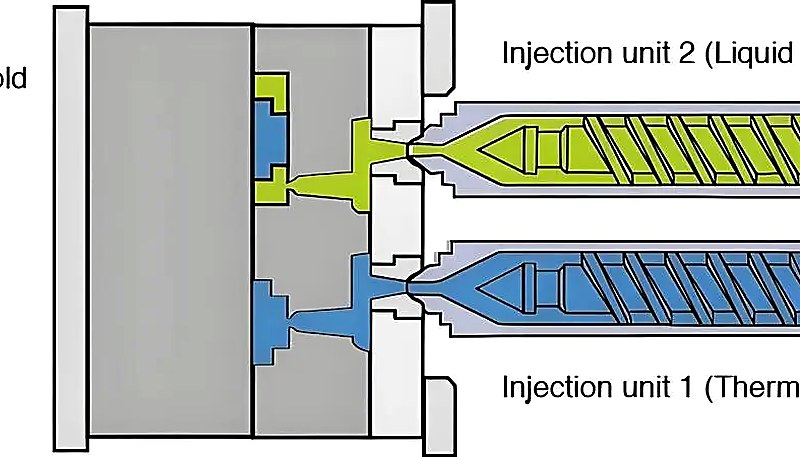
The most common EV overmolding application is the charging port assembly. Here is how it works in practice: the first shot molds a rigid PC housing that provides structural support and mounting features. The mold then rotates 180° on a rotary platen, and the second shot injects a soft TPE compound that fills the grooves around the port opening, creating a compression seal. When the charging cable plugs in, the TPE compresses against the cable connector, achieving IP67 waterproofing without any separate O-ring or gasket.
Other EV overmolding applications include:
High-voltage cable entries — TPE overmolded onto PA6-GF connector bodies to seal cable pass-throughs
Battery cell holders — soft TPU pads overmolded at cell contact points to absorb vibration and thermal expansion
Interior control buttons — rigid PC cores with soft-touch TPU overmold for premium tactile feel
Sensor housings — LCP structural shell with silicone overmold for environmental sealing
The key technical challenge in EV overmolding is material adhesion. Not all polymer combinations bond well. PC and TPE have good chemical affinity — the TPE flows into micro-texture on the PC surface and forms a mechanical interlock plus van der Waals bonding. But if you try to overmold TPE onto PPS, you will get almost zero adhesion without a tie-layer or surface treatment. Material pair selection must be validated with peel testing (typically targeting >2.5 N/mm peel strength for automotive applications) before committing to production tooling.
¿Qué Estándares de Calidad se Aplican a las Piezas de VE Moldeadas por Inyección?
EV injection-molded parts must meet strict automotive, electrical, flammability, and traceability standards simultaneously. EV injection-molded components must clear a higher regulatory bar than most consumer products. The combination of high-voltage electrical systems, thermal management, and crash safety requirements means that multiple standards apply simultaneously. Here are the ones that come up most frequently in our EV production work:
UL94 V-0 flammability — Required for any polymer within 200 mm of battery cells. Testing involves applying a flame to the material specimen twice for 10 seconds each; the material must self-extinguish within 10 seconds after each application, with no flaming drips.
IEC 62660 / UN 38.3 — Battery safety standards that indirectly dictate material selection and part design. Components must withstand thermal cycling from -40°C to +85°C without cracking, warping, or losing dimensional stability.
IATF 16949 — The automotive quality management system standard. Any molder supplying EV components to a major automaker must operate under IATF 16949 certification. This means full traceability from raw material lot to finished part, documented process control plans, and statistical process control (SPC) on critical dimensions. Every key detail — from clamping unit pressure to labeled inspection records — must be verifiable.
ISO 16750 — Road vehicle electrical and electronic equipment environmental conditions. This standard defines the temperature, humidity, vibration, and chemical exposure tests that EV electrical components must survive.
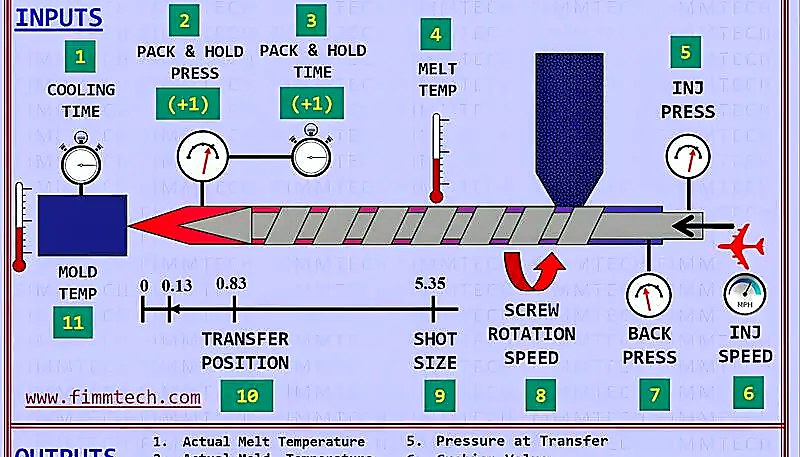
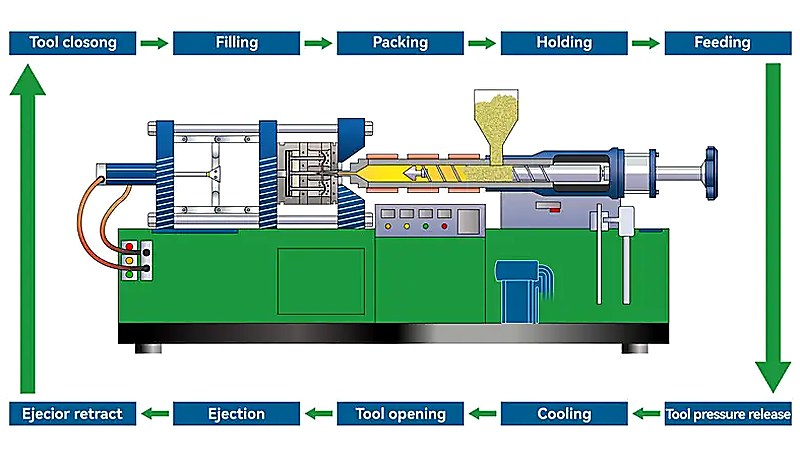
Meeting these standards is not just about passing a one-time lab test. In production, it requires consistent process control: monitoring melt temperature, injection pressure, holding pressure, and cooling time on every single cycle. Our approach is to use cavity pressure sensors that detect any deviation from the validated process window in real time, flagging suspect parts before they leave the machine.
¿Cómo se Escala la Producción de Moldeo por Inyección para los Volúmenes de VE?
Scaling from prototype EV parts to full production volume is where many projects stumble. The injection molding process itself does not change — but everything around it does. Here is how we approach the scaling challenge:
Phase 1: Prototype (100–1,000 parts) — Aluminum prototype molds for design validation. These run on production machines but cost 40–60% less than steel tooling, with shorter mold life of 5,000–10,000 shots.
Phase 2: Pre-production (5,000–50,000 parts) — Bridge tooling in P20 steel. This is where we discover production-level issues: does the part eject consistently? Are there weld lines in critical areas? We typically run 3–5 design iterations at this stage.
Phase 3: Full production (100,000+ parts/year) — Hardened H13 steel molds with optimized cooling, multi-cavity layouts, and full automation integration. At this scale, every second of cycle time matters. Reducing a 22-second cycle to 18 seconds on an 8-cavity mold producing 1.3 million parts per year saves 230 machine hours — roughly $23,000 in machine time at automotive production rates.
The scaling challenge is not purely technical. It is also logistical. When an EV OEM launches a new model, they need parts delivered in sequence, just-in-time, with full traceability documentation for every batch. Our ISO 9001 and IATF 16949 certified quality system handles this through a six-step process: incoming material inspection (IQC), in-process sample checks, process inspection, packaging and assembly inspection, final quality control (FQC), and outgoing quality control (OQC).
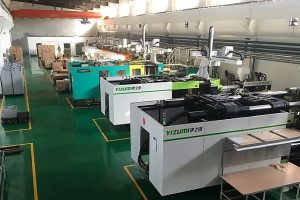
With 47 injection molding machines ranging from 90T to 1,850T, and a monthly mold manufacturing capacity of 100+ sets, we have the infrastructure to support EV programs from first article through full production. Our 120+ production team members — 70% of whom have 10+ years of experience — are the reason we can maintain 99.5% on-time delivery rates on automotive programs.
¿Cuáles son las tendencias emergentes en el moldeo por inyección para vehículos eléctricos?
The EV injection molding landscape is evolving rapidly. Three trends are reshaping how we think about production:
Structural foam molding for battery enclosures — By introducing nitrogen gas or chemical blowing agents into the melt, we can produce battery enclosures with 15–20% weight reduction while maintaining stiffness. The foam core reduces material usage and improves thermal insulation — a double benefit for EV range. The challenge is surface finish: foam-molded parts have visible swirl marks, which limits their use to concealed structural applications.
In-mold electronics (IME) — Integrating printed circuits directly into injection-molded EV interior panels. This eliminates wiring harnesses for functions like capacitive touch switches, LED lighting, and antenna arrays. The molding challenge is temperature: the electronic traces must survive the injection process (typically 220–280°C melt temperature) without degradation.
Sustainable material adoption — EV manufacturers are increasingly specifying recycled-content polymers and bio-based resins for non-critical components. Post-consumer recycled (PCR) PC/ABS at 30% recycled content is now available in UL94 V-0 grades, making it viable for battery brackets and interior trim. The processing window is narrower than virgin material, but the sustainability credential is becoming a proveedor de moldeo por inyección requirement rather than a nice-to-have.
Looking ahead, the convergence of electric autonomous vehicles will drive demand for even more complex injection-molded components. Sensor housings that are transparent to specific radar frequencies, integrated thermal management manifolds with internal channel geometries impossible to machine, and modular battery system components that snap together without fasteners — these are the challenges keeping mold designers busy today.
Preguntas frecuentes
What materials are commonly used for injection-molded EV battery components?
Flame-retardant PC/ABS blends and glass-filled nylon (PA6-GF15 to PA66-GF30) are the most common materials for EV battery components. PC/ABS provides the required UL94 V-0 flame rating with good impact strength, while glass-filled nylon offers superior creep resistance for structural load-bearing applications. PPS is used for components in direct contact with coolant due to its chemical resistance at elevated temperatures. Material selection must also consider automotive-grade approval, full traceability documentation, and whether your molder can process these specialized grades consistently on production-scale runs.
How does injection molding compare to 3D printing for EV prototyping?
3D printing wins for rapid iteration during early design stages, delivering parts in one to three days versus two to four weeks for prototype molds. However, injection molding pulls ahead dramatically at production volumes, with per-part costs dropping to 0.10 to 2.00 versus 5 to 50 for 3D printing, plus superior material properties, surface finish, and dimensional consistency. Most EV programs use both methods strategically: 3D printing for initial design validation and fit checks, then a transition to injection molding for pre-production bridge tooling and full-scale manufacturing.
What tolerances can injection molding achieve for EV parts?
Standard injection molding achieves plus or minus 0.1 mm for dimensions up to 50 mm, which is sufficient for most EV structural and interior components. Precision molding with process-optimized tooling can reach plus or minus 0.05 mm, adequate for battery module cell pockets and high-voltage connector interfaces where dimensional accuracy directly affects assembly quality. Tighter tolerances below 0.05 mm are possible but significantly increase tooling cost and require stricter statistical process control on the production floor. Always specify tolerances based on functional requirements rather than defaulting to the tightest possible.
How long does it take to tool up for an EV injection molding project?
A standard single-cavity prototype mold takes four to six weeks, while a production-class multi-cavity mold with hot runners and cooling optimization typically requires eight to fourteen weeks. Complex tools with side actions, lifters, or two-shot capability can extend to sixteen weeks or more. At our Shanghai factory, we maintain an in-house mold manufacturing facility that supports 100-plus mold sets per month, which helps compress lead times when schedules are tight. Planning tooling timelines early in the design cycle is critical for keeping EV launch schedules on track.
What quality certifications should an EV injection molder have?
At minimum, your molder should hold ISO 9001 for quality management and ISO 14001 for environmental management. For EV-specific requirements, IATF 16949 automotive quality certification is increasingly expected by OEMs and Tier 1 suppliers. ISO 45001 for occupational health and safety demonstrates operational maturity and is often required by European automotive customers. Material-specific certifications such as UL94 flammability ratings for battery components and IPC standards for electronic housings are also essential depending on the application. Always verify that certifications are current and audited by an accredited third-party body before placing production orders.
¿Listo para Comenzar su Proyecto de Moldeo por Inyección para VE?
Finding the right EV injection molding partner is critical for delivering precision, certified quality, and scalable production. At ZetarMold, we bring 20+ years of injection molding experience, 47 machines from 90T to 1,850T, and an 8-engineer team that has delivered hundreds of EV-component molds to global automotive customers.
Whether you need a prototype battery module frame for design validation, multi-cavity production tooling for 500,000+ HV connectors, or two-shot overmolding for IP67-rated charging assemblies, we have the equipment, the expertise, and the certified quality systems to deliver. Our team of 30+ English-speaking project managers ensures clear communication from first RFQ to full production ramp.
Get a free quote for your EV injection molding project → Send your 3D CAD files and material requirements to our engineering team. We typically respond within 24 hours with a preliminary DFM review and cost estimate. See our injection molding supplier sourcing guide if you need to evaluate an EV molding partner before launch.
-
vehículo eléctrico: An electric vehicle is a vehicle that uses one or more electric motors for propulsion, powered by rechargeable battery packs. ↩
-
material fundido: Molten material is defined as a substance heated to a liquid state for injection into a mold cavity in the injection molding process. ↩
-
flammability: Flammability is defined as how easily a material will ignite and burn, measured by standards such as UL 94 vertical burn testing. ↩



 EN
EN  ES
ES  FR
FR  DE
DE  PT
PT  AR
AR  RU
RU  JA
JA  KO
KO  IT
IT  NL
NL  TR
TR  PL
PL 