 İçeriğe geç

Yüksek ön ödeme, en düşük atış başına maliyet enjeksiyon kalıbıing includes tooling, materials, production, quality, logistics, and end-of-life costs — not just the per-part price.
– Tooling investment typically ranges from $3,000 to $100,000+, but a well-designed mold can produce 500,000–1,000,000+ shots, spreading fixed costs over millions of parts.
– Material selection can shift TCO by 15–40%: choosing the right resin grade and eliminating secondary operations reduces both direct and hidden costs.
– DFM (design for manufacturability) analysis during the design phase is the single highest-ROI action — catching one draft angle error early saves $2,000–$15,000 in rework.
What Is Total Cost of Ownership in Injection Molding?
Total cost of ownership (TCO) in injection molding is the full lifecycle cost of producing a plastic part, covering tooling amortization, raw materials, machine time, secondary operations, quality control, logistics, and end-of-life disposal — typically 3–5× higher than the quoted per-part price alone. In our factory, we calculate TCO before quoting any project because the “cheap” option on paper often becomes the most expensive choice after three years of production.
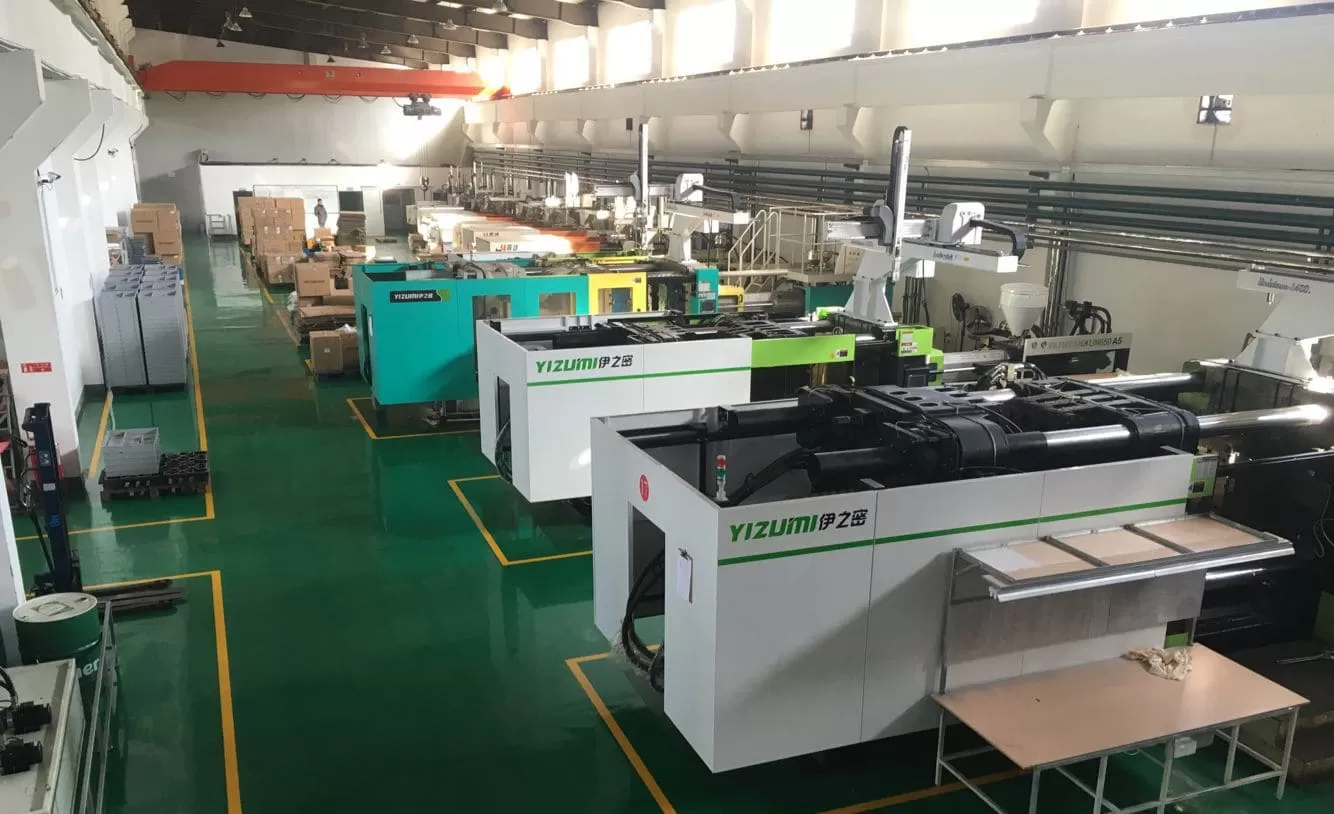
Unlike a simple price-per-piece calculation, TCO forces buyers and engineers to account for every dollar spent from concept to disposal. The injection molding industry often highlights low piece prices — $0.05 per part sounds impressive — but when you factor in a $50,000 mold, six months of ramp-up, and $8,000 in annual maintenance, the actual cost picture shifts dramatically.
A standard TCO framework for injection molding breaks down into six core cost categories:
| Cost Category | Typical Share of TCO | Key Drivers |
|---|---|---|
| Tooling (amortized) | 15–35% | Complexity, steel grade, cavity count |
| Raw materials | 30–50% | Resin type, scrap rate, yield |
| Machine & labor | 20–35% | Cycle time, automation level |
| Quality & scrap | 3–8% | Defect rate, inspection method |
| Logistics & supply chain | 5–12% | Lead time, shipping, tariffs |
| Maintenance & end-of-life | 2–5% | Mold wear, cleaning frequency |
How Does Tooling Cost Affect the Overall TCO?
Tooling cost is the largest fixed investment in injection molding TCO, ranging from $3,000 for simple single-cavity aluminum molds to $150,000+ for multi-cavity hot-runner1 steel tools, and it must be fully amortized across the production lifetime of the mold. In our factory, we’ve seen customers reduce tooling TCO by 40% simply by switching from single-cavity to a 4-cavity layout when annual volumes exceed 200,000 parts.

The amortization math is straightforward but often underestimated. A $40,000 mold producing 500,000 parts adds $0.08 per part to TCO before any other cost is counted. If that same mold is redesigned mid-production due to a missed draft angle, the $15,000 engineering change order plus $6,000 downtime cost wipes out months of savings.
Steel grade selection directly impacts tooling lifecycle and TCO. Here’s how common mold steels compare:
| Çelik Sınıfı | Expected Shots | İçin En İyisi | TCO Impact |
|---|---|---|---|
| Aluminum (7075) | 10,000–50,000 | Prototypes, low volume | Low upfront, high per-shot |
| P20 çelik | 500,000–1,000,000 | Medium-volume production | Balanced investment |
| H13 hardened steel | 1,000,000–2,000,000 | High-volume, abrasive resins | High upfront, lowest per-shot |
| : Güvenlik stoğu olmadan tek kaynaklı reçine tedariki, acil siparişlerde 15–40% oranında hızlandırma ek ücretleri oluşturur | 500,000–1,500,000 | Corrosive resins, medical | 30–50% premium, longer life |
“Investing in hardened H13 steel for high-volume production reduces long-term TCO.”Doğru
For annual volumes above 300,000 parts, H13 hardened steel molds (1–2M shot life) spread the higher upfront cost across far more parts than P20. In our factory, switching to H13 for a 500k/year program reduced the per-part tooling amortization from $0.12 to $0.04 — a 67% reduction in that cost component.
“The cheapest tooling quote always results in the lowest total cost of ownership.”Yanlış
Low-cost molds built from inferior steel or with simplified cooling channel layouts require more frequent maintenance, produce higher scrap rates, and often fail before the designed shot count. We’ve seen $8,000 “budget” molds require $4,000 in repairs within the first 50,000 shots — effectively doubling the real tooling cost compared to a $15,000 quality mold.
What Role Does Material Selection Play in Injection Molding TCO?
Material selection influences 30–50% of total injection molding TCO through direct resin cost ($1–$60/kg depending on grade), processing temperature requirements (affecting cycle time and energy), scrap rate (crystalline polymers2 typically generate 2–5% scrap vs. 1–3% for amorphous resins), and the need for post-processing steps like painting or coating. Choosing a $4/kg ABS grade over a $6/kg PC/ABS blend can appear to save 33%, but if it requires painting to achieve the required surface finish, the secondary operation typically adds $0.30–$1.50 per part.

Material-related TCO decisions go beyond just the resin price per kilogram. In our experience, these are the four most impactful material factors on TCO:
- Drying requirements: Hygroscopic resins (nylon, POM, PC) require 2–8 hours of pre-drying at 80–120°C, adding $0.005–$0.02/kg in energy costs plus the risk of silver streaks if skipped
- Cycle time sensitivity: Semi-crystalline resins like PP and HDPE require controlled cooling to 40–60°C mold temperature for dimensional stability, extending cycle times by 15–30% versus amorphous ABS
- Scrap and regrind rate: High-shrinkage materials (PA66 at 1.5–2.0%) need wider processing windows and produce more out-of-spec parts during startup
- Post-processing elimination: Selecting a self-colored, UV-stable ASA eliminates painting, reducing per-part cost by $0.20–$2.00 for exterior parts
How Do Production and Machine Costs Factor Into TCO?
Production and machine costs account for 20–35% of injection molding TCO, driven primarily by cycle time (every 1-second reduction at $120/hr machine rate saves $0.033 per part), cavity count, automation level, and the number of secondary operations required. In our 47-machine factory, we track machine utilization weekly — idle time above 15% signals either scheduling inefficiency or a design problem inflating cycle times.

Cycle time is the single most controllable variable in production TCO. The formula is: Cycle time = injection time + cooling time + ejection time + mold open/close time. Cooling time represents 50–70% of the total cycle, which is why conformal cooling channels — which follow the mold cavity contour instead of straight-drilled waterlines — can reduce cooling time by 20–40%.
Automation decisions also significantly alter production TCO:
| Automation Level | Setup Cost | Labor Cost/Part | Break-Even Volume |
|---|---|---|---|
| Manual operation | $0 | $0.08–0.25 | <50,000/year |
| Sprue picker robot | $5,000–15,000 | $0.02–0.06 | 100,000–200,000/year |
| 6-axis robot cell | $30,000–80,000 | $0.005–0.015 | 500,000+/year |
Hidden costs — those absent from standard quotes — can inflate injection molding TCO by 20–60%, including engineering change orders ($2,000–$25,000 each), first article inspection delays, mold storage fees ($50–$200/month), tooling transport, incoming quality control, and warranty returns from field failures. We’ve seen projects where the quoted price was $0.18/part but the delivered TCO after accounting for three ECOs, one mold repair, and a 2% field return rate reached $0.31/part.

The most common hidden cost categories we track for customers include:
- Engineering Change Orders (ECOs): Every dimensional revision after mold steel-safe3 sign-off requires either welding and re-machining ($800–$3,000) or a new insert ($2,000–$12,000)
- Mold storage and maintenance: A mold sitting idle for 6 months still needs climate-controlled storage, rust prevention oil changes, and periodic test shots to maintain condition — typically $500–$2,000/year
- Supply chain disruption costs: Single-source resin supply without safety stock creates expedite surcharges of 15–40% on rush orders
- Alıntılanan 38% fiyat farkı, tüm TCO unsurları dahil edildiğinde sadece 8%'ye düşüyor — ve sıkı toleranslı veya sık ECO'lu programlar için, yurtdışı avantajı tamamen ortadan kalkabilir.: UL94, RoHS, FDA, or automotive PPAP certification requirements add $3,000–$15,000 per program up front
- End-of-life disposal: Some thermoplastic blends cannot be recycled economically, adding $0.005–$0.02/kg in waste disposal fees
Warranty and field return costs are particularly severe for high-volume consumer products. At a 2% return rate on 1 million parts with a $4.00 part value plus $8.00 handling cost per return, the warranty liability alone equals $240,000 — equivalent to the entire tooling investment for a complex mold.
How Does DFM Analysis Reduce Total Cost of Ownership?
Design for manufacturability (DFM) analysis reduces injection molding TCO by 15–40% by identifying draft angle deficiencies, wall thickness variations beyond 3:1 ratio, sink mark risks, and undercut complications before steel is cut — when fixes cost $200–$500 in CAD time rather than $5,000–$25,000 in mold rework. In our experience running DFM on over 2,000 parts annually, 73% of submitted designs require at least one modification to meet cost-optimized manufacturing standards.
The DFM checklist items with the highest TCO impact are:
- Wall thickness uniformity: Walls varying by more than 25% of nominal thickness create differential cooling, causing warpage that triggers a 3–8% scrap rate throughout production life
- Draft angles: Insufficient draft (less than 0.5° for textured surfaces, less than 1° for smooth) causes part sticking, increasing cycle time by 5–15 seconds and raising ejection pin maintenance costs
- Gate location: A poorly placed gate location requires higher injection pressure (raising machine tonnage requirements by 10–30%) and increases weld line risk in structural areas
- Rib-to-wall ratio: Ribs thicker than 60% of the wall they support create sink marks requiring cosmetic rejection or post-processing
- Part consolidation: Combining two assembly components into one injection molded part typically saves $0.15–$0.80/assembly in labor and eliminates one set of tooling
“Running DFM analysis before mold construction is the highest-ROI action to reduce injection molding TCO.”Doğru
DFM identifies issues when changes cost CAD time ($200–$500) rather than mold rework ($5,000–$25,000). Our data shows that customers who complete a full DFM review before mold sign-off average 1.2 ECOs per project versus 3.8 ECOs for those who skip it — a 68% reduction in post-tooling change costs.
“DFM only affects aesthetics and surface finish, not production cost.”Yanlış
DFM primarily targets structural and process efficiency — wall thickness uniformity, draft angles, gate location, and parting line position. These choices directly control cycle time, scrap rate, tooling life, and the need for secondary operations. Aesthetic issues (surface texture, color) represent only a fraction of DFM’s total cost impact.
What Are Proven Strategies for Reducing Injection Molding TCO?
Proven TCO reduction strategies in injection molding include multi-cavity tooling for volumes above 150,000 parts/year (reducing per-part tooling cost by 50–75%), family molds for related parts, kalıp akış analizi4 before manufacturing to optimize gate size and cooling layout, resin grade consolidation to improve purchasing leverage, and regional sourcing to reduce logistics costs by 8–15%. We apply these in combination; no single lever moves the needle as much as the combination does.
Here is a prioritized list of TCO reduction actions by typical ROI and implementation timeline:
| Strategy | TCO Reduction | Implementation Time | Volume Threshold |
|---|---|---|---|
| Full DFM review before tooling | 10–25% | 1–2 weeks | Any volume |
| Kalıp akış simülasyonu | 5–15% | 3–7 days | Any volume |
| Multi-cavity tooling upgrade | 30–60% per-part | 6–12 weeks (new tool) | >150k/year |
| Konformal soğutma kanalları | 8–20% cycle time | 4–8 weeks | >200k/year |
| Resin grade consolidation | 3–8% material cost | 1–3 months | >500k/year |
| Automated part removal | 15–30% labor cost | 4–8 weeks | >300k/year |
Mold flow analysis deserves special mention. By simulating filling patterns, pressure distribution, and cooling uniformity before the mold is cut, we typically identify 2–4 design changes per project that prevent $8,000–$30,000 in post-build corrections. The simulation itself costs $500–$2,000 — one of the best returns in manufacturing engineering.
How Do You Calculate and Compare TCO Between Suppliers?
To calculate and compare injection molding TCO between suppliers, build a 5-year cost model that includes: tooling amortization (total tool cost ÷ projected lifetime units), material cost per kilogram × part weight + scrap allowance, machine rate × cycle time, secondary operation costs per piece, logistics (freight + duties + lead time buffer inventory), and a quality risk factor based on the supplier’s historical defect rate (typically 0.5–5% depending on quality system). Using this model, we’ve helped customers switch suppliers and achieve 18–32% TCO reductions despite higher per-part quotes.
A practical 5-year TCO model formula:
TCO (per part) = (Tooling ÷ Lifetime Units) + Material Cost + Machine Cost/part + Secondary Ops + Logistics/part + (Defect Rate × Part Value × Return Cost)
When comparing a domestic vs. overseas supplier, the calculation changes significantly:
| Cost Element | Domestic Supplier | Offshore Supplier |
|---|---|---|
| Per-part quote | $0.45 | $0.28 |
| Freight + duties | $0.02 | $0.08 |
| Safety stock (6-week lead) | $0.01 | $0.05 |
| Quality risk (defect rate diff.) | $0.01 | $0.04 |
| TCO per part | $0.49 | $0.45 |
The quoted 38% price difference shrinks to just 8% when all TCO elements are included — and for programs with tight tolerances or frequent ECOs, the offshore advantage can disappear entirely.
Enjeksiyon Kalıplamada Toplam Sahip Olma Maliyeti | ZetarMold5 settings in the production process also affect long-term costs: incorrect holding pressure causes part warpage or sink marks, increasing scrap rates by 2–6% and adding $0.01–$0.05/part in quality costs that compound over millions of cycles.
Sıkça Sorulan Sorular
What is a typical total cost of ownership for injection molding vs. the quoted price?
TCO is typically 2.5–4× the quoted per-part price when all factors are included. A part quoted at $0.10 often carries a true TCO of $0.25–$0.40 once tooling amortization, quality costs, logistics, and maintenance are included. Projects with complex geometries or frequent design changes can reach 5× the quoted price.
At what production volume does injection molding TCO become competitive?
Injection molding TCO becomes competitive with alternatives (CNC machining, 3D printing) at approximately 5,000–10,000 parts per year for simple geometries, or 20,000–50,000 parts per year for complex parts requiring expensive tooling. Below these thresholds, per-part TCO often favors other manufacturing methods.
How does mold cavity count affect TCO?
Adding cavities reduces per-part cost significantly. A 4-cavity mold running at 30 seconds cycle time produces 480 parts/hour vs. 120 parts/hour for a single-cavity tool — a 75% reduction in machine time per part. The mold itself costs 2.5–3× more than a single-cavity tool but typically pays back within 3–6 months for volumes above 200,000 parts/year.
What is the biggest hidden cost in injection molding TCO?
Engineering change orders (ECOs) are the most costly and unpredictable hidden expense. A single ECO requiring weld repair and re-machining of a cavity costs $3,000–$15,000 plus 2–4 weeks of production delay. Projects with inadequate upfront DFM review average 3–5 ECOs versus 0–2 for well-reviewed designs.
How do I calculate TCO when sourcing from China vs. a local supplier?
Build a model including: per-part quote × annual volume, plus freight (typically $0.05–$0.12/kg for sea freight from China), import duties (0–25% depending on tariff code), safety stock carrying cost (3–5 months of inventory × part value × 15% capital cost), incoming inspection labor, and a risk premium for lead time variability. In most cases, the China cost advantage narrows from 30–50% (quoted) to 5–20% (actual TCO).
Does investing in conformal cooling channels reduce long-term TCO?
Yes. Conformal cooling channels reduce cycle time by 15–40% compared to straight-drilled waterlines by maintaining mold temperature within ±2°C across the cavity surface. For a program running 500,000 parts/year at a 25-second base cycle and $120/hr machine rate, a 5-second cycle reduction saves approximately $8,300/year — paying back a $15,000 conformal cooling investment in under 2 years.
What quality certifications affect injection molding TCO?
ISO 9001 certification reduces incoming inspection costs for buyers by 10–25% by establishing documented quality systems. IATF 16949 (automotive) and ISO 13485 (medical) add $15,000–$50,000 in initial certification costs but unlock higher-margin market segments and reduce customer audit frequency by 60–80%, lowering the total compliance burden over 5 years.
Özet
Total cost of ownership in injection molding demands a systematic view beyond the quoted per-part price. The six cost categories — tooling amortization, materials, machine/labor, quality, logistics, and maintenance — interact to produce a TCO that is typically 2.5–4× the initial price quote. Understanding this framework allows both buyers and manufacturers to make smarter decisions at every stage of product development.
The highest-ROI actions are consistently those taken earliest: a thorough DFM review before mold construction, mold flow analysis to optimize gate and cooling design, and right-sizing the tooling investment to match actual production volumes. In our factory, customers who engage with TCO modeling during the design phase consistently achieve 15–35% lower delivered cost versus those who optimize only at the procurement stage.
For any injection molding program above 50,000 parts/year, we recommend building a formal 5-year TCO model before committing to a supplier or mold specification. The data consistently shows that the lowest-quote option and the lowest-TCO option are the same supplier only about 30% of the time.
-
A hot-runner system is a heated manifold assembly inside an injection mold that keeps the plastic resin molten during transit from the machine nozzle to the gate, eliminating cold-runner scrap and typically reducing cycle time by 10–20% for multi-cavity tools. ↩
-
Crystalline polymers are plastics (such as nylon, POM, PP, and HDPE) with a partially ordered molecular structure that provides sharp melting points, high chemical resistance, and predictable but higher shrinkage rates (1.0–3.0%) compared to amorphous polymers. ↩
-
Steel-safe refers to a mold design practice of cutting cavity dimensions slightly undersized (0.05–0.2 mm) so that if the first sample parts are too small, steel can be safely removed (opened up) rather than requiring costly weld repair to add material back. ↩
-
Mold flow analysis is a computer simulation process using software such as Moldflow or Moldex3D to predict plastic fill behavior, pressure distribution, weld line location, and cooling uniformity inside a mold cavity before physical tooling is manufactured. ↩
-
Holding pressure is the secondary injection pressure applied after the cavity is filled to compensate for volumetric shrinkage as the plastic cools, typically set at 50–80% of peak injection pressure and maintained for 5–30 seconds depending on part wall thickness. ↩



 EN
EN  ES
ES  FR
FR  DE
DE  PT
PT  AR
AR  RU
RU  JA
JA  KO
KO  IT
IT  NL
NL  TR
TR  PL
PL 