

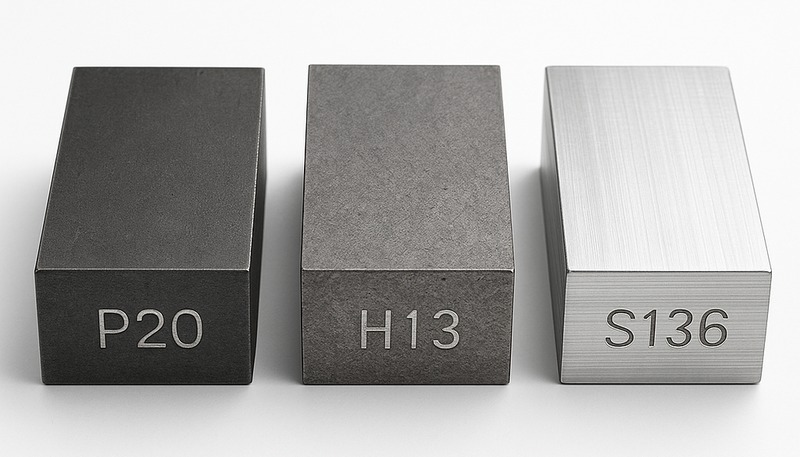
- P20 is the default for low-to-medium volume tooling (under 300,000 shots) and most general-purpose resins—it costs less and machines faster than hardened alternatives.
- H13 is the correct choice when production volumes exceed 500,000 shots, when abrasive or glass-filled resins are involved, or when operating temperatures run above 200°C.
- S136 is required for corrosive resins (PVC, flame retardants), food-contact applications, and optical parts that demand mirror-finish polishability.
- Steel grade choice is a tooling decision made before steel is cut—changing it after first article samples means scrapping or re-machining the tool.
You receive two mold quotes for the same part. One is 40% higher than the other. The supplier says it comes down to steel grade: one quotes P20, the other H13. You need to explain the difference to your engineering team and justify the budget decision—without starting from scratch on materials science. This guide gives you the framework to make that call correctly the first time.
Why Does Mold Material Selection Matter?
Mold material selection determines the tool’s wear life, surface finish capability, corrosion resistance, and total cost of ownership—not just the upfront tooling price. Choosing a lower-grade steel to save money on initial tooling can result in shorter mold life, more frequent maintenance, and surface degradation that forces a rebuild before the production volume is reached. For the full tooling lifecycle context, see our Injection Mold Complete Guide.
The three grades covered here—P20, H13, and S136—represent the majority of production mold steel selections in global injection molding. They differ primarily in hardness, polishability, corrosion resistance, and price. Each is correct for a specific range of applications; the goal is matching the grade to the actual production requirement, not always upgrading for safety margin. For professional mold manufacturing services, see our injection mould offerings.
What Is P20 Best For?
P20 is best for prototype molds, bridge tooling, and production molds expected to run under 300,000 shots with non-abrasive 열가소성 플라스틱1. It ships pre-hardened to 28–34 HRC, which means it can be machined without a post-machining heat treatment step—shorter lead time and lower tooling cost compared to through-hardened grades.
P20 works well with ABS, PP, PE, PS, and other commodity resins that do not contain glass, mineral, or other abrasive fillers. It supports polishing to SPI B2 finish or better for semi-cosmetic parts. Its limitation is wear rate: the lower hardness means that abrasive resins, high cavity pressures, or very long production runs will wear the cavity surface faster than H13 or S136.
Practical selection threshold: if the expected production volume is under 200,000–300,000 shots and the resin is unfilled, P20 almost always provides the best cost-per-part result when total tooling cost amortized over the production run is calculated. Beyond that volume, the cost crossover typically favours hardened steel.
“P20 can be machined without post-heat-treatment, reducing lead time and tooling cost compared to H13.”True
P20 ships pre-hardened to 28–34 HRC, which is within the range that allows standard milling and EDM without a separate hardening cycle. H13 and S136 require heat treatment to full hardness after rough machining, adding 2–4 weeks to the tool build schedule and additional cost for the treatment cycle.
“P20 is suitable for any injection mold application where budget is the primary constraint.”False
P20 is not suitable for molds running glass-filled or mineral-filled resins regardless of budget, because the abrasive wear mechanism will rapidly erode the cavity surface and reduce part quality below specification. For abrasive applications, H13’s higher hardness is a technical requirement, not an optional upgrade.
When Should You Choose H13?
H13 is the correct choice when production volumes exceed 500,000 shots, when processing glass-filled or mineral-filled resins, or when barrel temperatures exceed 200°C as required by engineering resins like PEEK or PPS. H132 is a hot-work tool steel hardened to 44–52 HRC after machining—significantly harder than P20 and more resistant to both abrasive wear and thermal fatigue.
For glass-filled grades of nylon, PBT, PP, or ABS—where the glass content is typically 15–50%—H13 is considered the minimum specification for cavity and core steel. Running glass-filled resins in P20 tooling produces visible cavity wear within 50,000–100,000 shots, manifesting as surface roughness increase, dimensional drift, and flash development at parting lines.
H13 also handles elevated temperature cycling better than P20. For resins processed above 300°C (PEEK, PEI, PPS), the repeated thermal expansion and contraction that occurs through the molding cycle creates fatigue stress in the cavity steel; H13’s thermal fatigue resistance is substantially better than P20 in these operating conditions.
When Is S136 the Better Choice?
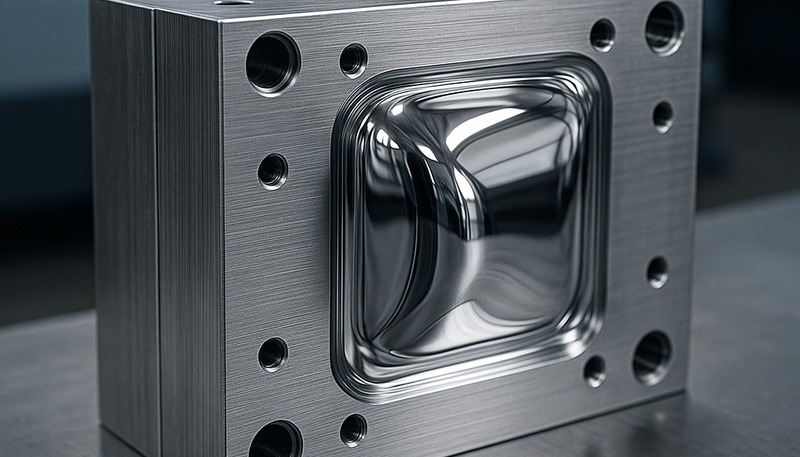
S136 is the correct choice when the resin is corrosive—PVC, flame-retarded grades with halogen additives, or any material that releases acidic gases during processing—or when the application requires mirror-finish optical clarity or food-contact compliance. S136 stainless tool steel3 is a stainless tool steel with chromium content above 13%, hardened to 48–52 HRC after machining.
The corrosion resistance mechanism matters for specification: standard tool steels including H13 will rust in the presence of acidic gases released by PVC or certain flame retardants, producing cavity surface pitting that shows up as surface defects on parts. S136’s stainless composition resists this degradation. For medical and food-contact applications, S136 also complies with cleanliness and chemical inertness requirements that exclude standard carbon and alloy steels.
S136’s polishability to SPI A1 mirror finish is significantly better than P20 or H13. The fine carbide structure of stainless tool steel supports finer polishing without pitting, which is critical for optical lens components, clear housings, or parts where surface finish translates directly to product appearance. For optically critical applications, S136 is not an optional upgrade—it is a technical requirement that H13 cannot match.
“S136 is required for PVC injection molds to prevent corrosion-driven cavity surface degradation.”True
PVC releases hydrochloric acid gas during processing. Standard tool steels including H13 corrode in the presence of this acid, producing cavity surface pitting that translates into part surface defects within relatively few thousand cycles. S136’s stainless composition resists acid corrosion and maintains cavity surface integrity over the production life.
“S136 and H13 can be polished to the same surface finish quality.”False
S136 can be polished to SPI A1 (mirror) finish reliably. H13 typically achieves SPI A2–B1 finish under optimal conditions, but its carbide structure and alloy composition limit final polish quality compared to S136. For optically critical parts, S136 is the only specification that reliably meets SPI A1 requirements.
How Do P20, H13, and S136 Compare?
The table below compares the three grades across the dimensions that drive selection decisions. Use it as a first-pass filter; verify the specific grade specification with your toolmaker for the resin and production volume in your application.
| 속성 | P20 | H13 | S136 |
|---|---|---|---|
| 경도(HRC) | 28–34 (pre-hardened) | 44–52 (post-HT) | 48–52 (post-HT) |
| Typical volume rating | Up to 300,000 shots | 500,000–1,000,000+ shots | 300,000–1,000,000+ shots |
| Abrasive resin suitability | Not recommended | Yes | Yes (with coatings for high abrasion) |
| Corrosive resin suitability | 아니요 | 아니요 | Yes |
| Max polish grade (SPI) | B2–B1 | A2–B1 | A1 (mirror) |
| Food/medical compliance | Limited | Not standard | Yes |
| Relative tooling cost | Lowest | Medium (+20–35%) | High (+40–60%) |
| Lead time impact | Shortest (no HT step) | +2–4 weeks for HT | +2–4 weeks for HT |
A transition note on cost: the table shows relative tooling cost impact, not per-part or amortized cost. A mold that costs 35% more in H13 but runs 3× longer than the same tool in P20 has a lower cost per shot over its lifetime. Steel grade selection should always be evaluated against the expected production volume, not just the initial tooling quote.
How Do Volume and Resin Affect Mold Steel Choice?
Production volume and resin type are the two primary inputs to mold steel selection—they determine which grade is technically adequate and which provides the best amortized cost. Volume thresholds are not hard limits; they are the ranges where the cost crossover typically occurs in practice.
Under 100,000 shots with unfilled resin: P20 almost always wins on total cost. Under 300,000 shots with unfilled resin: P20 remains the standard choice unless surface finish or corrosion resistance requirements point to S136. Over 500,000 shots with any resin: H13 minimum; evaluate S136 if corrosive or optical requirements exist. Any glass-filled or mineral-filled resin at any volume: H13 minimum regardless of volume—the abrasive wear mechanism disqualifies P20 regardless of shot count projection.
How Resin Type Affects Wear Rate by Steel Grade
Resin selection also affects maintenance frequency within the chosen steel grade. Glass-filled nylon running in H13 will wear the cavity surface, but the rate is manageable over the tool’s intended life with proper maintenance scheduling. The same resin in P20 will produce measurable cavity wear within the first 50,000 shots. For the broader process context behind resin-tooling interactions, see our Injection Molding Complete Guide.
At our Shanghai facility, we track steel grade performance across approximately 400 active production tools. Our data shows that 78% of unplanned cavity resurfacing events occur on P20 tools that exceeded their intended volume—typically because production demand grew after the tool was built. When customers provide volume projections, we build in a 30% buffer before making the P20/H13 decision. If the projected volume is within 30% of the P20 threshold for the given resin, we recommend H13 as the more cost-certain choice over the tool’s lifetime.
What Is the Simplest Rule for Choosing Mold Steel?
If you need one decision rule that handles the majority of cases: choose P20 for unfilled resins under 300,000 shots, H13 for anything abrasive or over 500,000 shots, and S136 for corrosive resins or optical/food applications—regardless of volume. The overlap zone (200,000–500,000 shots, unfilled resin) is where a conversation with your toolmaker adds value, because part geometry, maintenance plan, and cavity complexity all affect the crossover point.
If the application sits at a decision boundary, ask your supplier to calculate the cost-per-shot for both grades at the projected volume. The steel upgrade cost divided by the shot count difference between grades often produces a number that makes the decision obvious. For detailed engineering guidance on mold materials, specifications, and design, see our Injection Mold Complete Guide.
If you want a steel grade recommendation for a specific part and production program, contact our tooling engineering team for a mold material review.
Frequently Asked Questions: Which Mold Steel Should I Choose?
What is the difference between P20, H13, and S136 mold steel?
P20 is a pre-hardened steel (28–34 HRC) suited for low-to-medium volume tooling with unfilled resins. H13 is a hot-work tool steel hardened to 44–52 HRC after machining, providing higher wear resistance for abrasive resins and high-volume production. S136 is a stainless tool steel with 13%+ chromium, providing corrosion resistance for corrosive resins and polishability to mirror finish for optical applications.
When should I upgrade from P20 to H13?
Upgrade to H13 when expected production exceeds 300,000–500,000 shots, when the resin contains glass, mineral, or abrasive fillers at any percentage, or when processing temperatures exceed 200°C. The abrasive wear from glass-filled resins makes H13 a technical requirement, not just an optional upgrade—P20 will degrade faster than the tool’s intended production life at any volume with abrasive materials.
Is S136 always more expensive than H13?
S136 steel is typically 15–25% more expensive than H13 by material weight, and the tooling cost premium is usually 40–60% above P20 when machining and heat treatment are included. However, for applications where S136 is technically required—corrosive resins, optical parts, food contact—there is no cost-comparable alternative that meets the technical specification.

Can I use P20 for glass-filled nylon?
No. Glass-filled nylon and other abrasive resins will cause accelerated cavity surface wear in P20 tools, typically producing visible roughness increase within 50,000–100,000 shots. The minimum specification for glass-filled resins is H13 (44–52 HRC). Running glass-filled resins in P20 tooling is not a cost-saving decision; it produces a tool that does not last to its intended volume and requires early replacement or refurbishment.
What determines whether I need S136 vs H13?
S136 is required when the resin releases corrosive gases during processing (PVC, halogenated flame retardants), when the application requires food-contact or medical-grade compliance, or when the surface finish specification requires SPI A1 mirror finish. For all other high-volume applications with non-corrosive resins and semi-cosmetic finish requirements, H13 is the appropriate choice.
How does steel grade affect mold lead time?
P20 ships pre-hardened and requires no post-machining heat treatment, which keeps lead times shorter. H13 and S136 both require hardening after rough machining—typically 2–4 weeks added to the tool build schedule. This lead time difference is a real consideration for urgent programs, but it should not drive a steel selection that results in a tool with insufficient wear life for the production volume.
Sources
- ASM International. Tool Steels, 5th ed. (1998). P-series pre-hardened steel specifications (P20: 28–34 HRC); H-series hot-work tool steel compositions.
- SPI (Society of the Plastics Industry). Mold Technology Guide. Production volume thresholds and resin type guidelines for P20, H13, and stainless tool steel selection.
- Machinery’s Handbook, 31st ed. Injection mold materials section: relative tooling cost premiums (+20–35% for H13, +40–60% for S136 vs. P20) and heat treatment lead time estimates (2–4 weeks).
-
thermoplastics: Thermoplastics are polymers that soften when heated and harden when cooled, allowing repeated processing cycles without chemical change—the material class that injection molding is primarily designed to process. ↩
-
H13 hot-work tool steel: H13 is a chromium-molybdenum-vanadium hot-work tool steel standardized to AISI H13, designed for applications involving cyclic heating and cooling. Its alloy composition provides thermal fatigue resistance and hardness (44–52 HRC when through-hardened) that makes it suitable for high-temperature resin processing and abrasive fill applications. ↩
-
S136 stainless tool steel: S136 is a martensitic stainless tool steel with chromium content above 13%, providing corrosion resistance to acidic and oxidizing environments. It can be hardened to 48–52 HRC and polished to SPI A1 mirror finish, making it the standard choice for corrosive resin applications, optical parts, and food-contact tooling. ↩



 EN
EN  ES
ES  FR
FR  DE
DE  PT
PT  AR
AR  RU
RU  JA
JA  KO
KO  IT
IT  NL
NL  TR
TR  PL
PL 