 Skip to content

POM (polyoxymethylene) — also called acetal or Delrin — is one of the most reliable engineering plastics for precision parts. It machines beautifully, snaps together without breaking, and holds tolerances that would make most polymers jealous. If you’re designing gears, fasteners, or any mechanical component that needs to slide, snap, or bear load, POM deserves a hard look.
- POM offers exceptional dimensional stability and low friction for precision mechanical parts.
- Processing temperature window is narrow: 190–210 °C melt, 80–120 °C mold.
- Homopolymer (Delrin) is stronger; copolymer (Celcon/Ultraform) handles chemicals better.
- Post-mold shrinkage is ~2.0–2.5%, so mold design must compensate upfront.
- Dry POM before molding (80 °C, 2–4 h) even though it absorbs little moisture.
What Is POM and Why Is It a Go-To Material for Precision Parts?
POM, short for polyoxymethylene, is a semi-crystalline thermoplastic with a repeating –CH₂O– backbone. That simple molecular structure gives POM its standout properties: high stiffness, excellent fatigue resistance, and a remarkably low coefficient of friction. In plain terms, it’s the plastic that behaves most like metal when you need things to move, snap, or carry a load.
You’ll find POM in fuel systems, door lock mechanisms, conveyor belt links, and medical inhalers — anywhere a part needs to slide, flex, or stay dimensionally stable under stress. Two main families exist: homopolymer (think Delrin) and copolymer (Celcon, BASF Ultraform). They share a lot of DNA but diverge in ways that matter when you’re choosing one for a specific project.
At ZetarMold, we run POM regularly across our 45 injection molding machines (90T–1850T). Over 20+ years of production, POM has proven itself as one of the most consistent materials on our floor — provided you respect its processing window, which is narrower than most people expect.
Our Shanghai facility processes 400+ materials, and POM ranks in the top 15 by volume. We see it most often in automotive snap-fits, gear assemblies, and valve bodies. The 8 senior engineers on our team have documented processing parameters for dozens of POM grades from suppliers like DuPont, Celanese, and Asahi Kasei.
What Are the Key Properties of POM Materials?
POM’s property profile reads like a wishlist for mechanical design engineers. Here’s what matters most when you’re deciding whether POM fits your application.
| Property | Homopolymer (POM-H) | Copolymer (POM-C) |
|---|---|---|
| Tensile Strength | 68–72 MPa | 62–70 MPa |
| Flexural Modulus | 2,800–3,200 MPa | 2,500–2,800 MPa |
| Elongation at Break | 15–40% | 20–45% |
| Melting Point | 175 °C | 165 °C |
| Heat Deflection Temp (0.45 MPa) | 170 °C | 158 °C |
| Coefficient of Friction | 0.1–0.3 | 0.15–0.35 |
| Water Absorption (24h) | 0.20% | 0.22% |
| Shrinkage | 1.8–2.3% | 2.0–2.5% |
The numbers tell the story. Homopolymer is the strength champion — higher tensile strength, higher stiffness, better creep resistance. If your part needs to bear a continuous load (like a gear tooth), POM-H is usually the better pick. Copolymer trades a bit of strength for superior chemical resistance, especially against alkalis and hot water. It also handles thermal cycling better, which matters for under-hood automotive applications.
One property that catches engineers off guard: POM’s low moisture absorption. At roughly 0.2%, it’s dramatically lower than nylon 6 (which can hit 1.6%). This means POM parts maintain their dimensions in humid environments — a critical advantage for fuel system components and medical devices that undergo sterilization.
What Are the Optimal Processing Conditions for POM Injection Molding?
POM is forgiving in some ways and unforgiving in others. Get the parameters right, and it flows like a dream. Get them wrong, and you’ll see flash, voids, or degradation that smells like formaldehyde — because that’s literally what’s happening at the molecular level.
Here’s a practical processing window drawn from production data across hundreds of POM runs:
| Parameter | Recommended Range | Notes |
|---|---|---|
| Melt Temperature | 190–210 °C | Do not exceed 220 °C — degradation starts above this |
| Mold Temperature | 80–120 °C | Higher mold temp improves crystallinity and surface finish |
| Injection Pressure | 80–140 MPa | Higher pressures reduce shrinkage variation |
| Holding Pressure | 50–80 MPa | 60–70% of injection pressure is typical |
| Holding Time | 8–20 s | Depends on wall thickness; gate freeze-off determines end point |
| Screw Speed | 50–120 rpm | Moderate speed avoids shear overheating |
| Back Pressure | 0.5–1.5 MPa | Low back pressure is fine — POM melts easily |
| Drying (if needed) | 80 °C, 2–4 h | POM is low-hygroscopic but surface moisture can cause splay |
The biggest mistake we see: running POM too hot. Yes, a higher melt temperature improves flow, but POM degrades fast above 220 °C. Unlike PP or PE, which can tolerate a wide temperature band, POM has a relatively narrow processing window. The difference between a good part and a degraded, smelly part can be just 10–15 °C.
At ZetarMold, our standard operating procedure for POM includes a 30-minute purge with PP or PE before shutdown to prevent formaldehyde buildup in the barrel. Our 120+ production staff are trained to monitor for the characteristic acrid smell that signals thermal degradation — it’s a built-in early warning system.
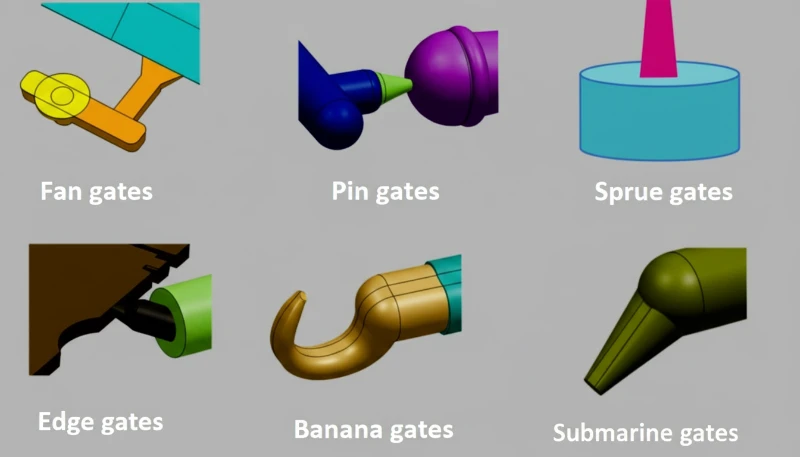
Another critical parameter that engineers frequently overlook is the screw design. POM processes best with a gradual-transition screw with an L/D ratio of 18:1 to 20:1. A general-purpose screw with a short compression zone can cause uneven melting, leading to surging and inconsistent part weight. If you are running POM on a machine with a nylon-optimized screw, expect more process variation.
Cooling time is the dominant factor in POM cycle time. Because POM is a semi-crystalline material, the part needs sufficient time in the mold to crystallize properly before ejection. Premature ejection leads to post-mold warpage as crystallization continues outside the mold. A good rule of thumb: cooling time in seconds equals 2 to 3 times the maximum wall thickness in millimeters. For a 2 mm wall, that is 4 to 6 seconds of cooling.
How Does POM Homopolymer Differ from Copolymer in Practice?
The homopolymer vs. copolymer decision isn’t academic — it directly affects your part performance, processing window, and even mold design. Here’s how we think about it in practice.
POM-H (Homopolymer) delivers ~10% higher tensile strength and stiffness. It’s the obvious choice for gears, clips, and load-bearing snap-fits where every MPa counts. The trade-off? It’s more sensitive to strong acids and oxidizing agents. If your part will see continuous exposure to aggressive chemicals, POM-H may embrittle over time.
POM-C (Copolymer) sacrifices a bit of mechanical performance for broader chemical compatibility and a wider processing window. It handles hot water, alkalis, and most solvents better than POM-H. In our experience, POM-C is the safer bet when you’re not sure about the chemical environment — think plumbing fittings, valve bodies, and fuel system components.
From a mold design perspective, POM-C’s slightly higher shrinkage (2.0–2.5% vs. 1.8–2.3%) means you need marginally more compensation in the injection mold steel. Both materials benefit from generous radii and uniform wall thickness — sharp corners are crack initiation sites in any semi-crystalline polymer.
Cost is another factor. POM-H grades (especially Delrin) tend to carry a 5–15% premium over comparable POM-C grades. For high-volume automotive parts where the material bill can run into millions, that difference adds up fast. We’ve helped many clients switch from POM-H to POM-C without any functional difference in the final part — it’s worth testing both before committing.
“POM copolymer has better resistance to hot water and alkalis than homopolymer.”True
The additional –CH₂– units in the copolymer backbone interrupt the crystalline regions slightly, reducing susceptibility to chemical attack in aggressive environments. This is well-documented in Celanese and BASF technical data sheets.
“POM parts don’t need drying before molding because the material absorbs almost no moisture.”False
While POM’s moisture absorption is indeed very low (~0.2%), surface moisture from storage in humid conditions can cause splay marks. A 2–4 hour dry at 80 °C is standard practice before molding.
What Are Common Defects in POM Injection Molding and How to Prevent Them?
POM is a reliable material when processed correctly, but it has its own failure modes. Here are the defects we encounter most often — and the fixes that actually work.
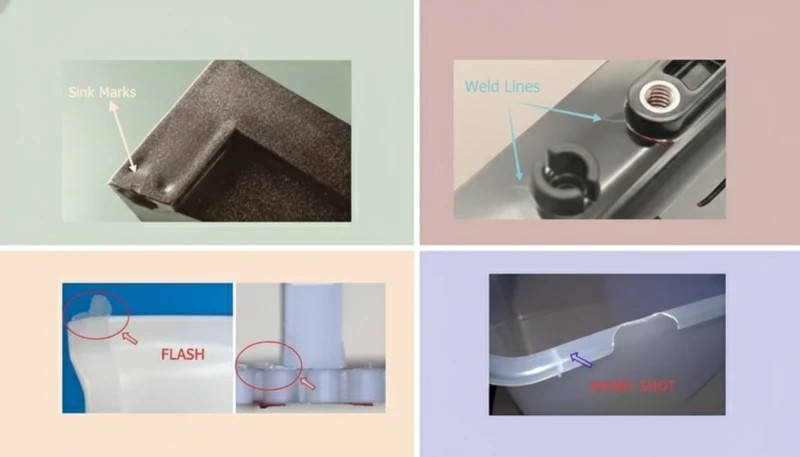
Flash is the #1 issue with POM. Because POM has low melt viscosity and flows easily, it can seep into parting lines, ejector pin holes, and slide interfaces. The fix isn’t always obvious: increasing clamp force helps, but often the real solution is lowering injection speed during the fill phase and ensuring mold venting is adequate. If you’re running POM on a machine with marginal clamp tonnage, flash is almost guaranteed.
Splay or silver streaks on the part surface usually mean moisture or degraded material. Even though POM absorbs very little water, surface condensation in humid storage conditions can cause splay. A quick 2–4 hour dry at 80 °C before molding eliminates this. If drying doesn’t fix it, you’re likely seeing thermal degradation — reduce melt temperature by 5–10 °C.
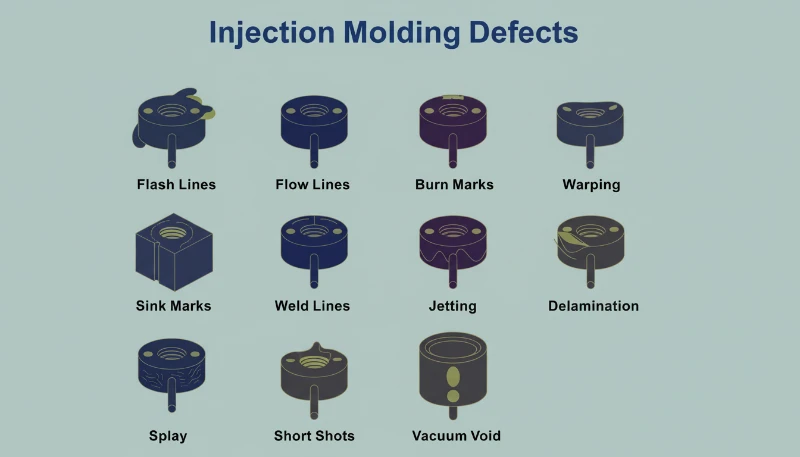
Voids and sink marks appear in thick sections where the material shrinks before the gate freezes. POM’s crystallinity-driven shrinkage is significant (around 2%), so uniform wall thickness is critical. If you can’t avoid a thick section, increase holding pressure and time, and run a warmer mold to slow crystallization at the surface.
Warping in POM parts is another common issue, particularly in flat, thin-walled designs. The root cause is usually differential shrinkage between the flow direction and the transverse direction. This anisotropic shrinkage is more pronounced in glass-reinforced POM grades. Mold design solutions include balanced gate placement, uniform cooling channels, and sometimes a slight convex crown in the cavity to compensate for the expected warpage direction.
In our production experience, the most cost-effective way to reduce POM defects is investing time in proper mold design upfront. A well-designed mold with adequate venting, balanced cooling, and properly sized gates will run reliably for hundreds of thousands of cycles. Skimping on mold quality and trying to compensate with processing adjustments is a losing game with POM, because the processing window simply is not wide enough to compensate for a marginal mold.
What Design Guidelines Should Engineers Follow for POM Parts?
Good POM part design follows the same principles as other semi-crystalline materials, with a few POM-specific considerations that can make or break your project.
Wall thickness: Aim for 1.0–3.0 mm. POM flows well, so you don’t need especially thin walls to fill the cavity, but thick sections above 4 mm will show shrinkage problems. Transition between thicknesses gradually — step changes should use 1:2 tapers minimum.
Radii: Every internal corner needs a radius of at least 0.5 mm, ideally 0.8× wall thickness. POM is notch-sensitive — a sharp internal corner concentrates stress and becomes a crack initiation site under cyclic loading. This matters enormously for snap-fits and living hinges.
Draft angle: 0.5–1.0° per side is the minimum for POM, but 1.5–2.0° will save you a lot of grief with ejection. POM’s low friction helps here, but textured surfaces still need more draft. If you’re using a mold finish of SPI B or coarser, go with at least 1.5°.
Snap-fit design: This is where POM truly shines. Its fatigue resistance (10⁷ cycles at 40 MPa for POM-H) and high resilience make it ideal for cantilever snap-fits. The key is keeping the strain below 5% for POM-H or 7% for POM-C during assembly. Use a tapered beam profile to distribute strain evenly along the length.
Thread inserts and metal inserts are commonly overmolded into POM parts for assembly purposes. The key consideration is insert design: knurled or grooved inserts provide the mechanical interlock that POM needs, since its low surface energy means adhesives alone will not hold reliably. Preheat metal inserts to 100 to 120 degrees Celsius before molding to reduce thermal shock and improve the bond between the insert and the POM substrate.
Surface finish options for POM parts deserve attention during the design phase. POM accepts a wide range of finishes from high-gloss (SPI A-2) to heavy texture (SPI D-2). However, highly polished mold surfaces can cause ejection problems because POM tends to stick to smooth steel. A vapor-honed or light-bead-blast finish on the cavity surface often gives the best combination of appearance and release characteristics. Texturing also hides minor flow lines and gate blush that would be visible on a glossy surface.
Thread inserts and metal inserts are commonly overmolded into POM parts for assembly purposes. The key consideration is insert design: knurled or grooved inserts provide the mechanical interlock that POM needs, since its low surface energy means adhesives alone will not hold reliably. Preheat metal inserts to 100 to 120 degrees Celsius before molding to reduce thermal shock and improve the bond between the insert and the POM substrate. In practice, we see the best results with brass inserts that have a minimum embedment depth of 1.5 times the insert diameter.
“POM can endure over 10 million flex cycles at moderate stress levels, making it ideal for snap-fit and living hinge applications.”True
POM-H grades exhibit fatigue endurance limits around 35–40 MPa at 10⁷ cycles. This exceptional fatigue life is why POM is the material of choice for automotive door lock mechanisms and conveyor chain links that cycle millions of times.
“POM cannot be used in food-contact applications because it contains formaldehyde.”False
While POM does release formaldehyde during thermal degradation, properly processed POM is stable and several grades are FDA-compliant for food contact. Celanese Celcon and DuPont Delrin both offer FDA-compliant grades widely used in food processing equipment.
What Are the Best Applications for POM Injection Molded Parts?
POM’s unique combination of stiffness, low friction, dimensional stability, and fatigue resistance makes it the default choice in several industries. Here’s where we see it most often on our production floor.
Automotive: Fuel system components (fuel caps, sender units, valve bodies), door lock mechanisms, window regulator gears, seat belt components. POM-C dominates here because of its superior fuel and chemical resistance. Production volumes are typically in the hundreds of thousands.
Industrial machinery: Conveyor chain links, gear wheels, bearings, bushings, and valve components. POM’s low friction eliminates the need for external lubrication in many applications. Gear teeth cut from POM run quieter than metal and don’t require grease.
Consumer products: Zippers, pen mechanisms, watch movements, sprinkler heads, and food processor components. POM is FDA-compliant in several grades, opening the door to food-contact applications.
Medical devices: Inhaler components, insulin pen mechanisms, surgical instrument handles. POM’s dimensional stability under sterilization (ethylene oxide gas or radiation) and low moisture absorption make it reliable in precision medical assemblies.

Why Choose ZetarMold for POM Injection Molding Projects?
Processing POM well requires experience — it’s not a material you want to learn on the job. ZetarMold has been molding POM parts since 2005, and our Shanghai facility is set up to handle everything from prototype runs to million-piece production volumes.
Our 45 injection molding machines (90T–1850T) cover the full range of POM part sizes. With in-house mold manufacturing (100+ sets per month), we control the entire process from tool design through production. Our 8 senior engineers each bring 10+ years of experience, and our ISO 9001 / 13485 / 14001 / 45001 certifications reflect the quality systems we’ve built over two decades.
For POM specifically, we maintain documented processing parameters for over 30 POM grades across six major suppliers. Our 6-step quality control process — from incoming inspection through outgoing verification — catches defects before they reach your assembly line. And with 30+ fluent English speakers on staff, communication is never a bottleneck.
Whether you need a single-cavity prototype mold for fit testing or a 16-cavity production mold running 24/7, we’ve done it before with POM. Get Your POM Molding Quote and let’s talk about your project.
Frequently Asked Questions About POM Injection Molding
Does POM need to be dried before injection molding?
Yes, POM should be dried before injection molding even though the material has very low moisture absorption at approximately 0.2 percent. The reason is that surface condensation can accumulate on pellet surfaces during storage in humid warehouse environments, and this surface moisture causes splay marks or silver streaks on the finished part surface. Standard practice is to dry POM at 80 degrees Celsius for 2 to 4 hours using a dehumidifying hopper dryer. This is a relatively short drying cycle compared to hygroscopic materials like nylon or polycarbonate, which typically require 4 to 6 hours or more.
What is the maximum melt temperature for POM injection molding?
The maximum recommended melt temperature for POM injection molding is 220 degrees Celsius. Above this temperature, POM begins to undergo thermal degradation, breaking down its molecular chains and releasing formaldehyde gas — which is both a health hazard and a clear signal that your material is being damaged. The optimal processing range is 190 to 210 degrees Celsius, which provides excellent flow characteristics while maintaining the material properties. Unlike polypropylene or polyethylene, which tolerate a wider temperature band, POM has a relatively narrow processing window. If you need better flow, consider adjusting injection speed or mold temperature rather than pushing melt temperature higher.
Can POM be used for snap-fit designs?
Yes, POM is one of the best engineering plastics available for snap-fit designs. Its exceptional fatigue resistance allows it to endure over 10 million flex cycles at moderate stress levels, which is why it is the dominant material choice for automotive door clips, consumer electronics enclosures, and medical device housings that require repeated assembly and disassembly. For optimal snap-fit performance with POM, keep the assembly strain below 5 percent for homopolymer grades and below 7 percent for copolymer grades. A tapered beam profile distributes strain more evenly along the cantilever length and significantly improves the snap-fit cycle life compared to a uniform cross-section design.
What is the typical shrinkage rate for POM injection molding?
POM homopolymer typically shrinks between 1.8 and 2.3 percent, while POM copolymer shrinks slightly more at 2.0 to 2.5 percent. This shrinkage is primarily driven by the crystallization process that occurs as the molten polymer cools and solidifies in the mold cavity. Several processing parameters affect the actual shrinkage value, including mold temperature (higher mold temperatures increase crystallinity and thus shrinkage), holding pressure and time (adequate packing reduces shrinkage variation), and wall thickness (thicker sections tend to shrink more). Mold designers must account for this shrinkage during tool construction, typically by scaling cavity dimensions accordingly. It is also important to note that shrinkage can be anisotropic in glass-filled POM grades.
What is the practical difference between POM-H and POM-C for injection molding?
POM-H (homopolymer, such as DuPont Delrin) offers approximately 10 percent higher tensile strength and flexural modulus compared to POM-C (copolymer, such as Celanese Celcon or BASF Ultraform). This makes homopolymer the preferred choice for heavily loaded mechanical components like gears and structural clips. However, POM-C provides significantly better resistance to strong alkalis, hot water, and many solvents. From a processing standpoint, POM-C has a slightly wider processing window and is more forgiving of temperature variations during molding. In terms of cost, POM-H grades typically carry a 5 to 15 percent premium over comparable POM-C grades. For most general-purpose applications, both materials perform well and the choice often comes down to the specific chemical and thermal environment the part will encounter.
Can POM injection molded parts be sterilized for medical applications?
Yes, POM parts can be sterilized using ethylene oxide gas sterilization and gamma radiation at standard medical device sterilization doses. These methods are compatible with POM because the material maintains its mechanical properties at the temperatures and radiation levels involved. However, POM is not suitable for autoclave or steam sterilization at 121 degrees Celsius, as this temperature exceeds the heat deflection temperature of the material (approximately 158 to 170 degrees Celsius depending on grade) and would cause permanent deformation. For medical device applications requiring repeated sterilization cycles, POM-C grades are generally preferred due to their slightly better thermal stability. Always verify sterilization compatibility with the specific POM grade supplier before qualifying a material for a medical device.





 EN
EN  ES
ES  FR
FR  DE
DE  PT
PT  AR
AR  RU
RU  JA
JA  KO
KO  IT
IT  NL
NL  TR
TR  PL
PL 