

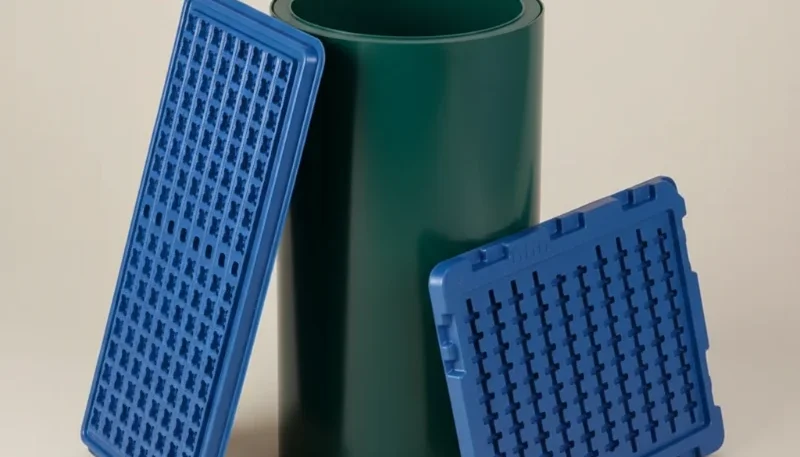
- PP is the world’s second most-produced plastic, valued for low cost, chemical resistance, and fatigue resistance—but high shrinkage (1.0–2.5%) makes warpage the primary processing challenge.
- Process at 200–270°C melt temperature with 40–80°C mold temperature; use uniform wall thickness (2–3 mm recommended) to minimize differential cooling.
- PP is not suitable above 100°C continuous use, high-gloss cosmetic parts, or applications requiring strong adhesion. Use PC, nylon, or ABS for those cases.
- Gate and cooling design matter more with PP than most commodity resins—mistakes here cause weld line failure and warpage that is difficult to correct after steel is cut.
“PP’s living hinge capability allows millions of flex cycles without failure—a unique property among commodity plastics.”True
PP living hinges survive 10–100 million flex cycles when properly designed (0.25–0.5 mm thickness, oriented perpendicular to flow). This property is exploited in snap-close containers, cosmetic caps, and tool cases. No other commodity thermoplastic offers equivalent hinge performance at comparable cost.
“PP can be used for continuous-use applications up to 130°C without modification.”False
Unfilled PP has HDT of 95–105°C at 0.45 MPa load. Continuous use above 90°C causes creep and dimensional instability. Glass-filled PP extends this range to 130–150°C but adds cost and changes processing. For true 130°C+ continuous use, nylon 6/66 or PPS is required.
When an engineer first requests a PP quote, the most common follow-up question from our team is: have you designed for shrinkage? PP warps. It warps more than ABS, more than PC, and often in directions that are hard to predict without simulation. The material is inexpensive and chemically resistant—that’s why it’s everywhere—but treating it like a forgiving commodity resin leads to warped housings, stressed weld lines, and parts that measure out-of-spec at room temperature. This guide covers the material behavior, processing parameters, and design rules that determine whether a PP program succeeds or fails.
PP injection molding1 is the process of melting polypropylene resin and injecting it under pressure into a closed mold cavity. PP is a semi-crystalline thermoplastic: it has a distinct melting point (~160–170°C), exhibits anisotropic shrinkage, and crystallizes during cooling in a way that directly affects dimensional stability. Understanding this behavior is the foundation for designing parts that mold consistently.
What makes PP a good choice for injection molding?
PP’s primary advantages are cost, chemical resistance, and fatigue life. At commodity pricing (typically 30–50% less than ABS), it delivers acid and alkali resistance that makes it suitable for containers, fluid fittings, and housings exposed to cleaning agents. Its living hinge capability—the ability to flex millions of cycles without failure—is unique among commodity plastics and explains its dominance in caps, closures, and hinged enclosures. Density of 0.89–0.91 g/cm³ makes PP parts intrinsically lightweight.
PP’s weakness is mechanical performance at elevated temperatures. Heat deflection temperature (HDT at 0.45 MPa) is 95–105°C for unfilled homopolymer. Continuous use above 80–90°C causes creep and dimensional drift. For applications near 120°C or above, PP is not the right choice regardless of grade—use nylon, PC, or PEEK. Notched impact strength at room temperature is moderate (40–80 J/m for homopolymer), improving significantly with copolymer grades (impact PP: 200–600 J/m) but never reaching PC levels (>800 J/m). Surface hardness is low; PP scratches easily, limiting its use in cosmetic applications where ABS or PC/ABS is preferred.
What are PP’s processing parameters?
PP’s melt temperature range is 200–270°C, with most production programs running 220–250°C for balanced flow and thermal stability. Below 200°C the resin doesn’t fully melt and causes short shots; above 270°C degradation begins, producing off-color material and elevated flash. Mold temperature should be 40–80°C—higher than polyethylene (20–40°C) because PP needs controlled crystallization to achieve target shrinkage. Too-cold molds lock in stress and produce parts that warp after demolding.
Injection speed should be moderate to high for thin-walled parts, lower for thick sections. PP’s low melt viscosity means it fills fast, but high-speed injection through small gates causes jetting—a cosmetic defect that can’t be polished out. Back pressure of 5–15 MPa provides adequate melt homogeneity without excessive shear heating. Cooling time is the primary cycle time driver: PP requires more cooling time than ABS because crystallization releases latent heat. Parts ejected too hot warp as they continue to cool outside the mold.
| Parameter | Typical Range | Notes |
|---|---|---|
| Melt temperature | 200–270°C | 220–250°C optimal for most grades |
| Mold temperature | 40–80°C | Higher = less residual stress, longer cycle |
| Injection pressure | 70–120 MPa | Lower than PC; PP flows easily |
| Shrinkage | 1.0–2.5% | Anisotropic; parallel vs. perpendicular to flow differ |
| Drying required | No | PP moisture absorption ~0.02%; no pre-drying needed |
“PP does not require pre-drying before injection molding.”True
PP’s moisture absorption is approximately 0.01–0.03%, well below the threshold where moisture affects processing. Unlike nylon or PC, PP can be run directly from the bag without hopper drying in most production conditions. This simplifies setup and reduces cycle preparation time.
“PP’s shrinkage is uniform in all directions, making warpage easy to predict.”False
PP is semi-crystalline and exhibits anisotropic shrinkage: shrinkage parallel to flow direction (1.5–2.5%) typically exceeds perpendicular shrinkage (1.0–1.8%). This differential causes warpage in flat or box-shaped parts. Predicting warpage requires mold flow simulation; designing for uniform wall thickness and symmetric gating reduces but does not eliminate the differential.
Where does PP fail—and what to use instead?
PP fails in three main situations. First, high-temperature applications: above 90–100°C continuous use, PP creeps under load and deforms permanently. Switch to nylon 6/66 (HDT 170–200°C with 30% GF) or PPS for chemical-resistant high-temperature applications. Second, structural applications requiring high stiffness: PP’s flexural modulus is 1.2–1.7 GPa (homopolymer), significantly lower than nylon (2.5–3.5 GPa) or PC (2.3 GPa). Glass-fiber-filled PP2 at 20–40% GF reaches 4–6 GPa but adds cost and changes gate/runner design requirements. Third, cosmetic surfaces: PP’s low surface hardness leads to visible scratches in handling; ABS or PC/ABS provides better surface quality at comparable cost for visible consumer parts.
What mold design considerations apply specifically to PP?
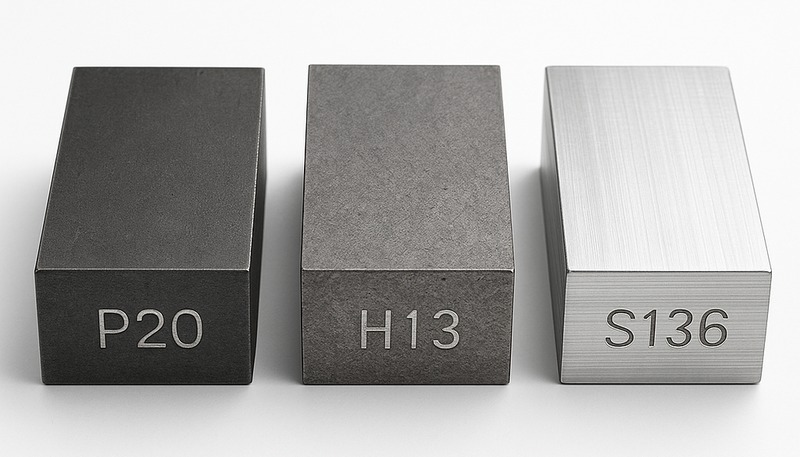
PP’s high shrinkage (1.0–2.5%) demands larger mold compensation than most commodity resins. Draft angles of 1–2° minimum are needed for smooth ejection; PP’s flexibility means parts stick more than rigid resins like PS. Gate sizing is critical: PP’s low viscosity means undersized gates fill adequately but create high shear stress and visible gate marks; oversized gates reduce cosmetic marks but extend gate freeze time. For the mold tooling strategy and steel selection, see our injection mold complete guide3.
Cooling circuit uniformity matters more for PP than for ABS or PC because of anisotropic crystallization. Uneven cooling—hot spots near thick sections—causes localized higher shrinkage and warpage. Baffle inserts or conformal cooling channels reduce temperature differential across the cavity surface. Wall thickness uniformity in part design is the single most effective warpage reduction strategy: designing to ±10% wall thickness variation reduces warpage significantly compared to unconstrained designs with 2:1 thickness ratios.
Factory Insight: PP Processing at ZetarMold
In our Shanghai facility, PP is our highest-volume resin—processed across roughly 30% of our 45 machines (90T–1850T) each month. With 20+ years of production experience, the warpage and sink mark problems we see in PP are almost always process setup issues, not material defects. Our standard protocol for new PP programs: establish baseline with 60°C mold temperature and 240°C melt, measure shrinkage at 24h and 72h after demolding (PP continues to crystallize post-mold), then adjust compensation accordingly. This protocol has reduced PP program ramp-up time by eliminating the first wave of dimensional nonconformances before production starts.
In our facility, warpage and sink marks together account for over 60% of PP rework cases. Both trace back to the same root cause: insufficient pack pressure or uneven cooling. Our recommendation: simulate before cutting steel on any PP part with L/T ratio above 100 or wall thickness variation exceeding 1.5×.
Frequently Asked Questions About PP Injection Molding
Does PP need pre-drying before molding?
No. PP moisture absorption is ~0.02%, well below the threshold for processing problems. Unlike nylon or PC, PP can run directly from the bag. No hopper drying is required in standard production conditions.
What causes PP parts to warp?
Warpage in PP stems from anisotropic shrinkage during crystallization. Shrinkage parallel to flow direction exceeds perpendicular shrinkage, creating internal stress that bends flat parts. Uneven mold cooling amplifies this effect. Solutions: uniform wall thickness design, symmetric gate placement, higher mold temperature (60–80°C), and adequate cooling time before ejection.
What is the difference between PP homopolymer and copolymer?
PP homopolymer is stiffer (flexural modulus ~1.5 GPa) and more brittle at low temperatures. PP copolymer (random or impact) has lower stiffness but significantly better low-temperature impact resistance—impact PP can reach 200–600 J/m notched Izod. For applications requiring both stiffness and toughness, glass-filled PP copolymer grades are available.
Can PP bond well with adhesives or overmolding?
PP bonds poorly. Its non-polar surface chemistry resists adhesives, paints, and overmolding with most other resins. Surface treatment (flame, plasma, or corona) improves adhesion but adds process steps. For parts requiring strong adhesive joints or two-material assemblies, ABS or PC provides significantly better bonding without surface treatment.
What is typical cycle time for PP injection molding?
PP cycle time depends on wall thickness and cooling setup. Thin-walled PP parts (1.5–2.5 mm) typically cycle at 15–30 seconds. Parts with 3–4 mm walls require 35–60 seconds. PP crystallization during cooling releases latent heat, extending cycle time compared to amorphous resins (ABS, PC) at similar wall thickness. Conformal cooling channels can reduce cycle time 20–30% on thick-walled PP programs.
What is the minimum wall thickness for PP injection molding?
Practical minimum wall thickness for PP is 0.8–1.0 mm for short flow lengths. For longer flows (L/T > 150), 1.2–1.5 mm minimum is safer to avoid short shots. Walls below 0.8 mm require high injection pressure and create elevated residual stress that leads to brittleness. Maximum recommended wall thickness is 4–5 mm to avoid excessive sink marks and extended cooling time.

Bottom line: PP is the right choice when you need low cost, chemical resistance, and moderate mechanical performance for room-temperature applications. It is not the right choice for structural parts above 100°C, high-gloss cosmetics, or applications requiring strong adhesion or bonding. If warpage is your primary concern, review wall thickness uniformity and cooling circuit design before changing resin. Process it at 220–250°C melt with 50–70°C mold temperature and measure shrinkage at 72h before setting final tolerances.
Planning a PP injection molding program? Contact us for a material and process review, or explore our injection molding services for full-program support from DFM to production.
-
injection molding: A manufacturing process in which molten thermoplastic resin is injected under pressure into a closed mold cavity, where it cools and solidifies. PP injection molding specifically uses polypropylene, the world’s second most-produced plastic, valued for low cost and chemical resistance. ↩
-
glass-fiber-filled PP: Polypropylene compounded with short glass fibers (typically 10–40% by weight) to increase stiffness and heat resistance. GF-PP reaches flexural modulus of 4–6 GPa vs. 1.2–1.7 GPa for unfilled PP, and HDT of 130–160°C. Trade-offs include reduced ductility, higher density, and more aggressive gate/runner wear. ↩
-
mold design: The engineering process of creating the steel tooling that shapes molten plastic into finished parts. For PP, mold design must account for high shrinkage (1.0–2.5%), adequate draft angles (1–2°), and cooling circuit uniformity to manage anisotropic crystallization. ↩




 EN
EN  ES
ES  FR
FR  DE
DE  PT
PT  AR
AR  RU
RU  JA
JA  KO
KO  IT
IT  NL
NL  TR
TR  PL
PL 