• Cooling systems account for 60-70% of injection molding cycle time, making proper design critical for production efficiency
• Channel diameter, spacing, and water temperature directly impact cooling effectiveness and part quality
• Conformal cooling channels can reduce cycle time by 15-30% compared to conventional straight channels
• Poor cooling design leads to warpage, sink marks, and dimensional instability in molded parts
• Cooling time calculation requires understanding material thermal properties and part wall thickness
What Is Injection Mold Cooling and Why Does It Matter?
After working with cooling systems on over 47 injection molding machines in our Shanghai facility, I can tell you that cooling design is where most mold projects succeed or fail. The cooling system’s job is straightforward: remove heat from the molten plastic as quickly and uniformly as possible so the part solidifies properly and can be ejected without defects.
Here’s the reality that many overlook – cooling accounts for 60-70% of your total injection molding1 cycle time. If your part needs 20 seconds to cool, but your injection and ejection only take 8 seconds combined, you’re looking at a 28-second cycle. Improve that cooling to 15 seconds, and you’ve just increased your production rate by nearly 20%.
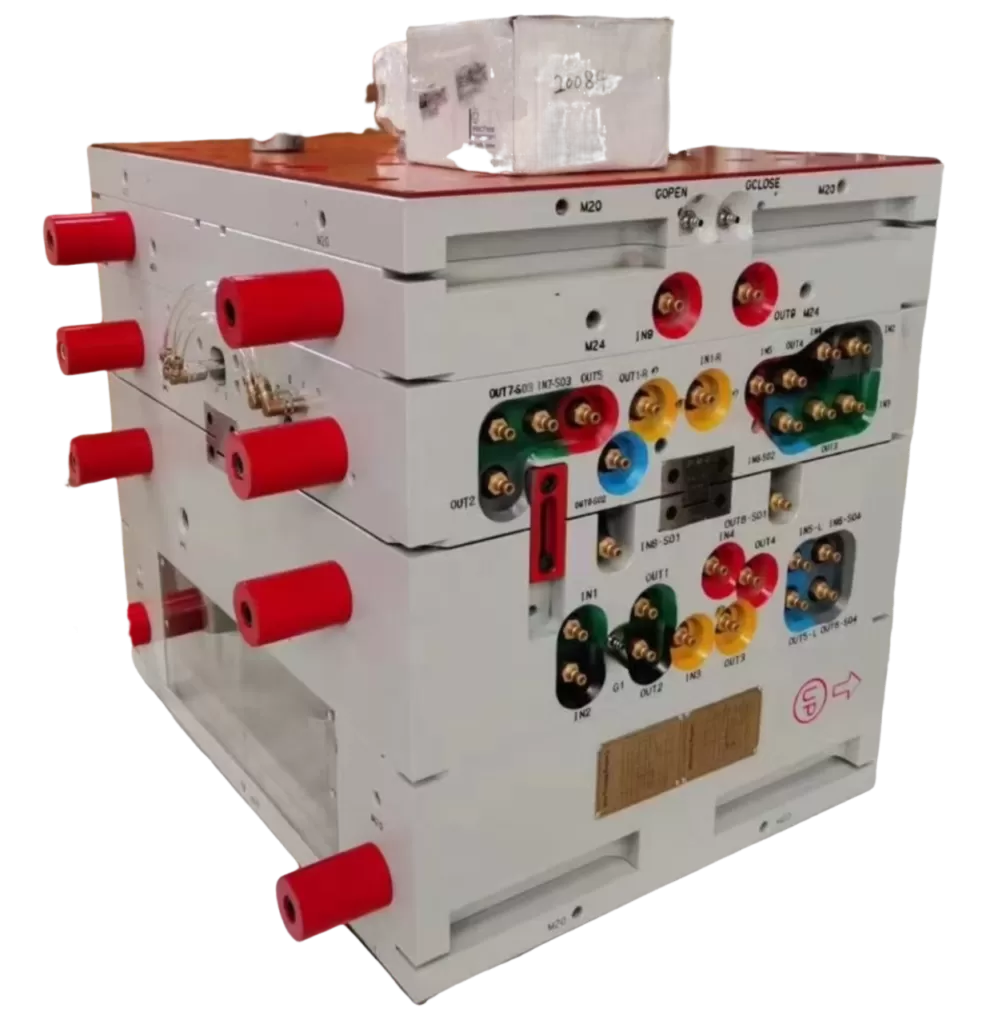
The cooling system consists of channels machined into the mold that circulate coolant (usually water) to extract heat. These channels must be positioned to provide uniform cooling across the entire part geometry. Uneven cooling creates internal stresses that manifest as warpage, dimensional instability, and poor surface finish.
I’ve seen molds with poorly designed cooling systems produce parts with 0.5mm warpage on what should be flat surfaces. The same parts, after cooling redesign, held tolerances within 0.05mm. That’s the difference between scrapped parts and profitable production.
What Are the Key Parameters for Cooling Channel Design?
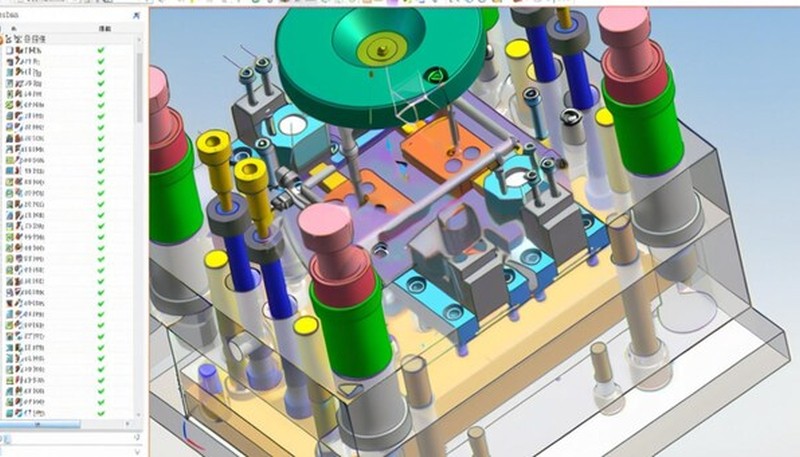
Channel diameter is your starting point. Most cooling channels range from 8mm to 16mm diameter, with 10-12mm being the sweet spot for most applications. Larger channels don’t always mean better cooling – you need sufficient water velocity to maintain turbulent flow for effective heat transfer. I typically target Reynolds numbers above 5000 for optimal heat transfer coefficient.
Channel spacing follows the 2-3 times diameter rule. For 10mm channels, space them 20-30mm apart center-to-center. Closer spacing improves cooling uniformity but increases machining costs. Wider spacing creates hot spots between channels where cooling is less effective.
Distance from the cavity surface matters enormously. Keep channels 1.5-2.5 times the channel diameter from the cavity surface. Too close and you risk breakthrough during machining or create weak spots in the mold steel. Too far and cooling efficiency drops significantly.
Water temperature control requires more thought than most realize. Inlet temperatures typically range from 10°C to 40°C depending on the material. The temperature difference between inlet and outlet should stay under 5°C to maintain consistent cooling. Higher temperature differences indicate insufficient flow rate or poor channel design.
Flow rate calculation involves balancing pressure drop with heat removal requirements. I use 2-4 liters per minute per channel as a starting point, then adjust based on calculated heat load. Higher flow rates improve heat transfer but increase pumping costs and pressure requirements.
What Are the Different Types of Cooling Channel Layouts?
Straight-through cooling channels are the most common and cost-effective option. Water enters one side of the mold and exits the other, following a straight path. These work well for simple geometries but struggle with complex shapes or areas far from the mold edges.
Series cooling connects multiple channels in sequence, creating a serpentine path through the mold. This approach works when you need to cool specific areas in a controlled sequence. The downside is that water temperature rises as it progresses through the circuit, creating temperature gradients.
Parallel cooling feeds multiple channels simultaneously from a common manifold. Each channel receives water at the same inlet temperature, providing more uniform cooling than series circuits. This is my preferred approach for most injection molds2 when manifold space permits.
Spiral cooling creates a helical path around cylindrical cores or pins. This design provides excellent temperature uniformity for round features but requires careful machining to maintain consistent channel diameter throughout the spiral path.
Baffle cooling uses internal baffles to direct coolant flow in confined spaces like narrow cores. The coolant enters through a tube, hits a baffle plate, and returns around the outside of the tube. This maximizes cooling in tight spaces where conventional channels won’t fit.
Bubbler cooling inserts a tube into a drilled hole, allowing coolant to flow down the center and return around the outside. It’s effective for cooling deep cores but requires careful sealing to prevent leaks. I use bubblers when core diameters are too small for conventional channels.
How Does Conformal Cooling Improve Mold Performance?
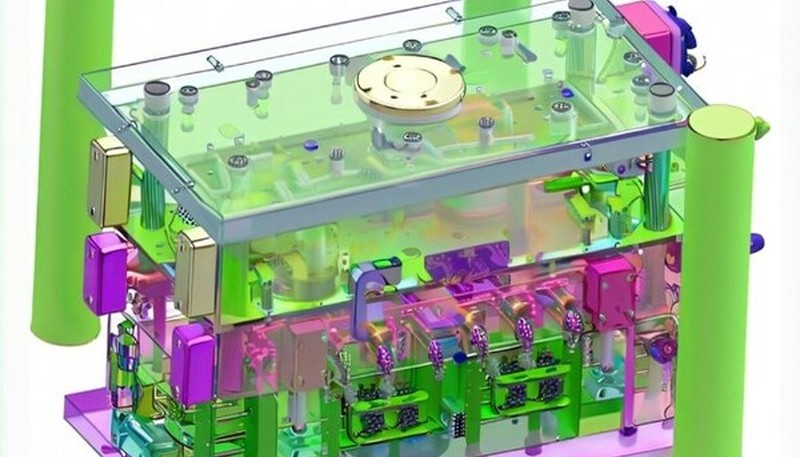
Conformal cooling channels follow the contours of the part geometry, maintaining consistent distance from the cavity surface regardless of part complexity. Traditional straight channels can’t achieve this uniformity on curved or complex geometries, leading to hot spots and uneven cooling.
The manufacturing process relies on additive manufacturing (3D printing) to create the mold inserts with internal conformal channels. We print these inserts in tool steel powders, then finish machine the cavity surfaces to final dimensions. This allows channel geometries impossible to achieve with conventional machining.
Cycle time improvements of 15-30% are typical with well-designed conformal cooling. I’ve seen even better results on thick-walled parts or complex geometries where conventional cooling struggles. The key is maintaining that consistent channel-to-surface distance that straight channels can’t achieve.
Temperature uniformity improves dramatically with conformal cooling. Where conventional channels might show 10-15°C temperature variations across the part surface, conformal systems often achieve uniformity within 3-5°C. This translates directly to reduced warpage and better dimensional stability.
Part quality benefits extend beyond just dimensional accuracy. More uniform cooling reduces internal stresses, improving impact resistance and fatigue life. Surface finish improves as thermal gradients that cause flow marks and other defects are minimized.
Cost considerations include higher upfront tooling costs but faster payback through reduced cycle times. For high-volume production, the cycle time savings typically justify the additional tooling investment within 6-12 months of production.
What Common Cooling Problems Cause Part Defects?
In our Shanghai facility with 47 injection molding machines, we've tracked cooling-related defects across 400+ different resin formulations. Poor cooling design accounts for nearly 40% of all part quality issues in our experience. Our 8 engineers have developed standardized cooling calculations that reduced warpage defects by 65% compared to traditional rule-of-thumb approaches.
Warpage tops the list of cooling-related defects. Uneven cooling creates differential shrinkage across the part, causing it to bow, twist, or distort. Thick sections cool slower than thin sections, creating internal stresses that pull the part out of shape. I’ve seen 2mm thick areas still cooling while 0.5mm sections have already solidified, creating permanent deformation.
Sink marks appear when thick sections shrink more than surrounding material as they cool. The surface pulls inward, creating visible depressions. This happens when cooling channels are too far from thick areas or when cooling time is insufficient for complete solidification.
Dimensional instability manifests as parts that measure correctly when hot but shrink beyond tolerance as they reach room temperature. This indicates incomplete cooling in the mold – parts are ejected before thermal equilibrium is reached. Extended cooling time usually solves this, but proper channel design prevents it.
Weld line weakness occurs when cooling channels create temperature imbalances around areas where flow fronts meet. If one side cools faster than the other, the weld line forms at different temperatures, reducing bond strength. Balanced cooling around weld lines is critical for structural integrity.
Surface defects like flow marks and gate blush often trace back to uneven mold temperatures. Hot spots create areas where plastic flows differently, leaving visible marks on the surface. Consistent mold temperature through proper cooling design eliminates most surface-related defects.
Ejection problems arise when parts aren’t uniformly cooled. Soft spots cause parts to deform during ejection, while overcooled areas become too rigid and crack. Uniform cooling ensures parts have consistent stiffness for reliable ejection.
How Do You Calculate Cooling Time for Injection Molding?
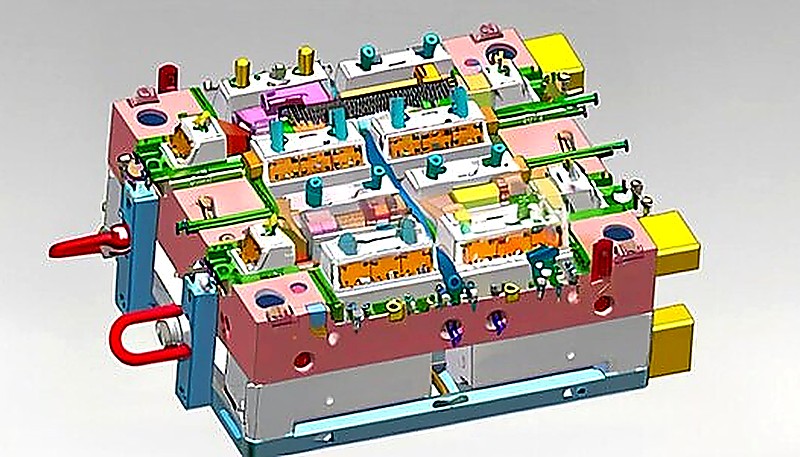
The fundamental cooling time formula is: t = h²/(π² × α), where t is cooling time, h is wall thickness, and α is thermal diffusivity of the plastic material. This equation assumes the part center reaches the ejection temperature when surface cooling is complete.
Thermal diffusivity (α) combines material density, specific heat, and thermal conductivity. For common plastics: ABS ≈ 1.1 × 10⁻⁷ m²/s, PP ≈ 1.0 × 10⁻⁷ m²/s, PC ≈ 1.4 × 10⁻⁷ m²/s. These values vary with temperature and filler content, so use material supplier data when available.
Wall thickness (h) uses the maximum thickness for safety, though average thickness gives more realistic times. For parts with varying thickness, calculate cooling time for the thickest section – thinner areas will cool faster and won’t limit the cycle.
A practical example: 3mm thick ABS part. Using α = 1.1 × 10⁻⁷ m²/s: t = (0.003)²/(π² × 1.1 × 10⁻⁷) = 9 × 10⁻⁶/(1.09 × 10⁻⁶) = 8.3 seconds. Add 20-30% safety margin for real-world conditions, giving roughly 10-11 seconds cooling time.
Temperature considerations affect the calculation significantly. The formula assumes cooling from melt temperature to ejection temperature, typically 60-80°C for most thermoplastics. Lower ejection temperatures require longer cooling times but improve dimensional stability.
Mold temperature impacts cooling rate through the temperature gradient driving heat transfer. Higher mold temperatures reduce the gradient, extending cooling time but improving surface finish and reducing internal stresses. Balance cycle time against part quality requirements.
Validation requires measuring actual part temperatures at ejection using infrared thermometry or thermocouples. If core temperatures exceed ejection targets, increase cooling time. If surface temperatures are too low, reduce cooling time or increase mold temperature to prevent overcooling.
What Are the Most Frequently Asked Questions About Mold Cooling Design?
How close can cooling channels be to the cavity surface?
Minimum distance should be 1.5 times the channel diameter, but 2-2.5 times diameter is safer for most applications. For 10mm channels, keep them at least 15mm from the cavity surface, preferably 20-25mm. Closer placement risks breakthrough during machining, creates weak spots in the steel, and can cause uneven cooling due to excessive heat flux. The exact distance depends on mold steel hardness, machining accuracy, and cooling requirements. Harder steels allow closer placement, while softer steels need more material for structural integrity.
What’s the optimal water temperature for injection mold cooling?
Water temperature depends on the plastic material and part requirements. Most thermoplastics work well with 10-40°C inlet water temperature. Lower temperatures (10-20°C) provide faster cooling but may cause surface defects like flow marks or poor gloss. Higher temperatures (30-40°C) improve surface finish but extend cycle time. Semi-crystalline materials like PP and PE benefit from higher mold temperatures to promote crystallization. Maintain inlet-outlet temperature difference under 5°C for consistent cooling across the circuit.
How do you prevent cooling channel leaks in injection molds?
Proper sealing starts with accurate machining – channels must be straight and round with smooth surfaces. Use appropriate O-ring grooves sized for the operating pressure and temperature. Standard NBR O-rings work for most applications, but use FKM (Viton) for high-temperature or chemical-resistant applications. Thread sealant on pipe fittings prevents leaks at connections. Regular maintenance includes O-ring replacement and checking for corrosion or erosion that creates leak paths. Test all circuits at 1.5 times operating pressure before production.
Can you retrofit existing molds with better cooling systems?
Retrofitting is often possible but requires careful evaluation of existing steel thickness and layout. Adding channels may require welding and re-machining, which risks distortion and affects steel properties. Sometimes it’s more cost-effective to replace inserts rather than modify existing steel. Conformal cooling retrofits usually aren’t practical due to the need for additive manufacturing. Focus on optimizing existing channel connections, improving flow distribution with manifolds, or adding cooling to previously uncooled areas. Each case requires individual assessment of costs versus benefits.
What flow rate should cooling water have in injection molds?
Target 2-4 liters per minute per channel for most applications, with Reynolds numbers above 5000 for turbulent flow. Higher flow rates improve heat transfer but increase pressure drop and pumping costs. Calculate flow rate based on heat removal requirements: Q = m × cp × ΔT, where Q is heat load, m is mass flow rate, cp is specific heat of water, and ΔT is temperature rise. Typical pressure drop should stay under 2-3 bar per circuit. Use flow meters and pressure gauges to monitor each circuit during production.
How does part geometry affect cooling channel design?
Complex geometries require creative cooling solutions to maintain uniform temperatures. Deep ribs need dedicated cooling lines or bubblers to prevent hot spots. Thick sections benefit from multiple cooling circuits at different distances from the surface. Undercuts and side features may require cooling in slides or lifters. Thin walls need careful channel spacing to avoid overcooling that causes brittleness. Large flat areas benefit from parallel channels spaced according to the 2-3 diameter rule. Always prioritize cooling the thickest sections first, as these control cycle time.
What maintenance do injection mold cooling systems require?
Regular flushing prevents scale and corrosion buildup that reduces cooling efficiency. Use filtered water and consider water treatment systems for areas with hard water. Monthly flow rate checks identify blockages or leaks early. Annual circuit cleaning with appropriate descaling agents removes mineral deposits. Replace O-rings and seals during scheduled maintenance. Monitor water temperature rise across circuits – increasing temperature difference indicates reduced flow or heat transfer efficiency. Keep spare quick-disconnect fittings and O-rings for rapid repairs during production.
How do you cool complex geometries like threads or undercuts?
Threaded areas often require spiral cooling channels following the thread pitch, or closely spaced straight channels around the threaded core. Undercuts in slides need dedicated cooling circuits connected through flexible hoses or rotary unions. Deep pockets benefit from fountain cooling (bubblers) when conventional channels won’t fit. Sometimes accepting slightly longer cycle times is more cost-effective than complex cooling solutions. Focus cooling efforts on the largest thermal mass areas first, then address smaller features if cycle time permits. ZetarMold’s experience with complex geometries helps optimize these challenging cooling situations.
Why Choose ZetarMold for Mold Cooling Optimization?
Our Shanghai facility has been refining cooling system design since 2005, with ISO 9001, 13485, 14001, and 45001 certifications ensuring consistent quality processes. Our team of 8 engineers has developed proprietary cooling calculations and design guidelines based on real-world experience with over 400 different resin formulations across our 47 injection molding machines.
What sets ZetarMold apart is our systematic approach to cooling optimization. We don’t rely on outdated rules of thumb – every cooling system is designed using thermal analysis software and validated with actual temperature measurements. Our 120+ staff members include over 30 English-speaking engineers who can communicate complex technical requirements clearly throughout your project development.
Ready to Optimize Your Mold Cooling System?
Get expert cooling design analysis for your next injection molding3 project
- Advanced injection molding process optimization techniques and cycle time reduction strategies
- Comprehensive mold design principles including cooling system integration and thermal management
- Professional injection molding services with advanced cooling system design and optimization