 コンテンツへスキップ

新しい射出成形プロジェクトを任され、RFQの最初の質問が「どの材料をお勧めしますか?」だったとします。多くのエンジニアと同様に、あなたも候補リストを持っているでしょう―おそらくPP、あるいは ABS1 — ただし、より安価なオプションが落下試験に耐えられるかどうかは100%確信が持てません。このガイドでは、射出成形で最も一般的に使用されるプラスチック材料を、当社の生産現場からの実数データとともに解説し、迷うことなく判断できるようにします。
- ポリプロピレン(PP)は、世界中で最も使用される射出成形プラスチックです。安価で耐薬品性があり、加工が容易です。
- ABSとPC/ABSは、衝撃強度と表面仕上げのバランスから、民生用電子機器の筐体で主流となっています。
- ナイロン(PA6/PA66)とPOMは、機械的・負荷支持部品向けの定番エンジニアリングプラスチックです。
- 光学透明度や極端な耐衝撃性が必要な場合は、ポリカーボネート(PC)が最適です。
- 材料コストは部品コストのわずか〜30〜50%です―使用中に故障する可能性がある最も安価な樹脂を選ばないでください。
射出成形で最も一般的に使用されるプラスチック材料は何ですか?
射出成形で最も一般的に使用されるプラスチック材料は、このセクションで説明されている主要なカテゴリーまたはオプションです。ベンダーを比較したり、調達を計画したりする場合は、当社の injection molding supplier sourcing guide covers RFQ prep, qualification, and commercial risk checks.
射出成形で最も一般的に使用されるプラスチックは ポリプロピレン(PP)2、続いてABS、ポリエチレン(PE)、ポリカーボネート(PC)、ナイロン(PA)です。これら5つの樹脂は、世界中の全射出成形生産量の約75%を占めています。理由は単純です:競争力のある価格で、典型的な性能要件の90%をカバーしているからです。
以下は、世界生産シェアによる簡易ランキングです: 射出成形:
| 素材 | 密度 (g/cm³) | 引張強さ (MPa) | Cost ($/kg) | Typical Use |
|---|---|---|---|---|
| PP | 0.90 | 31〜41 | 1.0–1.5 | Packaging, automotive, consumer |
| PE(HDPE/LDPE) | 0.92〜0.96 | 20〜37 | 1.0〜1.4 | ボトル、容器、キャップ |
| ABS | 1.04〜1.06 | 29–48 | 1.8–2.5 | 電子機器ハウジング、内装トリム |
| PC | 1.20 | 55–75 | 3.0–5.0 | レンズ、医療・安全機器 |
| Nylon (PA6) | 1.13–1.15 | 50–80 | 2.5〜4.0 | ギア、ブッシング、ボンネット下 |
| POM | 1.41〜1.42 | 60–70 | 2.5–3.5 | 精密機械部品 |
| PMMA (Acrylic) | 1.18–1.19 | 48〜76 | 2.0–3.5 | ライトカバー、ディスプレイ |
| PBT | 1.30–1.35 | 40–55 | 2.5〜4.0 | 電気コネクタ、自動車部品 |
| TPU | 1.10–1.25 | 25〜50 | 4.0–8.0 | 柔軟なグリップ、ウェアラブル、シール |
| 覗き見 | 1.30 | 90–100 | 60〜100以上 | 航空宇宙、石油・ガス、医療 |
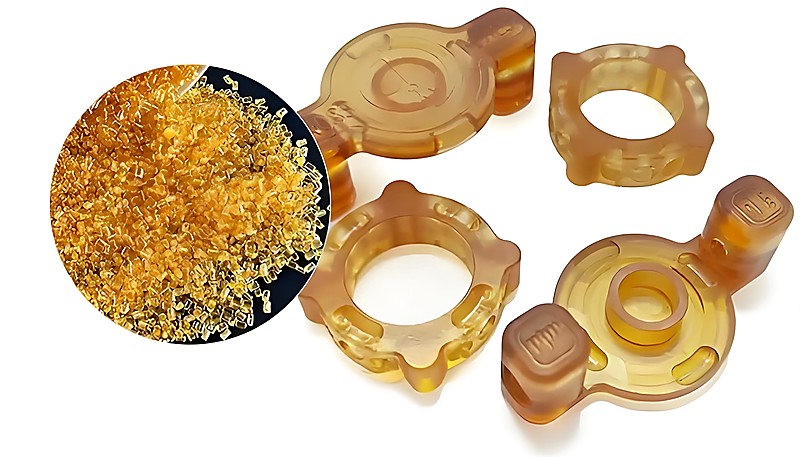
なぜポリプロピレンが最も広く成形されるプラスチックなのか?
ポリプロピレンは、コスト、品質、生産量、用途のトレードオフが支持されるため、最も広く成形されるプラスチックです。ポリプロピレン(PP)が射出成形で支配的な理由は3つあります:安価(約$1.0〜1.5/kg)であり、200〜260°Cで容易に加工されサイクルタイムが短く、ほとんどの化学薬品、湿気、疲労に耐性があるためです。当工場では、PPは全仕事の約30〜35%を占めており、リビングヒンジ付きの蓋から自動車用バッテリーケースまで多岐にわたります。
The density of PP is only 0.90 g/cm³ — the lightest among common structural plastics. That means more parts per kilogram of resin, which directly lowers your piece price. It also means PP parts float, which matters if you’re designing marine or outdoor equipment.
The downside: PP has relatively low rigidity (flexural modulus ~1.3–1.7 GPa) and poor UV resistance in its unmodified form. If your part needs stiffness, you’ll need glass-filled PP (which jumps to ~5 GPa but adds abrasion to the mold). If it sits outdoors, you need UV-stabilized grades.
In practice, we see PP selected most often for caps and closures (the living-hinge trick is a PP specialty), food containers (it’s FDA-compliant in many grades), automotive under-hood ducts and reservoirs, and consumer product housings where cost is the primary driver.
One thing most spec sheets won’t tell you: PP has a narrow processing window when you’re doing thin-wall molding. If your wall is under 0.8 mm, the melt freezes before it fills and you get short shots. We’ve learned to run PP thin-wall jobs at the top of the temperature range (250–260 °C) with fast injection speed — the kind of thing that only comes from running thousands of PP molds over 20 years.
ZetarMold Factory Data: Our 47 injection molding machines (90T–1850T) process 400+ materials including all major PP grades — homopolymer, copolymer, random copolymer, and glass-filled variants. With 120+ production staff running 24/7 shifts, we typically turn around PP molding samples in 15 days.
他のプラスチックよりもABSを選ぶべき場合はいつですか?
Choose ABS when you need a combination of impact resistance, surface finish quality, and moderate cost. ABS is the default for consumer electronics housings, appliance shells, and automotive interior trim — basically anything that people will see and touch.
ABS delivers impact strength of 200–400 J/m (Izod notched) at room temperature, which is significantly better than PP (~30–100 J/m) and comparable to many grades of nylon. It also takes paint, plating, and texture extremely well — the surface comes out of the mold with a high-gloss or matte finish depending on the mold finish, with no secondary operations needed.
Where ABS falls short: continuous service temperature is only ~85 °C (some heat-resistant grades reach 100 °C), and it’s not inherently UV-stable. For outdoor applications, you’d want ASA (acrylonitrile styrene acrylate) instead, which is essentially UV-resistant ABS.
A common upgrade path: PC/ABS blend. This gives you the impact strength of polycarbonate with the processability and cost of ABS. Tensile strength jumps to ~55 MPa, heat deflection temperature climbs to ~110 °C, and the material still finishes beautifully. If your project budget allows the extra $0.50–1.00/kg, PC/ABS is almost always worth it over straight ABS.
ナイロンやPOMなどのエンジニアリングプラスチックはどのように比較されますか?
This section is about engineering plastics like nylon and pom compare and its impact on cost, quality, timing, or sourcing risk. When you move past commodity plastics (PP, PE, ABS) into engineering plastics, you’re paying more per kilogram but getting mechanical properties that commodity resins simply can’t match. ナイロン(PA6/PA66)3 and POM (acetal) are the two most commonly used engineering plastics in injection molding.
Nylon’s standout property is toughness combined with wear resistance. Dry PA66 has tensile strength up to 80 MPa and can operate continuously at 120–150 °C (glass-filled grades push higher). It’s the standard for gears, bearing cages, cable ties, and automotive under-hood components. But nylon absorbs moisture — up to 2.5% at 50% RH — and every 1% moisture gain drops tensile strength by roughly 10% while increasing dimensions by ~0.3%. This means you must design tolerances around the conditioned state, not the dry-as-molded state.
POM (also known as acetal or Delrin) is the king of dimensional stability and low friction. Its coefficient of friction against steel is ~0.1–0.3, making it ideal for precision gears, latches, and sliding mechanisms. POM machines well, has excellent fatigue resistance, and maintains properties across -40 °C to +100 °C. The trade-off: POM is difficult to bond (surface energy is low), and it releases formaldehyde if overheated during processing.
ポリカーボネートが他の透明プラスチックと異なる点は何ですか?
Polycarbonate (PC) is in a class of its own when it comes to impact resistance among transparent plastics. Its notched Izod impact strength reaches 600–850 J/m — roughly 20x that of acrylic (PMMA) and 10x that of clear ABS. If your part needs to be see-through AND survive a drop test, PC is usually the answer.
PC’s tensile strength of 55–75 MPa and heat deflection temperature of ~130–140 °C put it well above PMMA (48–76 MPa, ~90–100 °C HDT) for structural and thermal performance. You’ll see PC used in safety glasses, medical device housings, automotive headlamp lenses, and bullet-resistant glazing.
The main drawback: PC is notch-sensitive. A sharp internal corner will crack under impact even though the material itself is incredibly tough. Design rule: all internal radii should be at least 0.5 mm, and 1.0 mm is preferred. PC is also sensitive to many common chemicals — solvents, oils, and even some cleaning agents can cause environmental stress cracking.
Processing tip: PC requires thorough drying (4+ hours at 120 °C) before molding. If you mold wet PC, you get splay marks and reduced molecular weight — and your expensive lens-grade PC is ruined. We always verify moisture content is below 0.02% before running PC jobs.
材料選択は金型設計をどのように変えますか?
This section is about es material selection change your mold design and its impact on cost, quality, timing, or sourcing risk. The material you choose doesn’t just affect part performance — it changes the 射出成形金型 itself. Different resins require different shrinkage allowances, gate types, cooling strategies, and even mold steel grades.
Shrinkage varies dramatically: PP shrinks 1.5–2.5%, ABS shrinks 0.4–0.7%, and POM shrinks 1.8–2.3%. Your mold cavity must be cut oversize to compensate for this. Get the shrinkage wrong, and every part will be out of tolerance.
Glass-filled nylon and glass-filled PP are extremely abrasive. Standard P20 mold steel will show wear after 50,000–100,000 shots. For production runs of 500K+ cycles, you need H13 or S136 hardened steel — which adds 30–50% to your tooling cost but saves you from premature mold failure.
Gate design matters more with crystalline materials (PP, POM, nylon) than with amorphous materials (ABS, PC). Wrong gate placement on a crystalline part leads to weld lines, jetting, or warpage that you can’t fix with processing parameters alone.
Drying requirements also limit your material choices based on your molder’s equipment. PC, nylon, PBT, and PET all require pre-drying. If your shop doesn’t have dryers, you’re limited to PP, PE, and PS. PEEK processes at 370–400 °C — most standard machines can’t handle that, requiring specialized equipment.
This is why we always recommend finalizing material selection before mold design starts. Changing material after the mold is cut is expensive — you might need to re-cut cavities to adjust shrinkage, modify gate dimensions, or change the entire cooling layout.
ZetarMold Factory Data: Our in-house mold manufacturing facility with 23 dedicated machines — including Makino CNC, Sodick slow-wire EDM, and precision engravers — allows us to build and modify molds quickly when material changes are needed. 8 senior engineers (each with 10+ years experience) handle DFM review to catch material-mold compatibility issues before steel is cut.
一般的な射出成形プラスチックのコスト差はどのくらいですか?
Material cost varies by a factor of 50x or more between commodity and high-performance plastics. PP and PE sit at the bottom (~$1.0–1.5/kg), while PEEK sits at the top ($60–100+/kg). But raw material cost is only part of the equation — cycle time, scrap rate, and tooling cost all factor into your piece price.
| Cost Tier | 材料 | $/kg (approx.) | サイクルタイム | Tooling |
|---|---|---|---|---|
| Commodity | PP, HDPE, LDPE, PS | 1.0–2.0 | Fast (10–25s) | Standard P20 OK |
| Mid-range | ABS, PMMA, TPU | 1.8–5.0 | Moderate (15–40s) | P20 or 718H |
| Engineering | PA6, PA66, POM, PBT, PC | 2.5–8.0 | Moderate–Slow | P20 short run, H13 for volume |
| High-Perf | PEEK, PEI, PPS, LCP | 15–100+ | Slow (30–60s+) | Hardened steel required |
A common mistake we see: choosing the cheapest resin without accounting for part weight, cycle time, and yield. PP might cost $1.20/kg vs. ABS at $2.20/kg — but if the PP part needs to be 20% thicker to achieve the same rigidity, the material cost difference shrinks or disappears. And if the thicker PP part causes sink marks that drive up scrap rate, the cheaper material actually costs more per good part.
プロジェクトに適したプラスチック材料をどのように選ぶべきですか?
Choosing the right plastic material for your project is about tooling capability, quality systems, communication, and commercial fit. Material selection comes down to matching your part requirements against five key criteria: mechanical performance, thermal resistance, chemical exposure, regulatory compliance, and cost. Here’s a practical decision framework we use with our clients.
First, identify the deal-breaker property — the one thing that absolutely cannot fail. Is it impact strength? Temperature resistance? Chemical resistance? FDA compliance? This single requirement eliminates 70% of your material options immediately and focuses the selection.
Second, check processing compatibility. Does your molder have drying equipment for hygroscopic materials like PC, nylon, and PBT? Can their machines hit the required melt temperature and injection pressure? Do they have experience running this specific material at production scale?
Third, run a cost-per-good-part analysis. Don’t just compare cost per kilogram. Factor in part weight, cycle time, expected scrap rate, and any secondary operations like painting or annealing. A $2/kg material that runs at 15-second cycles with 2% scrap beats a $1.50/kg material that runs at 25-second cycles with 8% scrap.
Fourth, validate with a sample run. Always mold and test samples before committing to production. Material datasheets don’t capture real-world factors like gate blush, weld line strength, or post-mold shrinkage behavior.
In our experience, most projects converge on one of four material families: PP for cost-driven consumer parts, ABS or PC/ABS for visible housings and enclosures, nylon (often glass-filled) for mechanical and automotive components, and PC for transparent or high-impact applications.
再生プラスチック樹脂とバージンプラスチック樹脂の長所と短所は何ですか?
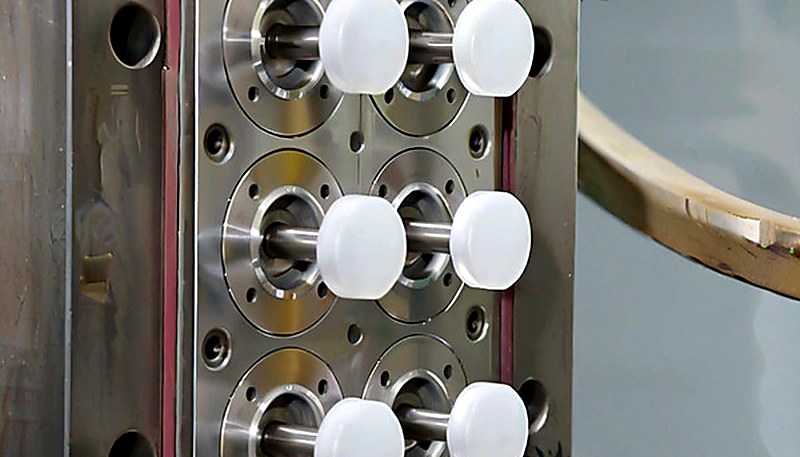
The pros and cons of recycled vs. virgin plastic resin are the main categories or options explained in this section. Recycled resin (regrind or rPCR — post-consumer recycled) costs 15–30% less than virgin material and is increasingly requested by sustainability-driven brands. But there are trade-offs you need to understand before specifying it.
Virgin resin has consistent melt flow index (MFI), color, and mechanical properties batch to batch. Recycled resin — especially post-consumer — has wider property variation. MFI can fluctuate by plus or minus 20%, and contaminant levels (other plastics, additives, moisture) can cause processing issues like splay, black spots, or inconsistent shrinkage.
Practical guidance from our shop floor: For non-critical, non-visible parts (internal brackets, non-structural components), 20–30% regrind blended with virgin is generally safe and we do this routinely. For visible, structural, or regulated parts, we recommend virgin material unless you can qualify the recycled grade with full testing.
ZetarMold Factory Data: We hold ISO 9001, ISO 13485, ISO 14001, and ISO 45001 certifications. Our 6-step quality process (IQC → In-Process → FQC → OQC) includes incoming material inspection that catches regrind quality issues before they reach the press.
“Polycarbonate is the strongest transparent thermoplastic for injection molding.”真
PC’s impact strength (600–850 J/m notched Izod) far exceeds PMMA (~20 J/m) and is unmatched among transparent thermoplastics. It’s used in bullet-resistant glazing and safety equipment.
“All plastics shrink the same amount in injection molding.”偽
Shrinkage varies dramatically — PP shrinks up to 2.5%, while ABS shrinks only 0.4–0.7%. Crystalline materials (PP, POM, nylon) shrink roughly 2–4x more than amorphous materials (ABS, PC, PMMA).
Understanding these common misconceptions about injection molding materials will help you make better decisions for your next project. The key takeaway is that material selection should always be driven by your specific application requirements and operating environment, not by assumptions about price equating to performance or by treating all plastics as interchangeable commodities. Every material has a sweet spot where its properties align with the demands of the application, and the best injection molding partners will help you find that sweet spot quickly rather than defaulting to the most expensive option.
“Nylon parts actually perform better in some ways after absorbing moisture.”真
Dry nylon is brittle; conditioned nylon has much higher impact strength. The key is designing tolerances for the conditioned state rather than fighting moisture absorption.
“More expensive plastic always means better part performance.”偽
PEEK costs 50x more than PP, but if your part is a simple food container that needs chemical resistance and low cost, PP is the better choice. Material selection is about matching properties to requirements.
射出成形材料に関する最もよくある質問は何ですか?
What is the most commonly used plastic in injection molding?
Polypropylene (PP) is the most commonly used plastic in injection molding, accounting for roughly 35% of global injection molding production volume. Its low cost of approximately $1.0 to $1.5 per kilogram, combined with excellent chemical resistance, low density of 0.90 g/cm³, and easy processing at 200 to 260 °C, makes it the default choice for packaging, consumer goods, and automotive applications. PP also offers good fatigue resistance, which is why living hinges on bottle caps are almost always made from PP.
What is the strongest plastic for injection molding?
PEEK offers the highest tensile strength at approximately 90 to 100 MPa among moldable thermoplastics, but it costs $60 to over $100 per kilogram and requires specialized processing equipment capable of 370 to 400 °C melt temperatures. For most industrial applications, glass-filled nylon PA66 in the GF30 grade delivers tensile strength up to 180 MPa at roughly $4 to $6 per kilogram, making it the practical high-strength choice for gears, brackets, and structural automotive components where the budget doesn’t justify PEEK.
What temperature range can POM handle in injection molding?
POM, also known as polyoxymethylene, acetal, or Delrin, processes at melt temperatures of 185 to 225 °C and maintains reliable mechanical properties across a continuous service temperature range of negative 40 °C to positive 100 °C. Its low friction coefficient of 0.1 to 0.3 against steel and excellent dimensional stability across this full range make it the preferred material for precision gears, latches, and sliding mechanisms in automotive and consumer products where consistent performance over temperature swings is critical. In our production experience, POM is one of the most reliable materials for consistent dimensional output across varying ambient conditions.
Is ABS or polypropylene better for outdoor use?
Neither standard ABS nor unmodified PP performs well outdoors without additives. PP degrades under UV exposure and becomes brittle over time, while ABS yellows and loses impact strength when exposed to sunlight. For outdoor applications, ASA (acrylonitrile styrene acrylate) is the recommended choice because it’s essentially a UV-stable variant of ABS that maintains both color and impact resistance in direct sunlight. UV-stabilized grades of PP are also available and work well for outdoor furniture, garden equipment, and automotive exterior trim components.
How much does nylon shrink in injection molding?
Unfilled nylon PA6 shrinks 0.5 to 1.5 percent and PA66 shrinks 0.8 to 1.8 percent during injection molding and cooling. Glass-filled grades shrink significantly less at 0.2 to 0.8 percent, but the shrinkage becomes anisotropic, meaning it differs between the flow direction and the transverse direction. This anisotropy must be carefully accounted for in mold design, especially for tight-tolerance parts like gears or bearing housings. Nylon also absorbs up to 2.5 percent moisture at 50 percent relative humidity, adding roughly 0.3 percent dimensional change per one percent moisture gain.
What plastic is best for transparent injection molded parts?
Polycarbonate (PC) is the best choice for transparent parts that also need high impact resistance, with notched Izod impact strength of 600 to 850 J/m and light transmission above 87 percent. PMMA (acrylic) offers slightly better optical clarity with 92 percent light transmission but has much lower impact strength at approximately 20 J/m, making it unsuitable for parts that may be dropped or struck. PC processes at 280 to 320 °C and requires thorough drying for at least 4 hours at 120 °C before molding, while PMMA processes at the lower range of 220 to 260 °C and is less demanding on drying equipment.
Do all injection molding materials need to be dried before processing?
No, not all injection molding materials require pre-drying before processing. Polypropylene (PP) and polyethylene (PE) are classified as non-hygroscopic materials, meaning they do not absorb significant moisture from the air and can be molded directly from the bag without any drying step. However, polycarbonate (PC), nylon (PA6 and PA66), PBT, PET, and TPU are all hygroscopic and must be dried for 3 to 4 hours at 80 to 120 °C depending on the specific material. Molding wet hygroscopic material causes visible splay marks, reduced molecular weight, lower mechanical properties, and dimensional instability in the finished parts.
What is the cheapest plastic material for injection molding?
Polypropylene (PP) and polyethylene (PE) are the cheapest injection molding materials, both priced at approximately $1.0 to $1.5 per kilogram for standard grades. Polystyrene (PS) is similarly priced and also widely available from multiple global suppliers. These commodity resins are suitable for non-critical, cost-sensitive applications like food packaging, disposable containers, and basic consumer housings. However, the final part price depends heavily on part geometry, cycle time, production volume, and scrap rate. A more expensive material that runs faster and produces less scrap can actually result in a lower cost per finished part than the cheapest resin available.
Choosing the right plastic material comes down to understanding what your part actually needs to survive — and being honest about where you can compromise and where you can’t. If you’re weighing options between two materials, send us the part design and we’ll give you a straight answer on which one we’d run and why. No upsell, just 20 years of shop-floor experience applied to your specific project.
Ready to discuss your material selection? Get in touch with our engineering team — we’ll review your design, recommend the most cost-effective material, and provide a detailed quote within 24 hours.
-
ABS: ABS refers to acrylonitrile Butadiene Styrene — an amorphous thermoplastic with impact resistance ~200–400 J/m, tensile strength 29–48 MPa, and heat deflection temperature ~90–105 °C. ↩
-
ポリプロピレン(PP): Polypropylene (PP) refers to a semi-crystalline thermoplastic with density ~0.90 g/cm³, melting point ~160–168 °C, and tensile strength 31–41 MPa. Widely used in packaging, automotive, and consumer goods. ↩
-
Nylon (PA6/PA66): Nylon (PA6/PA66) refers to polyamide engineering thermoplastics with tensile strength up to 80 MPa (dry), melting points 220–265 °C, and excellent wear resistance. ↩




 EN
EN  ES
ES  FR
FR  DE
DE  PT
PT  AR
AR  RU
RU  JA
JA  KO
KO  IT
IT  NL
NL  TR
TR  PL
PL 