

What Is PPAP in Injection Molding for Automotive?
PPAP is a mandatory AIAG quality gateway that requires automotive suppliers to submit 18 documented elements before shipping production parts. Your customer just sent you a 40-page requirement package, and your boss wants it done in two weeks. If you’ve never done one before — or if your last submission got rejected — this guide walks you through the entire process specifically for injection-molded parts.
“PPAP Level 3 requires all 18 documented elements plus production sample parts from a minimum run of 300 consecutive pieces.”真
Level 3 is the standard automotive submission level and requires the full package: Process Flow Diagram, PFMEA, Control Plan, MSA, dimensional results, material test results, SPC studies, and all other 18 elements defined by AIAG.
“A Cpk of 1.0 is sufficient to pass the PPAP initial process capability study.”偽
Most automotive OEMs require a minimum Cpk of 1.33 for initial process studies. A Cpk of 1.0 corresponds to roughly 2,700 defective parts per million — far above automotive quality thresholds.
- PPAP is mandatory for all Tier 1 and Tier 2 automotive suppliers
- Level 3 submission requires 18 documented elements plus sample parts
- Cpk ≥ 1.33 is the minimum for initial process capability studies
- Any process change after approval may trigger a full re-submission
- Documentation errors cause more rejections than actual part defects
What Is PPAP and Why Does It Matter in Automotive Injection Molding?
PPAP is a mandatory AIAG quality framework that proves your production process consistently meets customer requirements. It applies to all automotive 射出成形 suppliers — Tier 1 and Tier 2 alike — before they can ship production parts.
OEMs like Ford, GM, Toyota, and Volkswagen all require it. Their Tier 1 suppliers require it from their Tier 2s. The requirement flows down the supply chain. Here’s what PPAP actually prevents: a supplier setting up a “golden batch” in a lab environment, getting approval, then running production on a different machine with different parameters and shipping bad parts. The PPAP process forces you to document and validate your real production process — the actual machine, the actual mold, the actual material, the actual operators.
The cost of PPAP failure is steep. A rejected submission means delayed production starts, which in automotive translates to line-down penalties that can reach $10,000+ per hour. We’ve seen this firsthand at our Shanghai factory — in our 20.0 years of molding automotive parts, most first-time PPAP failures come from incomplete documentation, not bad parts.
“Any change to the injection molding process after PPAP approval may require re-submission.”真
Changes to material grade, machine, mold, process parameters, or production location all potentially trigger re-submission. The 4P rule (People, Process, Product, Place) is the standard framework for evaluating whether a change notification or re-submission is needed.
“PPAP only applies to metal parts in automotive manufacturing.”偽
PPAP applies to all production parts regardless of material — including injection-molded plastics, rubber, composites, and assembled components. Any part shipped to an automotive OEM or Tier 1 supplier requires PPAP approval.
What Are the 18 PPAP Elements for Injection Molded Parts?
The 18 PPAP elements are a standardized checklist from AIAG covering design records through the Part Submission Warrant. A Level 3 射出成形金型[1] submission must address every one.
Not every element applies to every part, but you need to address each one — either by including it or documenting why it’s not applicable. For injection-molded automotive parts, most of these are mandatory.
| # | Element | Relevance to Injection Molding |
|---|---|---|
| 1 | Design Records | CAD models and 2D drawings of the molded part |
| 2 | Engineering Change Documents | ECNs, deviation requests |
| 3 | Customer Engineering Approval | Written sign-off on design |
| 4 | Design FMEA | Failure modes in part design (usually customer’s) |
| 5 | Process Flow Diagram | Material receiving → molding → inspection → shipping |
| 6 | Process FMEA | Failure modes in your molding process |
| 7 | Control Plan | Detailed inspection and process control strategy |
| 8 | Measurement System Analysis (MSA) | Gage R&R for all measurement equipment |
| 9 | Dimensional Results | Full layout inspection against drawing specs |
| 10 | Material / Performance Test Results | Material certs, mechanical test data |
| 11 | Initial Process Study (SPC) | Cpk studies on critical dimensions |
| 12 | Qualified Lab Documentation | Lab scope and accreditation |
| 13 | Appearance Approval Report (AAR) | For visible Class A surfaces |
| 14 | Sample Production Parts | Parts from actual production run (300+ pieces) |
| 15 | Master Sample | Retained reference sample |
| 16 | Checking Aids | Go/no-go gauges, fixtures |
| 17 | Customer-Specific Requirements | OEM-specific forms or additional tests |
| 18 | 部品提出令状(PSW) | Summary cover sheet signed by supplier |
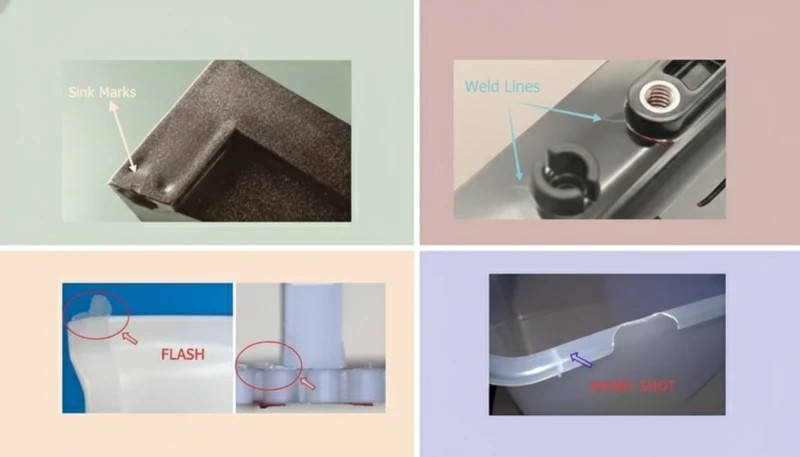
For injection molding specifically, elements 5 through 11 are where most of the work lives. Your Process Flow Diagram must capture every step from raw material receiving to final packaging. Your Process FMEA needs to address molding-specific risks: short shots, flash, sink marks, warpage, contamination. And your Control Plan has to show exactly how you’ll keep the process in control during production.
How Does the PPAP Submission Process Work Step by Step?
The PPAP submission process is a 6-step sequence spanning 4–8 weeks from quoting through customer approval. It covers requirement identification, process planning, T1 tryout, a 300-piece production run, measurement, and final submission.
PPAP doesn’t start when you get the forms. It starts during quoting. Here’s the typical timeline for an injection-molded automotive part:
Step 1: Understand Requirements (During Quoting). Before you quote, identify the PPAP level your customer requires. Level 1 is minimal — just the PSW. Level 3 is the full package. Level 5 means the customer audits your facility. Most automotive OEMs default to Level 3. If you don’t ask, assume Level 3.
Step 2: Process Planning (During Tooling Build). While the mold is being built, prepare your Process Flow Diagram, PFMEA, and Control Plan. These three documents must be consistent — the flow diagram feeds the PFMEA, which feeds the Control Plan. Any mismatch between them is a guaranteed PPAP rejection.
Step 3: Tryout and Sampling (T1 Phase). Run the mold for the first time. Collect initial shots. This is where you establish baseline process parameters: melt temperature, mold temperature, injection speed, holding pressure, cooling time. Document everything.
Step 4: Production Run for PPAP Samples. Run a production-representative batch — typically 300 consecutive parts minimum on the production machine, with production tooling, production material, and production operators. This is not a development run. It’s a simulation of your real production.
Step 5: Measurement and Testing. Perform full dimensional layout on samples from the beginning, middle, and end of the run. Conduct SPC studies on critical dimensions. Run any required material or performance tests. Complete Gage R&R studies.
Step 6: Compile and Submit. Assemble all 18 elements, fill out the PSW, and submit to your customer. Typical review time is 2–4 weeks for Tier 1 OEMs.
What Injection Molding Parameters Must Be Controlled for PPAP?
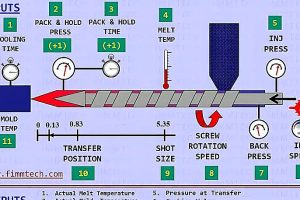
Five parameters are mandatory in every PPAP 射出成形[2] Control Plan. These are melt temperature, mold temperature, injection speed, holding pressure, and cooling time.
For glass-filled PA66 under-hood connectors, melt temperature typically runs 280.0°C–300.0°C with a tolerance of ±5.0°C. Melt temperature isn’t the barrel set temperature — it’s the actual melt temperature, measured with a pyrometer or thermal imager. Document the target and the tolerance. If your process drifts outside this window, that’s a PPAP deviation.
Mold surface temperature affects crystallinity, shrinkage, and dimensional stability. For tight-tolerance automotive parts, mold temperature control within ±2.0°C is common. You’ll need to show your temperature control method (thermolator settings, thermocouple locations) and actual measured data.
Injection speed and pressure determine fill pattern and weld line quality. Document the velocity-pressure switchover point. If your part has a weld line on a structural feature, the injection speed at that point is a critical parameter.
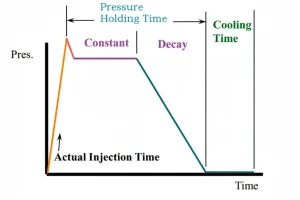
Holding pressure packs the cavity and compensates for shrinkage. For dimensional stability on parts with wall thickness variations, holding pressure is often the single most important parameter. Your SPC data on dimensions like hole diameter or flatness will largely reflect holding pressure consistency.
Cooling time matters too — insufficient cooling causes warpage and ejection damage, while excessive cooling wastes cycle time. Your PPAP run must demonstrate that the chosen cooling time produces parts within spec consistently.
For each critical dimension, you need to demonstrate Cpk ≥ 1.33 (some OEMs require 1.67 for safety-critical features). Cpk tells your customer that your process is not just capable, but consistently capable:
| Cpk Value | Defect Rate (ppm) | 解釈 |
|---|---|---|
| 1.00 | 2,700 | Barely capable — not acceptable for PPAP |
| 1.33 | 63 | Standard minimum for most automotive PPAP |
| 1.67 | 0.6 | Required for safety-critical features |
| 2.00 | 0.002 | Six sigma — rarely required but impressive |
If your Cpk comes back below 1.33, you can’t just submit and hope. You need to identify the root cause — usually process variation from inconsistent melt temperature, mold temperature, or holding pressure — and rerun the study.
At ZetarMold, we run 45 injection molding machines ranging from 90T to 1850T in our Shanghai facility. Our 10+ QC specialists maintain a 6-step quality process (IQC → OQC) with full process parameter logging on every production run — including melt temperature, mold temperature, and holding pressure records that feed directly into PPAP documentation.
What Are Common PPAP Failures in Injection Molding?
The five most common PPAP failures are incomplete dimensional data, mismatched documents, insufficient samples, traceability gaps, and Cpk below 1.33[3]. Together they account for over 80% of all rejections.
We’ve processed hundreds of PPAP submissions at our Shanghai factory over the past 20.0 years, and the same issues keep appearing:
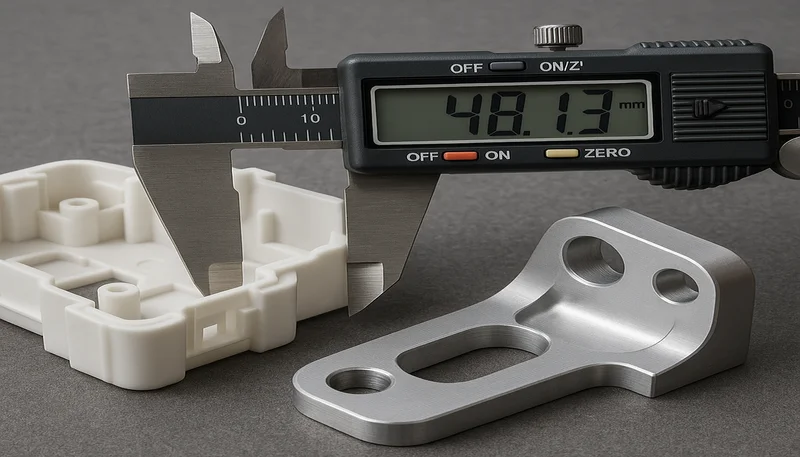
1. Incomplete Dimensional Data. The drawing calls out 47 dimensions. You reported 39. The missing 8 were “hard to reach” features. This is the number one reason for PPAP rejection. Every dimension on the drawing must be reported — no exceptions.
2. Mismatched Process Documents. Your Process Flow Diagram says you inspect at Station A. Your Control Plan says Station B. Your PFMEA doesn’t mention either. These three documents must be perfectly consistent. A good rule: have one person write all three.
3. Insufficient Sample Size. Your customer asked for 300 consecutive parts. You ran 150 on Thursday and 150 on Friday — on different shifts. That’s not a single consecutive run. The PPAP run must be one continuous production run.
4. Material Traceability Gaps. PPAP requires full material traceability: material certificate, lot number, date code, and confirmation that the material matches the customer-approved specification. Using a “similar” grade without formal approval is a PPAP failure — and a potential field failure.
5. Cpk Below Threshold on Critical Dimensions. This usually means your process isn’t stable enough. The fix isn’t to cherry-pick good parts or widen the tolerance — it’s to reduce process variation. In injection molding, this almost always comes down to better mold temperature control, more consistent drying, or tighter holding pressure regulation.
How Do You Maintain PPAP Compliance During Production?
PPAP compliance is maintained through the 4P rule: People, Process, Product, Place. Any change to your documented process triggers a re-submission review, enforced by ongoing SPC monitoring.
Changes that can trigger a re-submission:
- People: New operators on critical processes may require re-validation
- プロセス Changing injection speed, melt temperature, or mold temperature beyond documented ranges
- Product: Material grade change, color change, mold modification
- Place: Moving production to a different machine or facility
Each customer has their own change notification requirements, but the general rule is: if you change anything that was documented in your PPAP submission, you need to notify your customer. Some changes require a new PSW. Some require a complete re-submission.
PPAP isn’t a one-time event. Your Control Plan should include ongoing SPC monitoring for critical dimensions. X-bar and R charts are standard. If a dimension trends toward the control limit, you intervene before it goes out of spec — not after.
This is where many suppliers slip. They pass PPAP, file the documents, and six months later nobody’s running SPC charts anymore. Then the customer audit comes, and they’re hit with a finding for “Control Plan not being followed.” It’s not a quality problem — it’s a discipline problem.
What Quality Systems Support PPAP for Automotive Suppliers?
PPAP is supported by three frameworks: IATF 16949, APQP, and the five AIAG Core Tools. Together they form the backbone of automotive supplier quality management.
IATF 16949 is the automotive-specific quality management standard. It builds on ISO 9001 and adds requirements for PPAP, FMEA, MSA, SPC, and APQP. If your company is IATF 16949 certified, you already have the infrastructure to support PPAP. If you’re not certified, some OEMs will still accept your PPAP — but they’ll audit your quality system much harder.
APQP (Advanced Product Quality Planning) is the umbrella process that includes PPAP. APQP has five phases: Plan, Design, Process, Validation, and Launch. PPAP happens in Phase 4 (Product and Process Validation). If you’re doing APQP correctly, PPAP is the natural conclusion of a well-planned launch — not a surprise scramble.
The five AIAG Core Tools — APQP, PPAP, FMEA, SPC, and MSA — are interconnected. Your FMEA identifies risks. Your Control Plan (from APQP) manages those risks. Your SPC data (measured using MSA-qualified equipment) proves your process is in control. PPAP packages all of this into a submission that demonstrates competence.
Our Shanghai facility holds ISO 9001:2015 and ISO 13485 certifications, with 8 senior engineers averaging 10.0 years of experience each. Our quality system supports full PPAP documentation — including process flow diagrams, PFMEA, control plans, dimensional reports, and initial process capability studies. Our team of 30+ English-speaking project managers ensures documentation clarity throughout the submission process.
What Are the PPAP Submission Levels for Injection Molding?
PPAP submission levels are organized into 5 tiers ranging from Level 1 (PSW only) to Level 5 (on-site audit). Level 3, requiring all 18 elements plus sample parts, is the automotive default.
| Level | What’s Required | 典型的な使用例 |
|---|---|---|
| Level 1 | PSW only | Low-risk carryover parts |
| Level 2 | PSW + samples + limited data | Non-critical components |
| Level 3 | PSW + samples + all 18 elements | Standard for new automotive parts |
| Level 4 | PSW + customer-specified elements | OEM discretion |
| Level 5 | PSW + samples + full data at supplier site | High-risk parts, witnessed run |
Most first-time automotive injection molding programs require Level 3. If your customer doesn’t specify, assume Level 3 and prepare accordingly. It’s always easier to remove elements than to add them at the last minute.
Level 5 is the most rigorous — the customer sends an auditor to your facility to witness the production run and verify the entire process in person. This is typically reserved for safety-critical parts or suppliers with a history of quality issues.
簡単なルール: If you’re preparing a Level 3 PPAP for an injection-molded part, start with three documents — Process Flow Diagram, PFMEA, and Control Plan — make them consistent, then run 300 consecutive parts on the production machine with full data collection. Miss any of these and you’re looking at a rejection.
射出成形におけるPPAPは、書類作成のための書類作成ではありません。それは、あなたの工程が安定していること、部品が一貫していること、品質システムが機能していることの証明です。最初から正しく行いましょう。なぜなら、自動車業界では、二度行うコストは時間だけでなく、信頼でもあるからです。
PPAPを理解している成形パートナーが必要ですか?ZetarMoldは、完全な文書サポートを伴う自動車射出成形プログラムを20.0年間実施してきた経験があります。当社のエンジニアは数百件のPPAP承認を経験しています。 Get in touch あなたの次の自動車プロジェクトについて話し合うために。
よくある質問
PPAPレベル1とレベル3の違いは何ですか?
レベル1では、Part Submission Warrant(PSW)という1ページの要約フォームのみが必要です。レベル3では、PSWに加えて、寸法データ、SPCスタディ、FMEA、コントロールプラン、生産サンプル部品を含む18の要素すべてが必要です。レベル3は新しい自動車部品のデフォルトです。
PPAPプロセスは射出成形でどのくらいの時間がかかりますか?
射出成形された自動車部品の典型的なPPAPサイクルは、金型試作から顧客承認まで4〜8週間かかります。実際の生産ランニング自体は通常1〜2日です。タイムラインの大部分は、文書作成(2〜3週間)、測定と試験(1週間)、および顧客レビュー(2〜4週間)に費やされます。
Cpk値とは何か、そしてなぜPPAPは1.33を要求するのか?
Cpk(工程能力指数)は、工程の平均値が、工程のばらつきに対して仕様限界にどれだけ近いかを測定します。Cpkが1.33の場合、工程の平均値は最も近い仕様限界から少なくとも4標準偏差離れており、これは約100万個あたり63個の不良品に相当します。これは自動車業界の初期能力承認の最低要件です。
承認後のPPAP再提出はいつ必要ですか?
文書化されたパラメータ(材料グレード、射出成形機、金型修正、工程パラメータ範囲、生産場所など)に変更があった場合は再提出が必要です。寸法に影響を与える金型修理は、通常レベル3の再提出を引き起こします。
サプライヤーはPPAPを自己承認できますか?
自己承認はレベル1でのみ可能であり、かつ顧客が書面で自己承認権限を付与している場合に限ります。レベル3以上については、顧客または指定された代表者が提出物を確認し、正式に承認する必要があります。
PPAP提出が失敗した場合どうなりますか?
PPAPが不合格になると、生産を開始できません。サプライヤーは具体的な指摘事項(例:寸法データの欠落、Cpkが1.33未満など)を記載した正式な不合格通知を受け取ります。サプライヤーはすべての指摘事項に対処し、再提出しなければなりません。不合格のサイクルごとに、タイムラインは通常2〜4週間追加されます。
PPAPは自動車業界以外でも必要ですか?
PPAPは自動車業界(AIAG)で始まりましたが、航空宇宙、医療機器、重機などでますます使用されています。一部の医療機器会社は、AS9102に基づくFirst Article Inspection(FAI)と呼ばれる同様のプロセスを要求しています。AIAG PPAPフォーマットは、世界的に最も広く認知されています。
部品提出保証書(PSW)とは何ですか?
PSWはすべてのPPAP提出物の表紙であり、部品番号、リビジョンレベル、材料、提出レベル、および逸脱事項を要約した1ページのフォームです。サプライヤーの品質管理責任者と顧客の代表者が署名します。



 EN
EN  ES
ES  FR
FR  DE
DE  PT
PT  AR
AR  RU
RU  JA
JA  KO
KO  IT
IT  NL
NL  TR
TR  PL
PL 