

For a complete overview of injection mold manufacturing and maintenance, see our Injection Mold Complete Guide.
- Clean injection molds every 50,000–100,000 shots or whenever defects like flash, burn marks, or surface haze appear.
- Follow a five-step sequence: dry clean, solvent wipe, deep clean, rust treatment, then lubrication.
- Always use brass brushes on polished cavity surfaces — never steel wire or abrasive pads.
- Dry-ice blasting removes heavy carbon deposits without disassembly or chemical waste in 30–60 minutes.
- Log every cleaning event with date, method, and technician name to build a predictive maintenance schedule.
You’re three hours into a production run when the QC tech walks over and drops a part on the table. There it is — a faint brown streak across the surface, barely visible at first glance. Two shifts ago, the mold was making perfect parts. Now every fifth shot has a burn mark. You halt the line, pull the mold, and discover what you already suspected: the vents are packed solid with carbonized resin. A 30-minute cleaning job that should have happened two days ago just cost you four hours of downtime and a full tray of scrap.
| Cleaning Type | Interval | Focus Areas |
|---|---|---|
| Light cleaning | 5,000–10,000 shots | Parting line, vents |
| Full cleaning | 50,000–100,000 shots | Cavity, core, cooling lines |
| Deep inspection | 200,000+ shots | Steel wear, sealing surfaces |
In our factory, we run 45 injection molding machines across three shifts. We learned the hard way that mold cleaning is not a task you do when problems appear — it’s a discipline you build into every production schedule. This guide covers the exact five-step process our technicians follow, how to choose the right cleaning method, and the mistakes that damage molds even when operators think they’re doing it right.
Injection mold cleaning is a core tooling maintenance discipline that belongs to the mold ownership lifecycle, not to defect troubleshooting or process economics. A systematic cleaning protocol protects cavity surfaces, extends mold life, and prevents contamination-driven production failures. For the broader tooling framework, see our Injection Mold Complete Guide; for the process context, see our Injection Molding Complete Guide.
Why Does Injection Mold Cleaning Matter for Part Quality?
Injection mold cleaning matters for part quality because residue accumulation on cavity surfaces, vents, and runner channels directly causes flash, burn marks, surface haze, and dimensional drift. A mold that is not cleaned on schedule does not fail suddenly—it degrades gradually, producing out-of-spec parts that are harder to trace back to contamination as the root cause.
At ZetarMold, we run mandatory mold cleaning every 50,000 shots for production tools. Tools that skip scheduled cleaning develop flash 3× faster — a preventive clean costs less than 1% of an unplanned production shutdown.
| 欠陥 | Root Cause | Impact on Production |
|---|---|---|
| Burn marks | Carbonized resin in vents (diesel effect) | Cosmetic rejection, carbon pitting on cavity |
| フラッシュ | Fretting deposits on parting line faces | Secondary trimming, dimensional scrap |
| Short shots | Blocked vents or gates | 100% scrap, line shutdown |
| Surface haze | Release agent or carbon film on cavity | Gloss loss, customer complaint |
| Difficult ejection | Residue on ejector pins or cavity walls | Pin breakage, part damage |
Industry maintenance data shows that molds on a documented preventive maintenance schedule achieve 2–3× longer service life than molds cleaned only when defects appear. For a mold worth $20,000–$80,000, that multiplier translates directly into lower cost-per-part and faster tooling amortization. Mold cleaning is not a cost — it’s a capital protection strategy.
“Scheduled mold cleaning at 50,000–100,000 shots prevents the majority of surface-related part defects before they reach the quality inspection table.”真
Residue buildup accelerates after the first 50,000 shots as polymer degradation byproducts and outgassed additives accumulate on vent surfaces. Cleaning at this interval removes contamination before it bonds chemically to the 型鋼1, keeps cavity surfaces within surface finish specification, and maintains vent geometry at the designed 0.01–0.03 mm depth.
“You only need to clean an injection mold when visible defects appear on parts.”偽
By the time defects are visible, the mold is already contaminated enough to produce scrap — and the contamination may have begun bonding chemically to cavity steel. Invisible residue layers still degrade surface finish Ra values and restrict vent flow, causing silent non-conformances that escape visual inspection. Proactive scheduled cleaning costs a fraction of the downtime and scrap loss from reactive emergency teardown.
When Should You Clean an Injection Mold: Triggers and Frequency Guidelines?
Clean an injection mold when the shot count reaches 50,000–100,000 for standard engineering thermoplastics, or immediately when part defects appear. The right interval depends on resin type, part complexity, and observed quality data — not a fixed universal number. High-fill resins and corrosive materials require shorter intervals. A well-kept cleaning log is the only way to build accurate, mold-specific PM schedules. Understanding how 射出成形プロセス2 parameters — resin temperature, fill speed, and hold pressure — affect deposit formation helps set the right cleaning interval for each tool.
| Trigger | Required Action | Downtime Estimate |
|---|---|---|
| Every 50,000–100,000 shots (standard resins) | Full 5-step preventive cleaning | 4–8 hours |
| Every 25,000–50,000 shots (GF/CF-filled or FR resins) | Full 5-step cleaning + vent inspection | 4–8 hours |
| Burn marks on parts | Vent cleaning + cavity solvent wipe | 1–2 hours |
| Flash at parting line | Parting surface inspection and re-stoning | 1–3 hours |
| Surface haze or gloss loss | Solvent clean + cavity polish assessment | 2–4 hours |
| After shutdown >2 weeks | Anti-rust treatment + lubrication check | 1–2 hours |
| After PVC or flame-retardant run | Immediate solvent clean + vent flush | 2–3 hours |
Glass-fiber (GF) and carbon-fiber (CF) filled resins deposit abrasive particles in vents and on cavity surfaces, requiring cleaning every 25,000–50,000 shots. PVC releases hydrochloric acid gas that attacks unprotected mold steel within hours at operating temperature. Flame-retardant resins release corrosive off-gases (phosphorus and bromine compounds) that etch polished surfaces. For these materials, we treat the end of every production run as a cleaning trigger — full solvent wipe before the mold is stored.
What Is the 5-Step Injection Mold Cleaning Process?
The five-step mold cleaning sequence is: dry clean at 40–60°C, solvent wipe, deep clean, rust treatment, and lubrication. Each step is required — skipping rust treatment or final lubrication after cleaning leaves the mold vulnerable to corrosion and accelerated wear during the next production run.
Step 1: Dry Cleaning
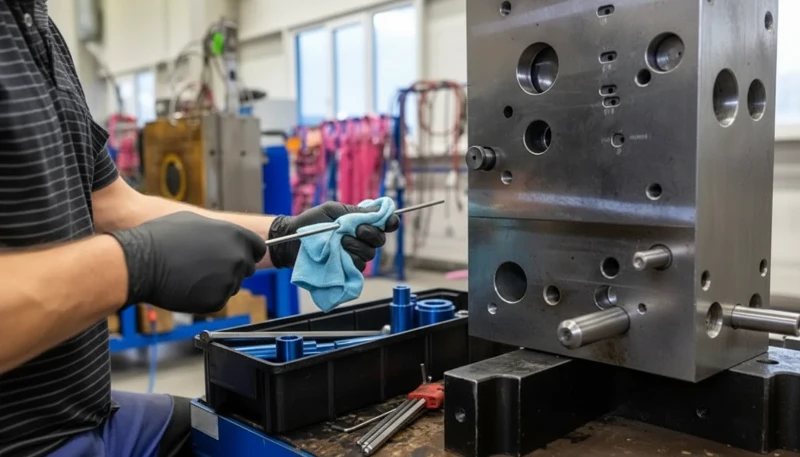
With the mold still warm at 40–60°C after the last shot, use a soft brass brush or wooden pick to dislodge loose polymer flash, gate vestige, and surface deposits from non-polished areas. Never use steel wire brushes on polished cavity surfaces — brass is soft enough to clean without inducing scratches on hardened tool steel. Use filtered, oil-free compressed air at maximum 0.3 MPa to blow residue out of vents, ejector pin holes, and parting line recesses. A vacuum is preferred over compressed air for enclosed areas to avoid redistributing particles to already-clean surfaces.
| Tool / Material | 申し込み | Key Restriction |
|---|---|---|
| Brass brush (soft bristle) | Non-polished cavity areas, runner system | Never use on polished or mirror-finish surfaces |
| Wooden pick / bamboo skewer | Deep corners, rib bases, fine cavity detail | Zero scratch risk — safe on any surface |
| Lint-free vacuum | Vents, ejector pin holes, parting line gaps | Preferred over compressed air in enclosed areas |
| Filtered compressed air (≤0.3 MPa) | Blowing debris from vents and holes | Must be oil-free and moisture-free |
| Cotton swabs | Precision areas, text engravings, O-ring grooves | Single use only — do not double-dip |
Step 2: Solvent Cleaning
Apply a mold-safe solvent to a lint-free cloth or foam applicator. Isopropyl alcohol (IPA) at 99% purity is the safest general-purpose choice for polished and coated surfaces. Acetone is effective on non-polished steel but attacks certain chrome and PVD coatings. Purpose-formulated mold cleaners are the gold standard for production environments — they are pH-balanced for specific steel grades and contamination chemistry. Wipe cavity surfaces in one direction only — never scrub in circles, which embeds abrasive particles from the cloth into the polished steel in a characteristic swirl pattern visible at 10× magnification.
Avoid chlorinated solvents such as trichloroethylene or methylene chloride on chrome-plated, nickel-plated, or PVD-coated surfaces — they attack the coating and accelerate delamination. Always verify solvent compatibility with your mold steel grade and surface treatment before first use on production tooling. Allow the solvent to flash off completely before proceeding to Step 3.
Step 3: Deep Cleaning (Dry-Ice or Ultrasonic)
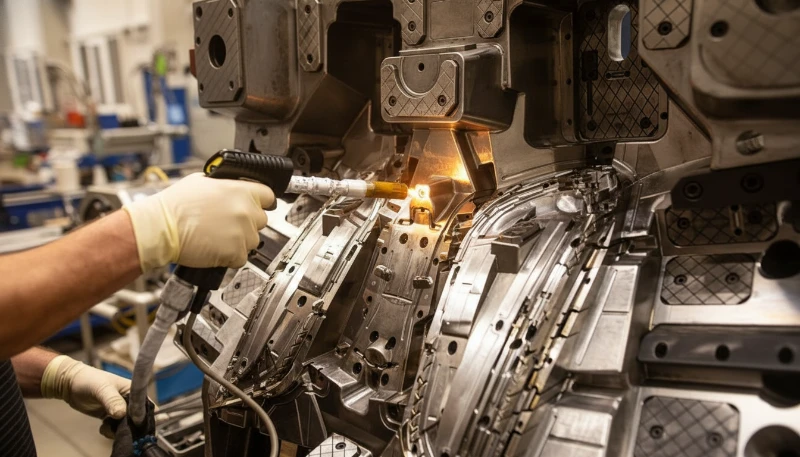
For heavy carbon deposits, burnt resin, or areas inaccessible by manual cleaning, two advanced methods are available. Dry-ice blasting uses solid CO₂ pellets accelerated at high velocity — they sublimate on contact, lifting contaminants without leaving secondary waste or moisture. It can be performed with the mold in the press, requires no disassembly, and produces no chemical waste. Cleaning a single-cavity mold takes 30–60 minutes. This is the preferred deep-clean method for high-volume production because it minimizes downtime.
Ultrasonic cleaning immerses disassembled mold components in a heated cleaning solution at 60–80°C, agitated by 20–40 kHz ultrasonic waves. Cavitation bubbles reach into fine vent slots at 0.01–0.03 mm depth, ejector pin clearance holes, and cooling channel inlets — surfaces that no manual tool can access. Schedule ultrasonic cleaning at major overhaul intervals, typically every 500,000 shots or annually. Disassembly adds 2–4 hours to total cleaning time, so this method is reserved for planned maintenance windows rather than routine PM.
Step 4: Rust Treatment and Surface Inspection
After cleaning, inspect all cavity surfaces, parting line faces, and ejector pin holes under bright raking light or with a 10× loupe. For light surface rust (whitish oxidation film, no pitting), apply a phosphoric acid-based rust remover, allow 5–15 minutes dwell time per manufacturer instructions, neutralize with clean water, dry immediately with filtered compressed air, and apply rust-preventive oil within 15 minutes. For moderate pitting, mechanical polishing from 400 through 2000 grit paper, then 6 µm and 1 µm diamond paste, is required to restore the original surface finish Ra.
| Severity | 説明 | Treatment Method |
|---|---|---|
| Light (surface film) | Whitish oxidation, no visible pitting | Rust remover + rust-preventive oil — no polishing needed |
| Moderate (shallow pitting) | Reddish spots, Ra value degraded | Rust remover + 1200–2000 grit paper + 1 µm diamond paste |
| Heavy (pitting >0.1 mm) | Visible steel loss, dimensional impact | Mold shop: TIG weld repair or EDM re-spark |
| Fretting (parting line) | Micro-burrs, sealing failure under clamp force | Re-stone with fine whetstone, re-lap to flatness |
Step 5: Lubrication and Corrosion Protection
Apply a thin, uniform coat of mold-grade lubricant to all moving components: ejector pins and bushings, guide pins and guide bushings, slider rails, and lifter rods. Use the lubricant type specified for your mold — PTFE-based dry lubricant for medical or food-contact molds, silicone-based grease for mold temperatures above 100°C, and lithium grease for standard production under heavy mechanical loads. Apply sparingly and wipe away all excess immediately — excess lubricant migrates onto the cavity surface within the first few shots and causes part contamination defects.
If the mold will sit idle for more than 48 hours, apply rust-preventive oil or wax to all cavity and core surfaces. For extended storage beyond one month, wrap components in VCI (volatile corrosion inhibitor) film after coating with rust-preventive oil. Store horizontally in a temperature- and humidity-controlled environment: ideally 20–25°C, RH below 60%. Re-inspect every 90 days during storage.
How Do You Choose the Right Cleaning Method for Your Mold?
Manual solvent cleaning is best for routine PM (1–2 hours), dry-ice blasting for in-press deep cleaning (0.5–1 hr), and ultrasonic cleaning for major overhauls at 500,000-shot intervals (4–8 hours). Match the method to your contamination level and available downtime.
| Method | 最適 | Surface Safe? | ダウンタイム | Chemical Waste |
|---|---|---|---|---|
| Manual (brass brush + solvent) | Light surface deposits, routine PM cleaning | Yes — brass brush only on polished surfaces | 1–2 hrs | Minimal |
| Dry-ice blasting | Heavy carbon deposits, in-press cleaning | Yes — safe on mirror-finish surfaces | 0.5–1 hr | None |
| Ultrasonic cleaning | Complex geometry, deep vents, full overhaul | Yes — verify cleaning solution compatibility | 4–8 hrs (disassembly required) | Cleaning solution disposal |
| Laser cleaning | Precision medical/optical molds, non-contact | Yes — no abrasive contact | 1–3 hrs | None |
| Chemical stripping | Severe polymer bonding, coating removal | Depends on coating type | 2–6 hrs | Significant — proper disposal required |
グッド 射出成形金型設計3 plays a critical role in how cleanable a mold is. Deep, narrow ribs with draft angles below 0.5° are nearly impossible to reach with manual tools. Vent slots shallower than 0.01 mm on the parting line clog faster and require more frequent attention. When we review new tooling at our factory, cleanability is one of our DFM (design for manufacturability) evaluation criteria — a mold that’s easier to clean will cost less to maintain over its full service life.
“Dry-ice blasting at 0.3–0.6 MPa is safe for SPI A1 and A2 mirror-finish injection mold cavity surfaces.”真
CO₂ pellets sublimate on contact, generating no secondary abrasive residue. The -78°C thermal differential between the pellet and the warm mold steel causes contaminant layers to embrittle and shear cleanly from the surface without mechanical abrasion. Correct process parameters — nozzle distance 150–300 mm and controlled traverse speed — are essential. Always perform a test pass on a non-critical area with a new blasting unit or operator before cleaning precision surfaces.
“Ultrasonic cleaning is the fastest option for routine mold maintenance between production runs.”偽
Ultrasonic cleaning requires full mold disassembly, component immersion, cleaning cycle time of 20–40 minutes, and reassembly — adding 2–4 hours to the base process. It is the most thorough method for internal surfaces but is far too time-consuming for routine PM intervals. Manual solvent cleaning and dry-ice blasting are the correct tools for between-run maintenance; ultrasonic cleaning belongs at planned major overhaul windows.
What Are Common Cleaning Mistakes That Damage Injection Molds?
A steel wire brush is the most damaging tool in mold cleaning — it permanently increases surface roughness Ra on polished cavities. Once introduced, abrasive damage requires full mechanical re-polishing from 400 grit through 2000 grit plus diamond paste to restore. Wrong timing and missing maintenance logs are the next most costly errors.
Three categories cover most cleaning damage: wrong tool selection (abrasive materials on polished surfaces), wrong timing (cleaning a cold mold, or waiting until defects appear), and wrong technique (over-lubrication, circular wiping, skipping vent cleaning entirely). The fourth category — no documentation — doesn’t damage the mold immediately, but it makes every future decision about cleaning intervals a guess.
Wrong Tool, Wrong Timing: The Two Root Causes
“Blowing out loose debris with compressed air before applying solvent prevents cleaning-induced micro-scratches on polished cavity surfaces.”真
Loose abrasive particles — polymer flash fragments, carbon flakes, and metallic wear debris — act as lapping compound when dragged across polished steel under a cloth. Blowing them clear first with filtered compressed air (0.3 MPa, oil-free) before any solvent or cloth contact eliminates this abrasion mechanism. This single step preserves Ra surface finish between scheduled polishing cycles and is the most cost-effective damage prevention habit in any mold PM program.
“Steel wool or fine-grit sandpaper can be used to quickly remove stubborn deposits from injection mold cavity surfaces.”偽
Even 400-grit sandpaper leaves scratches visible at 10× magnification on hardened tool steel. These scratches increase surface roughness Ra permanently, cause ejection drag, create stress concentration points in thin walls, and transfer texture to molded parts. Once introduced, abrasive damage requires controlled mechanical polishing through a full 400–600–800–1200–2000 grit sequence plus diamond paste to restore specification. Always use brass tools, wooden picks, or approved chemical methods first.
Additional high-frequency mistakes: cleaning a fully cooled mold (residue is harder and more adhesive below 40°C — cleaning at 40–60°C is measurably more effective), over-lubricating ejector pins (excess grease migrates onto the cavity surface and contaminates the first few shots of the next run), skipping vent cleaning because the part “looks OK” (clogged vents cause burn marks that are routinely misdiagnosed as injection speed or hold pressure problems), and failing to log cleaning events (without a log, there is no predictive schedule — only reactive firefighting).
How Do You Integrate Cleaning into a Total Mold Maintenance Program?
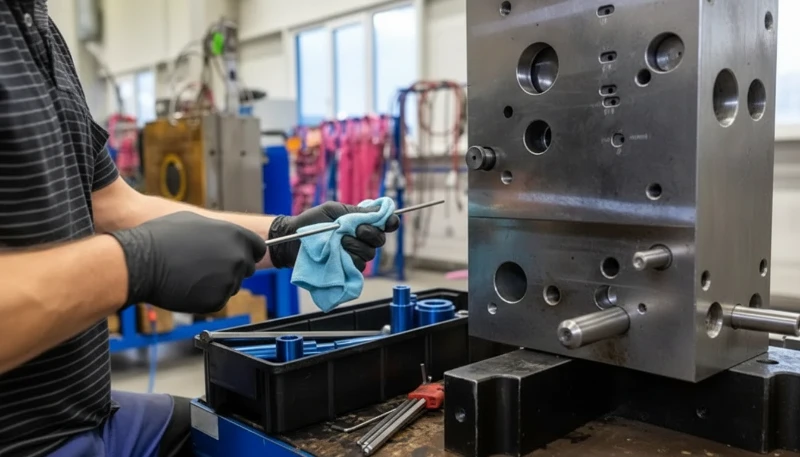
Cleaning is one pillar of a complete mold maintenance program. A total PM schedule integrates cleaning events with dimensional verification, wear part replacement, cooling channel flow testing, and end-of-life assessment. The goal is to maximize total shot count over the mold’s designed service life: typically 500,000–1,000,000 shots for P20 pre-hardened mold steel, and 1,000,000–2,000,000 shots for H13 or S136 hardened stainless steel. At our factory, every mold has a maintenance logbook — physical or digital — that records every cleaning event, every defect found, and every repair made.
Cooling channel maintenance is frequently overlooked in routine PM programs. Scale, biological growth, and rust deposits inside cooling channels insulate the channel walls and reduce coolant velocity, cutting heat transfer efficiency by 20–40% in severe cases. We perform a descaling flush and flow rate measurement at every inlet-outlet pair during each major overhaul. Restoring cooling efficiency to specification directly reduces cycle time and improves part-to-part consistency — two improvements that cost nothing beyond planned downtime.
Cooling Channel Maintenance: The Overlooked Priority
We also integrate a formal mold condition assessment at every 250,000-shot interval — mid-point between full overhauls. During this assessment, a toolmaker inspects cavity surface Ra at three reference points using a surface profilometer, measures ejector pin clearance against the original specification, and checks parting line flatness with a precision straightedge. Any deviation beyond 50% of the tolerance band triggers immediate corrective action rather than waiting for the next scheduled overhaul. This mid-cycle assessment prevents small issues from compounding into expensive repairs.
Documentation is the most underestimated element of any mold maintenance program. Without a complete maintenance log, you cannot build a predictive schedule — you are always reacting to defects rather than preventing them. Our log format records: mold ID, date, shot count at cleaning, cleaning method used, defects found, repairs made, and technician signature. After six months of data, patterns emerge that allow us to shorten or extend PM intervals based on actual mold behavior rather than general industry guidelines. A $15 notebook or a simple spreadsheet turns reactive maintenance into preventive maintenance.
| Milestone | Action | Key Check |
|---|---|---|
| Every PM clean (50K–100K shots) | 5-step cleaning sequence | Vent depth, cavity Ra, parting line flatness |
| 250,000 shots (mid-cycle) | Condition assessment + dimensional check | Pin clearance, surface Ra at 3 reference points |
| 500,000 shots (overhaul) | Full disassembly, ultrasonic clean, cooling flush | Flow rate per channel, wear part replacement |
| Annual (or 1M shots) | Complete inspection + tooling life assessment | Steel hardness spot-check, cavity insert fit |
“Flushing injection mold cooling channels with descaling solution at every 500,000-shot overhaul prevents 20–40% heat transfer efficiency loss from scale buildup.”真
Mineral scale from hard water deposits layers on the inner channel walls, acting as thermal insulation. A commercial descaling solution (typically citric or phosphoric acid-based, circulated at 40–60°C for 30–60 minutes) dissolves calcium carbonate and iron oxide deposits without damaging the channel walls. Follow with a clean water flush and measure flow rate at each channel pair to confirm full blockage removal before reassembly.
“A clean cavity surface is all that matters for injection mold performance — cooling channel condition is secondary.”偽
Cavity surface cleanliness affects surface finish and part ejection, but a fouled cooling system affects cycle time, dimensional stability, and warp simultaneously. In our production experience, degraded cooling causes part-to-part variation that is difficult to diagnose without thermal imaging, because it manifests as inconsistent shrinkage rather than visible surface defects. Cooling channel condition is equally important to cavity surface condition — both require scheduled maintenance.

Frequently Asked Questions About Injection Mold Cleaning?
How often should you clean an injection mold?
Clean every 50,000–100,000 shots as a baseline PM interval for standard engineering thermoplastics such as ABS, PP, and nylon. High-fill resins (GF30, CF15), flame-retardant grades, and PVC-based materials require cleaning every 25,000–50,000 shots because they deposit more aggressive residue or release corrosive gases. Always clean immediately after any run where burn marks, flash, or surface discoloration appeared on parts, regardless of shot count. Track cleaning dates and shot counts in a maintenance log to identify trends and refine your interval based on actual mold and material behavior.
What is the safest solvent for cleaning polished injection mold cavities?
Isopropyl alcohol (IPA) at 99% purity is the safest general-purpose solvent for polished cavity surfaces. It dissolves most thermoplastic residues — including polyolefin wax deposits, styrenic polymer buildup, and release agent films — without attacking chrome plating, PVD coatings, or polished tool steel. For heavier carbon deposits that IPA cannot dissolve, use a purpose-formulated mold cleaner such as Moldklenz or Slide Mold Cleaner. Acetone is effective on non-polished steel but can attack certain coatings. Always confirm solvent compatibility with your mold’s steel grade and surface treatment before first use on production tooling.
Can you clean an injection mold while it is still in the press?
Yes — both dry-ice blasting and manual solvent cleaning can be performed in-press without removing the mold from the machine. Keep the mold at 40–60°C (warm from the last production run) for maximum cleaning effectiveness, and ensure the press is in full lockout/tagout (LOTO) condition to prevent accidental mold closure during cleaning. In-press cleaning eliminates mold changeover labor, avoids the risk of reassembly errors, and is the standard approach in high-volume facilities where maximizing press uptime is a primary operational goal. Only ultrasonic cleaning requires full mold removal and disassembly.

How do you remove rust from injection mold cavities?
Apply a phosphoric acid-based rust remover specifically formulated for mold steel, following the manufacturer’s dwell time — typically 5–15 minutes depending on rust severity. Neutralize with clean water or a dilute baking soda solution (10 g/L), then dry immediately with filtered compressed air to prevent flash rusting. Apply rust-preventive oil within 15 minutes of drying. For moderate pitting, mechanical polishing from 600 grit through 2000 grit paper, then 6 µm and 1 µm diamond paste, is required to restore original surface finish Ra. If pitting exceeds 0.1 mm depth, consult a mold shop — this level typically requires TIG weld repair or EDM re-spark.
What lubricant should you use on injection mold ejector pins?
Use PTFE-based dry lubricant for clean-room, medical-device, or food-contact molds where silicone or grease migration onto part surfaces is unacceptable. For standard production molds, mold-grade lithium grease applied sparingly is effective for ejector pins, guide pins, and bushings under normal load. Silicone-based grease is preferred for high-temperature mold applications (mold temperature above 100°C) where lithium grease may degrade or flow excessively. Always wipe away all excess lubricant immediately after application — excess migrates onto the cavity surface within the first few shots and causes part surface contamination defects.
If you need support building a mold cleaning and preventive maintenance program, contact our mold maintenance team. For the full tooling lifecycle reference, see our Injection Mold Complete Guide.
How do you prevent corrosion damage to injection molds during storage?
For long-term mold storage (over 2 weeks), apply rust-preventive oil or VCI (vapor corrosion inhibitor) paper to all steel surfaces, seal cavity and core faces, and store in a dry environment. For high-humidity facilities, silica gel desiccant inside the mold packaging reduces corrosion risk. Before restarting production, inspect all surfaces for rust spots and polish out any corrosion before the first shot to prevent part surface defects.
Bottom Line: How Can Factory Engineers Implement Effective Mold Cleaning?
Systematic injection mold cleaning prevents contamination-driven defects, premature wear, and costly downtime. Follow the five-step protocol—inspection, dry cleaning, chemical cleaning, rinsing, and lubrication—on a cavity-count schedule rather than a fixed calendar. The most expensive mistake is delaying cleaning until defects appear; by then, surface damage is often irreversible. Build the cleaning protocol into your mold maintenance plan before production starts, not after problems emerge.
Need Expert Mold Maintenance Support?
ZetarMold’s factory engineers provide full tooling lifecycle services—from first article inspection through mold repair and preventive maintenance programs. See our Injection Mold Complete Guide for the complete tooling framework.



 EN
EN  ES
ES  FR
FR  DE
DE  PT
PT  AR
AR  RU
RU  JA
JA  KO
KO  IT
IT  NL
NL  TR
TR  PL
PL 