 Skip to content

Your first-article samples arrive and the surface is covered in sink marks. The mold cost $45,000 and production starts in three weeks. Sound familiar? Injection molding defects—whether sink marks, warping, flash, or short shots—can derail schedules, inflate costs, and damage customer relationships. This guide breaks down the ten most common defects, their root causes, and exactly how to fix them.
- Sink marks, warping, weld lines, flash, and short shots are the most common injection molding defects.
- Most defects result from non-uniform wall thickness, incorrect process parameters, or inadequate venting.
- Material contamination and moisture are leading causes of surface defects including splay, delamination, and discoloration.
- Mold flow simulation identifies defect-prone areas before tooling begins, reducing trial-and-error corrections.
- Each defect has a root cause hierarchy: design, material, process, and tooling—address in that order.
- For a complete overview of the process itself, see our guide to injection molding.
What Are the Most Common Injection Molding Defects?
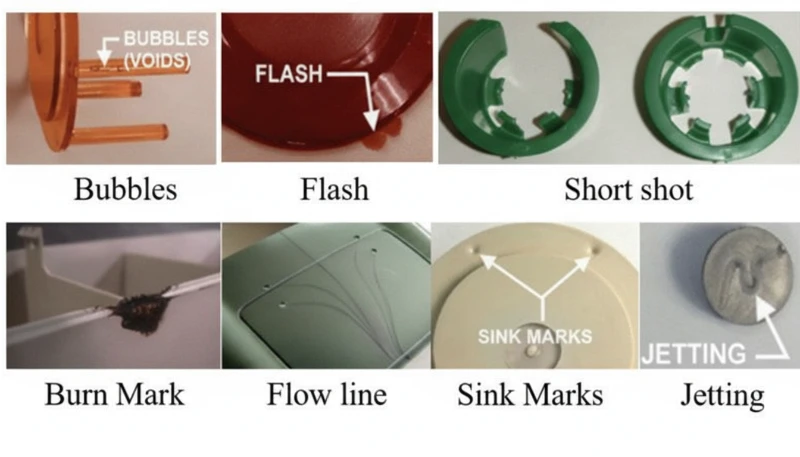
The ten most common injection molding defects are: sink marks1 (localized surface depressions), warping (dimensional distortion), weld lines2 (flow-front merge seams), flash3 (excess plastic at parting line), short shots (incomplete fill), burn marks (thermal degradation), splay or silver streaks (gas/moisture on surface), delamination (surface layer separation), jetting (snake-like flow mark), and voids (internal bubbles). Each has a distinct root cause and correction pathway.
“Most injection molding defects are preventable through proper part design before tooling begins.”True
Design-related defects—non-uniform wall thickness, undercuts without draft, and gating in thick sections—account for over 60% of first-article failures. Addressing these issues during DFM review eliminates the root cause permanently, unlike process adjustments that only manage symptoms.
“Defects that appear after ejection can always be corrected by adjusting machine parameters.”False
Many defects—including warping from non-uniform wall thickness, sink marks from overly thick sections, and weld lines from poor gate placement—are design-driven. Machine parameter adjustments can only compensate partially; design modification is required for complete elimination.
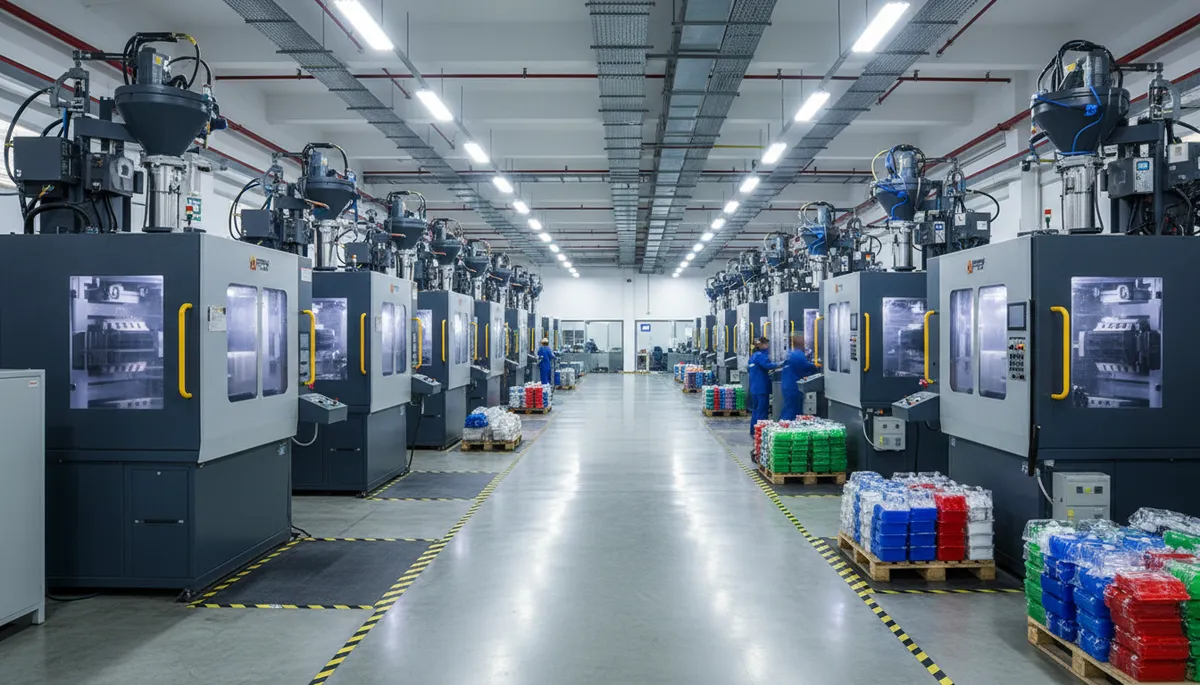
In our factory, we track defect occurrence rates across all 47 injection molding machines. Sink marks and warping together account for over 40% of first-article failures. Flash and short shots together account for another 25%. Understanding the root cause hierarchy—design, material, process, tooling—is the fastest path to resolution. Design-caused defects cannot be fixed by adjusting machine parameters alone.
What Causes Sink Marks and How Are They Prevented?
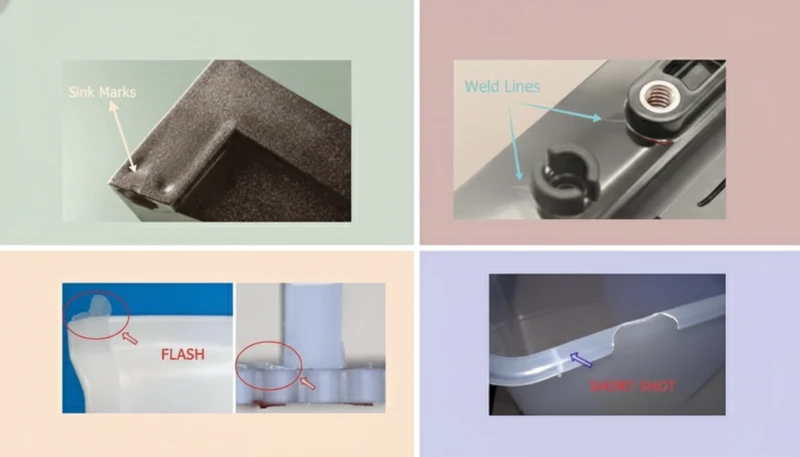
Sink marks form when the outer skin of a molded part solidifies while the interior remains molten. As the core cools and contracts, it pulls the surface inward, creating a visible depression. The primary cause is non-uniform wall thickness: sections thicker than 4 mm, ribs thicker than 60% of the adjoining wall, or bosses with wall-to-outer-diameter ratios above 60% are most susceptible.
Prevention strategies operate at three levels. Design: core out thick sections, keep ribs at 50–60% of the nominal wall, and use radiused transitions between thickness changes. Process: increase packing pressure (typically 60–80% of injection pressure), extend pack and hold time until the gate freezes, and reduce melt temperature to minimize volumetric shrinkage. Tooling: add a vent or gas-assist channel in the thick section, or reposition the gate to the thick section so packing pressure reaches it before the thin sections freeze.
“Packing pressure is more effective than injection pressure for eliminating sink marks.”True
Injection pressure fills the mold cavity; packing pressure compensates for volumetric shrinkage during solidification. Increasing packing pressure—typically 60–80% of injection pressure—with extended hold time keeps material feeding into the thick section until the gate freezes, directly reducing sink mark depth.
“Sink marks on highly visible surfaces can always be hidden with surface texture.”False
Surface texture reduces the optical visibility of shallow sink marks but cannot hide deep depressions. Parts with structural sink marks—deep enough to affect dimensional tolerance—require design correction regardless of surface finish. Texture is a cosmetic measure, not a structural fix.
How to Prevent and Correct Sink Marks
The most reliable prevention is design modification before tooling. Once a sink-prone thick section is machined into the mold, corrections require either process optimization (which may only partially eliminate the defect) or mold modification (adding steel to core out the thick section—expensive and time-consuming). In our factory, we flag all wall sections above 4 mm during DFM review and require customer approval before proceeding.
Gas-assist injection molding offers an alternative solution for structurally thick sections that cannot be cored out for functional reasons. A nitrogen gas channel is injected into the thick section after the initial shot, creating a hollow core that eliminates the volume of material that would otherwise shrink and form a sink. This technique adds tooling and equipment cost but enables thick-section parts that would be impossible to produce with standard injection molding.
What Causes Warping and How Is It Corrected?
Warping occurs when cooling rate variation across the part exceeds 15°C, generating differential internal stresses that manifest as non-planar distortion after ejection. Primary causes include: non-uniform wall thickness creating unequal shrinkage rates, asymmetric cooling (one mold half hotter than the other), semi-crystalline resins with high anisotropic shrinkage (PP, nylon, POM), and ejection of parts before they reach thermal equilibrium.
How to Correct Warping in Injection Molded Parts
Correction follows a systematic approach. First, verify wall thickness uniformity—walls varying more than 25% from nominal generate differential shrinkage that causes warping regardless of process settings. Second, balance mold cooling: our factory typically requires cooling channel temperature differential between core and cavity of ≤ 5°C. Third, extend cooling time until the part reaches ejection temperature (typically Tg − 30°C for amorphous resins). Fourth, use mold flow analysis to simulate warpage and identify the dominant cause before modifying the mold.
Fiber orientation in glass-filled resins creates a particularly challenging warping mode. When GF nylon flows through a gate, fibers align in the flow direction. Perpendicular to flow, shrinkage is 2–3× higher than in-flow shrinkage, causing the part to curl. Correcting this requires balanced gating (multiple gates to minimize unidirectional flow), modified mold temperature settings, or switching to a lower-fiber-content or mineral-filled grade.
Part fixturing immediately after ejection is a temporary workaround used when design modifications are impractical. The part is held in a fixture at elevated temperature (50–80°C) until stresses relax, then cooled under constraint. This adds 30–120 seconds per part cycle and requires fixture tooling, but can achieve acceptable flatness for moderately warped parts while permanent design corrections are implemented.
What Causes Flash, Short Shots, and Burn Marks?
Flash is thin excess plastic at the parting line or around ejector pins, caused by: injection pressure exceeding the clamping force for the projected area; worn or damaged parting surfaces with gaps > 0.02 mm; insufficient clamping tonnage (rule: 2–5 tons/in² of projected area); or processing at excessively high melt temperature or injection speed. Flash is a dimensional and cosmetic defect that requires trimming and indicates process or tooling problems. Mold maintenance—including regular inspection of the parting surface for wear and proper venting—is essential to keeping flash rates near zero in high-volume production runs.
Short shots are incomplete fills where one or more sections of the cavity do not fill. Causes include: insufficient shot size (check screw forward position at end of injection); gate freeze-off before cavity fills (gate undersized); insufficient injection pressure or speed; blocked vents preventing air escape; or cold melt plugging the flow path. Systematic root-cause analysis using a short-shot study (progressive fill from 20% to 100%) reveals where and why filling stops.
What Causes Burn Marks in Injection Molding?
Burn marks (brown or black discoloration at end-of-fill areas) result from adiabatic compression of trapped air as the melt front converges. The trapped air reaches temperatures exceeding 300°C, scorching the plastic. Correction: add or open vents (0.02–0.05 mm depth, 6–8 mm wide) at burn mark locations. If vents are already present, verify they are not plugged with degraded material. Reducing injection speed at the last 10–20% of fill also helps by slowing the melt front and allowing air more time to escape.
How Are Weld Lines, Delamination, and Splay Defects Addressed?
Weld lines form where two melt flow fronts meet. They are unavoidable in parts with holes, multiple gates, or complex flow paths, but their severity can be minimized. The strength reduction at a weld line is 10–30% for unfilled resins and up to 50% for glass-filled grades. To reduce weld line impact: increase melt and mold temperature to improve flow-front bonding, increase injection speed to keep the fronts hot when they meet, add vents at the merge point, and reposition gates to move the weld line away from cosmetic or high-stress areas.
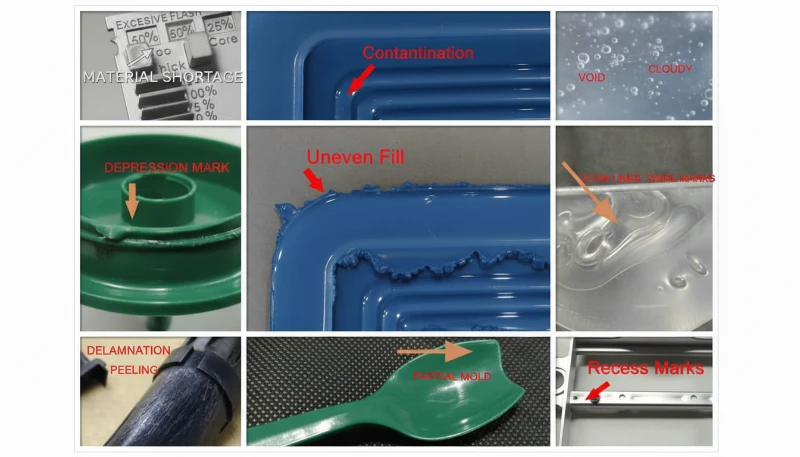
Delamination appears as flaky or layered surface peeling and is usually caused by material contamination, incompatible regrind, or degraded resin. The first corrective step is material control: purge the machine, verify resin identity, and eliminate cross-contamination in the dryer, hopper, and conveying lines. Splay—also called silver streaking—usually indicates moisture or trapped gas. Hygroscopic materials such as nylon, PC, ABS, and PET require proper drying before molding, while excessive barrel temperature or back pressure can also generate gas streaking.
What Does the Injection Molding Defect Summary Table Show?
| Defect | Primary Cause | First Correction Step |
|---|---|---|
| Sink marks | Thick sections, low pack pressure | Core out walls, increase packing |
| Warping | Non-uniform cooling or wall thickness | Balance cooling, verify wall uniformity |
| Weld lines | Flow-front convergence | Raise melt/mold temperature, move gate |
| Flash | Excess pressure, mold wear | Reduce pressure, inspect parting line |
| Short shot | Insufficient fill, gate freeze | Increase speed/pressure, enlarge gate |
| Burn marks | Trapped air | Add vents, slow final fill speed |
| Splay | Moisture, gas in material | Dry material, check temperature profile |
| Delamination | Material contamination | Purge machine, verify material purity |
| Jetting | Gate undersized, melt too fast | Enlarge gate, reduce injection speed |
| Voids | High shrinkage, low pack | Increase pack pressure, reduce wall |
In our factory, this defect matrix is posted at every molding machine. Operators trained to identify symptoms and refer to the root-cause hierarchy prevent minor defects from escalating into full production rejections. Early detection—within the first 10 shots of a production run—is the most cost-effective point of intervention.
Bottom line: Fix design-caused defects at the DFM stage—every defect you find after tooling is cut costs 10× more to correct. Follow the root-cause hierarchy (design → material → process → tooling) and you will resolve 90% of first-article failures before a single machine parameter is touched.
What Questions Do Buyers Often Ask About Injection Molding Defects?
What are the most common injection molding defects?
The most common injection molding defects, ranked by frequency in production environments, are: (1) sink marks from thick-section shrinkage; (2) warping from differential cooling and shrinkage; (3) weld lines at flow-front convergence points; (4) flash at parting lines or ejector pins; (5) short shots from insufficient fill; (6) burn marks from trapped air; (7) splay or silver streaks from moisture or gas; (8) delamination from contamination; (9) jetting from improper gate sizing; (10) voids from internal shrinkage. Understanding their root-cause hierarchy—design, material, process, tooling—is essential for effective defect reduction and first-article approval.
How can weld lines be reduced in injection-molded parts?
Weld line reduction involves controlling where flow fronts meet and improving their bonding strength. Core strategies include repositioning gates to change the merge location, increasing melt temperature (higher fluidity improves knit strength), increasing injection speed, and adding or relocating vents near the weld line location. Mold flow simulation identifies weld line positions before tooling; design changes at this stage cost far less than mold modifications. Post-mold options include vibration welding or overmolding to reinforce the weld line location structurally. Gate redesign to eliminate weld lines entirely is the most effective solution when product appearance and structural requirements are critical.
Why do injection molded parts warp after ejection?
Warping results from non-uniform internal stresses that cause differential dimensional change as the part cools after ejection. Root causes include non-uniform wall thickness, asymmetric gate placement, inadequate cooling time, excessively high melt temperature, or fiber orientation in glass-filled resins creating anisotropic shrinkage. Prevention requires uniform wall design, balanced cooling channels, appropriate pack and hold pressure, and mold flow simulation to verify shrinkage balance before tooling. Using mold flow analysis before tooling identifies warping-prone designs early, preventing costly mold corrections after tool completion.
How is flash prevented in injection molding?
Flash prevention requires adequate clamping force and proper parting surface maintenance. Clamping force must exceed the cavity pressure multiplied by the projected area—the standard rule is 2–5 tons per square inch of projected area, with amorphous resins at the lower end and filled or high-viscosity resins at the upper end. Beyond adequate tonnage, preventive measures include maintaining parting surface flatness, controlling melt temperature, and checking vent condition during routine mold maintenance.
What causes splay (silver streaks) in injection-molded parts?
Splay appears as silver or white streaks on the part surface radiating from the gate, and results from gas or steam being trapped in the melt stream. Moisture splay occurs when hygroscopic resins (nylon, PC, ABS, PET) are processed with moisture content above specification—typically above 0.1–0.3% by weight. The moisture flashes to steam at melt temperatures, creating the characteristic silver streaks. Solution: dry material to specification in a hopper dryer or conveyor dryer with monitored dew point. Process controls including material drying confirmation and melt temperature verification before each production run effectively prevent splay from recurring.
How does mold flow analysis help prevent injection molding defects?
Mold flow analysis simulates the injection molding process virtually before any steel is cut, predicting defect locations and process windows. It identifies weld line positions for different gate configurations, air trap locations requiring vents, fill pressure distribution revealing areas at risk for short shots, cooling uniformity predicting warpage magnitude and direction, and shear stress levels at gates flagging potential degradation or jetting. By comparing multiple gate positions, wall thickness options, and runner layouts in simulation, engineers select designs that minimize defect risk.
-
sink marks: Sink marks is a term for localized surface depressions on injection-molded parts, caused by non-uniform wall thickness; thicker sections cool slower, pulling the outer skin inward. ↩
-
weld lines: Weld lines is a type of visible seam on injection-molded parts where two melt flow fronts meet and fail to fully bond, resulting in a localized strength reduction of 10–40%. ↩
-
flash: Flash is a thin fin of excess plastic that escapes at the parting line, ejector pins, or other mold openings during injection molding, caused by insufficient clamping force or mold wear. ↩



 EN
EN  ES
ES  FR
FR  DE
DE  PT
PT  AR
AR  RU
RU  JA
JA  KO
KO  IT
IT  NL
NL  TR
TR  PL
PL 