 Skip to content

Key Takeaways
- Injection molding fills a steel mold cavity with molten plastic under high pressure — ideal for solid, high-volume parts with tight tolerances and repeatable surface finish.
- 3D printing builds parts layer by layer from digital files — ideal for prototypes, complex internal geometries, and low-volume custom parts without tooling investment.
- Injection molding per-part cost is 10–100× lower at volume; 3D printing tooling cost is zero, making it superior for quantities below 100–500 units.
- Both processes are converging: 3D-printed tooling inserts reduce injection mold lead times, while advanced resins bring 3D-printed parts closer to production material properties.
- The correct choice depends on volume, geometry, material requirements, and time-to-market constraints — not on which technology is “better.”
Few questions come up more often in product development than “should I 3D print this or injection mold it?” The answer has evolved significantly over the past decade as 3D printing has matured from a pure prototyping tool to a legitimate production technology for certain applications. In this guide, we provide the head-to-head comparison we use internally at ZetarMold, covering every relevant parameter so you can make the right call for your specific project.

What Is Injection Molding and What Makes It the Dominant Production Process?
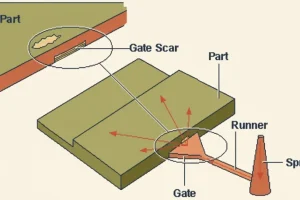
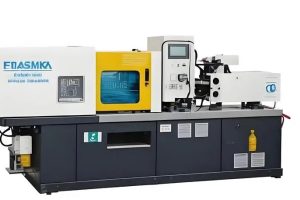
Injection molding forces molten thermoplastic1 pellets through a heated barrel and into a closed steel mold cavity under pressures of 10,000–30,000 psi. The plastic fills every contour of the cavity, cools against the mold walls, solidifies, and is ejected as a finished part. The cycle repeats — typically in 15–60 seconds — for as many parts as are needed.
Injection molding is the dominant global plastic manufacturing process because it uniquely combines three properties: extremely low per-part cost at volume, outstanding dimensional consistency part-to-part, and the ability to replicate any mold surface feature including fine textures, mirror finishes, sharp edges, and complex functional geometry like threads and snap fits. In our factory, once a tool is qualified, we can produce hundreds of thousands of identical parts with variation measured in hundredths of a millimeter.
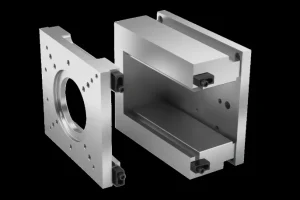
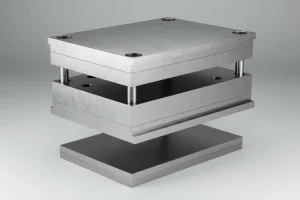
The limitation is the upfront investment: an injection mold2 typically costs $5,000–$100,000+ and takes 4–8 weeks to build. This front-loaded economics makes injection molding uneconomical for very low volumes or frequent design changes, which is precisely where 3D printing has found its role.

What Is 3D Printing and Where Does It Excel Over Injection Molding?
3D printing, formally called additive manufacturing3, builds parts by depositing, curing, or sintering material layer by layer according to a digital model — with no tooling required. The most common plastic 3D printing processes include FDM (fused deposition modeling), SLA (stereolithography), SLS (selective laser sintering), and MJF (multi jet fusion).
3D printing excels in four domains where injection molding struggles. First, zero tooling: any digital file can be printed immediately without mold fabrication, making it the fastest path from design to physical part. Second, geometric freedom: internal channels, lattice structures, and enclosed geometries that would be impossible to mold or require complex multi-piece tooling are trivial in 3D printing. Third, mass customization: each part in a print run can be different without any additional cost. Fourth, iteration speed: design changes are implemented in hours by updating the file, not weeks by recutting a mold.
We use 3D printing extensively in our own development process — for fit-and-function prototypes before committing to tooling, for checking assembly clearances, and for producing functional test samples with actual part geometry. It has dramatically accelerated our tooling approval cycles and reduced costly mold revision costs.

How Do the Two Processes Compare on Production Cost and Volume?
Cost comparison between 3D printing and injection molding depends entirely on production volume. There is a clear crossover point for every part geometry where injection molding becomes the lower total cost option.
3D printing has zero tooling cost but relatively high per-part cost — from $5 to $200+ per part depending on material, size, and process. This cost does not decrease meaningfully with quantity because each part takes the same machine time regardless of how many others are printed simultaneously (except for SLS/MJF which benefit from packing efficiency). For 1–100 parts, 3D printing is almost always cheaper in total cost.
Injection molding has high tooling cost ($5,000–$100,000+) but very low per-part cost — often $0.05–$5.00 for typical consumer parts at volume. Above the break-even point (typically 500–5,000 units depending on part size and mold cost), injection molding total cost is lower than 3D printing. At 100,000+ units, injection molding is 10–100× cheaper per part than any 3D printing process.
“3D printing is more cost-effective than injection molding for quantities below approximately 1,000 units.”True
For most part geometries and materials, the break-even point between 3D printing (zero tooling, high per-part cost) and injection molding (high tooling cost, low per-part cost) falls between 500 and 2,000 units. Below this range, the tooling investment for injection molding cannot be amortized efficiently, and 3D printing delivers lower total project cost. Above this range, injection molding’s per-part cost advantage compounds with each additional unit, making it the clear economic winner for production scale.
“Modern 3D printing achieves the same dimensional accuracy and surface finish as injection molding.”False
While 3D printing has advanced significantly, even the most accurate desktop processes (SLA, PolyJet) cannot match injection molding’s combination of ±0.05 mm tolerances, true isotropic material properties, and production-grade surface finishes across large volumes. 3D-printed parts have inherent layer anisotropy that reduces mechanical performance perpendicular to print orientation. For production parts requiring precision fits, sealing surfaces, or structural performance, injection molding remains the gold standard.

Which Process Achieves Better Dimensional Accuracy and Surface Finish?
Dimensional accuracy and surface quality are critical for parts that must fit precisely into assemblies or meet aesthetic standards for consumer-facing products.
Injection molding delivers tolerances of ±0.05 mm with precision tooling and excellent surface finish — from SPI A1 mirror polish to controlled texture identical to the mold surface. The mold constrains the plastic on all sides during solidification, and every part in the production run is dimensionally identical within process variation. Part-to-part consistency measured in the thousands of units is one of injection molding’s greatest competitive advantages.
3D printing tolerances vary by process: FDM typically ±0.2–0.5 mm with visible layer lines; SLA ±0.1–0.2 mm with smooth surfaces; SLS/MJF ±0.2–0.3 mm with matte surface finish. Layer lines on FDM and SLS parts affect surface finish and can create stress concentration points. Post-processing (sanding, painting, vapor smoothing) improves surface finish but adds cost and time. Part-to-part consistency within a single print run is generally good but degrades across different machines or print sessions.
How Do Material Properties Compare Between the Two Processes?
Material performance is where the gap between injection molding and 3D printing remains most significant for production applications.
Injection molded parts are isotropic — the plastic flows and packs into the mold cavity without significant directional variation in mechanical properties (beyond minor orientation effects in fiber-filled grades). Material certifications (FDA, USP Class VI, UL 94, REACH) are well-established for injection molding grades from hundreds of suppliers. We can process over 50 materials with certified properties.
3D-printed parts are inherently anisotropic — mechanical properties differ by 20–50% between in-plane and through-thickness directions for FDM and SLS processes. Material selection is limited to what filament or powder suppliers offer, and independent certification for medical or food-contact use is less common than for injection molding resins. High-performance engineering resins like PEEK and LCP are printable but require specialized industrial printers costing $50,000+.
The gap is closing: SLS and MJF nylon parts have nearly isotropic properties, and continuous fiber 3D printing (Markforged, Anisoprint) achieves structural performance competitive with metal for certain geometries. However, for the vast majority of consumer, medical, and industrial applications requiring certified material properties, injection molding remains the only viable production option.
“Injection molding and 3D printing are increasingly used together in product development workflows.”True
Modern product development routinely combines both technologies: 3D printing for rapid prototyping and geometric validation in the design phase, followed by injection molding for production tooling and manufacturing. Some factories also use 3D-printed tooling inserts for short-run injection molding, bridging the technologies directly. At ZetarMold, we actively recommend 3D printing to clients for early-stage validation precisely because it reduces the number of costly mold revisions during the injection tooling phase.
“3D printing will replace injection molding for mass-market consumer products within five years.”False
3D printing per-part economics at scale remain 10–100× more expensive than injection molding for identical parts at volumes above 10,000 units. Material certifications, part-to-part consistency, and surface quality requirements for mass-market consumer goods still firmly favor injection molding. While 3D printing is displacing injection molding in niche markets (custom goods, spare parts, medical devices), mass-market replacement at scale is not projected within any credible five-year horizon.
How Does Design Freedom Compare Between the Two Processes?
Design freedom is arguably 3D printing’s strongest advantage over injection molding, enabling geometries that were previously impossible or prohibitively expensive to manufacture.
Injection molding requires draft angles (typically 1–3°) on all vertical surfaces to enable part ejection, limits undercuts to features manageable by slides and lifters, and cannot produce internal enclosed voids or truly organic shapes without multi-piece tooling. Every feature must be producible by the mold at acceptable tooling cost. These constraints force designers to simplify geometry relative to what might be ideal functionally.
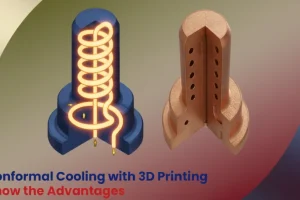
3D printing has virtually no geometric constraints for external features and enables internal channels, lattice infill structures, part consolidation (combining assembly subcomponents into a single printed part), and complex organic shapes optimized by generative design algorithms. For aerospace brackets, medical implants, and custom jigs and fixtures, 3D printing’s geometric freedom delivers functional performance improvements impossible in injection molding.
We’ve seen this play out in jig and fixture design for our own factory: complex assembly fixtures that would have required 5–10 machined components can be printed as a single piece overnight. The labor and lead time savings are significant, even though the printed fixture costs more per piece than machined steel.
Frequently Asked Questions About Injection Molding vs 3D Printing
Can I use 3D printing to make molds for injection molding?
Yes — 3D-printed mold inserts in resins like Digital ABS (Stratasys) or engineering PETG can run 50–500 injection molding cycles before degrading. This “rapid tooling” approach is useful for bridge production between prototyping and full steel tooling, providing actual injection-molded material properties and surface finish at reduced tooling cost and 1–2 week lead time.
Which process is better for medical devices?
For production medical devices, injection molding is almost always required. It provides FDA-traceable material certifications, ISO 13485-compliant process documentation, and the part-to-part consistency required for regulatory submissions. 3D printing is used extensively for medical prototyping, surgical guides, and custom patient-specific implants in certified biocompatible materials.
How does lead time compare between 3D printing and injection molding?
3D printing delivers parts in 1–5 days. Injection mold tooling requires 4–8 weeks for standard tools. However, once injection tooling is qualified, production runs of 10,000+ parts can be completed in 1–2 weeks — a throughput 3D printing cannot match. For urgent initial quantities followed by production scale, the typical approach is to 3D print the first 50–100 units while the mold is being built.
Can 3D printing replace injection molding for consumer products?
Not currently at mass-market scale. The per-part economics, material certifications, and surface quality of injection molding remain unmatched by 3D printing for products requiring tens of thousands of identical units. 3D printing is replacing injection molding in niche markets: custom consumer goods (personalized items), end-of-life spare parts, and products where geometric complexity justifies the cost premium.
What is the right process for a startup launching a new product?
Use 3D printing for all design validation and early customer samples (0–100 units). Transition to injection molding when the design is frozen and demand justifies the tooling investment — typically at 1,000+ units annually for most consumer products. We offer design-for-manufacturability (DFM) reviews at the prototyping stage specifically to ensure the design can transition smoothly to injection molding without costly revisions.
-
Thermoplastic: a polymer material that softens when heated and hardens when cooled, making it processable by injection molding and recyclable at end of life; contrasted with thermosets which permanently cure and cannot be remelted. ↩
-
Injection mold design: The engineering process of creating tooling that defines the shape, dimensions, and surface finish of injection-molded parts, including gate placement, cooling channels, and ejection systems. ↩
-
Additive manufacturing: a category of processes that build three-dimensional objects by depositing, curing, or sintering material layer by layer from a digital model — enabling complex geometries without tooling investment, at the cost of higher per-part production costs relative to injection molding at volume. ↩


 EN
EN  ES
ES  FR
FR  DE
DE  PT
PT  AR
AR  RU
RU  JA
JA  KO
KO  IT
IT  NL
NL  TR
TR  PL
PL 