Skip to content
- Energy costs represent 30-40% of injection molding operating expenses
- All-electric machines use 50-70% less energy than hydraulic presses
- Hot-runner molds eliminate runner waste, saving 15-30% material per cycle
- Regrind material can be mixed at 15-30% ratios without major quality loss
- ISO 14001 certification provides the framework for systematic environmental improvement
Injection molding is one of the most widely used manufacturing processes worldwide, producing everything from medical devices to automotive components. But as pressure mounts to cut carbon footprints and reduce plastic waste, the industry is shifting toward more sustainable practices. This guide covers practical strategies for energy efficiency, waste reduction, and material optimization — drawn from 20+ years of real factory experience at a Shanghai-based facility running 47 injection molding machines.
What Is Sustainable Injection Molding?
Sustainable injection molding means optimizing energy, materials, and waste to reduce environmental impact while maintaining part quality. It covers three core areas: energy consumption, material usage, and waste management. In practice, sustainability isn’t about sacrificing performance — it’s about optimizing every stage so you use less energy, generate less scrap, and extend material life cycles.
For a factory running 40+ injection molding machines, even a 5% reduction in energy consumption per cycle adds up to significant cost savings and carbon reduction over a year. The economics and environmental benefits align — which is why most sustainability investments pay for themselves.
Key components of sustainable injection molding include: Machine technology — all-electric energy savings1[3] deliver 50-70% less energy than hydraulic machines; Process optimization — reducing cycle time, tuning injection speed and pressure; Material management — using regrind, recycled resins, and bio-based polymers; Waste reduction — minimizing runner systems and reprocessing rejected parts; Facility design — LED lighting, heat recovery, and compressed air leak management.
“All-electric injection molding machines consume 50-70% less energy than hydraulic machines.”True
All-electric machines eliminate the continuous energy drain of hydraulic pumps, recovering energy during braking phases and consuming significantly less power per cycle. The savings are well-documented across thousands of installations worldwide.
“Bio-based polymers like PLA always have a lower environmental impact than conventional plastics.”False
While PLA is derived from renewable sources, its overall environmental impact depends on agricultural practices, transportation distances, and end-of-life management. If PLA ends up in a landfill instead of an industrial composting facility, its environmental benefit is significantly reduced.
How Can Injection Molding Facilities Reduce Energy Consumption?
Energy consumption is the largest controllable cost in injection molding operations. According to DOE energy data2[1], industrial equipment in plastics manufacturing accounts for a significant share of facility energy use. For a factory running 40+ machines, even a 5% reduction per cycle translates to substantial annual savings.
Beyond machine selection, practical energy reduction strategies include: Process optimization — reduce cooling time through optimized mold temperature control, minimize hold pressure time, and use scientific molding principles to find optimal process windows. Facility-level improvements — install variable frequency drives (VFDs) on cooling water pumps, recover waste heat from machine motors for facility heating, fix compressed air leaks (a single 3mm leak wastes $2,000-5,000/year), and switch to LED lighting in production areas. Production scheduling — run high-volume jobs on the most energy-efficient machines, avoid frequent machine changeovers requiring barrel reheating, and schedule energy-intensive operations during off-peak electricity hours. In our experience running 47 injection molding machines in Shanghai, VFD retrofits alone cut per-part energy cost by 12-18%.
Why Is Plastic Waste a Critical Challenge in Injection Molding?
Plastic waste is a critical challenge because 3–8% of processed material becomes scrap, compounding into significant cost and environmental impact. That waste represents lost resin, energy, machine time, and disposal fees across thousands of production cycles. In a facility running 24/7, even a 1% waste reduction can save tens of thousands of dollars annually.
Common sources of injection molding waste include: Runners and sprues — in cold-runner systems, these can represent 15-30% of shot weight; Rejected parts — dimensional defects, surface blemishes, and short shots; Purge material — wasted during color or resin changes; Startup scrap — parts produced while the process stabilizes; Flash and overflow — excess material escaping the mold cavity. The good news: most thermoplastic waste from injection molding can be reground and reprocessed. Regrind from runners and rejected parts can typically be mixed with virgin resin at ratios of 15-30% without significant loss of mechanical properties, depending on the material and application.
For critical applications — medical devices, automotive safety parts — regrind use may be restricted by industry standards. But for consumer products, enclosures, and non-critical components, regrind is a straightforward sustainability win.
How Do Material Choices Drive Sustainability in Injection Molding?
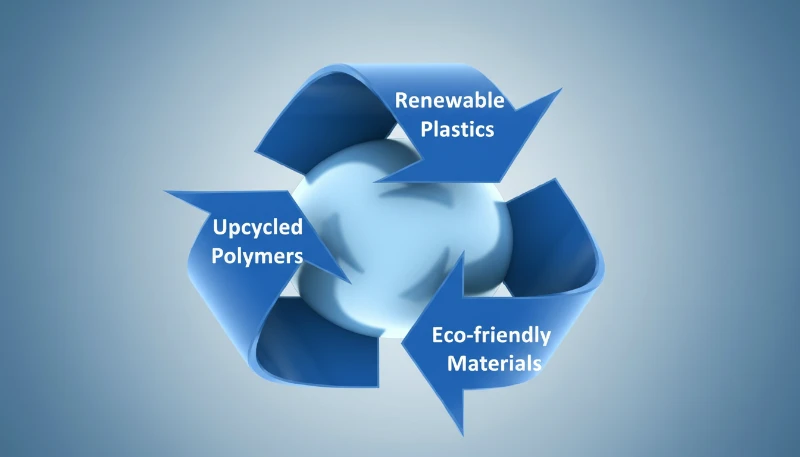
Material selection has a direct and lasting impact on the sustainability of injection molded products. The resin choice affects environmental footprint, recyclability, part weight, and energy requirements during processing. Bio-based polymers are increasingly viable: PLA (Polylactic Acid) — derived from corn starch or sugarcane, compostable under industrial conditions, processing at 170-200°C, best for packaging and disposable items; Bio-PE (Bio-polyethylene) — chemically identical to conventional PE but derived from sugarcane, processes identically to standard PE with no machine adjustments needed; PHA (Polyhydroxyalkanoates) — produced by bacterial fermentation, fully biodegradable, though higher cost limits use to specialty applications.
Recycled resins are another major sustainability lever: Post-consumer recycled (PCR) PP — available in grades for non-food applications, typically 15-25% less expensive than virgin material; rPET (recycled PET) — widely available, suitable for packaging, textiles, and consumer goods; In-house regrind — from runners and rejected parts, usable at 15-30% ratios.
When selecting sustainable materials, consider the full lifecycle: virgin resin has high carbon footprint with standard processing ease; recycled resin offers 60-80% carbon reduction at -10% to +5% cost with slightly lower mechanical properties; bio-based polymers fall in the middle on carbon footprint but cost 20-100% more with widely varying properties. Understanding injection mold design principles is essential when switching to bio-based or recycled materials, as these may have different flow characteristics, shrinkage rates, and processing windows compared to virgin resins. For sourcing guidance on sustainable material suppliers, our injection molding supplier sourcing guide covers qualification and risk assessment.
“Hot-runner mold systems can eliminate runner waste entirely, saving 15-30% of material per cycle.”True
Hot-runner systems keep the plastic in runner channels molten between cycles, so there is no solidified runner waste. This directly reduces material consumption by the percentage that runners would have occupied in a cold-runner system, delivering hot-runner material savings3 that quickly offset the higher tooling cost.
“Regrind material from rejected parts can be used at 100% ratio without any quality impact.”False
Each reprocessing pass causes thermal degradation of the polymer, reducing mechanical properties over time. Most applications limit regrind to 15-30% of the total material mix, and melt flow index (MFI) monitoring is essential to track degradation levels and ensure consistent part quality.
What Role Does Mold Design Play in Sustainable Manufacturing?
Mold design is central to sustainable manufacturing because it directly controls material waste, energy use, and cycle efficiency. Every design decision — runner layout, cavity count, cooling channel geometry — compounds over the mold’s lifetime, making mold design one of the highest-leverage sustainability investments.
Runner system optimization
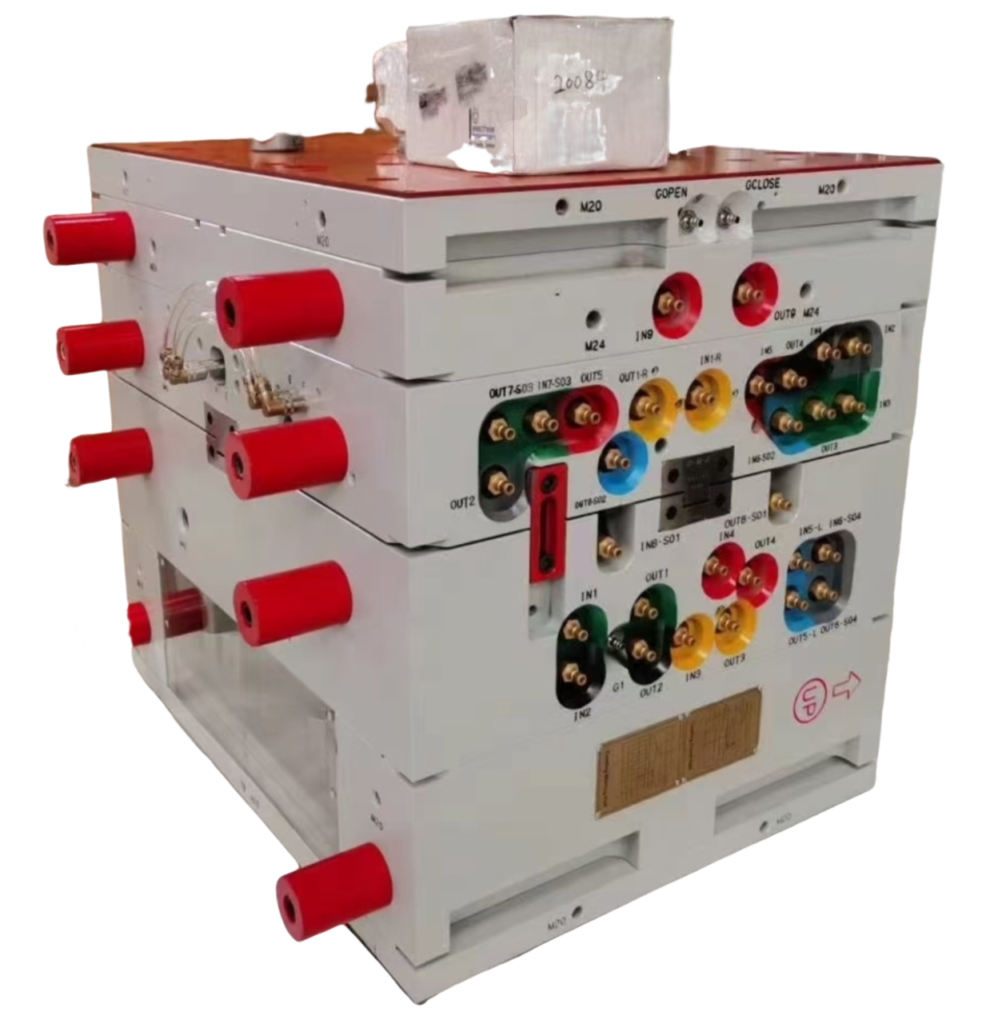
Hot-runner systems eliminate runner waste entirely, saving 15-30% of material per cycle compared to cold-runner molds[2]. While hot-runner molds cost 5,000-20,000 USD more upfront, the material savings alone often pay back the investment within 6-12 months on high-volume production.
Cavity optimization
Multi-cavity molds with balanced flow reduce material per part and improve cycle efficiency. A well-designed 4-cavity mold produces parts with significantly less energy per part than running a single-cavity mold four times.
Cooling channel design
Conformal cooling channels — enabled by additive manufacturing — can reduce cooling time by 20-40%, directly cutting energy per part. Baffles and bubblers in conventional molds also improve cooling efficiency.
Design for manufacturing (DFM)
Wall thickness optimization reduces both material usage and cycle time.
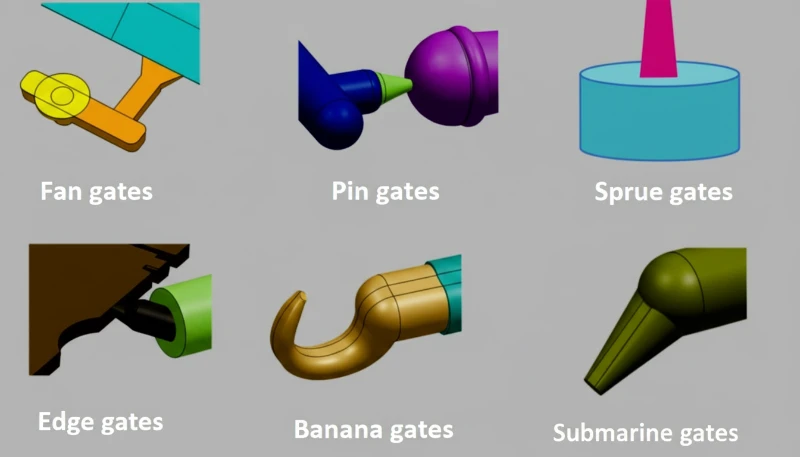
Each 10% reduction in wall thickness can cut cooling time by approximately 10-15%, with compounding energy savings over the mold’s lifetime. Key material-saving mold features include: valve gates that minimize gate vestige and reduce waste, quick-change systems that reduce startup scrap during color changes, and mold surface treatments that reduce demolding force and cycle time.
How Can Recycled and Regrind Materials Be Used Effectively?
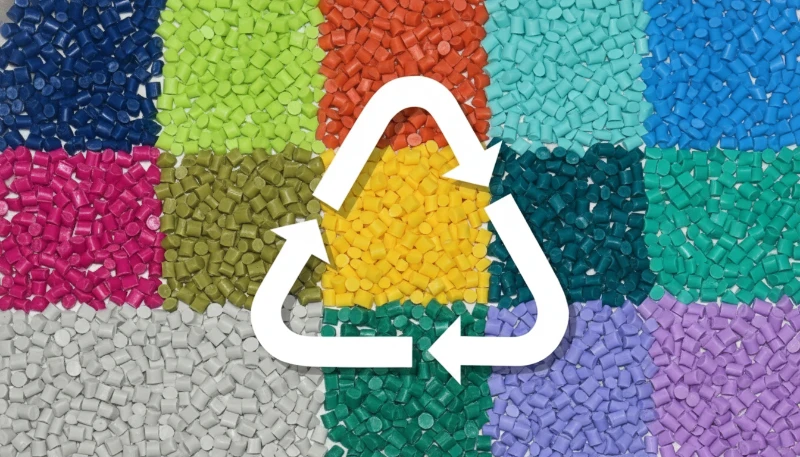
Recycled and regrind materials are effectively reused by blending 15–30% regrind with virgin resin while monitoring quality. This disciplined process diverts 100% of post-industrial waste from landfills and reduces raw material costs by 10-25%, depending on the resin and application.
Regrind management best practices
Regrind management best practices: Control the regrind ratio — start with 15% regrind and increase gradually; most applications tolerate up to 25-30% with proper monitoring. Monitor melt flow index (MFI) — each pass degrades the polymer slightly; track MFI to stay within specification. Separate by material and color — cross-contamination creates quality problems and limits recyclability. Dry regrind properly — reground material has more surface area and absorbs moisture faster; follow material-specific drying requirements. Use regrind promptly — degradation accelerates when stored in regrind form for extended periods.
Post-consumer recycled (PCR) materials
PCR materials require additional quality control. Key steps include incoming material testing for MFI, contamination level, and color consistency; processing parameter adjustments since PCR may flow differently than virgin resin; part qualification testing to verify mechanical properties meet requirements; and traceability documentation for regulatory compliance.
Closed-loop recycling:
The most sustainable approach is closed-loop recycling, where post-industrial waste (runners, rejected parts) is reground and fed back into the same product line. This approach diverts 100% of manufacturing waste from landfill, reduces virgin material consumption by 15-30%, lowers material costs, and simplifies material traceability.
What Are the Industry Standards for Green Injection Molding?
The key standards for green injection molding are ISO 14001, ISO 50001, and EU regulations like CBAM. The ISO 14001 framework provides a systematic approach to managing environmental responsibilities, from energy consumption to waste disposal. ISO 50001 focuses specifically on energy management, helping organizations develop policies for efficient energy use.
ISO 50001: Energy Management Systems
focuses specifically on energy management, helping organizations develop policies for more efficient energy use. For injection molding facilities, this translates to machine-level energy monitoring, target-setting, and optimization programs. Leading injection molding facilities integrate environmental management (ISO 14001) with quality management (ISO 9001) and occupational health and safety (ISO 45001) into a unified management system. This integrated approach ensures that sustainability goals don’t conflict with quality or safety requirements. UL ECVP (Environmental Claim Validation Procedure):
For products claiming recycled content, UL provides third-party validation — increasingly important for customers verifying sustainability claims in their supply chain.
EU regulations
For manufacturers exporting to the EU, the Carbon Border Adjustment Mechanism (CBAM) and Extended Producer Responsibility (EPR) regulations create new requirements for carbon footprint reporting and environmental performance documentation.
When Should You Choose a Sustainable Injection Molding Partner?
Choose a sustainable injection molding partner whenever environmental compliance is required for your product. This is now standard in automotive, electronics, consumer goods, and medical supply chains. Major OEMs increasingly require documented sustainability programs from all Tier 1 and Tier 2 suppliers.
Signs of a genuinely sustainable injection molding partner
Look for these signs of a genuinely sustainable injection molding partner: ISO 14001 and ISO 50001 certification, documented energy management programs with year-over-year improvement, closed-loop recycling for manufacturing waste, capability to process recycled and bio-based materials, transparent carbon footprint reporting, and an all-electric or hybrid machine fleet. Sustainability matters most for consumer-facing brands with public commitments, EU market access (CBAM, EPR compliance), automotive OEMs with Scope 3 targets, medical device companies, and electronics manufacturers addressing e-waste. A facility with 20+ years of experience, ISO 14001 certification, and 400+ materials capability has the foundation to support sustainable manufacturing at scale.
With 8 senior engineers and a team of 120+ production staff, such a partner can guide material selection, optimize mold design for sustainability, and deliver consistent quality with a lower environmental footprint.
Real Results: Sustainability in Practice
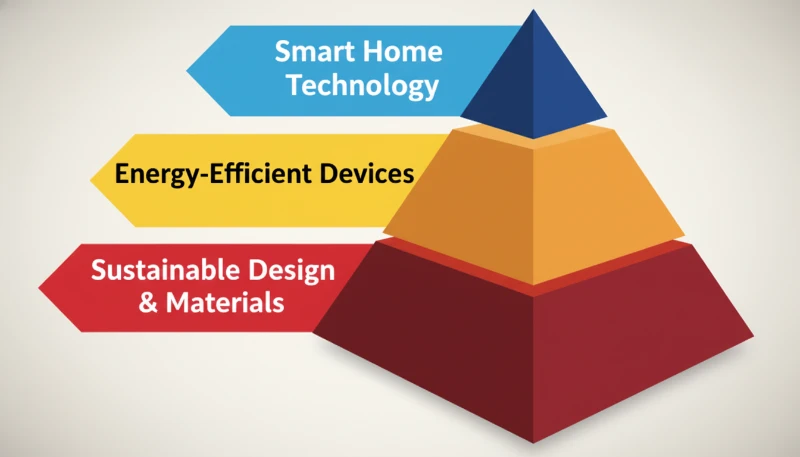
At our Shanghai injection molding facility, we’ve seen firsthand how sustainability investments pay for themselves. Our all-electric machines — part of a 45-machine fleet ranging from 90T to 1850T — consistently demonstrate 40-50% lower energy consumption per cycle compared to our older hydraulic units. Combined with closed-loop regrind recycling and ISO 14001 environmental management, we’ve cut per-part waste by over 25% in the past three years. The key insight: sustainability and cost efficiency aren’t competing goals in injection molding — they reinforce each other.
Looking for a sustainable injection molding partner with real factory experience? ZetarMold offers 20+ years of manufacturing expertise, ISO 14001-certified environmental management, and the capability to process 400+ materials — including recycled and bio-based resins. Our 45-machine facility in Shanghai combines all-electric efficiency with closed-loop waste recycling. Get a Free Quote →
Frequently Asked Questions
What is the most energy-efficient type of injection molding machine?
All-electric injection molding machines are the most energy-efficient option available today, consuming 50-70% less energy than traditional hydraulic machines across their full operating range. They eliminate the continuous energy drain of hydraulic pumps and recover kinetic energy during braking phases, which further improves their overall efficiency profile across long production runs. For high-volume manufacturing operations, the annual electricity savings typically pay back the higher purchase price within 2-3 years, making all-electric machines both an environmental and a strong economic investment.
Can recycled plastics match the quality of virgin materials in injection molding?
Post-consumer recycled (PCR) plastics can match virgin material quality for many non-critical applications when they are properly processed and rigorously tested throughout production. Key quality parameters including melt flow index, contamination levels, and color consistency must be carefully monitored throughout the entire production run to ensure consistent results batch after batch. For critical applications such as medical devices or automotive safety components, virgin material or specifically certified recycled grades are typically required by stringent industry standards and regulatory frameworks to guarantee product safety.
How much plastic waste does a typical injection molding facility generate?
A typical injection molding operation generates 3-8% waste as a percentage of total raw material processed throughout the facility over the course of normal daily production. This waste originates from several distinct sources: runners and sprues representing 15-30% of shot weight in cold-runner systems, rejected parts with dimensional defects or surface blemishes, purge material wasted during color or resin changes, and startup scrap produced while the molding process stabilizes. Most thermoplastic waste can be reground and reused at 15-30% blend ratios.
Is PLA suitable for all injection molding applications?
No, PLA is not suitable for all injection molding applications due to its inherent material property limitations. It has lower heat resistance with a processing temperature range of only 170-200 degrees Celsius, lower impact strength than most engineering resins, and inherent brittleness compared to engineering plastics like polycarbonate or nylon. PLA works well for packaging applications, disposable consumer items, and non-load-bearing products, but it should not be used for structural components, high-temperature environments, or mechanically demanding applications where long-term durability is absolutely critical.
What ISO certifications indicate sustainable injection molding practices?
The key certifications that indicate genuine sustainable manufacturing practices are ISO 14001 for environmental management systems and ISO 50001 for energy management systems. ISO 14001 provides a comprehensive framework for systematic environmental improvement across all facility operations and departments, while ISO 50001 focuses specifically on energy efficiency optimization at the individual machine level. Together with ISO 9001 for quality management and ISO 45001 for workplace safety, these standards form an integrated management approach that demonstrates a facility’s ongoing commitment to responsible manufacturing practices.
How does hot-runner tooling reduce material waste in injection molding?
Hot-runner mold systems keep the plastic material in the runner channels molten between injection cycles, completely eliminating the solidified runner waste that cold-runner systems produce after every single shot. This innovative mold design can save 15-30% of material per cycle depending on the specific part geometry and runner layout configuration being used. The molten material remaining in the hot-runner manifold is directly injected into the next cycle, simultaneously reducing both material waste and overall cycle time for measurably improved production efficiency.
Can bio-based polymers be processed on standard injection molding machines?
Most drop-in bio-based polymers like bio-PE and bio-PET can be processed on standard injection molding machines without any modification whatsoever, since they are chemically identical to their conventional petroleum-based counterparts and share completely identical melt processing characteristics. However, other bio-based polymers like PLA and PHA may require adjusted barrel temperature profiles, specialized screw designs optimized for their specific viscosity range, or additional dehumidification drying equipment due to their different thermal degradation behavior and significantly higher moisture sensitivity during high-temperature melt processing operations.
What is closed-loop recycling in injection molding?
Closed-loop recycling in injection molding is the systematic manufacturing practice of regrinding in-house production waste such as runners, rejected parts, and startup scrap, then feeding it directly back into the same production process on-site at the manufacturing facility. This comprehensive recycling approach diverts 100% of post-industrial plastic waste from landfill disposal, reduces virgin resin consumption by 15-30%, lowers overall material procurement costs significantly, and simplifies material traceability compliance since the regrind composition is fully known and controlled within the facility.
-
all-electric energy savings: All-electric energy savings refers to the 50-70% reduction in energy consumption achieved by all-electric injection molding machines compared to hydraulic machines, as documented by the Society of Plastics Engineers. ↩
-
DOE energy data: DOE energy data refers to statistics published by the U.S. Department of Energy showing that industrial energy efficiency improvements in plastics manufacturing can reduce consumption by 20-30%. ↩
-
hot-runner material savings: Hot-runner material savings refers to the 15-30% reduction in material waste achieved by hot-runner mold systems that keep runner channels molten between cycles, per industry data from Plastics Technology. ↩



 EN
EN  ES
ES  FR
FR  DE
DE  PT
PT  AR
AR  RU
RU  JA
JA  KO
KO  IT
IT  NL
NL  TR
TR  PL
PL